

Phase 1: Empathy (Immersive Opening)
Greeting: 안녕하세요! (Hello!) I’m your Daily Hangul Editor.
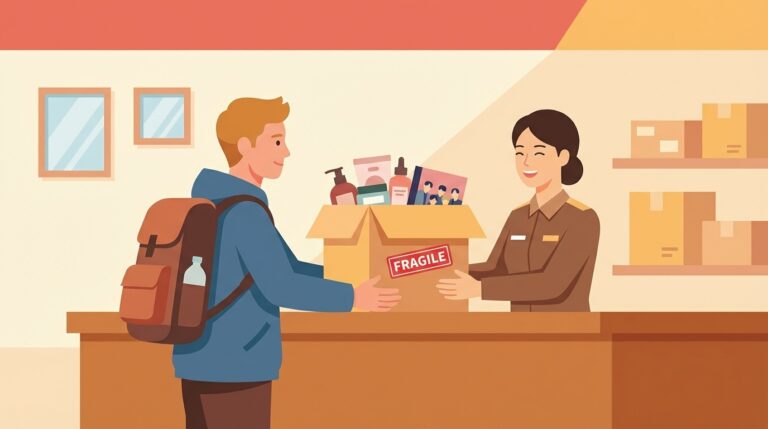
K-Culture Cold Open: Picture this: You’ve just spent your afternoon wandering around Myeongdong, and you finally bought that luxurious, glass-bottled K-Beauty serum you’ve been dreaming of. Or maybe you scored a limited-edition, easily bendable photo book of your favorite K-Pop idol in Hongdae. You carefully pack everything into a red box at the Korean post office (우체국) to send back home. You place the box on the scale, the staff grabs the shipping label, and suddenly panic sets in.
What if it gets crushed in transit? What if the glass breaks?
You look at the busy staff member and want to scream, “Please be careful!” but you don’t know the words.
The ‘Why’: Knowing how to ask for a ‘Fragile’ sticker isn’t just about protecting your precious souvenirs. It’s about navigating the lightning-fast, highly efficient Korean delivery system like a true insider. If you don’t say anything, your box might join the Palli-Palli (Hurry-Hurry) express lane a little too roughly. But say this one magic phrase, and you’ll get VIP treatment for your package!
Transparency: This guide is created from the real-life sweaty-palm moments of our expat and tourist students who just wanted their beautiful Korean ceramics to survive the flight home.
Phase 2: Core Expressions Deep Dive
1. 파손 주의 스티커 붙여 주세요. (Please attach a fragile sticker.)
- Pronunciation: [Pason ju-ui seutikeo bucheo juseyo]
- Sound-alike guide: ‘Pa-son’ sounds like “Pa” (as in papa) + “son”. ‘ju-ui’ sounds like “joo-we”. ‘bucheo’ sounds like “boo-chuh”.
- Meaning: Literal: Damage caution sticker attach please. vs Real nuance: “Could you please put a fragile sticker on this?”
- K-Culture Moment: In K-Dramas, you’ll often see scenes where a character receives a care package from their mom in the countryside. The box is usually covered in tape and a bright red ‘파손주의’ (Fragile) sticker to protect the homemade Kimchi and side dishes inside.
- Editor’s Insight: This is your golden, go-to phrase. It’s polite, direct, and exactly what the post office staff needs to hear. The word ‘스티커’ (sticker) makes it very easy for English speakers to remember!
- Situation Spectrum:
- Friends (Casual): ⚠️ (You wouldn’t use the formal ‘~주세요’ with close friends)
- Post Office Staff (Semi-formal): ✅ (Perfect!)
- Boss/Elders (Formal): ✅ (Appropriate and polite)
- 🤔 Think About It: Koreans use the word ‘주의’ (caution/care) in many contexts. You’ll see ‘미끄럼 주의’ (Caution: Slippery) or ‘문 주의’ (Caution: Doors). Why do you think Korean society prefers using visual stickers and signs to communicate care rather than just verbal warnings?
2. 안에 깨지기 쉬운 게 들어있어요. (There are fragile things inside.)
- Pronunciation: [Ane kkaejigi swiun ge deureoisseoyo]
- Sound-alike guide: ‘Ane’ sounds like “ah-neh”. ‘kkaejigi’ sounds like “ggeh-jee-gee” (make the ‘gg’ tense!).
- Meaning: Literal: Inside, easy-to-break things are entered. vs Real nuance: “There are fragile items inside this box.”
- K-Culture Moment: Imagine buying expensive celadon teacups in Insadong. When you hand the box to your friend to carry, you’d urgently say this to make sure they don’t swing the bag around like they do when excited at a Noraebang (karaoke)!
- Editor’s Insight: This phrase explains the reason you need the sticker. If you forget the word for ‘sticker’, just saying “깨지기 쉬운 게 있어요” (There are things easy to break) will make the staff instinctively reach for the fragile tape.
- Situation Spectrum:
- Friends (Casual): ✅ (Change to “들어있어” without the ‘요’)
- Post Office Staff (Semi-formal): ✅
- Boss/Elders (Formal): ✅
- 🤔 Think About It: ‘깨지다’ means ‘to break’ or ‘shatter’. Interestingly, Koreans also use this word when a couple breaks up (“걔네 깨졌어” – They broke up). Does your native language use the concept of physical shattering for emotional breakups too?
Phase 3: Textbook vs. Real Korean
[When handing over your delicate package]
* 📖 Textbook Korean: 파손에 주의하여 주십시오. (Please pay attention to damage.)
* 🗣️ Real Korean: 안에 깨지는 거 있어요. 스티커 좀 붙여주세요. (There’s something breakable inside. Please put a sticker on it.)
* 💡 Why the difference?: The textbook phrase uses extremely formal, written Korean (often printed on the boxes themselves). In real life, Koreans prefer conversational, softer requests using “좀” (a little/please) to sound friendly and less demanding.
[Warning someone about the contents]
* 📖 Textbook Korean: 이것은 깨지기 쉬운 물품입니다. (This is a fragile article.)
* 🗣️ Real Korean: 아, 그거 조심이요! 유리예요. (Ah, careful with that! It’s glass.)
* 💡 Why the difference?: Efficiency! In Korea’s fast-paced environment, immediately stating what the item is (유리 – glass) explains the urgency much faster than a formal declaration of its fragility.
Bottom Note: For B1 (Intermediate) learners, using phrases like “깨지는 거 있어요” is the perfect sweet spot. It shows you understand casual, natural phrasing while still maintaining politeness with the “요” ending.
Phase 4: Cultural Context — K-Culture Deep Dive
4-1. Non-verbal Elements: The Art of Handing Over
When you ask for the sticker, don’t just point at the box with one finger. In Korea, using two hands is a sign of respect. Lightly support your right arm with your left hand when gesturing toward the box, or hand the box over with both hands. Also, use your Nunchi (눈치). Post offices in Korea are famously efficient. Have your box fully taped and your address perfectly written before you step up to the counter. The staff will appreciate your readiness!
4-2. K-Culture Connection: The “Palli-Palli” Delivery vs. Idol Merch
If you’re a K-Pop fan, you know that buying albums, lightsticks, and photocards is a serious business. Fans trade and sell merchandise constantly online. When sending these items via Korean convenience store delivery (편의점 택배) or the post office, protecting the goods is practically a religion.
A single scratch on a photocard? Disaster. Therefore, fans always wrap items in a ridiculous amount of bubble wrap (뽁뽁이) and boldly ask for the 파손 주의 (Fragile) sticker. While Korea’s delivery drivers (택배 기사님) are superhumanly fast—sometimes delivering packages by dawn the next day—this speed means boxes can be tossed around. The fragile sticker is your social contract with the driver: “I know you are in a rush, but please spare my BTS album!”
Phase 5: Real-life Roleplay Scenario
Setting: It’s 3:00 PM on a Friday at the bustling Seoul Central Post Office. The sound of tape tearing echoes through the room. You are standing at Counter 4 with a box containing traditional Korean ceramics you bought for your parents.
Characters:
– YOU: An expat/tourist who wants to make sure the ceramics survive the 14-hour flight.
– Staff (직원): A middle-aged, highly efficient post office worker wearing glasses. He moves at the speed of light.
Dialogue:
직원 (Staff): 다음 분 오세요! 저울에 박스 올려주세요.
(Daeum bun oseyo! Jeoure bakseu ollyeojuseyo.)
[Next person, please come forward! Please place your box on the scale.]
YOU: 네, 여기요. 미국으로 보낼 거예요.
(Ne, yeogiyo. Migureuro bonael geo-yeyo.)
[Yes, here. I’m going to send it to the US.]
직원: 안에 내용물이 뭡니까? 위험한 물건 없죠?
(Ane naeyongmuri mwomnikka? Wiheomhan mulgeon eopjyo?)
[What are the contents inside? No dangerous items, right?]
YOU: 네, 도자기예요.
(Ne, dojagi-yeyo.)
[Yes, it’s ceramics.]
(🎭 Stage Direction: The staff starts typing incredibly fast, about to print the normal shipping label.)
🔀 Your Turn! How should you respond?
– A) “저기요! 조심해!” (Excuse me! Watch out!)
– B) “안에 깨지는 거 있어요. 파손 주의 스티커 좀 붙여주세요.” (There’s something breakable inside. Please attach a fragile sticker.)
– C) “스티커 주세요.” (Give me a sticker.)✅ Best Choice: B — Reason: It clearly states the reason (breakable items) and makes a polite request using “좀” and “주세요”.
⚠️ Choice A Analysis: NEVER say “조심해” (Watch out/Be careful in informal language) to a staff member. In Korea, saying this abruptly sounds like a threat, akin to “Watch your back!”
⚠️ Choice C Analysis: It’s too blunt and doesn’t specify which sticker you need.
직원: 아, 도자기요? 알겠습니다. (Grabs a bright red sticker and slaps it on the box) 파손 주의 스티커 붙여드렸고요. 결제 도와드릴게요.
(Ah, dojagi-yo? Algetseumnida. Pason ju-ui seutikeo bucheodeuryeotgoyo. Gyeolje dowadeurilgeyo.)
[Ah, ceramics? Understood. I’ve attached the fragile sticker. I’ll help you with the payment.]
YOU: 감사합니다!
(Gamsahamnida!)
[Thank you!]
Phase 6: 10-Second Shadowing Drill
Practice this sentence until it flows naturally. Pay attention to the pauses (/) and the feeling!
🥺 안에 / 깨지는 게 / 있어요. / 파손 주의 스티커 / 붙여 주세요~
(A-ne / kkaejineun ge / isseoyo. / Pa-son ju-ui seutikeo / bu-cheo ju-se-yo~)
[There is / something breakable / inside. / Fragile sticker / please attach~]
Phase 7: K-Culture Mini Dictionary
| 한국어 (Korean) | Romanization | English | Context / Explanation |
|---|---|---|---|
| 뽁뽁이 | bbok-bbok-i | Bubble wrap | Named after the popping sound it makes. A must-have for safe packing! |
| 택배 기사님 | taekbae gisa-nim | Delivery driver | The heroes of Korea’s delivery culture. Always add “님” (nim) for respect! |
| 송장 | songjang | Waybill / Shipping label | The paper you fill out with the address. You get a tracking number (송장 번호) from it. |
| 취급 주의 | chwigeup ju-ui | Handle with care | The formal term often printed on the red fragile stickers. |
| 눈치 | nunchi | Social awareness | The art of reading the room. Essential when packing your box quickly in a busy post office! |
Phase 8: Traveler’s Survival Kit
Sending luggage or shopping boxes home is a rite of passage for travelers in Korea. Here is what you need to know at the post office:
🆘 Survival Expressions #1
– 🇰🇷 “가장 큰 박스 하나 주세요.” (Gajang keun bakseu hana juseyo.)
– 🗣️ Pronunciation: [Ga-jang keun bak-seu ha-na ju-se-yo]
– 📍 Where to use: At the post office or convenience store when buying a shipping box.
– 💡 Pro Tip: Korean post offices sell sturdy boxes in sizes from 1 to 5. Size 5 is usually the largest!🆘 Survival Expressions #2
– 🇰🇷 “선편으로 보낼 수 있나요?” (Seonpyeoneuro bonael su innayo?)
– 🗣️ Pronunciation: [Seon-pyeon-eu-ro bo-nael su in-na-yo?]
– 📍 Where to use: Asking to send the box via surface mail (by ship), which is much cheaper but takes months.📌 Editor’s Travel Note
– Useful Apps: If you want to track your package inside Korea, use the “택배파인더” (Delivery Finder) app or just search your tracking number on Naver.
– Convenience Store Delivery (편의점 택배): You don’t always need to find a post office! Most CU, GS25, and 7-Eleven stores have a self-service machine where you can send packages 24/7. Just don’t forget to ask the cashier for a fragile sticker (파손 주의 스티커)!
Phase 9: Critical Thinking Corner — “One Step Deeper”
Language & Power: The Irony of “Palli-Palli” vs. Safety
Korea is globally renowned for its Palli-Palli (hurry up) culture. This cultural DNA has created one of the most efficient delivery infrastructures in the world—Rocket Delivery (로켓배송) can get items to your door by 7 AM the next day! But this hyper-efficiency comes with a trade-off: speed often conflicts with safety. The ‘Fragile’ (파손 주의) sticker in Korea isn’t just a label; it acts as a polite, social plea. It bridges the gap between our desire for lightning-fast service and our human need to protect what is precious to us. It asks the overworked delivery driver to momentarily pause their palli-palli mindset for just one box.
💬 Your Turn: Does your country have a culture of extremely fast delivery? How do people in your culture balance speed with the safety of packages? Share your thoughts in the comments!
Phase 10: FAQ & Avoiding Misunderstandings
Q: Can I just tell the staff “조심하세요” (Please be careful)?
A: MAYBE, but use caution. “조심하세요” can sound a bit condescending, like a teacher warning a student, or even slightly accusatory. It’s much more natural and polite to focus on the item rather than commanding the person. Say “깨지는 물건이에요” (It’s a breakable item) instead!
Q: Do I need to pay extra for the fragile sticker?
A: No! Post offices and convenience stores provide these stickers for free.
Q: Will the fragile sticker guarantee my item won’t break?
A: Sadly, no. While the sticker helps, proper packing is your real savior. Use plenty of bbok-bbok-i (bubble wrap)!
❌ Common Mistake #1: Pointing at the staff and saying “조심해” (Informal “watch out”).
✅ Do this instead: Point at the box and say “파손 주의 스티커 부탁드립니다” (Fragile sticker, please).
Phase 11: Summary & Action Items
One-Liner Summary: To protect your precious items, remember to ask for the magic red sticker by saying: “파손 주의 스티커 붙여 주세요!” (Please attach a fragile sticker!)
Action Mission 3-Step:
– 🥉 Bronze (Solo): Stand in front of a mirror, pretend you are holding a box of expensive K-Beauty products, and say the phrase 3 times aloud.
– 🥈 Silver (Online): Go to a K-Pop or Korean travel forum (like Reddit) and share this phrase with fellow fans who are planning to send merch home.
– 🥇 Gold (Real-world): The next time you are in Korea (or at a Korean market), buy a fragile item, ask for bubble wrap, and use this phrase!
K-Culture Mission:
Next time you watch a K-Drama or a K-Pop idol’s unboxing V-log, pay close attention to the boxes! See if you can spot the red “파손 주의” or “취급 주의” sticker on the packaging.
Engagement: What is the most precious or fragile souvenir you’ve ever brought back from a trip? Did it survive the journey? Let me know below!
Phase 12: Quiz — Interactive Challenge
1. Situational Judgment:
You are at the post office sending a fragile glass snow globe from Namsan Tower to your friend. The staff is working very fast. What is the most natural thing to say?
– A) “당신, 조심해!” (You, watch out!)
– B) “이 안에 깨지는 거 있어요. 스티커 좀 붙여주세요.”
– C) “빨리빨리 해주세요.”
👉 Click to see the answer
Answer: B. It politely explains the situation and makes a clear request. ‘A’ sounds aggressive, and ‘C’ means “Hurry up,” which is the opposite of what you want for a glass item!
2. Fill in the Blank:
When packing delicate items, you should use a lot of ___________ (bubble wrap) before putting it in the box.
👉 Click to see the answer
Answer: 뽁뽁이 (Bbok-bbok-i)
3. True or False – K-Culture Edition:
In Korea, you must always go to a post office (우체국) to send a package; you cannot send packages from a convenience store.
👉 Click to see the answer
Answer: False. Korea has an amazing convenience store delivery system (편의점 택배) where you can weigh and send packages 24/7!
Frequently Asked Questions (FAQ)
Q: What does "파손 주의 스티커 붙여 주세요. (Please attach a fragile sticker.)" mean in Korean and how do you pronounce it?
A: In Korean, "파손 주의 스티커 붙여 주세요. (Please attach a fragile sticker.)" is pronounced [Pason ju-ui seutikeo bucheo juseyo] and means: a key conversational Korean expression covered in this lesson.
Q: What does "안에 깨지기 쉬운 게 들어있어요. (There are fragile things inside.)" mean in Korean and how do you pronounce it?
A: In Korean, "안에 깨지기 쉬운 게 들어있어요. (There are fragile things inside.)" is pronounced [Ane kkaejigi swiun ge deureoisseoyo] and means: a key conversational Korean expression covered in this lesson.







