

Phase 1: Empathy (The K-Culture Cold Open)
Hello! It’s your Daily Hangul Editor. 👋
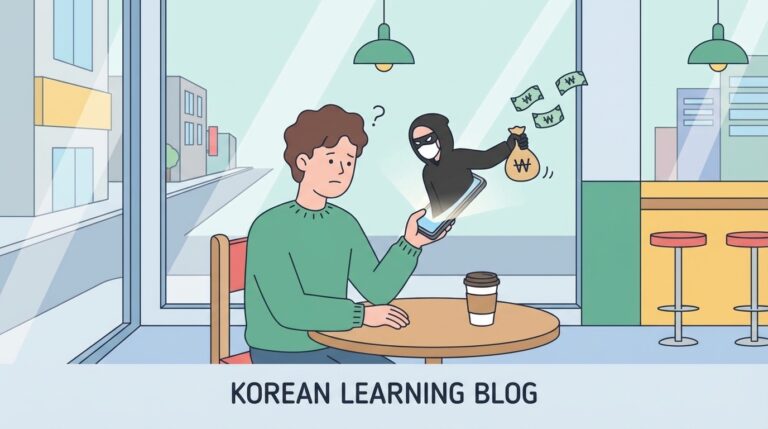
Picture this: You’re enjoying a peaceful afternoon at a trendy cafe in Yeonnam-dong, sipping your iced Americano. Suddenly, your phone rings with an unknown 02 (Seoul) number. You answer, and a stern, professional voice says, “Hello, this is Investigator Kim from the Seoul Central District Prosecutors’ Office. Your bank account has been involved in a massive fraud case.”
Your heart drops. You start sweating. But wait… you only have 50,000 won in that account, and you barely speak enough Korean to order a latte, let alone pull off a “massive fraud”!
Welcome to the infamous world of Korean Voice Phishing (보이스피싱). If you’ve watched K-Dramas like Taxi Driver or The Roundup, you know that scam calls and texts are a recurring theme. As an expat or long-term traveler in Korea, dealing with banking and finance is already stressful enough without scammers trying to steal your hard-earned Won.
Today, we’re going to equip you with the essential B2-level Korean expressions to identify, prevent, and report financial scams. This isn’t just about learning vocabulary; it’s about protecting yourself like a true local!
Phase 2: Core Expression Deep Dive
Let’s look at the absolute must-know phrases when dealing with suspicious financial situations.
1. 계좌 지급 정지 부탁드립니다.
- Pronunciation: [Gyejwa jigeup jeongji butakdeurimnida.]
(Sound analogy: “Gye-jwa” sounds like a quick “Geh-jwa”, “ji-geup” is like “jee-goop”, and “jeong-ji” is “jung-jee”.)- Meaning: Please suspend payments on my account.
- K-Culture Moment: This is the dramatic line in every K-Drama when the protagonist realizes their money has been drained and rushes into the bank, slapping their hands on the teller’s counter.
- Editor’s Insight:
계좌means account, and지급 정지literally means “payment halt.” This is the magic phrase that freezes all outward money flow. If you suspect your account is compromised, say this to your bank immediately.- Situation Spectrum:
- Bank Teller / Customer Service (Formal): ✅
- Friends (Casual): 🚫 (Too formal for casual talk)
- 🤔 Think About It: Notice how formal Korean banking terms heavily rely on Sino-Korean (Hanja) words like
지급and정지. Does your native language also use distinct, highly formal vocabulary for legal or financial matters compared to everyday speech?2. 이거 보이스피싱(사기) 같은데요.
- Pronunciation: [Igeo boiseupising(sagi) gateundeyo.]
- Meaning: I think this is voice phishing (a scam).
- K-Culture Moment: You show a weird text message to your Korean coworker during lunch. They take one look, widen their eyes, and say this phrase to warn you.
- Editor’s Insight:
-은/는 것 같다(it seems like / I think) is a staple of intermediate (B2) Korean. Koreans use it to soften their statements, even when they are 100% sure it’s a scam!사기means scam or fraud.- Situation Spectrum:
- Friends / Coworkers (Semi-formal/Casual): ✅
- Police Officer (Formal): ⚠️ (Better to say: 보이스피싱을 당한 것 같습니다)
- 🤔 Think About It: Why do Koreans prefer saying “I think it is a scam” instead of “This is a scam”? How does this reflect the culture of indirect communication and maintaining harmony (even when evaluating objects/situations)?
3. 모르는 번호로 온 링크는 절대 누르지 마세요.
- Pronunciation: [Moreuneun beonhoro on ringkeuneun jeoldae nureuji maseyo.]
- Meaning: Never click on links from unknown numbers.
- K-Culture Moment: The public service announcements playing on the screens inside the Seoul Subway.
- Editor’s Insight: This addresses Smishing (스미싱), a massive issue in Korea where scammers send fake “wedding invitations” or “CJ Logistics package tracking” links via SMS.
누르다means to press/click, and-지 마세요is the polite imperative “do not.”- Situation Spectrum:
- Advising anyone (Polite/Formal): ✅
Phase 3: Textbook vs. Real Korean
Let’s bridge the gap between your Korean textbook and the streets of Seoul.
[Situation 1: Warning a friend about a suspicious call]
* 📖 Textbook: 사기 전화를 조심하십시오. (Please beware of fraudulent phone calls.)
* 🗣️ Real Korean: 야, 그거 피싱 냄새 나는데? 걍 끊어! (Hey, that smells like phishing. Just hang up!)
* 💡 Why the difference?: Real conversation relies heavily on sensory metaphors (냄새가 나다 – smells like) and quick slang (걍 for 그냥) for urgency.
[Situation 2: Responding to a scammer trying to pressure you]
* 📖 Textbook: 당신은 누구십니까? 전화를 끊겠습니다. (Who are you? I will hang up the phone.)
* 🗣️ Real Korean: 아, 예. 됐고요, 끊을게요. (Ah, yeah. Whatever, I’m hanging up.)
* 💡 Why the difference?: 됐고요 (literally “it is done”) is the ultimate passive-aggressive phrase to shut down unwanted conversations, perfect for telemarketers and scammers alike.
Bottom Note: At the B2 level, using phrases like “됐고요” shows you understand the cultural nuance of polite rejection without being overly confrontational.
Phase 4: Cultural Context — K-Culture Deep Dive
4-1. The Non-Verbal “Nunchi” (눈치) of Scam Prevention
In Korea, eye contact and body language speak volumes. If you get a call in a public place and suddenly freeze, staring blankly at your phone with a stressed expression, a Korean friend with good nunchi will immediately ask, “무슨 일 있어요?” (Is something wrong?). Also, when dealing with bank tellers to report a scam, maintaining a serious demeanor and handing over your ID/bankbook with both hands ensures they take your crisis seriously and process it quickly.
4-2. The “Institution Spoofing” Trope in Media
Korean scams frequently impersonate authorities: Police, Prosecutors, or the Financial Supervisory Service (FSS). Why? Because Korean society has a historically strong hierarchical respect for governmental authority. Scammers use highly formal language (-지 말입니다, -하셨습니까?) to intimidate victims.
Critical Viewpoint: While K-Dramas often portray brilliant hackers tracking down these scammers in dramatic showdowns (like the basement crew in Taxi Driver), reality is far more bureaucratic. You won’t get a revenge squad; you’ll get a long afternoon filling out forms at the police station. Don’t fall for the “detective” act on the phone!
Phase 5: Real-Life Roleplay Scenario
Setting: Friday afternoon. You are at your desk in a busy Seoul office. Your phone buzzes with a text message: “[CJ Logistics] Unresolved address issue. Please click the link to update your delivery address: http://bit.ly/fake-link”
Characters:
– YOU: An expat who did order something from Coupang recently.
– Ji-yoon (28, your Korean coworker): Sharp, tech-savvy, and always looking out for you.
Dialogue:
YOU: 어? 택배 주소가 잘못됐다고 문자가 왔네요. 링크 눌러서 확인해야겠다.
(Eo? Taekbae jusoga jalmotdwaetdago munjaga watneyo. Ringkeu nulleoseo hwakinhaeyagetda.)
[Oh? I got a text saying my delivery address is wrong. I should click the link to check.]
(🎭 Stage Direction: You move your thumb toward the screen)
Ji-yoon: 잠깐만요! 그거 당장 멈춰요! 🛑
(Jamkkanmanyo! Geugeo dangjang meomchwoyo!)
[Wait a minute! Stop right there!]
YOU: 네? 왜요? 저 어제 쿠팡에서 로켓배송 시킨 거 있는데요?
(Ne? Waeyo? Jeo eoje kupang-eseo roketbaesong sikin geo itneundeyo?)
[Huh? Why? I ordered something on Coupang Rocket Delivery yesterday.]
Ji-yoon: 그거 스미싱일 확률이 높아요. 발신자 번호 확인해 봤어요?
(Geugeo seumising-il hwangryuri nopayo. Balsinja beonho hwakinhae bwasseoyo?)
[There’s a high chance that’s smishing. Did you check the sender’s number?]
🔀 Your Turn! How do you reply?
– A) “어… 010으로 시작하는 개인 번호네요.” (Uh… it’s a personal number starting with 010.)
– B) “네! CJ 대한통운이라고 써 있어요!” (Yes! It says CJ Logistics!)
– C) “아, 몰라요. 그냥 누를게요.” (Ah, I don’t know. I’ll just click it.)✅ Best Choice: A — Reason: Delivery companies in Korea usually use official business numbers (like 1588-XXXX). If a “company” texts from a 010 personal mobile number with a link, it is almost certainly a scam!
⚠️ Choice C Analysis: Never do this in Korea! Clicking malicious links can install APK files that hijack your phone, allowing scammers to intercept calls you make to the actual police or banks.
Ji-yoon: 거봐요! 택배 기사님들은 주소 틀렸다고 이상한 링크 안 보내요. 그냥 전화하시지.
(Geobwayo! Taekbae gisanimdeureun juso teullyeotdago isanghan ringkeu an bonaeyo. Geunyang jeonhwahasiji.)
[See! Delivery drivers don’t send weird links saying the address is wrong. They just call you.]
YOU: 헉, 진짜 큰일 날 뻔했네요. 알려주셔서 감사합니다!
(Heok, jinjja keunil nal ppeonhaetneyo. Allyeojusyeoseo gamsahamnida!)
[Gasp, I was almost in big trouble. Thanks for letting me know!]
Phase 6: 10-Second Shadowing Drill
Practice this essential boundary-setting phrase. Remember, confidence is key to scaring off scammers!
😤 검찰청이라고요? / 저 지금 바빠서요. / 끊을게요.
(geomchalcheong-iragoyo? / jeo jigeum bappaseoyo. / kkeuneulgeyo.)
[You’re the prosecutors’ office? / I am busy right now. / I’m hanging up.]
Pro-tip: Raise your pitch slightly at “고” to show skepticism, then drop your tone sharply at “요” to sound firm and final.
Phase 7: K-Culture Mini Dictionary
| Korean | Romanization | English | Cultural Context |
|---|---|---|---|
| 보이스피싱 | boiseupising | Voice Phishing | Phone scams. A huge societal issue in Korea, often run by overseas syndicates. |
| 스미싱 | seumising | Smishing | SMS phishing. Scammers send links pretending to be wedding invites, package deliveries, or COVID relief funds. |
| 사칭하다 | sachinghada | To impersonate | Scammers often impersonate the FSS (금융감독원) or police to gain your trust. |
| 대포통장 | daepotongjang | Burner account | Literally “cannon bankbook.” Bank accounts created under false identities used for money laundering in scams. |
| 명의 도용 | myeongui doyong | Identity theft | When someone uses your alien registration number or name to open accounts. |
Phase 8: Traveler & Expat Survival Kit
Even if you are just traveling, you might buy a local SIM card and immediately receive spam texts. Here are your survival phrases:
🆘 Survival Phrases for Scams & Banks
– 🇰🇷 “비밀번호는 알려줄 수 없습니다.” (bimilbeonhoneun allyeojul su eopseumnida.)
– 🗣️ Meaning: I cannot give you my password.
– 📍 Where to use: On the phone with anyone asking for your PIN.
– 💡 Pro Tip: Korean banks and police will NEVER ask for your full password or the full 13 digits of your ARC over the phone. If they do, hang up immediately.📌 Editor’s Travel & Life Note
– Emergency Numbers: Dial112for the Police. Dial1332for the Financial Supervisory Service (FSS) voice phishing hotline.
– Bank Apps: Korean banking apps are highly secure but complex. If you think you clicked a bad link, turn your phone to “Airplane Mode” immediately so the hacker cannot transfer your funds via Wi-Fi/Data!
– Public Wi-Fi: Avoid logging into your Korean banking apps on open cafe Wi-Fi networks to prevent data sniffing.
Phase 9: Critical Thinking Corner — “One Step Deeper”
Media vs Reality: The Illusion of Authority in Korea
Why are voice phishing scams so successful in a highly educated country like South Korea? It comes down to the intersection of language and authority. In Korean culture, institutions like the Prosecutor’s Office hold immense social power. Scammers manipulate this by using highly advanced, formal registers of Korean (안녕하십니까, 수사 중입니다). For an expat learning Korean, hearing this formal language triggers the “respect” response we are taught in textbooks. The media often portrays these institutions as infallible or intimidating. Scammers weaponize this cultural conditioning to bypass your logical defenses.
💬 Your Turn: Does a highly formal tone of voice automatically command respect and compliance in your home country? How do scammers operate differently where you are from? Share in the comments!
Phase 10: FAQ & Avoiding Common Mistakes
Q: “Can I yell at the scammer in Korean?”
Maybe. It’s tempting to use colorful Korean curse words, but officials advise against antagonizing them. Scammers have your phone number and sometimes your address; they might retaliate by ordering hundreds of dollars of delivery food to your house (a real revenge tactic used by scammers!). Just say “됐고요” and hang up.
Q: “What if I legitimately lost my card on the subway? Is it the same phrase?”
Yes! You can call your bank and use the exact same concept: “카드 분실 신고 및 지급 정지 부탁드립니다” (Please report my card as lost and suspend payments).
❌ Common Mistake #1: Confusing
계좌 이체(Account Transfer) with지급 정지(Payment Suspension).
✅ How to fix it: If you panic and say “이체해 주세요”, you are asking to transfer money! Always remember 정지 (Jeong-ji) means STOP. Think of a stop sign.
Phase 11: Summary & Action Items
One-Liner Summary: When an unknown caller demands your personal information or sends a link, block it, drop it, and say “지급 정지” if your bank account is compromised!
Your Action Missions:
– 🥉 Bronze (Solo): Read the shadowing drill (Phase 6) out loud three times in your most skeptical, unbothered tone.
– 🥈 Silver (Online): Look through your recent Korean SMS messages. Can you spot any suspicious links? (Don’t click them!)
– 🥇 Gold (Real World): Visit your Korean banking app or an ATM. Change the language to Korean and try to navigate to the “신고” (Report) or “분실/정지” (Lost/Suspend) section so you know where it is in an emergency.
Special K-Culture Mission:
Search “보이스피싱 레전드” (Voice Phishing Legend) on YouTube. You will find hilarious audio clips of everyday Koreans outsmarting scammers with witty comebacks. See how much of the conversation you can understand at your B2 level!
Phase 12: Quiz — Interactive Challenge
1. Situational Judgment: You get a call from someone claiming to be “Seoul Police.” They ask for your bank account password to “safeguard your funds.” What is the MOST natural and culturally appropriate way to handle this?
– A) “경찰관님, 수고하셨습니다. 제 비밀번호는 1234입니다.”
– B) “저기요, 어디서 사기를 쳐요? (Hangs up)”
– C) “계좌 이체 부탁드립니다.”
2. Fill in the Blank:
“내 통장 돈이 다 빠져나가고 있어! 빨리 은행에 전화해서 계좌 ____ ____ 해달라고 해!”
(My account is being drained! Call the bank and ask them to ________ ________!)
3. True or False (K-Culture Edition):
“Korean delivery drivers will frequently send you links via text message from their personal 010 mobile numbers if they cannot find your address.”
🚨 Click here for the Answers!
1. Answer: B. While A is very polite, you are giving away your password! C means “Please transfer my money” (Yikes!). B is the natural reaction—calling out the scam and hanging up.
2. Answer: 지급 정지. The magical words to freeze your account.
3. Answer: False. This is the classic “Smishing” tactic. Real drivers will call you directly or leave the package at the door and send a photo, rarely asking you to “click a link to update an address.”
Frequently Asked Questions (FAQ)
Q: What does "계좌 지급 정지 부탁드립니다." mean in Korean and how do you pronounce it?
A: In Korean, "계좌 지급 정지 부탁드립니다." is pronounced [Gyejwa jigeup jeongji butakdeurimnida.] and means: Please suspend payments on my account.
Q: What does "이거 보이스피싱(사기) 같은데요." mean in Korean and how do you pronounce it?
A: In Korean, "이거 보이스피싱(사기) 같은데요." is pronounced [Igeo boiseupising(sagi] and means: I think this is voice phishing (a scam).
Q: What does "모르는 번호로 온 링크는 절대 누르지 마세요." mean in Korean and how do you pronounce it?
A: In Korean, "모르는 번호로 온 링크는 절대 누르지 마세요." is pronounced [Moreuneun beonhoro on ringkeuneun jeoldae nureuji maseyo.] and means: Never click on links from unknown numbers.







