

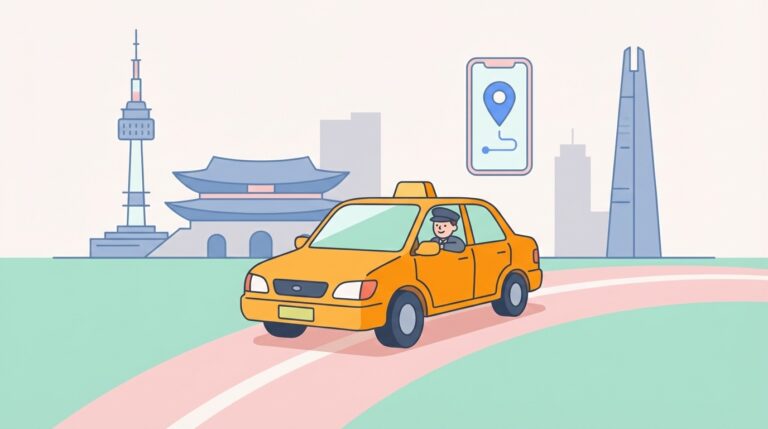
Phase 1: Empathy (The K-Drama Taxi Illusion)
Hello there! It’s your Daily Hangul Editor.
Imagine this: You’re in Seoul. You’ve just watched your 20th K-Drama where the main character jumps into a taxi, slams the door, and dramatically yells, “Ahjussi, follow that car!” or “To the airport, step on it!”
So, when you finally visit Korea and slide into an iconic orange cab, you might feel a rush of adrenaline. But then reality hits. The driver turns around, looks at you expectantly, and… your mind goes completely blank. You know the name of your hotel, but how do you actually say “Please take me there” without sounding like a robotic textbook or an overly dramatic soap opera star?
Don’t worry. Taking a taxi in Korea is fast, safe, and incredibly affordable. But communicating your destination can be the ultimate A2-level boss fight. Today, I’m going to share the exact, natural phrases actual Koreans use every day.
Note: This guide is crafted from the real panic moments of my foreign students in Seoul. Let’s make sure you ride like a local!
Phase 2: Core Expressions – Deep Dive
Let’s master the three essential phrases you need for a flawless taxi ride.
1. [장소] + (으)로 가주세요.
- Pronunciation: [Jangso] + eu-ro ga-ju-se-yo.
- Sound-alike guide: ‘으(eu)’ sounds like the noise you make when you step in something gross.
- Meaning: Please go to [Location].
- K-Culture Moment: This is the bread and butter of Korean transportation. Whether you’re a K-Pop idol rushing to a music show recording at KBS or a tired office worker heading home after a hoesik (company dinner), this is the default phrase.
- Editor’s Insight: It feels polite, direct, and softly commanding. The key is the ending “주세요” (give/do for me), which frames your request as asking for a favor, rather than barking an order.
- Situation Spectrum:
- Friendly/Casual: ✅ (With friends, you’d drop the ‘yo’: 홍대로 가줘)
- Semi-formal (Taxi driver): ✅ (Perfect!)
- Formal/Elders: ✅
- 🤔 Think About It: Why does Korean use “give” (주세요) when asking someone to go somewhere? How does your native language handle polite requests?
2. 여기서 세워주세요.
- Pronunciation: yeo-gi-seo se-wo-ju-se-yo.
- Meaning: Please stop/pull over here.
- K-Culture Moment: You’re navigating through the narrow, winding alleys of Bukchon Hanok Village. The GPS is getting confused. You spot your Airbnb. You need the driver to stop right now before you pass it!
- Editor’s Insight: “세우다” literally means to stand something up, but in driving context, it means to park or pull over. It’s much more natural than saying “Stop!” (멈춰!), which sounds like you’re talking to a dog or stopping a thief.
- Situation Spectrum:
- Friendly/Casual: ✅
- Semi-formal (Taxi driver): ✅
- Formal/Elders: ✅
3. 영수증 주세요.
- Pronunciation: yeong-su-jeung ju-se-yo.
- Meaning: Please give me the receipt.
- K-Culture Moment: You’ve just arrived at your hotel. You step out, take a breath of fresh Seoul air, and realize… your brand-new K-Beauty haul is still in the back seat.
- Editor’s Insight: Always ask for the receipt! In Korea, taxi receipts have the taxi’s license plate number and the driver’s contact info. It’s your ultimate insurance policy for lost items.
- Situation Spectrum:
- Store clerks/Taxi drivers: ✅
Phase 3: Textbook vs Real Korean
[Telling the Driver Your Destination]
* 📖 Textbook Korean: “저는 서울역에 가고 싶습니다.” (I want to go to Seoul Station.)
* 🗣️ Real Korean: “서울역으로 가주세요.” (To Seoul Station, please.) OR simply “서울역이요.” (Seoul Station, please.)
* 💡 Why the difference?: Koreans value efficiency in service situations. Stating “I want to…” feels unnecessarily wordy and a bit unnatural to natives.
[Telling the Driver to Stop]
* 📖 Textbook Korean: “목적지에 도착했습니다. 정차해 주세요.” (We have arrived at the destination. Please halt the vehicle.)
* 🗣️ Real Korean: “여기서 내려주세요.” (Please drop me off here) or “앞에 세워주세요.” (Please stop up ahead.)
* 💡 Why the difference?: Everyday spoken Korean is highly context-dependent and prefers visual, spatial words like “here” (여기) and “ahead” (앞).
Bottom Note: At the A2 level, attaching “~이요(iyo)” to a noun is your best friend. Don’t know the full grammar? Just say the place + 이요. (e.g., 홍대입구역이요!)
Phase 4: Cultural Context — K-Culture Deep Dive
4-1. Non-verbal Etiquette (The Taxi “Nunchi”)
In Korea, you generally sit in the back seat of a taxi unless you have a party of four. Sitting in the front seat when you are alone can make the driver feel a bit awkward, as if you are monitoring their driving!
Also, Korean taxi doors (except for the black “Deluxe” taxis) do not open automatically. You have to open and close them yourself. Just don’t slam them too hard!
4-2. The “Kakao T” Cheat Code
If you want to travel like a true modern Korean, you need the Kakao T app. It’s the Korean equivalent of Uber.
* The K-Drama vs Reality check: In dramas, characters flag down cabs on the street in the pouring rain. In reality? 90% of Koreans are standing comfortably under an awning, staring at their Kakao T app waiting for their assigned driver.
* When using the app, the driver already knows your destination. You just hop in, say “안녕하세요” (Hello), and perhaps confirm briefly: “강남역 맞죠?” (It’s Gangnam Station, right?).
Phase 5: Interactive Roleplay Scenario
Setting: It’s 11:30 PM on a Friday. You just had amazing K-BBQ with friends in Hongdae. The subways are closing. You manage to flag down a silver taxi. You open the back door and slide in.
Characters:
– YOU: A traveler who knows basic Korean and wants to get back to Myeongdong safely.
– 기사님 (Gisanim): The taxi driver in his 50s. Friendly but wants to get moving quickly.
Dialogue:
기사님: 어서 오세요. 어디로 모실까요?
(eoseo oseyo. eodiro mosilkkayo?)
[Welcome. Where shall I take you?]
YOU: 안녕하세요! 명동으로 가주세요.
(annyeonghaseyo! myeongdong-euro gajuseyo.)
[Hello! Please take me to Myeongdong.]
(🎭 Stage Direction: The taxi merges into the heavy late-night traffic. After 20 minutes, you see your hotel approaching on the right.)
YOU: 기사님, 저기 편의점…
(gisanim, jeogi pyeon-ui-jeom…)
[Driver, that convenience store over there…]
🔀 Your Turn! How should you finish the sentence to get him to stop?
– A) “멈춰라!” (Meomchwora!)
– B) “앞에서 세워주세요.” (Ap-eseo sewojuseyo.)
– C) “도착했습니다.” (Dochakaetseumnida.)✅ Best Choice: B — “Please stop up ahead.” It’s polite, natural, and uses the exact verb (세우다) Koreans use for vehicles.
⚠️ Choice A Analysis: NEVER use this. “멈춰라” is a plain/command form. It sounds like a police officer yelling at a fleeing criminal in an action movie!
기사님: 네, 알겠습니다. 다 왔습니다.
(ne, algetseumnida. da watseumnida.)
[Yes, understood. We’ve arrived.]
YOU: 카드로 결제할게요. 영수증 주세요!
(kadeu-ro gyeoljehalgeyo. yeongsujeung juseyo!)
[I’ll pay by card. Please give me the receipt!]
Phase 6: 10-Second Shadowing Drill
Practice these lines with the correct feeling. / marks a slight pause.
- 😊 Politely directing: 기사님, / 명동역으로 / 가주세요.
(gisanim, / myeongdong-yeok-euro / gajuseyo.) - 🥺 Urgently stopping: 저기 / 횡단보도 앞에서 / 세워주세요!
(jeogi / hoengdan-bodo ap-eseo / sewojuseyo!) - 💳 Paying: 카드 / 되나요?
(kadeu / doenayo? – Do you take cards?)
Phase 7: Mini K-Culture Dictionary
| 한국어 | Romanization | English | Context |
|---|---|---|---|
| 기사님 | gisanim | Driver | The polite way to address any driver (taxi, bus, delivery). Never just say “Hey!” |
| 할증 | haljeung | Surcharge | Late-night extra fee applied to taxis, usually from 10 PM to 4 AM. |
| 티머니 | T-money | Transit Card | Korea’s universal transportation card. Works on buses, subways, and YES, taxis! |
| 카카오T | Kakao T | Kakao Taxi App | The must-have app for hailing cabs in Korea. Works with international cards now! |
Phase 8: Traveler’s Survival Kit
🆘 Survival Phrases for Taxis
– 🇰🇷 “여기 지도 봐주세요.” (yeogi jido bwajuseyo.)
– 🗣️ English: Please look at this map here.
– 📍 Where to use: When you can’t pronounce the destination.
– 💡 Pro Tip: Pre-load your destination on Naver Map (Google Maps doesn’t work well for walking/driving in Korea) and just show the screen to the driver!
📌 Editor’s Travel Note
– Payment: Korea is a cashless society. 99.9% of taxis accept credit cards and T-money cards. You don’t need to fumble with cash.
– Tipping: There is NO tipping culture in Korea. If the fare is 9,500 won and you give 10,000 won, expect 500 won back. If you tell them to “keep the change,” they might get confused or chase after you thinking you forgot your money!
Phase 9: Critical Thinking Corner — “Language & Power”
🧠 Think Deeper:
Have you noticed we call the driver “기사님” (Gisanim)? “기사” means driver/engineer, and “님” (nim) is a suffix of deep respect. Many tourists learn the word “아저씨” (Ahjussi – middle-aged man) from dramas. While some older Koreans do say “Ahjussi” to drivers, using “기사님” elevates the person’s profession. It shows that in modern Korean society, respecting the labor and role of the person serving you is becoming increasingly important. Language evolves to reflect social respect.💬 Your Turn: How do you address service workers (like drivers or waiters) in your culture? Is there a specific title, or do you just say “Excuse me”? Share in the comments!
Phase 10: FAQ & Common Mistakes
- Q: Can I use basic English with taxi drivers?
- A: Maybe. Younger drivers might understand basic words, but older drivers usually do not. Always have the Korean address ready on your phone!
- Q: What if the taxi is black with a yellow stripe?
- A: That is a “모범택시” (Mobeom Taxi / Deluxe Taxi). They offer premium service, more space, and the drivers often speak some English. However, the starting fare is nearly double that of a regular taxi!
❌ Common Mistake #1: Saying just the location without “가주세요”.
* Instead of: “홍대.” (Sounds rude, like a boss commanding a subordinate).
* ✅ Do this: “홍대 가주세요.” (Polite and natural).
❌ Common Mistake #2: Relying on Google Maps.
* ✅ Do this: Download Naver Map or Kakao Map. Google Maps cannot provide driving or walking directions in South Korea due to local security laws.
Phase 11: Summary & Action Items
One-Liner Summary: Remember to attach “(으)로 가주세요” to your destination and always politely ask them to stop with “세워주세요.”
Your Mission for Today:
* 🥉 Bronze (Solo): Say “명동으로 가주세요” out loud 3 times while looking in the mirror.
* 🥈 Silver (Online): Open a map of Seoul, pick a random landmark, and write how you would ask a taxi driver to go there in the comments below!
* 🥇 Gold (Real Life): If you are in Korea, try flagging down a cab and speaking your destination without showing your phone first.
* 🌟 K-Culture Mission: Open YouTube and search for K-Drama taxi scenes. Can you hear the characters using the verb “가주세요” or “세워주세요”?
Did this guide help you feel less anxious about taking a Korean taxi? Let me know which location you want to practice in the comments!
Phase 12: Quiz — Interactive Challenge
1. Fill in the Blank:
You want to go to Gangnam Station.
“기사님, 강남역(_____).”
A) 가요
B) 으로 가주세요
C) 도착했습니다
2. True or False — K-Culture Edition:
“If the taxi fare is 8,000 won, it is polite to give them 10,000 won and tell them to keep the change as a tip.”
3. Situational Judgment:
You left your favorite umbrella in the taxi! What phrase should you have used when paying to make sure you could track the driver down?
A) 수고하셨습니다 (Thank you for your effort)
B) 영수증 주세요 (Please give me the receipt)
C) 빨리 가주세요 (Please go fast)
👀 Click here for the answers!
1. B (으로 가주세요 is the most polite and natural way to request a destination.)
2. False (Korea has no tipping culture. You just pay the exact amount using your card or get your exact change!)
3. B (Always ask for the 영수증/receipt, as it contains the taxi company’s number and the car’s license plate!)
Frequently Asked Questions (FAQ)
Q: What does "[장소] + (으)로 가주세요." mean in Korean and how do you pronounce it?
A: In Korean, "[장소] + (으)로 가주세요." is pronounced [Jangso] and means: a key conversational Korean expression covered in this lesson.
Q: What does "여기서 세워주세요." mean in Korean and how do you pronounce it?
A: In Korean, "여기서 세워주세요." is pronounced [yeo-gi-seo se-wo-ju-se-yo.] and means: Please stop/pull over here.
Q: What does "영수증 주세요." mean in Korean and how do you pronounce it?
A: In Korean, "영수증 주세요." is pronounced [yeong-su-jeung ju-se-yo.] and means: Please give me the receipt.







