

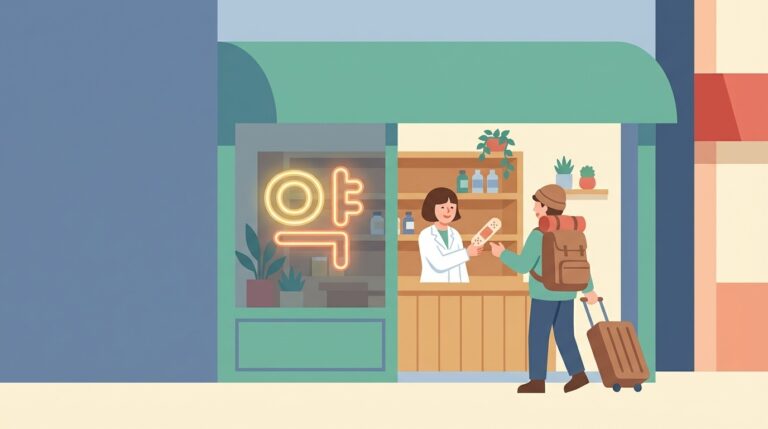
Phase 1: Empathy & The K-Culture Cold Open
Hello! This is your Daily Hangul Editor.
Imagine this: You are having the time of your life in Seoul. You bought a gorgeous new pair of shoes in Myeongdong or Hongdae, and you are walking around wearing them. Suddenly, you feel it—that sharp, burning sensation on your heel. A blister.
If you’ve watched K-Dramas, you know exactly what happens next. The handsome male lead notices the female lead limping. He runs to a nearby pharmacy, buys a band-aid, squats down right on the street, and gently puts it on her heel. It’s romantic, right? But wait… what if you are traveling alone, or your Korean friends are miles away?
You open your translation app, but standing in front of a busy pharmacist, your mind goes blank. Don’t worry! Today, we are going to learn how to handle minor emergencies in Korea like a true local. By the end of this lesson, you won’t just know how to ask for a band-aid; you’ll understand the culture behind Korean pharmacies and convenience stores.
Note: This guide is tailored for A1 (Absolute Beginners) and is based on real SOS messages from my tutoring students who got blisters from too much walking in Seoul!
Phase 2: Core Expressions Deep Dive
Let’s learn the most essential, lifesaver expressions you need when you’re hurt.
1. 반창고 주세요 (Please give me a band-aid)
- Pronunciation: [ban-chang-go ju-se-yo] / ban-chang-go sounds like ‘ban’ + ‘chang’ (like the start of ‘change’) + ‘go’ + ju-se-yo (jew-seh-yo).
- Meaning: (Literal) Give me an adhesive bandage. (Real nuance) I need a band-aid, please.
- K-Culture Moment: This is the standard way to ask. When you walk into a pharmacy with a slight limp, say this, and the pharmacist will immediately know what to hand you.
- Editor’s Insight: ‘주세요 (ju-se-yo)’ is your magic wand in Korea. It means “Please give me [item].” Just put any noun before it!
- Situation Spectrum:
- Casual with friends: ✅ (Though friends might just say “반창고 있어?”)
- Convenience store staff: ✅
- Pharmacist (Formal): ✅
- 🤔 Think About It: In Korean, we put the object first and the request (“give me”) at the end. How does this compare to your native language?
2. 밴드 있어요? (Do you have bands?)
- Pronunciation: [baen-deu is-seo-yo?] / baen-deu sounds like the English word “band” but with an “eu” (like the disgusted sound ‘ugh’ without the ‘gh’) at the end.
- Meaning: (Literal) Do you have bands? (Real nuance) Do you sell band-aids here?
- K-Culture Moment: Koreans love shortening words or using brand names. “밴드 (Band)” comes from “Band-Aid.” In everyday life, 90% of Koreans will just say “밴드 (Band)” instead of the formal “반창고 (Banchanggo).”
- Editor’s Insight: If you can’t remember “Banchanggo,” just use your English! Say “Band 있어요?” and they will understand perfectly.
- Situation Spectrum:
- Casual with friends: ✅
- Convenience store staff: ✅
- Pharmacist: ✅
- 🤔 Think About It: Why do you think Koreans adopted the English word “Band” for bandages? Does your country also use brand names (like Kleenex for tissues) as regular words?
3. 여기 아파요 (It hurts here)
- Pronunciation: [yeo-gi a-pa-yo] / yeo-gi (yuh-gee) + a-pa-yo (ah-pah-yo).
- Meaning: (Literal) Here hurts. (Real nuance) I have pain right here.
- K-Culture Moment: Imagine you have a stomachache after eating too much spicy Tteokbokki. You go to the pharmacy, point to your stomach, and say “여기 아파요.” The pharmacist will nod knowingly and give you the right medicine.
- Editor’s Insight: For A1 beginners, pointing is your best friend. You don’t need to know the Korean words for head, stomach, or toe yet. Just point and say “여기 아파요!”
- Situation Spectrum:
- Casual with friends: ✅
- Pharmacist/Doctor: ✅
- 🤔 Think About It: Korean often drops the subject (“I” or “My”). We don’t say “My head hurts,” we just say “Hurts.” This shows how Korean relies heavily on context.
Phase 3: Textbook vs. Real Korean
Let’s see how language changes from the textbook to the busy streets of Seoul.
[Asking for a Band-Aid at a Pharmacy]
* 📖 Textbook Korean: 반창고를 주시겠습니까? (Would you please give me an adhesive bandage?)
* 🗣️ Real Korean: 밴드 하나 주세요. (One band, please.)
* 💡 Why the difference?: Korean culture values “빨리빨리” (Ppal-li Ppal-li / Hurry, hurry). In commercial settings, simple and efficient communication is preferred over overly polite, lengthy textbook phrases.
[Saying where it hurts]
* 📖 Textbook Korean: 저는 발뒤꿈치에 상처가 났습니다. (I have obtained a wound on my heel.)
* 🗣️ Real Korean: (Pointing to the heel) 아, 여기 아파요. 밴드 있어요? (Ah, it hurts here. Do you have bands?)
* 💡 Why the difference?: Non-verbal communication (pointing) combined with simple verbs is the most natural way Koreans express minor discomfort in daily life.
Bottom Note: For A1 learners, keep it simple! You don’t need complex grammar to survive. Noun + “주세요 (Ju-se-yo)” is all you need.
Phase 4: Cultural Context — K-Culture Deep Dive
4-1. Non-verbal Cues & Nunchi
When you are in pain, your facial expressions are a universal language. But in Korea, showing a bit of a distressed face (even slightly exaggerating it) when saying “아파요 (apayo)” helps the pharmacist use their Nunchi (social sense) to act faster. Also, when receiving the band-aid and handing over your credit card, try to use two hands or lightly support your right elbow with your left hand. It’s a subtle sign of respect!
4-2. The “Yakguk” vs. Convenience Store Culture
In Korea, pharmacies are called 약국 (Yak-guk). You can easily spot them by looking for a brightly lit sign with the word “약” (Yak – meaning medicine) on it.
Here is a crucial K-Travel survival tip: Pharmacies usually close around 7 PM or 8 PM. What if you get a blister at 11 PM after a late-night shopping spree?
Look for a 편의점 (Pyeon-ui-jeom / Convenience Store) like CU, GS25, or 7-Eleven! Since 2012, Korean convenience stores are legally allowed to sell basic over-the-counter items like band-aids, basic painkillers, and digestive medicine. Just walk to the small medical shelf or ask the cashier, “밴드 있어요?”
Phase 5: Real-life Roleplay Scenario
Let’s put you in a movie scene.
Setting: It’s 9 PM in Hongdae. The glowing neon signs are everywhere. You’ve been walking for 5 hours, and your new sneakers are giving you a terrible blister. Pharmacies are closed, so you walk into a brightly lit CU convenience store.
Characters:
– YOU: A tired traveler whose heel is on fire.
– Cashier (Ji-hoon): A 20-something part-time worker listening to K-Pop on his earphones, but friendly.
Dialogue:
YOU: 저기요… (Excuse me…)
(Romanization) Jeogiyo…
(🎭 Stage Direction: You limp slightly toward the counter.)
Ji-hoon: 네, 어서 오세요.
(Romanization) Ne, eoseo oseyo.
(English) Yes, welcome.
YOU: 혹시…
(Romanization) Hoksi…
(English) By any chance…
🔀 Your Turn! How do you ask for the band-aid?
– A) “저에게 반창고를 주시겠습니까?” (Using the long textbook phrase)
– B) “밴드 있어요?” (Using the natural, simple phrase)
– C) “마이 힐 이즈 브로큰!” (Panic in English)✅ Best Choice: B — It’s natural, short, and exactly what a Korean would say in a convenience store.
⚠️ Choice A Analysis: The cashier will understand, but he might freeze for a second because it sounds like a robot talking! Keep it casual.
(Continuing with Choice B)
YOU: 밴드 있어요?
(Romanization) Baendeu isseoyo?
(English) Do you have bands (band-aids)?
Ji-hoon: 아, 네! 저기 뒤에 있어요. (Ah, yes! It’s right back there.)
(🎭 Stage Direction: Ji-hoon points to the small shelf near the window.)
YOU: 감사합니다!
(Romanization) Gamsahamnida!
(English) Thank you!
Phase 6: 10-Second Shadowing Drill
Let’s practice your pronunciation! Read out loud following the pauses and emotion tags.
- 🥺 Desperately: 반창고 / 주세요! (ban-chang-go / ju-se-yo!)
- 😢 In pain: 여기 / 너무 / 아파요… (yeo-gi / neo-mu / a-pa-yo…)
- 😊 Politely: 혹시 / 밴드 / 있어요? (hok-si / baen-deu / is-seo-yo?)
Phase 7: K-Culture Mini Dictionary
| Korean | Romanization | English | Context |
|---|---|---|---|
| 약 | yak | Medicine | The magical word you’ll see on neon signs when you’re sick. |
| 약국 | yak-guk | Pharmacy | Where you go for medicine, usually closed by 8 PM. |
| 편의점 | pyeon-ui-jeom | Convenience Store | Your 24/7 savior for late-night snacks and band-aids. |
| 밴드 | baen-deu | Band-aid | The most common, everyday word for a plaster/bandage. |
| 파스 | pa-seu | Pain relief patch | Very popular in Korea! If your muscles ache from walking, stick a ‘Paseu’ on it. |
Phase 8: Traveler’s Survival Kit
🆘 Survival Phrases for Medical Emergencies
– 🇰🇷 “밴드 하나 주세요.” (baen-deu ha-na ju-se-yo)
– 🗣️ Meaning: One band-aid, please.
– 🇰🇷 “약국 어디에 있어요?” (yak-guk eo-di-e is-seo-yo?)
– 🗣️ Meaning: Where is the pharmacy?
– 🇰🇷 “살려주세요!” (sal-lyeo-ju-se-yo!)
– 🗣️ Meaning: Save me! / Help me! (Use only in extreme, real emergencies—or jokingly with close friends when you are exhausted).📌 Editor’s Travel Note
– Finding a Pharmacy: Download Naver Map or KakaoMap. Search for “약국” in Korean. Google Maps is not very accurate for walking directions in Korea!
– No Prescriptions Needed: You don’t need a doctor’s note for basic things like band-aids, Tylenol, cold medicine, or ‘Paseu’ (muscle patches).
Phase 9: Critical Thinking Corner — “One Step Deeper”
Media vs. Reality: The K-Drama Band-Aid Myth
🧠 Think Deeper:
We’ve all seen the K-Drama trope: The male lead magically appears with a band-aid and kneels to put it on the female lead’s foot. It’s the ultimate romantic gesture. But in reality? Buying medicine or a band-aid for someone in Korea isn’t just about romance; it’s a profound expression of 정 (Jeong – deep affection and care). In Korean culture, actions speak louder than words. If a coworker sees you coughing, they might silently place a warm honey tea or cough drop on your desk. Buying a band-aid for a friend with a blister is how Koreans say “I care about you” without actually saying it.💬 Your Turn: Does your culture have a specific way of showing care through small physical items like medicine or food? Share it with us in the comments!
Phase 10: FAQ & Mistake Prevention
Q: “Can I ask for a band-aid at a cafe or restaurant?”
Maybe! Many friendly cafe owners keep a first-aid kit. You can politely ask, “혹시 밴드 있어요?” (By any chance, do you have a band-aid?). They might give you one for free!
Q: “Do I need to bow when buying a band-aid?”
A slight head nod when saying “감사합니다 (Thank you)” is perfect. No need for a deep 90-degree bow!
❌ Common Mistake #1: Asking for a “Plaster” (British English) or “Adhesive Bandage.” Korean staff likely won’t understand.
✅ Do this instead: Always use the Konglish word “Band” (밴드).❌ Common Mistake #2: Trying to explain your exact symptoms in broken Korean.
✅ Do this instead: For A1 beginners, just point to the wound and say “아파요” (It hurts). It’s much safer and faster.
Phase 11: Summary & Action Items
- One-Liner Summary: Remember to say “밴드 주세요” (Baendeu juseyo) when you need a band-aid, and look for the glowing 약 (Yak) sign!
Action Mission:
– 🥉 Bronze (Solo): Stand in front of a mirror, point to your heel, and say “여기 아파요. 밴드 주세요.”
– 🥈 Silver (Online): Find a scene in a K-Drama where someone gets hurt, and imagine yelling “밴드 주세요!” at the screen.
– 🥇 Gold (Real Life): When you visit Korea, walk into a convenience store, locate the medicine shelf, and try to find the word ‘밴드’ on the packages!
K-Culture Mission:
Open Naver Map or Google Maps right now, pick a spot in Gangnam, and search for “약국”. See how many pop up near the subway stations!
Phase 12: Quiz — Interactive Challenge
1. Situational Judgment:
It’s 11:30 PM. You have a blister. Where is the BEST place to go?
A) 약국 (Pharmacy)
B) 편의점 (Convenience Store)
C) 식당 (Restaurant)
(Answer: B! Pharmacies are usually closed by 8 PM, but Convenience Stores are open 24/7.)
2. Fill in the Blank:
You walk into the store. You want to ask, “Do you have a band-aid?”
“_______ 있어요?”
(Answer: 밴드 / baendeu)
3. True or False — K-Culture Edition:
“In Korea, it’s considered rude to just point at where you are hurt. You must know the exact medical term.”
(Answer: False! Pointing and saying “여기 아파요” is perfectly normal and highly recommended for beginners!)
Frequently Asked Questions (FAQ)
Q: What does "반창고 주세요 (Please give me a band-aid)" mean in Korean and how do you pronounce it?
A: In Korean, "반창고 주세요 (Please give me a band-aid)" is pronounced [ban-chang-go ju-se-yo] and means: (Literal) Give me an adhesive bandage. (Real nuance) I need a band-aid, please.
Q: What does "밴드 있어요? (Do you have bands?)" mean in Korean and how do you pronounce it?
A: In Korean, "밴드 있어요? (Do you have bands?)" is pronounced [baen-deu is-seo-yo?] and means: (Literal) Do you have bands? (Real nuance) Do you sell band-aids here?
Q: What does "여기 아파요 (It hurts here)" mean in Korean and how do you pronounce it?
A: In Korean, "여기 아파요 (It hurts here)" is pronounced [yeo-gi a-pa-yo] and means: (Literal) Here hurts. (Real nuance) I have pain right here.







