

Phase 1: Empathy & The “Secret Agent” Moment
Hello! I’m the Lead Editor of Daily Hangul.
Imagine this: It’s 7 PM on a Friday. You are standing near Exit 3 of a bustling Seoul subway station. You’re holding an orange paper bag, darting your eyes around, trying to make eye contact with strangers who look equally suspicious. Suddenly, someone approaches you cautiously and whispers… “Are you… Danggeun?”
If this sounds like a scene from a spy K-Drama, you’re not wrong! But in Korea, this is just a typical Tuesday evening for anyone using second-hand trading apps like Karrot Market (당근마켓 – Danggeun Market).
Second-hand trading (중고 거래) is a massive part of Korean daily life. It’s so deeply embedded in the culture that meeting at a subway station for a direct transaction (직거래) is practically a modern Korean ritual. If you don’t know the specific phrases for these meetups, you might end up waiting at the wrong exit, or worse, paying a subway fare just to hand over a used photocard!
This guide is based on real struggles from my expat students who successfully navigated the Korean “underground” market. Let’s get you trading like a true local!
Phase 2: Core Expressions Deep Dive
1. 당근이세요?
- Pronunciation: danggeun-iseyo? [Sounds like: dang-goon ee-se-yo?]
- Meaning: Literal = Are you a carrot? / Real nuance = Are you the buyer/seller from the Karrot app?
- K-Culture Moment: You’ll see this in countless Korean vlogs and even comedy sketches. Two strangers awkwardly holding shopping bags, softly asking if the other person is a “carrot.”
- Editor’s Insight: The app is called Karrot (당근). So Koreans simply ask, “Are you Karrot?” instead of “Are you the person I’m supposed to meet?” It’s slightly embarrassing but universally understood.
- Situation Spectrum:
- Casual (Strangers on the app): ✅
- Semi-formal (Workplace): 🚫
- Formal (Elders): 🚫
- 🤔 Think About It: Why do Koreans substitute an app’s name for a person’s identity? Does your culture have a brand name that became an everyday verb or noun?
2. 저 지금 N번 출구 앞이에요.
- Pronunciation: jeo jigeum [Number]-beon chulgu apieyo. [chul-gu ah-pee-eh-yo]
- Meaning: Literal = I am in front of exit number N right now. / Real nuance = I’ve arrived at our meeting spot.
- K-Culture Moment: Korean subway stations are massive (some have over 15 exits!). In dramas, missing each other at the subway station is a classic trope. Specifying the exact exit number is a survival skill.
- Editor’s Insight: Drop the fluff. Just state your location. Efficiency is key in Korean “Bbali-bbali” (hurry up) culture.
- Situation Spectrum:
- Casual: ✅
- Semi-formal: ✅
- Formal: ✅
- 🤔 Think About It: How does the complexity of public transportation shape the way people communicate locations in big cities?
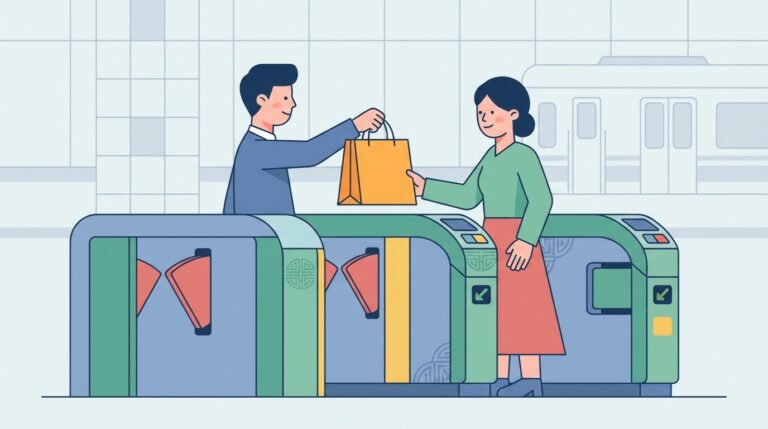
3. 개찰구 너머로 주실 수 있나요?
- Pronunciation: gaechalgu neomeoro jusil su innayo? [gae-chal-goo neo-meo-ro…]
- Meaning: Literal = Can you give it over the ticket gate? / Real nuance = Can we trade over the turnstile so I don’t have to tap my card and pay the fare?
- K-Culture Moment: You took the subway to meet the seller, but you want to go right back home. Instead of tapping out (which costs money), Koreans often do the “Turnstile Trade.” It’s totally legal and very common!
- Editor’s Insight: “개찰구” (turnstile/ticket gate) is a word you rarely learn in textbooks but absolutely need in real life.
- Situation Spectrum:
- Casual: ✅
- Semi-formal: ✅
- Formal: ⚠️ (Polite, but slightly informal to ask an elder to walk to the gate)
- 🤔 Think About It: Does your local transit system allow people to interact over the barrier without paying?
Phase 3: Textbook vs. Real Korean
[Confirming identities at the meeting spot]
* 📖 Textbook Korean: 중고 거래하러 오신 분이신가요? (Are you the person who came for the second-hand trade?)
* 🗣️ Real Korean: 당근이세요? (Are you Danggeun?)
* 💡 Why the difference?: Brand dominance! Just like saying “Google it” instead of “Search for it on the internet.”
[Saying you have arrived]
* 📖 Textbook Korean: 저는 지하철 역에 도착했습니다. (I have arrived at the subway station.)
* 🗣️ Real Korean: 저 도착이요! / 개찰구 앞이에요. (I’m an arrival! / I’m at the turnstile.)
* 💡 Why the difference?: Koreans drop verbs heavily in text messages for speed. Adding “이요/요” to a noun makes it instantly polite but quick.
[Sending the money]
* 📖 Textbook Korean: 은행 계좌로 돈을 보내겠습니다. (I will send the money to your bank account.)
* 🗣️ Real Korean: 계좌이체 해드릴게요. / 토스 되세요? (I’ll do an account transfer. / Do you take Toss?)
* 💡 Why the difference?: Korea is a nearly cashless society. Mobile banking apps (like Toss or KakaoPay) are the standard for personal transactions.
Bottom Note: For B1 (Intermediate) learners, using “도착이요!” instead of full sentences makes you sound incredibly fluent and natural over text!
Phase 4: Cultural Context — K-Culture Deep Dive
4-1. Non-verbal Communication: The “Danggeun Nod”
When you meet for a trade, do not go in for a handshake or a hug! The standard protocol is a slight bow of the head (the “Danggeun Nod”), handing over the item with two hands (or one hand supporting your other arm), and quickly parting ways. It relies heavily on Nunchi (눈치)—reading the room. If the other person looks like they are in a hurry, don’t try to make small talk.
4-2. The “Cool-Trade” (쿨거래) Culture
In K-Dramas, characters might sit at a cafe and chat. In real Korean second-hand trading, the ideal scenario is a “Cool-georae” (쿨거래). It means a “cool trade”—fast, no haggling at the scene, exact change or instant transfer, and a quick “Thank you.”
Critical View: While Koreans are known for “Jeong” (warmth and connection), in the modern digital age, efficiency and respecting personal boundaries often take priority over making a new friend.
Phase 5: Interactive Roleplay Scenario
Setting: Friday 6 PM, Hongdae Station. You are inside the station near the ticket gates (개찰구). You are buying a limited-edition K-Pop photocard from a seller named Minji.
Characters:
– YOU: An expat hunting for K-Pop merch.
– Minji (20s): A fast-walking, efficient university student holding a small envelope.
Dialogue:
(On the app message)
YOU: 저 지금 2번 출구 개찰구 안쪽이에요! 😊
(jeo jigeum i-beon chulgu gaechalgu anjjogieyo!)
[I am inside the turnstile at Exit 2 right now!]
Minji: 앗 네! 저 노란색 패딩 입고 있어요. 가고 있습니다!
(at ne! jeo noransaek paeding ipgo isseoyo. gago itseumnida!)
[Ah yes! I am wearing a yellow puffer jacket. I’m on my way!]
(In person at the turnstile)
YOU: 🥺 (Approaching the yellow jacket) 혹시… 당근이세요?
(hoksi… danggeun-iseyo?)
[By any chance… are you Danggeun?]
Minji: 아 네! 포카(포토카드) 맞으시죠? 상태 확인해 보세요.
(a ne! poka majeushijyo? sangtae hwaginhae boseyo.)
[Ah yes! You are here for the photocard, right? Please check the condition.]
(🎭 Stage Direction: Minji hands you the envelope over the turnstile. You check it.)
YOU: 네, 너무 좋아요! 감사합니다.
(ne, neomu joayo! gamsahamnida.)
[Yes, it’s great! Thank you.]
🔀 Your Turn! How should you pay?
– A) Hand her a 50,000 won bill for a 5,000 won item and wait for change.
– B) “잠시만요, 깎아주시면 안 돼요?” (Wait, can you give me a discount?)
– C) “계좌번호 알려주세요. 바로 이체할게요!” (Please tell me your account number. I’ll transfer it right now!)✅ Best Choice: C. It’s fast, cashless, and polite.
⚠️ Choice B Analysis: Asking for a discount (네고 – Nego) at the meeting spot without discussing it on the app beforehand is considered extremely rude in Korea!
Phase 6: 10-Second Shadowing Drill
Practice these lines with the right rhythm! (Slash / means a short pause).
- 🥺 Cautiously: 혹시 / 당근… / 이세요? (hoksi / danggeun… / iseyo?)
- 📱 Texting vibe: 저 지금 / 개찰구 쪽에 / 있어요. (jeo jigeum / gaechalgu jjoge / isseoyo.)
- 😊 Brightly: 계좌번호 / 알려주세요! / 바로 이체할게요. (gyejwabeonho / allyeojuseyo! / baro ichehalgeyo.)
Phase 7: K-Culture Mini Dictionary
| Korean | Romanization | English | Context |
|---|---|---|---|
| 쿨거래 | kul-georae | Cool trade | A fast, hassle-free transaction with no haggling. The highest compliment as a buyer! |
| 네고 | ne-go | Negotiation | Short for negotiation. Often seen on listings as “네고 불가” (No haggling allowed). |
| 잠수 | jam-su | Ghosting | Lit: “Diving.” When a buyer/seller stops responding or doesn’t show up. |
| 포카 | po-ka | Photocard | Highly traded K-Pop merchandise on these apps. |
| 개찰구 | gaechalgu | Turnstile/Ticket gate | The physical barrier at subway stations where you tap your card. |
Phase 8: Traveler Survival Kit
Even if you aren’t trading second-hand goods, knowing subway station geography is crucial for traveling in Korea.
🆘 Survival Expressions for the Subway
– 🇰🇷 “N번 출구가 어디예요?” (N-beon chulguga eodiyeyo?)
– 🗣️ English: Where is Exit N?
– 📍 Where to use: Inside massive stations like Seoul Station or Hongdae.
– 💡 Pro Tip: Koreans navigate entirely by exit numbers. Never say “Let’s meet at Gangnam Station.” Say “Let’s meet in front of Gangnam Station Exit 11.”📌 Editor’s Travel Note
– Useful Apps: KakaoMetro and Naver Map will show you exactly which subway car door (e.g., 3-1) to stand at for the fastest transfer to your exit!
– Turnstile Trouble: If you accidentally enter the wrong gate, press the “Help” (호출) button at the turnstile or simply tap your card again on the opposite side within 15 minutes (in Seoul) to cross over for free.
Phase 9: Critical Thinking — “One Step Deeper”
Trust & Society (Language & Power)
Why is second-hand trading so successful in Korea? It comes down to Korea being a “High-Trust Society.” It is very common for buyers to wire money before even receiving the item, or for sellers to leave the item in a public mailbox (비대면 거래 – non-face-to-face trade) trusting the buyer to pick it up and wire the funds. The language used reflects this trust—using polite forms (존댓말) instantly establishes a social contract between strangers. The physical safety of well-lit subway stations also plays a huge role in making these meetups feel secure for everyone.
💬 Your Turn: Does your culture have a high level of trust when trading with strangers online? How do you ensure safety? Share your thoughts in the comments!
Phase 10: FAQ & Avoiding Mistakes
Q: Do I need to speak formally to the seller if they look younger than me?
Yes! Always use “요/습니다” (polite form) during transactions, regardless of age. You are strangers conducting business. Dropping honorifics (반말) is a huge red flag.
Q: What if I don’t have a Korean bank account for transfers?
Cash is still accepted! Just make sure to bring exact change. It’s polite to mention on the app beforehand: “제가 현금으로 드려도 될까요?” (May I give it to you in cash?)
❌ Common Mistake #1: Trying to make small talk. Do not ask personal questions like “Why are you selling this?” Unless they offer the information, “Hello” and “Thank you” are all you need.
❌ Common Mistake #2: Tapping out of the turnstile when the seller is waiting inside the station. Always clarify: “개찰구 안이세요, 밖이세요?” (Are you inside or outside the ticket gate?)
Phase 11: Summary & Action Items
- One-Liner Summary: Find your trade quickly by asking “당근이세요?” and smoothly navigate the subway gates with “개찰구 너머로 주실 수 있나요?”
Your Action Missions:
– 🥉 Bronze (Solo): Say “저 지금 개찰구 쪽에 있어요” out loud 3 times pretending to text someone.
– 🥈 Silver (Online): Find a Korean subway map online. Locate an exit (출구) and a turnstile (개찰구) in your mind.
– 🥇 Gold (Real-world): Next time you meet a Korean friend at a subway station, text them: “저 도착이요! 00번 출구 앞이에요!”
K-Culture Mission:
Download a Korean map app (Naver Map) and use the street view to look inside a major station like Gangnam. Try to spot the “개찰구”!
Phase 12: Interactive Quiz
1. Situational Judgment:
You arrive at the station to buy a used book. The seller approaches. What is the most natural thing to say?
– A) 중고 거래하러 오신 분이신가요?
– B) 혹시 당근이세요?
– C) 책 파는 사람입니까?
(Answer: B. It’s the most natural, native-like expression!)
2. Fill in the Blank:
You want the seller to hand the item over the subway barrier so you don’t pay.
“( ____ ) 너머로 주실 수 있나요?”
(Answer: 개찰구 – gaechalgu)
3. True or False – K-Culture Edition:
“It is highly recommended to haggle (Nego) for a lower price when you meet the seller face-to-face in Korea.”
(Answer: False. Haggling should only be done via the app beforehand. On-site haggling is considered bad manners!)
Frequently Asked Questions (FAQ)
Q: What does "당근이세요?" mean in Korean and how do you pronounce it?
A: In Korean, "당근이세요?" is pronounced [danggeun-iseyo? [Sounds like: dang-goon ee-se-yo?] and means: Literal = Are you a carrot? / Real nuance = Are you the buyer/seller from the Karrot app?
Q: What does "저 지금 N번 출구 앞이에요." mean in Korean and how do you pronounce it?
A: In Korean, "저 지금 N번 출구 앞이에요." is pronounced [jeo jigeum [Number] and means: Literal = I am in front of exit number N right now. / Real nuance = I've arrived at our meeting spot.
Q: What does "개찰구 너머로 주실 수 있나요?" mean in Korean and how do you pronounce it?
A: In Korean, "개찰구 너머로 주실 수 있나요?" is pronounced [gaechalgu neomeoro jusil su innayo? [gae-chal-goo neo-meo-ro...] and means: Literal = Can you give it over the ticket gate? / Real nuance = Can we trade over the turnstile so I don't have to tap my card and pay the fare?







