

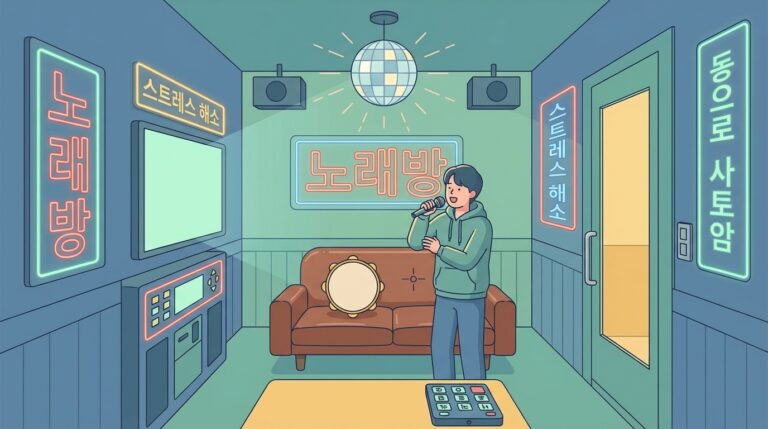
Phase 1: Empathy & Immersion (Welcome to the Neon Room)
Hello! I’m your Daily Hangul Editor.
Picture this: You are watching a K-Drama. The main character just had a terrible day at work, or maybe they just got their heart broken. Instead of going home to cry into a pillow, where do they end up? A small, neon-lit, soundproof room with a spinning disco ball. They have a microphone in one hand, a tambourine in the other, and they are screaming the lyrics to a 90s tragic ballad or a hype K-Pop track.
Welcome to Noraebang (노래방)—the ultimate Korean sanctuary for stress relief.
For Koreans, Noraebang isn’t just about showing off your vocal skills. It’s a culturally sanctioned space to let loose, scream out your frustrations (소리 지르기), and bond with your friends or coworkers. But what happens when you’re actually invited to one? The fast-paced song reservations, the sudden tambourine shaking, the confusing remote control… it can be overwhelming!
Don’t worry. This guide is crafted from real questions my expat students have asked after surviving their first Korean Hoesik (company dinner) Noraebang experience. By the end of this, you won’t just survive; you’ll be the star of the night.
Phase 2: Deep Dive into Key Expressions
Here are the absolute must-know phrases for B2 learners to navigate the Noraebang like a local.
1. 스트레스 확 풀려요 (My stress is completely blown away)
- Pronunciation: seuteureseu hwak pullyeoyo [seu-teu-re-seu hwak pool-lyeo-yo]
(Tip: ‘hwak’ sounds like a sharp, dramatic exhale you make when you’re surprised or relieved.)- Meaning: Literal: My stress is untangled entirely. / Real nuance: That totally relieved my stress!
- K-Culture Moment: You’ve just finished screaming a high-energy BTS or BLACKPINK song. You drop onto the leather sofa, out of breath, and say this to your friends.
- Editor’s Insight: The word ‘확’ is a Korean onomatopoeia/mimetic word that means ‘suddenly and completely.’ Adding it makes your Korean sound incredibly natural and expressive.
- Situation Spectrum:
- Friends (Casual): ✅ (Use: 스트레스 확 풀린다!)
- Coworkers (Semi-formal): ✅
- Boss/Elders (Formal): ⚠️ (A bit too expressive, but okay if the mood is good)
- 🤔 Think About It: Why does the Korean language use the verb ‘풀다’ (to untangle/untie) for stress? Does your native language view stress as a knot to be untangled, or a weight to be dropped?
2. 분위기 좀 띄워볼까요? (Shall we liven up the mood?)
- Pronunciation: bunwigi jom ttiwobolkkayo? [boon-wee-gee jom ttee-wo-bol-kka-yo?]
(Tip: ‘띄’ is tricky! Say ‘ttee’ quickly while smiling.)- Meaning: Literal: Shall we float the mood? / Real nuance: Let’s hype this place up!
- K-Culture Moment: The first three songs were sad breakup ballads, and the room is getting a bit sleepy. You grab the mic and announce this before queuing up a famous Trot song or a club banger.
- Editor’s Insight: ‘분위기를 띄우다’ is an essential B2 verb phrase. Koreans value the collective ‘mood’ (분위기) of a room immensely. Being the person who can ‘lift’ it makes you a highly valued guest.
- Situation Spectrum:
- Friends (Casual): ✅ (Use: 분위기 좀 띄워볼까?)
- Coworkers (Semi-formal): ✅
- Boss/Elders (Formal): ✅ (Very proactive and loved by bosses!)
- 🤔 Think About It: Notice how Koreans “float” the mood rather than “break the ice.” It reflects a culture where social harmony is a shared atmosphere that everyone actively maintains.
3. 삑사리 났어요 (My voice cracked)
- Pronunciation: ppiksari nasseoyo [bbik-sa-ree na-sseo-yo]
(Tip: Make the ‘pp’ sound explosive, like you’re popping a balloon.)- Meaning: Literal/Real nuance: My voice cracked! (Slang)
- K-Culture Moment: You try to hit the legendary “3-octave high note” of IU’s Good Day, but instead, a squeak comes out. Everyone laughs, and you jokingly use this phrase to defend yourself.
- Editor’s Insight: This is a very common, lighthearted slang term used exclusively for voice cracks. It instantly shows you understand casual, real-life Korean culture.
- Situation Spectrum:
- Friends (Casual): ✅
- Coworkers (Semi-formal): ⚠️ (Okay if you’re close)
- Boss/Elders (Formal): 🚫 (Too informal)
- 🤔 Think About It: Slang often develops around shared cultural activities. Since singing together is so common in Korea, naturally, there’s a specific, funny word just for voice cracks!
Phase 3: Textbook vs. Real Korean
Let’s upgrade your textbook Korean to “Hongdae Street-Smart” Korean.
[Situation 1: Reserving a song]
* 📖 Textbook Korean: 제가 노래를 예약하겠습니다. (I will reserve a song.)
* 🗣️ Real Korean: 나 한 곡 예약할게! 번호 좀 눌러줘. (I’m gonna queue a song! Punch in the number for me.)
* 💡 Why the difference?: Noraebang is fast-paced. People use the remote control (리모컨) constantly. Asking someone near the remote to “punch in the number” (번호 누르다) is pure teamwork.
[Situation 2: Getting extra time]
* 📖 Textbook Korean: 시간을 연장해 주세요. (Please extend the time.)
* 🗣️ Real Korean: 사장님, 서비스(Service) 많이 주실 거죠? (Boss, you’ll give us a lot of ‘service’ right?)
* 💡 Why the difference?: In Korea, “Service” means complimentary freebies. In Noraebang, owners generously add 15-30 minutes of free time to your room if you ask nicely (or even if you don’t)!
Bottom Note: At the B2 level, transitioning from direct translations to culturally loaded words like ‘서비스’ is what makes you sound fluent!
Phase 4: Cultural Context — K-Culture Deep Dive
4-1. The Non-Verbal Art of Nunchi (눈치) in Noraebang
Language isn’t enough; you need body language. If you’re at a Hoesik (company dinner) and your boss starts singing, you do not look at your phone. You pick up the tambourine (탬버린) and shake it to the beat. If you don’t know the song, just clap and cheer. That is the essence of Nunchi—reading the room and contributing to the shared energy.
4-2. The K-Drama Trope: The “Tearful Ballad vs. Hype Dance” Switch
Have you noticed in K-Dramas that the Noraebang scene always has two phases?
First, the heartbroken character sings a tear-jerking 90s ballad, crying into the mic. Suddenly, their best friend cancels the song, aggressively presses buttons on the giant remote, and puts on an upbeat dance track, forcing them to jump on the sofa.
Critical View: While jumping on sofas is fun in dramas, in real life, owners might scold you for damaging the furniture! Keep the hype on the floor.
Phase 5: Interactive Roleplay Scenario
Setting: Friday night, 10 PM. You and your Korean coworkers just finished eating greasy Samgyeopsal (pork belly) in Gangnam. You are stuffed, but the night is young.
Characters:
– YOU: An expat working in Seoul, nervous but excited.
– Minji (30): Your friendly and energetic coworker who loves K-Pop.
Dialogue:
Minji: 삼겹살 먹었으니까 이제 소화시키러 가야죠? 노래방 콜? 🎤
(samgyeopsal meogeosseunikka ije sohasikireo gayajyo? noraebang kol?)
[We ate pork belly, so we need to go digest it, right? Noraebang, deal?]
(🎭 Minji points toward a glowing neon sign across the street.)
YOU: 콜! 근데 저 노래 잘 못 불러요.
(kol! geunde jeo norae jal mot bulleoyo.)
[Deal! But I’m not really good at singing.]
Minji: 에이, 괜찮아요! 그냥 스트레스 풀러 가는 거예요. 가시죠!
(ei, gwaenchanayo! geunyang seuteureseu pulleo ganeun geoeyo. gasijyo!)
[Hey, it’s fine! We’re just going to relieve stress. Let’s go!]
(🎭 You enter a room with flashing disco lights. Minji grabs the giant remote.)
Minji: 자, 뭐 부를래요? 제가 예약해 드릴게요.
(ja, mwo bureullaeyo? jaega yeyakha드릴게요.)
[Alright, what do you want to sing? I’ll queue it for you.]
YOU: 음… 한국 노래 아는 게 별로 없는데…
(eum… hanguk norae aneun ge byeollo eomneunde…)
[Hmm… I don’t know many Korean songs…]
Minji: 팝송도 다 있어요! 분위기 띄우는 신나는 걸로 갈까요?
(papsongdo da isseoyo! bunwigi ttiuneun sinnaneun geollo galkkayo?)
[They have pop songs too! Shall we go with something exciting to hype the mood?]
🔀 Your Turn! How do you respond?
– A) “아니요, 저는 아주 슬픈 발라드를 부를게요.” (No, I will sing a very sad ballad.)
– B) “좋아요! 다 같이 부를 수 있는 방탄소년단 노래 어때요?” (Sounds good! How about a BTS song we can all sing together?)
– C) “저 그냥 구경만 할게요.” (I’ll just watch.)✅ Best Choice: B — Perfect Nunchi! Picking a famous K-Pop song that everyone knows is the ultimate way to “분위기를 띄우다” (liven up the mood).
⚠️ Choice C Analysis: While it’s okay to pass occasionally, saying you’ll only watch right at the beginning might kill the mood. In Korea, participating, even if you just shake the tambourine, is highly appreciated!
Minji: 오, 대박! 센스 만점이네요. 번호 누릅니다~ 시작!
(o, daebak! senseu manjeomineyo. beonho nureumnida~ sijak!)
[Oh, awesome! You have great sense. Pressing the numbers~ Start!]
(🎭 Suddenly, the screen shows “Service: 30 Minutes Added”)
YOU: 어? 시간 끝났는데 왜 계속 노래가 나와요?
(eo? sigan kkeunnanneunde wae gyesok noraega nawayo?)
[Huh? The time is up, but why is the music still playing?]
Minji: 아, 사장님이 서비스 주셨네요! 우리 오늘 밤새야겠는데요? 😂
(a, sajangnimi seobiseu jusyeonneyo! uri oneul bamsaeyagenneundeyo?)
[Ah, the owner gave us ‘Service’! Looks like we’ll have to stay up all night!]
🎬 Bonus K-Culture Scenario: The Coin Noraebang (코노)
You are alone and just want to sing two songs. You go to a ‘Coin Noraebang’ (코노).
– Machine: 천 원에 세 곡입니다. (1,000 won for three songs.)
– YOU: (Inserting a 1,000 won bill) 오, 진짜 싸다! 혼자 스트레스 풀기 딱이네.
(o, jinjja ssada! honja seuteureseu pulgi ttagine.)
[Wow, really cheap! Perfect for relieving stress alone.]
Phase 6: 10-Second Shadowing Drill
Read this out loud. Pay attention to the pauses (/) and the emotion tags!
😊 밝고 신나게 (Bright & Excited):
우리 / 분위기 좀 / 띄워볼까요?! / 신나는 노래 / 예약해 주세요!
(uri / bunwigi jom / ttiwobolkkayo?! / sinnaneun norae / yeyakhae juseyo!)🥺 아쉽지만 웃기게 (Regretful but funny):
아… / 저 방금 / 완전 / 삑사리 났어요. / 부끄럽다…
(a… / jeo banggeum / wanjeon / ppiksari nasseoyo. / bukkeureopda…)
Phase 7: K-Culture Mini Dictionary
| 한국어 | Romanization | English | Context |
|---|---|---|---|
| 코노 | kono | Coin Noraebang | Short for 코인 노래방. A tiny booth where you pay per song (or time). Huge among Gen Z! |
| 떼창 | ttechang | Sing-along / Fan-chant | When the whole crowd sings the chorus together. Essential K-Pop concert culture. |
| 탬버린 | taembeorin | Tambourine | The holy weapon of Noraebang. Used by those not singing to keep the mood up. |
| 1절만 해 | iljeolman hae | Stop at verse 1 | Slang: “Don’t drag it out” or “Stop nagging.” (Origin: Noraebang etiquette where singing a long, boring song fully is a faux pas!) |
Phase 8: Traveler Survival Kit
Visiting Korea soon? You MUST try a Coin Noraebang. Here are your survival phrases.
🆘 Survival Phrases for Noraebang
– 🇰🇷 “지폐 교환기 어디 있어요?” (jipye gyohwangi eodi isseoyo?)
– 🗣️ Meaning: Where is the bill exchange machine?
– 📍 Used at: Unmanned Coin Noraebangs (to get 1,000 won bills).
- 🇰🇷 “인기 차트 어떻게 봐요?” (ingi chateu eotteoke bwayo?)
- 🗣️ Meaning: How do I see the popular charts?
- 📍 Used at: Figuring out the remote control.
📌 Editor’s Travel Note
– Remote Control Hack: Look for the green button (시작 – Start) and the red button (취소 – Cancel). To queue a song, press the song number, then 예약 (Reserve), NOT Start! Pressing Start will abruptly cut off the current singer!
– Solo Friendly: Korean Coin Noraebangs are perfectly designed for solo travelers. Nobody will judge you for going alone.
Phase 9: Critical Thinking Corner — “A Step Deeper”
🧠 Think Deeper: Collective Stress Relief in a High-Pressure Society
Korea is known for its intense work and academic culture (빨리빨리 – hurry hurry). In such a hierarchical and high-pressure society, Noraebang serves as a vital societal pressure valve. Inside that neon room, hierarchy temporarily blurs. A junior employee can scream a rock song in front of their strict manager, and it’s perfectly acceptable. It reveals how Korean culture handles stress not just individually, but collectively. The act of suffering together during the day is resolved by singing and drinking together at night.
💬 Your Turn: Does your culture have a specific physical space or activity where social hierarchies are temporarily ignored for the sake of stress relief? Share it in the comments!
Phase 10: FAQ & Avoiding Common Mistakes
Q: “Is it rude if I don’t sing at a Hoesik (company dinner) Noraebang?”
A: Yes and no. You don’t have to be Beyonce. If you’re shy, simply pick a highly recognizable, easy song, or just shake the tambourine enthusiastically. The effort matters more than the vocal talent.
Q: “Can I sing English pop songs?”
A: Absolutely! The machines have thousands of pop songs. However, singing a 6-minute, slow indie song might kill the mood. Know your audience!
❌ Common Mistake #1: Pressing ‘시작’ (Start) instead of ‘예약’ (Reserve) on the remote. This will instantly cancel whoever is currently singing and start your song. It is the ultimate Noraebang crime! Always press 예약.
❌ Common Mistake #2: Refusing the mic too many times. Koreans will offer you the mic out of politeness. Declining once is humble; declining five times makes things awkward. Just embrace the 삑사리 (voice crack)!
Phase 11: Summary & Action Items
- One-Liner Summary: Noraebang isn’t about perfect pitch; it’s about untangling your stress (스트레스 확 풀다) and floating the mood (분위기 띄우다) together!
-
Action Mission:
- 🥉 Bronze: Say “스트레스 확 풀린다!” out loud while stretching your arms right now.
- 🥈 Silver: Search “Korean Noraebang remote” on Google Images and try to spot the 예약 (Reserve) and 취소 (Cancel) buttons.
- 🥇 Gold: Next time you go to Karaoke with friends, teach them the word “삑사리” when someone’s voice cracks!
- K-Culture Mission: Watch an episode of Hospital Playlist or Business Proposal and pay attention to the Noraebang scenes. Notice who holds the tambourine and how they react when the ‘Service’ time pops up!
Phase 12: Quiz — Interactive Challenge
1. You want to make the room more energetic. What should you say?
A) 스트레스 확 풀려요.
B) 분위기 좀 띄워볼까요?
C) 삑사리 났어요.
(Answer: B. ‘A’ is used AFTER the fun, and ‘C’ is for voice cracks.)
2. Fill in the blank:
“아싸! 사장님이 _______ 30분 주셨다!” (Yay! The owner gave us 30 minutes of _______!)
(Answer: 서비스 / Service – free extra time!)
3. True or False: In a Korean Noraebang, if you want to queue a song while someone is singing, you type the number and press ‘시작’ (Start).
(Answer: FALSE! Pressing Start will cut off the current singer. You must press ‘예약’ / Reserve!)
Frequently Asked Questions (FAQ)
Q: What does "스트레스 확 풀려요 (My stress is completely blown away)" mean in Korean and how do you pronounce it?
A: In Korean, "스트레스 확 풀려요 (My stress is completely blown away)" is pronounced [seuteureseu hwak pullyeoyo [seu-teu-re-seu hwak pool-lyeo-yo] and means: Literal: My stress is untangled entirely. / Real nuance: That totally relieved my stress!
Q: What does "분위기 좀 띄워볼까요? (Shall we liven up the mood?)" mean in Korean and how do you pronounce it?
A: In Korean, "분위기 좀 띄워볼까요? (Shall we liven up the mood?)" is pronounced [bunwigi jom ttiwobolkkayo? [boon-wee-gee jom ttee-wo-bol-kka-yo?] and means: Literal: Shall we float the mood? / Real nuance: Let's hype this place up!
Q: What does "삑사리 났어요 (My voice cracked)" mean in Korean and how do you pronounce it?
A: In Korean, "삑사리 났어요 (My voice cracked)" is pronounced [ppiksari nasseoyo [bbik-sa-ree na-sseo-yo] and means: Literal/Real nuance: My voice cracked! (Slang)







