

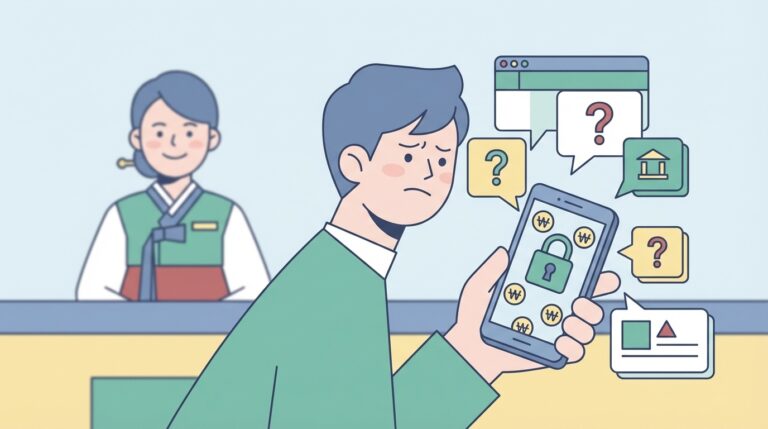
Phase 1: The Cold Open – Welcome to the “Final Boss” of Korea
Hello! I’m the Senior Editor at Daily Hangul, your personal veteran tutor and cultural navigator.
Picture this: It’s 7:59 PM. You are sitting in front of your laptop, heart pounding. Tickets for your favorite K-Pop idol’s concert open at exactly 8:00 PM. You click “Buy,” select the perfect VIP seat, and proceed to checkout. Victory is yours! But then… a gray pop-up appears: “Please verify your identity with a Joint Certificate (공동인증서). Please install AhnLab Safe Transaction.” Panic sets in. By the time you download the security programs and find your passwords, the tickets are gone.
If you’ve lived in Korea for more than a month, you know this pain. While K-Dramas show chaebol CEOs casually transferring billions of won with a single tap, the reality of Korean internet banking is a rite of passage for every expat.
Today, we are tackling the B2-level “Final Boss” of living in Korea: Banking & Finance, specifically Internet Banking and Certificates. Knowing these expressions won’t just save you from headaches; it will earn you the ultimate insider respect at your local bank branch. Let’s dive in!
Phase 2: Deep Dive into Core Expressions
Here are the top three expressions you absolutely need when your internet banking app locks you out.
1. 공동인증서 발급받으려고요. (I’d like to get a joint certificate issued.)
- Pronunciation: gong-dong-in-jeung-seo bal-geup-ba-deu-ryeo-go-yo. [Think of ‘gong-dong’ like a ringing gong, and ‘bal-geup’ sounds like a tiny hiccup at the end.]
- Meaning: Literal: “I intend to receive issuance of a joint certificate.” / Real Nuance: “Please help me set up my digital certificate so I can survive online.”
- K-Culture Moment: You’ll use this at the bank counter after waiting 40 minutes. The bank teller will sigh empathetically, knowing the complex process ahead for a foreigner.
- Editor’s Insight: Notice we use 발급받다 (to be issued) instead of just 만들다 (to make). In Korean bureaucracy, official documents or cards aren’t “made” by you; they are “issued” to you by an authority.
- Situation Spectrum:
- Bank Teller (Formal/Polite): ✅
- Friends (Casual): ⚠️ (You’d say “나 인증서 발급받아야 돼”)
- 🤔 Think About It: Why does Korea rely so heavily on these complex digital certificates instead of just email and passwords? What does this say about the culture’s approach to security and trust?
2. 이체 한도를 늘리고 싶어요. (I want to increase my transfer limit.)
- Pronunciation: i-che han-do-reul neul-li-go si-peo-yo.
- Meaning: “I want to increase my daily/per-transaction transfer limit.”
- K-Culture Moment: You finally got your first paycheck! You try to send money home to pay rent, but the app says you can only transfer 300,000 KRW. Welcome to the “Financial Fraud Prevention Account” (금융거래 한도제한 계좌).
- Editor’s Insight: New accounts for expats are strictly limited to prevent voice phishing. To “increase the limit” (한도를 늘리다/해제하다), you need proof of employment. Saying this phrase smoothly shows the teller you mean business.
- Situation Spectrum:
- Bank Teller (Formal/Polite): ✅
3. 비밀번호 오류 횟수를 초과했어요. (I exceeded the password error limit.)
- Pronunciation: bi-mil-beon-ho o-ryu hoe-ssu-reul cho-gwa-hae-sseo-yo.
- Meaning: “I messed up my password too many times and got locked out.”
- K-Culture Moment: The classic tragedy. You tried your pet’s name, your birthday, and “123456”. After 5 failed attempts, the app mercilessly tells you to visit a physical bank branch.
- Editor’s Insight: 초과하다 (to exceed) is a great B2-level word. It sounds much more natural and mature than saying “비밀번호 많이 틀렸어요 (I got the password wrong a lot).”
- Situation Spectrum:
- Bank Teller (Formal/Polite): ✅
Phase 3: Textbook vs. Real Korean
How do real Koreans talk about money transfers in daily life?
[Situation 1: Sending money to a friend]
* 📖 Textbook Korean: 제 계좌에서 돈을 송금하겠습니다. (I will remit money from my account.)
* 🗣️ Real Korean: 카카오페이로 보낼게! (I’ll send it via KakaoPay!) or 계좌 이체할게. (I’ll do an account transfer.)
* 💡 Why the difference?: “송금” (remittance) is a formal, Sino-Korean word. Young Koreans prefer the English loanword “Pay” or the simpler verb “보내다” (to send) thanks to the rise of Fintech apps.
[Situation 2: Splitting the bill after a K-BBQ dinner]
* 📖 Textbook Korean: 각자 낸 돈을 나누어서 냅시다. (Let us divide the money we each spent and pay.)
* 🗣️ Real Korean: N빵 하자! (Let’s split it N-ways!) / 정산해 줘. (Settle the bill for me.)
* 💡 Why the difference?: “N빵” (N-bbang) comes from the math variable ‘N’ and ‘빵’ (slang for splitting). It perfectly captures Korea’s fast-paced “Palli-Palli” culture—one person pays the whole bill, and everyone instantly transfers their share.
Bottom Note: At a B2 level, using “N빵 하자” with friends makes you sound incredibly fluent. But stick to “나눠서 낼게요 (We will pay separately)” when talking to the restaurant staff!
Phase 4: K-Culture Deep Dive
4-1. The Non-Verbal “Nunchi” at the Bank
When you enter a Korean bank, do not walk straight to the teller! The golden rule of bank Nunchi is finding the 번호표 기계 (Number Ticket Machine). Grab a ticket first, sit down, and wait for the “Ding!” When handing your ARC (Alien Registration Card) to the teller, always use two hands—or at least support your right elbow with your left hand. It’s a subtle sign of respect that changes the entire atmosphere of your interaction.
4-2. The K-Drama Illusion vs. Reality
Have you noticed in K-Dramas like Vincenzo or Crash Landing on You, characters casually transfer billions of won using a sleek black card or a single fingerprint?
The Reality: In actual Korea, transferring large sums requires a labyrinth of security: a Joint Certificate, an OTP (One-Time Password) generator device, ARS phone verification, and sometimes a selfie with your ID!
Critical View: Media portrays Korea as a frictionless cyber-utopia. While everyday payments (like Toss or KakaoPay) are incredibly fast, institutional banking is heavily fortified due to historical cybersecurity laws.
Phase 5: Real-Life Roleplay Scenario
Setting: A brightly lit, bustling bank branch in Gangnam. It’s 3:00 PM, and the bank closes at 4:00 PM. You’ve just taken a half-day off work to fix your locked banking app.
Characters:
– YOU: An expat who just wants to order delivery food tonight but got locked out of the app.
– Jimin (지민): The polite but fast-speaking bank teller.
Dialogue:
지민: 34번 고객님, 이쪽으로 오세요. 어떻게 오셨어요?
(34-beon gogaengnim, i-jjogeuro o-se-yo. Eotteoke o-syeo-sseo-yo?)
[Customer number 34, please come this way. How can I help you?]
(🎭 Stage Direction: Jimin smiles warmly but types aggressively fast on her keyboard.)
YOU: 안녕하세요, 인터넷 뱅킹 비밀번호 오류 횟수를 초과해서요.
(Annyeonghaseyo, inteonet baengking bi-mil-beon-ho o-ryu hoe-ssu-reul cho-gwa-hae-seo-yo.)
[Hello, I exceeded the password error limit for my internet banking.]
지민: 아, 네. 신분증 먼저 주시겠어요?
(Ah, ne. Sin-bun-jeung meon-jeo ju-si-ge-sseo-yo?)
[Ah, I see. Could you give me your ID first?]
YOU: 네, 여기 외국인 등록증이요.
(Ne, yeo-gi oe-gu-gin deung-nok-jjeung-i-yo.)
[Yes, here is my Alien Registration Card.]
지민: 고객님, 혹시 스마트폰에 은행 어플 깔려 있으신가요?
(Gogaengnim, hok-si seu-ma-teu-pon-e eu-naeng eo-peul kkal-lyeo i-sseu-sin-ga-yo?)
[Customer, by any chance do you have the bank app installed on your smartphone?]
🔀 Your Turn! How do you respond?
– A) “네, 깔려 있어요. 여기요!” (Yes, it’s installed. Here!)
– B) “아니요. 대신 깔아주실 수 있나요?” (No. Can you install it for me?)
– C) “어플 너무 복잡해요. 짜증 나요!” (The app is too complicated. It’s annoying!)✅ Best Choice: A — Reason: Handing over your phone with the app open is the ultimate “Nunchi” move. It saves everyone time.
⚠️ Choice B Analysis: Tellers are helpful, but B2 learners should try to navigate the app themselves! Plus, handing your unlocked phone to a stranger is a security risk.
🚫 Choice C Analysis: Venting your frustration at the teller is a major cultural faux pas. They didn’t design the app!
Phase 6: 10-Second Shadowing Drill
Let’s practice the tone! You are a bit frustrated, but polite. Follow the slashes for pauses and emphasis.
🥺 저기요, / 비밀번호를 잊어버려서 / 로그인이 / 안 돼요.
(jeo-gi-yo, / bi-mil-beon-ho-reul i-jeo-beo-ryeo-seo / ro-geu-in-i / an dwae-yo.)
[Excuse me, / I forgot my password / so I can’t / log in.]
Pro-tip: Stretch out the “안~~~ 돼요” slightly to sound genuinely distressed. The teller will want to help you faster!
Phase 7: K-Culture Mini Dictionary
| 한국어 | Romanization | English | Context |
|---|---|---|---|
| 공동인증서 | gongdong injeungseo | Joint Certificate | Formerly ‘Public Certificate’. The digital file required to prove your identity online. |
| 보안카드 | boankadeu | Security Card | A plastic card with grid numbers used to verify bank transfers. Slowly being replaced by mobile OTPs. |
| 한도 제한 | hando jehan | Limit Restriction | A security measure limiting daily transfers, notoriously hard for expats to lift without a job contract. |
| N빵 | N-bbang | Splitting the bill | The modern cultural norm among young Koreans for splitting costs instantly via mobile apps. |
| 더치페이 | deochipei | Dutch Pay | Another common term for splitting the bill, though N빵 implies absolute equal division. |
Phase 8: Traveler’s Survival Kit
Even if you’re just visiting Korea for a week, you’ll encounter the digital payment wall, especially at traditional markets or underground shopping malls where they prefer cash or account transfers.
🆘 Survival Expressions for Payments
– 🇰🇷 “계좌 이체 할게요. 은행이랑 계좌번호 알려주세요.”
– 🗣️ (Gye-jwa i-che hal-ge-yo. Eu-naeng-i-rang gye-jwa-beon-ho al-lyeo-ju-se-yo.)
– 🇬🇧 “I’ll do an account transfer. Please tell me the bank and account number.”
– 📍 Where to use: Dongdaemun market, street food stalls, small indie cafes.
– 💡 Pro Tip: Many vendors have a piece of paper taped to the wall with their Toss or KakaoBank account number. Just point to your phone and say “계좌 이체?” (Account transfer?)📌 Editor’s Travel Note
– Cash vs. Card: Korea is practically a cashless society. Your Visa/Mastercard will work 99% of the time. But for street food (like Tteokbokki at Gwangjang Market) or reloading your T-Money subway card, you must have physical KRW cash.
– Tipping: Do not tip! Handing extra money will confuse the staff, and they will literally chase you down the street to return your change.
Phase 9: Critical Thinking — “One Step Deeper”
Media vs. Reality: The “IT Powerhouse” Paradox
Korea proudly holds the title of a global “IT Powerhouse” with the world’s fastest internet and cutting-edge smartphones. Yet, its internet banking system often feels stuck in 2005. Why? In the early 2000s, the Korean government mandated specific encryption software (like Active X and public certificates) to ensure maximum security for online transactions. While the rest of the world moved on to agile, browser-based security, Korea’s massive institutions were locked into these legacy systems.
The frustration you feel trying to install “AhnLab Safe Transaction” isn’t just an expat problem—it’s a national inside joke among Koreans, too. It highlights a fascinating cultural paradox: a society that demands Palli-Palli (hyper-speed) innovation, yet is bound by rigid, slow-moving bureaucratic safety nets.
💬 Your Turn: Does your home country prioritize speed and convenience, or strict security when it comes to digital banking? Let us know in the comments!
Phase 10: FAQ & Avoiding Common Mistakes
Q: “Can I use my English name exactly as it appears on my passport for banking?”
A: YES, but it must be EXACT. It must match your Alien Registration Card perfectly. If your ARC says “SMITH JOHN DOE”, you cannot type “John Doe Smith” or “SMITHJOHN DOE” (spacing matters!). This is the #1 reason expats fail online identity verification.
❌ Common Mistake #1: Saying “아이디를 잃어버렸어요” (I lost my ID).
✅ Do this instead: Say “비밀번호를 까먹었어요” (I forgot my password). “잃어버리다” means to physically lose an object (like losing a wallet). For information in your head, use “까먹다” (to forget) or “기억이 안 나요” (I can’t remember).❌ Common Mistake #2: Assuming tellers speak English.
✅ Do this instead: While some branches in Itaewon or Myeongdong have English-speaking staff, most don’t. Bring screenshots of your app’s error message. A picture is worth a thousand Korean words!
Phase 11: Summary & Action Items
One-Liner Summary: Mastering internet banking vocabulary transforms you from a stressed traveler into a fully integrated Korean resident.
Your Action Missions:
– 🥉 Bronze (Solo): Look at your own banking app (even if it’s in English) and try to find where “이체” (Transfer) and “한도” (Limit) would be in Korean.
– 🥈 Silver (Online): Leave a comment below sharing your most frustrating (or funny!) banking/payment experience in Korea using the word “초과하다” or “발급받다”.
– 🥇 Gold (Real World): Next time you are at a Korean restaurant with friends, confidently shout, “제가 계산할게요! 나중에 N빵 해요!” (I’ll pay! Let’s split it later!)
🌟 Special K-Culture Mission:
Watch a modern K-Drama (like Queen of Tears or Itaewon Class) and keep an eye out for scenes where characters pay for a meal. Notice how they rarely hand over cash—it’s almost always a quick card tap or a smartphone transfer!
Phase 12: Interactive Challenge (Quiz)
Test your B2 knowledge before your next bank visit!
1. Situational Judgment: You entered the wrong password 5 times on your banking app. What should you tell the bank teller?
a) 비밀번호를 잃어버렸어요.
b) 비밀번호 오류 횟수를 초과했어요.
c) 어플이 고장 났어요.
2. Fill in the Blank:
“친구야, 밥값은 내가 먼저 낼게. 이따가 카카오페이로 _____ 하자!”
(Friend, I’ll pay for the meal first. Later, let’s do _____ via KakaoPay!)
3. True or False (K-Culture Edition):
“In Korea, handing your credit card to the cashier with one hand while looking at your phone is considered perfectly polite.”
(Answers: 1. b – it sounds professional and accurate. 2. N빵. 3. False – Always use two hands or support your arm, and give a slight nod of acknowledgment!)
Frequently Asked Questions (FAQ)
Q: What does "공동인증서 발급받으려고요. (I'd like to get a joint certificate issued.)" mean in Korean and how do you pronounce it?
A: In Korean, "공동인증서 발급받으려고요. (I'd like to get a joint certificate issued.)" is pronounced [gong-dong-in-jeung-seo bal-geup-ba-deu-ryeo-go-yo. [Think of 'gong-dong' like a ringing gong, and 'bal-geup' sounds like a tiny hiccup at the end.] and means: Literal: "I intend to receive issuance of a joint certificate." / Real Nuance: "Please help me set up my digital certificate so I can survive online."
Q: What does "이체 한도를 늘리고 싶어요. (I want to increase my transfer limit.)" mean in Korean and how do you pronounce it?
A: In Korean, "이체 한도를 늘리고 싶어요. (I want to increase my transfer limit.)" is pronounced [i-che han-do-reul neul-li-go si-peo-yo.] and means: "I want to increase my daily/per-transaction transfer limit."
Q: What does "비밀번호 오류 횟수를 초과했어요. (I exceeded the password error limit.)" mean in Korean and how do you pronounce it?
A: In Korean, "비밀번호 오류 횟수를 초과했어요. (I exceeded the password error limit.)" is pronounced [bi-mil-beon-ho o-ryu hoe-ssu-reul cho-gwa-hae-sseo-yo.] and means: "I messed up my password too many times and got locked out."







