

Phase 1: Empathy (Immersive Open)
Hello! I’m your Daily Hangul Editor.
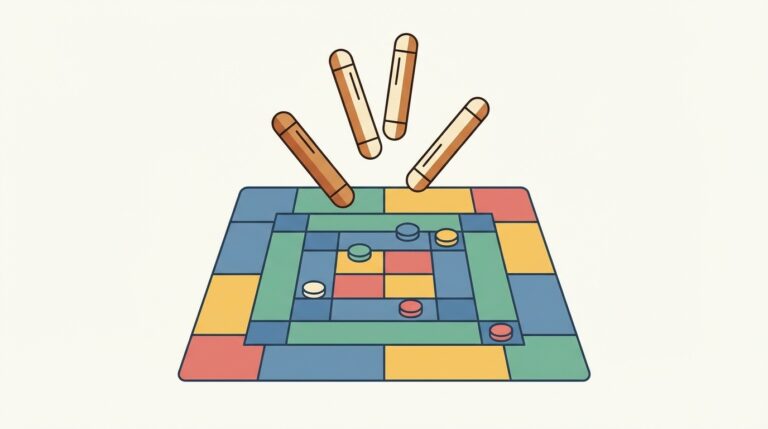
Picture this: It’s the Lunar New Year (Seollal). You’re watching an episode of Run BTS or Earth Arcade, and suddenly, the cast is huddled around a piece of paper on the floor, throwing four wooden sticks in the air. Within seconds, chaos ensues. Someone is screaming, someone is doing a victory dance, and someone is dramatically claiming betrayal. The subtitles read: “He caught my piece!” or “Let’s piggyback them!”
Welcome to the cutthroat world of 윷놀이 (Yutnori).
At first glance, Yutnori looks like a simple traditional board game. But any Korean will tell you: it is a high-stakes psychological battlefield disguised as holiday fun. If you’ve been invited to a Korean home during the holidays, or if you simply want to understand why your favorite K-Pop idols turn into ruthless tacticians on variety shows, understanding the rules and the highly specific vocabulary of Yutnori is essential.
This guide isn’t just about how to play; it’s about the language of strategy that Koreans use naturally. Let’s dive into the words that will make you the MVP of the malpan (game board).
Phase 2: Core Expressions Deep Dive
To play Yutnori at a C1 level, you need to understand the strategic vocabulary that dictates the flow of the game.
1. 업고 가다 (Eopgo gada)
- Pronunciation: [eop-go ga-da] + [Sounds like: ‘up-go gah-dah’ (Imagine ‘up’ as in carrying someone up on your back)]
- Meaning: Literal: To go piggybacking. / Real nuance: To combine two or more of your pieces on the board to move them together as one unit.
- K-Culture Moment: This is the ultimate “high risk, high reward” strategy. In a K-Drama, you might hear this phrase used metaphorically in business: “저 팀은 우리가 업고 가야 해” (We have to carry/piggyback that team with us).
- Editor’s Insight: It feels bold and greedy. If you move two pieces together, they run fast, but if the opponent catches them, both pieces die at once. It’s a true test of nerve.
- Situation Spectrum:
- Casual (Friends): ✅ “야, 그냥 업고 가!” (Hey, just piggyback them!)
- Semi-formal (Colleagues at a workshop): ✅ “업고 가는 게 낫지 않을까요?” (Wouldn’t it be better to piggyback?)
- Formal (Bosses/Elders): ⚠️ (Use polite form, but elders usually dictate the strategy anyway!)
- 🤔 Think About It: Why does Korean have a specific verb for carrying someone on your back (업다)? It reflects a culture with deep physical closeness and mutual reliance. How do you say this in your native language?
2. 낙 (Nak)
- Pronunciation: [nak] + [Sounds like: ‘knock’, but shorter and abrupt]
- Meaning: Literal: Fall/Drop (from Hanja 락/낙). / Real nuance: An invalid throw because one or more Yut sticks rolled completely off the playing mat.
- K-Culture Moment: In K-Variety shows, this is often accompanied by dramatic sound effects (like a shattering glass). If you throw a ‘Mo’ (the best score) but one stick rolls off the blanket, it’s a Nak. Turn over. Zero points.
- Editor’s Insight: It’s the most tragic word in the game. You’ll hear collective groans or cheers depending on whose turn it is. It teaches you to control your 승부욕 (competitive spirit)—throw hard, but within boundaries.
- Situation Spectrum:
- Casual: ✅ “아싸, 낙이다!” (Yes, it’s a Nak!)
- Semi-formal: ✅ “낙이네요, 다음 차례입니다.” (It’s a Nak, next turn.)
- Formal: ✅ (It’s a strict rule word, perfectly fine to use.)
- 🤔 Think About It: The concept of ‘boundaries’ is strict in Korean culture (crossing the line). Does your culture have a strict ‘out of bounds’ penalty in casual games?
3. 잡다 / 먹히다 (Japda / Meokhida)
- Pronunciation: [jap-da / meo-ki-da] + [Sounds like: ‘jahp-dah / muh-kee-dah’]
- Meaning: Literal: To catch / To be eaten. / Real nuance: Landing exactly on an opponent’s piece, sending it back to the start, AND earning an extra throw.
- K-Culture Moment: The highlight of any game. You don’t just ‘remove’ the opponent’s piece; you “eat” it. It’s aggressive, satisfying, and usually sparks a vengeance arc for the rest of the game.
- Editor’s Insight: Notice the passive form 먹히다 (to be eaten). In Yutnori, you aren’t just beaten; your progress is devoured. It brings out the dramatic flair in everyone.
- Situation Spectrum:
- Casual: ✅ “내 말 먹혔어!” (My piece got eaten!)
- Semi-formal: ✅ “저희가 잡겠습니다.” (We will catch yours.)
- Formal: 🚫 (Avoid saying ‘먹혔어’ to a grandfather; use ‘잡혔어요’ instead.)
- 🤔 Think About It: Why use the verb “to eat” for capturing game pieces? It shows the visceral, survival-of-the-fittest nature of traditional games.
Phase 3: Textbook vs. Real Korean
Let’s look at how Yutnori is described in language textbooks versus what you’ll actually hear on the floor of a Korean living room.
[Moving the Pieces]
* 📖 Textbook Korean: 말을 움직이세요. (Please move the piece.)
* 🗣️ Real Korean: 말 써! / 내가 말 쓸게. (Use the piece! / I’ll write/use the piece.)
* 💡 Why the difference?: Koreans use the verb 쓰다 (to use/write) for moving Yut pieces on the malpan (board). The person who strategizes and moves the pieces is called the 말 쓰는 사람, and they hold all the power.
[When the situation is tense]
* 📖 Textbook Korean: 전략이 중요합니다. (Strategy is important.)
* 🗣️ Real Korean: 완전 눈치 싸움이야. (It’s a total battle of wits/reading the room.)
* 💡 Why the difference?: Yutnori isn’t just math; it’s about predicting if the opponent will retaliate. 눈치 (nunchi) is the ultimate Korean social skill applied to gaming.
[When making a comeback]
* 📖 Textbook Korean: 뒤로 한 칸 이동합니다. (Move backwards one space.)
* 🗣️ Real Korean: 빽도(Back Do) 대박! (Back Do is epic!)
* 💡 Why the difference?: One Yut stick has a mark on it. If only that stick turns over, it’s a ‘Back Do’ (minus one space). It can be a disaster, or a genius way to catch an opponent right behind you. It’s the ultimate wildcard.
Bottom Note: For C1 learners, mastering words like 빽도 and 눈치 싸움 shows you don’t just speak Korean; you understand the cultural heartbeat behind the language.
Phase 4: Cultural Context — K-Culture Deep Dive
4-1. Non-Verbal Elements: The Art of the Throw
Language isn’t enough; you need the attitude. In Yutnori, the person throwing the sticks must sit on a blanket (담요). You cannot simply ‘drop’ the sticks. You must gather them in one hand, shake them dramatically to intimidate your opponent, and toss them upward. If you slide them across the floor, older Koreans will scold you: “그게 던진 거야, 놓은 거야?” (Did you throw them or place them?).
4-2. K-Variety Shows & Competitiveness (승부욕)
If you watch K-Pop idols on variety shows playing traditional games, you will witness immense 승부욕 (Seungbuyok – competitive spirit).
Yutnori perfectly captures this. In dramas or shows, the board strategy (말판 쓰기) often leads to hilarious betrayals. One member might shout, “Let’s go separate ways to be safe!” while another insists, “No, piggyback them! All or nothing!” (모 아니면 도 – All or nothing, literally ‘Mo or Do’). This phrase, 모 아니면 도, originated from Yutnori but is now used in everyday life to describe an extreme situation where you either win big or lose everything.
Phase 5: Real-Life Roleplay Scenario
Setting: Lunar New Year (Seollal) evening at your friend Min-su’s house. The remnants of Tteokguk (rice cake soup) have been cleared. A thick blanket is spread on the living room floor. You are teamed up with Min-su against his two very competitive uncles.
Characters:
– YOU: The foreign guest who secretly knows Yutnori strategy.
– Min-su: Your friend, slightly intimidated by his uncles.
– Uncle (삼촌): The self-proclaimed Yutnori grandmaster of the family.
Dialogue:
Uncle: 자, 외국인 손님부터 던져! 우리 팀은 한 칸 봐준다.
(Ja, oegugin sonnim-buteo deonjeo! Uri timeun han kan bwajunda.)
[Translation] Alright, the foreign guest throws first! Our team will go easy on you by one space.
(🎭 Stage Direction: The Uncle smirks and tosses the Yut sticks to you)
YOU: 에이, 삼촌. 봐주실 필요 없습니다. 저 완전 승부욕 강해요!
(Ei, samchon. Bwajusil pil-yo eopseumnida. Jeo wanjeon seungbuyok ganghaeyo!)
[Translation] Hey, Uncle. No need to go easy on me. I’m highly competitive!
(You throw. It’s a ‘Yut’ – 4 spaces, plus an extra throw! You throw again. It’s a ‘Gae’ – 2 spaces.)
Min-su: 와 대박! 윷에 개 나왔어! 야, 말 어떻게 쓸까? 하나는 나가고, 하나는 업을까?
(Wa daebak! Yuche gae nawasseo! Ya, mal eotteoke sseulkka? Hananeun nagago, hananeun eobeulkka?)
[Translation] Wow, epic! A Yut and a Gae! Hey, how should we use the pieces? Move one out, and piggyback the other?
Uncle: 윷놀이는 원래 업고 가는 맛이지! 안 그래?
(Yunnori-neun wollae eopgo ganeun masiji! An geurae?)
[Translation] The real flavor of Yutnori is piggybacking! Isn’t that right?
(🎭 Stage Direction: The Uncle is clearly baiting you into a risky move so he can catch both your pieces later.)
🔀 Your Turn! How do you respond to Min-su?
– A) “네, 업고 갑시다! 모 아니면 도잖아요!” (Yes, let’s piggyback! It’s all or nothing!)
– B) “아니요, 안전하게 두 개 따로 이동해요.” (No, let’s safely move two separately.)
– C) “삼촌, 저희 말 잡지 마세요 ㅠㅠ” (Uncle, please don’t catch our pieces ㅠㅠ)✅ Best Choice: A — Reason: It matches the festive, competitive vibe! Throwing out idioms like ‘모 아니면 도’ (All or nothing) will impress the uncles immensely.
⚠️ Choice B Analysis: Smart strategy, but in a holiday setting, it might be seen as playing too safely (재미없다 – boring).
YOU: (Choosing A) 네, 업고 갑시다! 모 아니면 도잖아요!
(Ne, eopgo gapsida! Mo animyeon dojanhayo!)
[Translation] Yes, let’s piggyback! It’s all or nothing, right!
Uncle: 오~ 한국말 잘하는데? 좋아, 어디 한 번 해보자고!
(O~ Hangungmal jal-haneunde? Joa, eodi han beon haebojago!)
[Translation] Oh~ Your Korean is good! Alright, let’s see what you’ve got!
Phase 6: 10-Second Shadowing Drill
Let’s practice the exclamations you need when playing the game. Pay attention to the pausing and intonation!
- 😤 Decisively: 야! / 우리는 / 무조건 / 업고 간다!
(Ya! / u-ri-neun / mu-jo-geon / eop-go gan-da!)
Hey! We are piggybacking unconditionally! - 😲 Shocked: 헐… / 여기서 / 빽도가 / 나온다고?
(Heol… / yeo-gi-seo / bbaek-do-ga / na-on-da-go?)
Wait… A ‘Back Do’ comes out here? - 😈 Smugly: 아싸! / 내가 / 삼촌 말 / 잡았어요!
(A-ssa! / nae-ga / sam-chon mal / ja-ba-sseo-yo!)
Yes! I caught Uncle’s piece!
Phase 7: K-Culture Mini Dictionary
| Korean | Romanization | English | Context/Meaning |
|---|---|---|---|
| 말판 | malpan | Game Board | The paper or cloth where the Yut pieces move. Strategizing here is called ‘말판 쓰기’ (writing/using the board). |
| 도, 개, 걸, 윷, 모 | Do, Gae, Geol, Yut, Mo | The 5 outcomes | Represents animals (Pig, Dog, Sheep, Cow, Horse). Moves 1, 2, 3, 4, and 5 spaces respectively. |
| 승부욕 | seungbuyok | Competitive Spirit | A strong desire to win. Often highly praised in Korean society and a staple of K-Variety shows. |
| 빽도 | bbaek-do | Back Do | The marked Yut stick. If only this one flips, you move backwards 1 space. A game-changer. |
| 깍두기 | kkakdugi | The Wildcard Player | If there is an odd number of players or a child, they become ‘Kkakdugi’—they play, but their mistakes don’t hurt the team. |
Phase 8: Traveler Survival Kit
Even if you aren’t playing Yutnori, the phrases learned here are incredibly useful for navigating team dynamics or competitive situations in Korea.
🆘 Survival Phrases #1
– 🇰🇷 “저희는 따로 결제할게요.” (Jeohui-neun ttaro gyeolje-halgeyo.)
– 🗣️ English Guide: [juh-hee-neun ddah-ro gyul-jeh hal-geh-yo]
– 📍 Where to use: Restaurants/Cafes
– 💡 Pro Tip: Just like deciding whether to ‘piggyback’ (업고 가다) or go separate (따로 가다) in Yutnori, this is how you ask to split the bill (pay separately) in Korea!📌 Editor’s Travel Note
– Holiday Travel: If you visit Korea during Seollal (Jan/Feb) or Chuseok (Sep/Oct), many shops close, but traditional palaces (Gyeongbokgung) are open and often host massive, life-sized Yutnori games you can join!
– Competitive Culture: Koreans play hard. Even in casual drinking games (술게임), the 승부욕 (competitiveness) is real. Don’t be offended if they show no mercy; it means they treat you as an equal!
Phase 9: Critical Thinking Corner — “One Step Deeper”
Language & Power: The Strategy of ‘Kkakdugi’ and ‘Piggybacking’
🧠 Think Deeper:
Korean traditional games like Yutnori beautifully mirror Korean social structures. The concept of 업고 가다 (Piggybacking) reflects a deeply collectivist mindset—you share the risk and the reward as a single unit. Conversely, the existence of the 깍두기 (Kkakdugi) rule—allowing a younger, weaker, or less skilled person to participate without penalizing the team—shows a society that values inclusion and taking care of the vulnerable within a competitive framework. It’s a ruthless game, yet it ensures no one is left completely out of the circle.💬 Your Turn: Does your culture have a concept similar to ‘Kkakdugi’ (a safe-pass player) in childhood or family games? Share your thoughts in the comments!
Phase 10: FAQ & Avoiding Misunderstandings
- Q: If my piece gets “eaten” (잡혔다), can I show I’m annoyed?
- Yes, absolutely! Yutnori is a loud, expressive game. Sighing, holding your head, or jokingly shouting “Ah, why!” (아 왜!) is fully expected. Playing silently is actually considered boring.
- Q: Can I use “모 아니면 도” (All or nothing) in the workplace?
- Maybe. It is slightly informal but very common in business when discussing high-risk strategies. Just use polite endings: “이번 프로젝트는 모 아니면 도입니다.” (This project is all or nothing.)
❌ Common Mistake #1: Calling the Yut sticks “주사위” (dice).
✅ Do this instead: Always call them “윷” (Yut). They are cast, not rolled.❌ Common Mistake #2: Saying “내 말이 죽었어” (My piece died) to an elderly person.
✅ Do this instead: While ‘죽었다’ is common among friends, when playing with elders, use “제 말이 잡혔네요” (My piece was caught) to maintain respect while losing gracefully.
Phase 11: Summary & Action Items
- One-Liner Summary: Yutnori isn’t just a game; it’s a crash course in Korean strategic vocabulary (업고 가다, 낙, 잡다) and high-octane competitiveness.
-
Action Mission 3 Steps:
- 🥉 Bronze (Solo): Say “업고 가자!” (Let’s piggyback!) and “완전 모 아니면 도야” (It’s totally all or nothing) out loud 3 times with dramatic flair.
- 🥈 Silver (Online): Find a YouTube video of K-Pop idols playing Yutnori and leave a comment identifying when someone gets a Nak (낙).
- 🥇 Gold (Real World): Next time you face a tough, risky choice with a Korean friend (like choosing an extremely spicy dish), say, “모 아니면 도! 갑시다!” (All or nothing! Let’s go!).
- K-Culture Mission: Watch an episode of Going Seventeen or Earth Arcade featuring Yutnori. See if you can spot the moment someone uses 눈치 (nunchi) to decide their board strategy (말판 쓰기).
Engage with us: What is the most cutthroat family game in your country? Let us know below!
Phase 12: Quiz — Interactive Challenge
1. Situational Judgment:
You are playing Yutnori. You throw the sticks, but one stick slides entirely off the blanket onto the hard floor. What should you yell?
– A) 잡았다! (I caught it!)
– B) 빽도! (Back Do!)
– C) 아… 낙이다. (Ah… it’s a Nak.)
(Correct: C. A ‘Nak’ invalidates your turn because it went out of bounds!)
2. Fill in the Blank:
When you decide to combine two of your pieces to move together as a single, faster unit, you say: “우리 그냥 (____) 가자!”
– A) 잡고 (Japgo)
– B) 업고 (Eopgo)
– C) 죽고 (Jukgo)
(Correct: B. 업고 가다 – To piggyback/carry together.)
3. True or False – K-Culture Edition:
In Yutnori, the phrase “모 아니면 도” (Mo or Do) means “Win or Lose” and is only used during the game. (T/F)
(Answer: False. It originated from the game but is now a very common daily idiom meaning “All or nothing.”)
Frequently Asked Questions (FAQ)
Q: What does "업고 가다 (Eopgo gada)" mean in Korean and how do you pronounce it?
A: In Korean, "업고 가다 (Eopgo gada)" is pronounced [eop-go ga-da] and means: Literal: To go piggybacking. / Real nuance: To combine two or more of your pieces on the board to move them together as one unit.
Q: What does "낙 (Nak)" mean in Korean and how do you pronounce it?
A: In Korean, "낙 (Nak)" is pronounced [nak] and means: Literal: Fall/Drop (from Hanja 락/낙). / Real nuance: An invalid throw because one or more Yut sticks rolled completely off the playing mat.
Q: What does "잡다 / 먹히다 (Japda / Meokhida)" mean in Korean and how do you pronounce it?
A: In Korean, "잡다 / 먹히다 (Japda / Meokhida)" is pronounced [jap-da / meo-ki-da] and means: Literal: To catch / To be eaten. / Real nuance: Landing exactly on an opponent's piece, sending it back to the start, AND earning an extra throw.







