

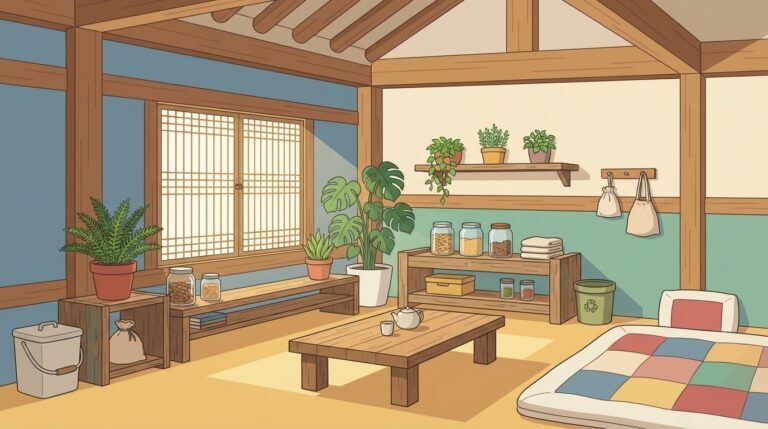
Hello! I’m your Lead Editor at Daily Hangul.
Imagine walking through the trendy alleys of Seongsu-dong, often called the ‘Brooklyn of Seoul.’ You step into a stunning café that used to be an abandoned shoe factory. The tables are made from old doors, the lighting fixtures are crafted from discarded glass bottles, and the vibe is impeccably chic. You want to compliment the owner’s eco-friendly aesthetic, but you freeze. All you can think of is the textbook phrase “재활용품” (recycling). But wait—is this just ‘recycling’? If you call their artisan-crafted table a ‘recycled good,’ you might accidentally insult them!
At the C2 level, you’re no longer just learning survival Korean; you’re mastering the nuances of culture, lifestyle, and philosophy. Today, Korea is deeply obsessed with ‘가치 소비’ (value-based consumption) and zero-waste living. Knowing how to articulate these advanced eco-friendly interior design concepts won’t just make you sound fluent—it will grant you instant ‘insider’ status among Korea’s hip, environmentally conscious millennials and Gen Z.
Let’s dive into the refined language of sustainable Korean interiors!
Phase 2: Core Expressions Deep Dive
1. 새활용 (Upcycling)
- Pronunciation: [Sae-hwal-yong]
(Sound analogy: ‘Sae’ sounds like the ‘sa’ in ‘sad’ but shorter, ‘hwal’ like ‘hwall’ with a soft L, ‘yong’ like the start of ‘yonder’.) - Meaning: Upcycling (Literal: New usage)
- K-Culture Moment: You’ll hear this on reality shows like I Live Alone (나 혼자 산다) when a celebrity proudly shows off a quirky lamp they bought from a local artist. It’s not just 재활용 (Jae-hwal-yong / Recycling, which implies breaking something down to its raw materials); it’s taking something old and elevating its value.
- Editor’s Insight: This word feels creative, modern, and highly educated. Using 새활용 instead of the English loanword 업사이클링 (upcycling) shows you have a deep appreciation for the Korean language’s modern evolution.
- Situation Spectrum:
- Casual (Friends): ✅
- Semi-formal (Colleagues): ✅
- Formal (Professionals/Elders): ✅
- 🤔 Think About It: Why did the Korean government actively push to create the native word ‘새활용’ instead of just adopting ‘업사이클링’? How does language shape our perception of a new environmental trend?
2. 비우는 삶 (The life of emptying / Decluttering)
- Pronunciation: [Bi-u-neun salm]
(Sound analogy: ‘Bi’ like ‘bee’, ‘u’ like ‘ooh’, ‘neun’ like ‘nun’, ‘salm’ sounds like ‘sam’ with a very subtle ‘L’ before the ‘M’.) - Meaning: Minimalist lifestyle (Literal: The life of emptying)
- K-Culture Moment: In K-Dramas, the wealthy antagonist usually has a cold, sterile mansion, while the warm-hearted protagonist has a cozy, cluttered room. But in real life, young Koreans living in small Seoul apartments are embracing 비우는 삶 to maximize space and minimize environmental impact.
- Editor’s Insight: This phrase has a slightly philosophical, almost Zen-like nuance. It’s much deeper than just “cleaning up” (청소하다). It implies a conscious, psychological decision to detach from materialism.
- Situation Spectrum:
- Casual (Friends): ✅
- Semi-formal (Colleagues): ✅
- Formal (Professionals/Elders): ✅
- 🤔 Think About It: Does your culture view an “empty” room as peaceful or lacking? How does the dense population of Seoul influence this desire for ‘empty space’?
3. 자투리 (Remnants / Scraps)
- Pronunciation: [Ja-tu-ri]
(Sound analogy: ‘Ja’ like ‘jar’, ‘tu’ like ‘two’, ‘ri’ like ‘ree’ with a flipped R.) - Meaning: Leftover materials, scraps, or dead space.
- K-Culture Moment: When discussing eco-friendly interiors, you’ll often hear about 자투리 목재 (scrap wood) or 자투리 공간 (leftover space). In a densely populated country, utilizing every 자투리 is both an economic necessity and an environmental virtue.
- Editor’s Insight: This is a fantastic native Korean word. It sounds very warm and resourceful. If you tell a Korean contractor, “자투리 공간을 활용하고 싶어요” (I want to utilize the leftover space), they will immediately respect your sophisticated vocabulary.
- Situation Spectrum:
- Casual (Friends): ✅
- Semi-formal (Colleagues): ✅
- Formal (Professionals/Elders): ✅
Phase 3: Textbook vs. Real Korean
[Describing an eco-friendly item]
* 📖 Textbook Korean: 이것은 환경을 보호하는 가구입니다. (This is furniture that protects the environment.)
* 🗣️ Real Korean: 이거 완전 친환경 소재로 빠졌어요. / 당근에서 득템했어요! (This came out completely in eco-friendly materials. / I scored this on Karrot!)
* 💡 Why the difference?: Advanced speakers use verbs like ‘빠지다’ (to come out/to be designed as) for aesthetics, and mention “당근” (Karrot – Korea’s dominant secondhand app) as a verb/noun for sustainable shopping.
[Expressing a desire to declutter]
* 📖 Textbook Korean: 저는 물건을 버리고 싶습니다. (I want to throw things away.)
* 🗣️ Real Korean: 요즘 미니멀 라이프에 꽂혀서 다 비워내려고요. (I’m hooked on the minimal life these days, so I’m trying to empty everything out.)
* 💡 Why the difference?: ‘꽂히다’ (to be fixated/hooked on) makes you sound like a native, while ‘비워내다’ expresses the philosophical intent of zero-waste better than ‘버리다’ (to simply discard).
Bottom Note: At the C2 level, your goal is to blend high-level vocabulary (친환경, 새활용) with natural conversational flow (꽂히다, 득템하다) to sound both educated and relatable.
Phase 4: Cultural Context — K-Culture Deep Dive
4-1. Non-Verbal Elements: The Art of Appreciating “여백의 미”
When discussing minimalist, zero-waste interiors in Korea, you must understand 여백의 미 (Yeo-baek-ui mi)—the “beauty of empty space.” This is a traditional Korean aesthetic found in ancient ink paintings, where the unpainted white space is just as important as the brushstrokes. When complimenting someone’s minimalist home, don’t just stare at the furniture. Sweep your gaze across the uncluttered room, nod slowly, and say, “여백의 미가 느껴지네요” (I can feel the beauty of empty space). This shows an elite level of cultural Nunchi (눈치).
4-2. K-Culture Connection: The “Karrot” Economy
You cannot talk about zero-waste living in modern Korea without mentioning 당근마켓 (Karrot Market). Originally a hyper-local secondhand trading app, it has become a lifestyle. Upcycling interior enthusiasts constantly hunt for vintage furniture here.
* Critical Viewpoint: While “Danggeun” promotes zero-waste by giving items a second life, it has also created a subculture of hyper-consumerism where people buy and sell constantly just for the thrill of the trade. It’s a fascinating paradox of modern Korean eco-consciousness!
Phase 5: Real-Life Roleplay Scenario
- Setting: A Saturday afternoon in Euljiro (힙지로). You are in a small, dusty but incredibly stylish workshop that upcycles old Hanok wood into modern furniture. The scent of pine and linseed oil fills the air.
- Characters:
- YOU: A foreign resident who just moved to an old villa and wants to decorate it sustainably.
- Ji-hoon (35): The passionate, slightly hipster owner of the workshop.
Ji-hoon: 어서 오세요. 찾으시는 거 있으세요? 🌿
(Eoseo oseyo. Chajeusineun geo isseuseyo?)
[Welcome. Are you looking for anything in particular?]
(🎭 Stage Direction: Ji-hoon wipes wood dust off his apron)
YOU: 아, 네. 이번에 이사를 했는데, 제로 웨이스트 인테리어에 관심이 생겨서요.
(A, ne. Ibeone isareul haenneunde, jero weiseuteu interieoe gwansimi saenggyeoseoyo.)
[Ah, yes. I recently moved, and I’ve become interested in zero-waste interiors.]
Ji-hoon: 오, 제대로 찾아오셨네요. 저기 있는 테이블 어떠세요? 철거된 한옥에서 나온 자투리 목재를 새활용한 거예요.
(O, jedaero chajaosyeonneyo. Jeogi inneun teibeul eotteoseyo? Cheolgeodoen hanogeseo naon jaturi mokjaereul saehwaryonghan geoyeyo.)
[Oh, you came to the right place. How about that table over there? It’s upcycled from scrap wood from a demolished Hanok.]
YOU: 와, 질감이 엄청 독특하네요. 완전 환골탈태인데요?
(Wa, jilgami eomcheong dokteukhaneyo. Wanjeon hwangoltaltae-inde-yo?)
[Wow, the texture is incredibly unique. It’s a complete transformation (turning over a new leaf), isn’t it?]
Ji-hoon: 그쵸? 옛날 나무라 내구성은 말할 것도 없고요. 가격은 85만 원입니다.
(Geuchyo? Yennal namura naeguseongeun malhal geotdo eopgoyo. Gagyeogeun palsiboman wonimnida.)
[Right? Because it’s old wood, the durability goes without saying. The price is 850,000 won.]
🔀 Your Turn! How do you respond to the price?
– A) “너무 비싸요! 안 살래요.” (Too direct and borderline rude.)
– B) “역시 수공예라 가치가 있네요. 근데 예산이 조금 초과돼서… 혹시 네고 가능할까요?” (Acknowledges value while smoothly negotiating.)
– C) “대박! 그냥 당근에서 비슷한 거 찾아볼게요.” (A bit insensitive to the artist’s face.)✅ Best Choice: B — At the C2 level, you know how to validate the artisan’s effort (“가치가 있네요” – it has value) before asking for a discount using the Konglish slang “네고” (negotiation), which softens the request and sounds very natural.
(Continuing with B)
YOU: 역시 수공예라 가치가 있네요. 근데 예산이 조금 초과돼서… 혹시 네고 가능할까요?
Ji-hoon: 하하, 손님이 안목이 있으셔서 특별히 80만 원까지 맞춰드릴게요.
(Haha, sonnimi anmogi isseusyeoseo teukbyeolhi palsimman wonkkaji matchwodeurilgeyo.)
[Haha, since you have such a good eye, I’ll adjust it to 800,000 won specially for you.]
Scenario B: Bonus Karrot Market Interaction
(You find an upcycled lamp on the Karrot app and meet the seller at the subway station).
* You: “혹시 당근…이세요?” (By any chance… are you Karrot?)
* Seller: “네! 여기 조명요. 뽁뽁이(bubble wrap) 대신 안 입는 옷으로 싸왔어요.”
* You: “와, 센스 있으시네요! 환경까지 생각해주시고. 감사합니다!”
Phase 6: 10-Second Shadowing Drill
Read this out loud to master the natural cadence and emotion of a sophisticated Korean speaker.
😲 와, 이 테이블 / 자투리 목재를 / 새활용해서 만든 거라고요? / 완전 / 제 스타일이에요!
(Wa, i teibeul / jaturi mokjaereul / saehwaryonghaeseo mandeun georagoyo? / wanjeon / je seutairieyo!)
[Wow, this table… you’re saying it’s made by upcycling scrap wood? It’s completely my style!]
Phase 7: K-Culture Mini-Dictionary (Interior & Eco Edition)
| Korean | Romanization | English | Context |
|---|---|---|---|
| 새활용 | saehwaryong | Upcycling | The native Korean term for upcycling; adding design/value to discarded items. |
| 가치 소비 | gachi sobi | Value-based consumption | Buying things that align with one’s personal values (like eco-friendliness), even if they cost more. |
| 당근하다 | danggeunhada | To trade on Karrot | A newly coined verb meaning to buy or sell secondhand goods locally. |
| 여백의 미 | yeobaegui mi | Beauty of empty space | Traditional aesthetic deeply tied to modern minimalist interior design. |
| 플랜테리어 | peullaenterieo | Planterior | Plant + Interior. Using indoor plants as a core design element, very popular in zero-waste homes. |
Phase 8: Traveler Survival Kit (Hipster Shopping Edition)
Are you visiting Seoul and want to shop for eco-friendly or vintage interior items in places like Dongmyo or Seongsu? Here are your survival phrases!
🆘 Survival Phrase #1: Refusing packaging
– 🇰🇷 “포장은 안 해주셔도 돼요. 제 가방에 담아갈게요.”
– 🗣️ (Pojangeun an haejusyeodo dwaeyo. Je gabange damagalgeyo.)
– 📍 Where to use: Zero-waste shops, vintage stores.
– 💡 Pro Tip: Say this before they start wrapping! Koreans are very quick and love providing excellent service, which often means wrapping things in layers of plastic.🆘 Survival Phrase #2: Asking about materials
– 🇰🇷 “이거 혹시 친환경 소재인가요?”
– 🗣️ (Igeo hoksi chinhwangyeong sojaeingayo?)
– 📍 Where to use: Pop-up stores in Seongsu or The Hyundai Seoul.
📌 Editor’s Travel Note:
* Dongmyo Flea Market vs. Seongsu: Dongmyo is purely for 재활용 (Recycling/Secondhand) where haggling is aggressive. Seongsu is for 새활용 (Upcycling/Curated Vintage) where items are treated like art, so haggle gently or not at all.
Phase 9: Critical Thinking — “One Step Deeper”
🧠 Think Deeper: Global Era Korean (언어의 순수성 vs 실용성)
In the realm of interior design and eco-activism, Korean is heavily saturated with English loanwords: 제로 웨이스트 (Zero waste), 업사이클링 (Upcycling), 미니멀리즘 (Minimalism), 플랜테리어 (Planterior). The government actively tries to replace these with “pure” Korean words, which is how we got 새활용 (Upcycling). However, younger generations often prefer the English terms because they feel more “global” or “trendy.” This creates a fascinating sociolinguistic divide. Using 새활용 shows you respect the linguistic purity efforts, while using 제로 웨이스트 shows you are tapped into global internet culture. As a C2 learner, you have the power to choose which nuance you want to project!
💬 Your Turn: How does your native language handle new global trends? Do you invent new native words (like 새활용), or do you just import the English word? Let us know in the comments!
Phase 10: FAQ & Avoiding Mistakes
Q: If I buy a vintage item from an elder at a market, can I compliment them by saying “여백의 미가 있네요”?
* Maybe not. 여백의 미 is a highly refined, artistic term. If you say this at a gritty flea market in Dongmyo, it might sound a bit pretentious or sarcastic! Save it for curated galleries or upcycling workshops.
Q: Can I use “당근하다” in a formal business meeting about sustainability?
* No. While everyone uses the app, “당근하다” is a casual slang verb. In formal settings, use “중고 거래를 하다” (to do secondhand trading).
❌ Common Mistake #1: Confusing 재활용 (Recycling) and 새활용 (Upcycling).
✅ Do this: If an artist made a beautiful bag out of an old truck tarp (like the brand Freitag), it is strictly 새활용. Calling it 재활용 diminishes their artistic effort.
Phase 11: Summary & Action Items
- One-Liner Summary: Elevate your eco-friendly vocabulary from simple “recycling” to sophisticated concepts like 새활용 (upcycling) and 비우는 삶 (decluttering) to truly connect with modern Korean values.
-
Action Mission 3 Steps:
- 🥉 Bronze (Solo): Look around your room right now. Identify one item that is 자투리 or 새활용 and say the word aloud.
- 🥈 Silver (Online): Go to a Korean interior hashtag on Instagram (like #오늘의집 or #제로웨이스트) and leave a comment: “친환경적인 인테리어가 너무 멋져요!” (Your eco-friendly interior is so cool!)
- 🥇 Gold (Real World): Visit an upcycling shop in your city (or Seoul, if you’re here) and ask the owner about the materials using today’s phrases!
- K-Culture Mission: Download the Karrot (당근마켓) app (or visit their website). Change your region to a neighborhood in Seoul (like Mapo-gu) and search the keyword “업사이클링” or “빈티지 가구” just to read how locals describe their items in Korean!
Phase 12: Interactive Challenge Quiz
1. Situational Judgment: You are invited to a Korean designer’s extremely minimalist, zero-waste apartment. The living room has almost no furniture. What is the most sophisticated compliment to give?
* A) “가구가 너무 없네요. 돈을 많이 아끼셨어요!” (You have no furniture. You saved a lot of money!)
* B) “집에서 여백의 미가 느껴지네요. 비우는 삶을 실천하고 계시군요.”
* C) “이거 다 재활용품인가요?”
2. Fill in the Blank:
“버려지는 _______ 목재를 활용해서 멋진 의자를 만들었어요.”
(I made a cool chair using discarded [leftover/remnant] wood.)
3. True or False – K-Culture Edition:
At trendy upcycled furniture boutiques in Seongsu-dong, it is customary to aggressively haggle down the price by at least 50%.
🚨 Click here for the answers!
1. B – It perfectly acknowledges their aesthetic choice using high-level cultural vocabulary. (A is insulting, C undermines their design).
2. 자투리 (Jaturi – remnant/scrap).
3. False. Unlike traditional flea markets (Dongmyo), trendy curated vintage/upcycling shops operate more like art galleries. You can ask for a slight ‘nego’ (discount), but aggressive haggling is considered rude.
Did you enjoy this deep dive into sustainable Korean? Let me know which expression you found the most fascinating in the comments! 👇
Frequently Asked Questions (FAQ)
Q: What does "새활용 (Upcycling)" mean in Korean and how do you pronounce it?
A: In Korean, "새활용 (Upcycling)" is pronounced [Sae-hwal-yong] and means: Upcycling (Literal: New usage)
Q: What does "비우는 삶 (The life of emptying / Decluttering)" mean in Korean and how do you pronounce it?
A: In Korean, "비우는 삶 (The life of emptying / Decluttering)" is pronounced [Bi-u-neun salm] and means: Minimalist lifestyle (Literal: The life of emptying)
Q: What does "자투리 (Remnants / Scraps)" mean in Korean and how do you pronounce it?
A: In Korean, "자투리 (Remnants / Scraps)" is pronounced [Ja-tu-ri] and means: Leftover materials, scraps, or dead space.







