

Hello there! I’m your lead editor at Daily Hangul.
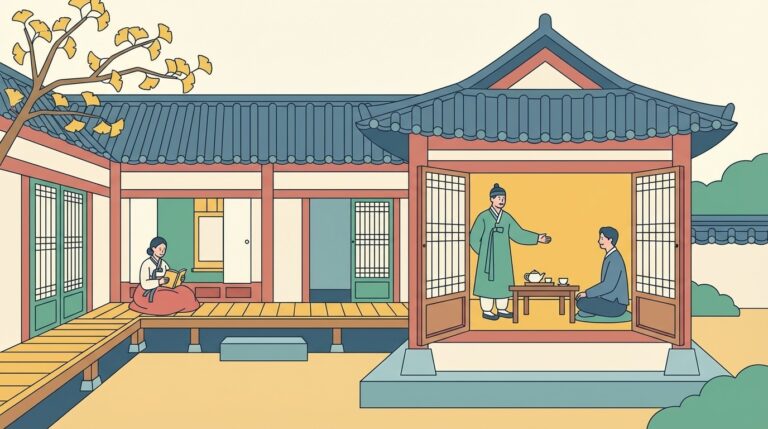
If you’ve ever watched a historical K-Drama (Sageuk), you’ve definitely seen this scene: The stoic male lead sits in a beautifully open, elevated room, sipping tea with his political allies. Meanwhile, the female lead is across the courtyard, hidden away in a cozier, heavily guarded inner room, dealing with family secrets.
But wait… why are they in completely different parts of the house?
Welcome to the architectural blueprint of Korean social boundaries: the traditional Hanok (한옥). Specifically, the strict division between the 안채 (Anchae, the Inner Quarters) and the 사랑채 (Sarangchae, the Outer Quarters).
For a C1 learner like you, this isn’t just an architecture lesson. Understanding these two spaces is the absolute masterkey to understanding modern Korean concepts of ‘In-group’ (Uri) vs. ‘Out-group’, traditional hospitality, and why Koreans act so differently in public spaces compared to their private homes. Let’s step over the threshold, shall we?
Phase 2: Core Expressions Deep Dive
To grasp the C1-level nuances of Korean social dynamics, you need to understand the vocabulary born from these spaces.
1. 안채 (Anchae) & 안방 (Anbang)
- Pronunciation: [an-chae] / [an-bang] (Sounds like ‘ahn-che’ – think of the ‘an’ in ‘answer’)
- Meaning: Literal: Inner quarters / Inner room. Real nuance: The heart of the home, the private family sanctuary, traditionally the matriarch’s domain.
- K-Culture Moment: In modern family dramas like Reply 1988, the ‘Anbang’ is where the parents sleep, the safe is kept, and the deepest family meetings happen. It’s the ultimate “VIP Family Only” zone.
- Editor’s Insight: Today, Anchae isn’t used much for modern apartments, but the word 안방 (Anbang) is everywhere. It represents absolute comfort and control. If a Korean sports team plays a home game, we call it “안방 경기” (Anbang match). If someone is acting overly comfortable in a public space, we sarcastically say, “여기가 안방인 줄 아나?” (Do they think this is their Anbang?).
- Situation Spectrum:
- Used literally for Hanok tours: ✅
- Used metaphorically for ‘home turf’: ✅
- Used to describe a living room: 🚫 (Living room is 거실)
- 🤔 Think About It: Why is the inner room associated with the matriarch and ultimate family power? How does this challenge the Western stereotype of patriarchal traditional Korea?
2. 사랑채 (Sarangchae)
- Pronunciation: [sa-rang-chae] (Sounds like the word for love ‘sarang’, but here it means a reception/study area)
- Meaning: Literal: Outer quarters. Real nuance: The public face of the family, the men’s domain, the reception area for guests.
- K-Culture Moment: Think of Mr. Sunshine. Eugene Choi visits Go Ae-shin’s grandfather. Where do they meet? The Sarangchae. It’s where philosophy is debated, art is created, and guests are entertained.
- Editor’s Insight: The Sarangchae is where you show your best face. It’s the origin of Korean formal hospitality (손님 접대). The host must provide the best food and drinks here. The modern equivalent? The high-end BBQ restaurant where your boss takes the clients.
- Situation Spectrum:
- Discussing history/architecture: ✅
- Complimenting someone’s guest room: ⚠️ (A bit overly poetic for a modern apartment)
- 🤔 Think About It: The Sarangchae was physically close to the main gate. How does this spatial design reflect the importance of hospitality in Confucian society?
3. 내외하다 (Naewoe-hada)
- Pronunciation: [nae-oe-ha-da] (Nae = inside, Oe = outside)
- Meaning: Literal: To separate inside and outside. Real nuance: To act shy or maintain a strict formal distance (historically between men and women, now between awkward acquaintances).
- K-Culture Moment: In a reality show, when two idols who don’t know each other well are left alone in a room, the captions will pop up: “서로 내외하는 중…” (Currently maintaining an awkward distance…).
- Editor’s Insight: This word perfectly bridges Hanok architecture and modern psychology. Just as the Anchae (Inside/Nae) and Sarangchae (Outside/Oe) were separated, Naewoe-hada means keeping that invisible wall up. It’s an advanced C1 word that makes you sound incredibly fluent!
- Situation Spectrum:
- Teasing awkward friends: ✅
- Describing formal historical gender rules: ✅
- Professional business emails: 🚫 (Too psychological/casual)
Phase 3: Textbook vs. Real Korean
How do these spatial concepts translate into how we talk about our “spaces” today?
[Describing someone who never leaves the house]
* 📖 Textbook Korean: 제 친구는 집에 있는 것을 좋아해요. (My friend likes staying at home.)
* 🗣️ Real Korean: 걔 완전 집순이(Jipsuni – female) / 집돌이(Jipdori – male)야. 안채 지박령 수준이야. (She/He is a total homebody. Practically a ghost haunting the Anchae.)
* 💡 Why the difference?: Modern Koreans love categorizing personality types (like MBTI). Adding ‘-순이’ or ‘-돌이’ creates a cute, instantly recognizable persona.
[Welcoming a guest to your home/space]
* 📖 Textbook Korean: 저희 집에 오신 것을 환영합니다. (Welcome to our house.)
* 🗣️ Real Korean: 누추한 곳에 귀한 분이… 어서 오세요! (A precious person in such a humble place… welcome!)
* 💡 Why the difference?: This is a classic Sarangchae hospitality mindset. Elevating the guest (귀한 분) while aggressively humbling your own space (누추한 곳), even if you live in a luxury Gangnam penthouse!
Phase 4: Cultural Context — K-Culture Deep Dive
4-1. Non-Verbal Elements: The Threshold (문지방)
In a Hanok, rooms are separated by raised wooden thresholds (문지방). Never step on them. Historically, it was believed the spirits of ancestors rested there. Practically, stepping on it warps the sliding doors. If you step on it today, even in a modern house, a Korean grandmother will magically appear and scold you: “문지방 밟으면 복 나간다!” (Step on the threshold, and your luck flies away!)
4-2. K-Culture Connection: K-Drama Trope & Tourism
The “Forbidden Crossing” Trope:
In historical dramas, the ultimate romantic tension happens when the male lead illicitly crosses into the Anchae, or the female lead disguises herself to enter the Sarangchae. These architectural walls were the literal barriers to their love.
Travel Reality:
Today, you can book a “Hanok Stay” in Bukchon or Jeonju. When you visit, you’ll notice modern tourism has merged these spaces. The Sarangchae is often turned into a cafe, while the Anchae is the private guesthouse.
Survival Tip: If a door in a Hanok is covered with white mulberry paper (한지) and has no obvious handle, or has a small brass spoon through the latch, it’s the modern Anchae (staff only). Don’t open it!
Phase 5: Real-World Roleplay Scenario
Setting: A crisp autumn afternoon. You and your Korean coworker, Minho, are on a business trip to Jeonju Hanok Village. You’ve been invited to his uncle’s traditional Hanok for tea.
Characters:
– YOU: A C1 Korean learner, fascinated by culture but nervous about etiquette.
– Minho (34): Your friendly coworker, acting as your cultural bridge.
Dialogue:
Minho: 삼촌 댁에 다 왔어요. 여기가 사랑채예요.
(Samchon daege da wasseoyo. Yeogiga sarangchaeyeyo.)
[English: We’ve arrived at my uncle’s house. This is the Sarangchae.]
(🎭 Stage Direction: Minho points to a beautiful outer building with doors propped wide open to the courtyard)
YOU: 와, 진짜 고즈넉하고 아름답네요. 신발은 댓돌 위에 벗으면 되나요?
(Wa, jinjja gojeuneokhago areumdamneyo. Sinbareun daetdol wie beoseumyeon doenayo?)
[English: Wow, it’s so tranquil and beautiful. Should I take off my shoes on the stone step?]
Minho: 네, 맞아요. 삼촌이 다과를 준비하고 계실 거예요. 안으로 들어가시죠.
(Ne, majayo. Samchoni dagwareul junbihago gyesil geoyeyo. Aneuro deureogasijyo.)
[English: Yes, that’s right. My uncle is probably preparing tea and snacks. Let’s go in.]
(Inside, the uncle pours you a cup of delicate plum tea)
Uncle: 누추한 곳에 귀한 손님이 오셨네. 차가 입에 맞을지 모르겠소.
(Nuchuhan gose gwihan sonnimi osyeonneyo. Chaga ibe majeulji moreugetso.)
[English: A precious guest has come to this humble place. I don’t know if the tea will suit your taste.]
🔀 Your Turn! How do you respond to this traditional humility?
– A) “아니에요, 집이 안 누추해요. 아주 큽니다!” (No, the house isn’t humble. It’s very big!)
– B) “초대해 주셔서 감사합니다. 차 향이 정말 좋습니다!”
– C) “저 사랑채 처음 와봐요. 안채도 구경해도 돼요?”✅ Best Choice: B — Acknowledge the hospitality gracefully and compliment the tea.
⚠️ Choice A Analysis: Taking “humble” literally and correcting him is a bit tone-deaf to the poetic humility.
🚫 Choice C Analysis: Asking to see the Anchae right away is like asking to look inside someone’s bedroom 5 minutes after meeting them. Major boundary violation!
(You choose B. The uncle smiles warmly, pleased with your refined manners.)
YOU: (Sipping the tea) 향이 정말 깊네요. 그런데 민호 씨, 화장실은 어디에 있어요?
(Hyangi jeongmal gimneyo. Geureonde Minho ssi, hwajangsireun eodie isseoyo?)
[English: The aroma is really deep. By the way, Minho, where is the restroom?]
Minho: 아, 화장실은 안채 쪽으로 돌아가야 해요. 제가 안내할게요. 문지방 밟지 않게 조심하시고요!
(A, hwajangsireun anchae jjogeuro doragaya haeyo. Jaega annaehalgeyo. Munjibang bapji anke josimhasigoyo!)
[English: Ah, the restroom is around back towards the Anchae. I’ll guide you. Careful not to step on the threshold!]
Phase 6: 10-Second Shadowing Drill
Let’s practice a high-level sentence to impress your Korean friends. Focus on the pauses (/) and intonation!
🎓 우아하게 (Elegantly)
예전에는 / 사랑채에서 손님을 맞았지만, / 요즘은 / 거실이 그 역할을 하죠.
(Yejeoneneun / sarangchae-eseo sonnimeul majatjiman, / yojeumeun / geosil-i geu yeokhaleul hajyo.)
[In the past, guests were received in the Sarangchae, but nowadays, the living room serves that role.]
Phase 7: K-Culture Mini Dictionary
| 한국어 | Romanization | English | Cultural Context |
|---|---|---|---|
| 안채 | anchae | Inner Quarters | The matriarch’s domain, private family space. |
| 사랑채 | sarangchae | Outer Quarters | The patriarch’s domain, guest reception area. |
| 문지방 | munjibang | Threshold | The raised wooden frame of a door. Taboo to step on it. |
| 댓돌 | daetdol | Stone step | The stone block where you leave your shoes before stepping onto the wooden floor (마루). |
| 고즈넉하다 | gojeuneok-hada | Tranquil / Peaceful | A C1 adjective frequently used to describe the quiet, elegant atmosphere of a Hanok or temple. |
Phase 8: Traveler Survival Kit
If you’re visiting a Hanok Village (Bukchon, Jeonju, Andong) or staying in a traditional guesthouse, you absolutely need these phrases to navigate the boundaries.
🆘 Survival Expression #1: Asking for Permission
– 🇰🇷 “여기 들어가도 되는 곳인가요?” (Yeogi deureogado doeneun gosingayo?)
– 🗣️ English Guide: Is this a place I am allowed to enter?
– 📍 Where to use: When you see a beautiful open courtyard but aren’t sure if it’s a private residence (Anchae) or a public exhibit.🆘 Survival Expression #2: The Shoe Dilemma
– 🇰🇷 “신발 신고 들어가도 되나요?” (Sinbal singo deureogado doenayo?)
– 🗣️ English Guide: May I go in with my shoes on?
– 📍 Where to use: Modernized Hanok cafes. Sometimes the wooden floor requires taking shoes off, sometimes it doesn’t. Always ask!📌 Editor’s Travel Note
– Private Residences in Bukchon: Bukchon Hanok Village in Seoul is not just a museum; people actually live there! The Anchae lifestyle is strictly private. Keep your voice down and never peer over walls.
– Floor Heating (Ondol): The reason Koreans take off their shoes is because of Ondol, the underfloor heating system born in the Hanok. Sitting on the warm floor in winter is an experience you must try!
Phase 9: Critical Thinking Corner — “One Step Deeper”
🧠 Think Deeper: Language & Power — The Echoes of Hanok Architecture
The physical walls between the Anchae (female/family) and Sarangchae (male/guests) were based on the Confucian principle of Namnyeo-yubyeol (distinction between men and women). While modern Koreans live in open-plan apartments where these physical walls have completely vanished, the linguistic walls remain.
Notice how Korean uses highly complex honorifics (존댓말) for “Out-group” members (the Sarangchae dynamic) and completely drops them for intimate “In-group” members (the Anchae dynamic). The architecture disappeared, but the mental map of “inside vs. outside” continues to govern exactly how a Korean person speaks to you depending on your relationship distance.
💬 Your Turn: Does your native language or culture have “linguistic walls” that change based on whether someone is considered a guest or family? Share in the comments!
Phase 10: FAQ & Avoiding Misunderstandings
- Q: “Can I use the word ‘Sarangchae’ to describe my living room?”
- No. It sounds incredibly archaic, like saying “Welcome to my drawing-room manor.” Use 거실 (Geosil) for a modern living room.
- Q: “I hear idols say ‘Anbang’ a lot during concerts (e.g., 안방 1열). What does that mean?”
- A: “안방 1열” (Row 1 of the Anbang) is a famous K-Pop slang! It refers to fans watching the concert from the comfort of their own room/bed (Anbang) via live stream. It means “I have the best VIP seat right in my house!”
❌ Common Mistake #1: Stepping on the wooden threshold (문지방) when crossing rooms in a Hanok stay.
✅ Do this instead: Always step over it. Not only is stepping on it bad luck, but the owner will mentally dock your etiquette points!
Phase 11: Summary & Action Items
- One-Liner Summary: The Anchae (Inner/Private) and Sarangchae (Outer/Public) are the architectural roots of Korea’s strict separation of formal hospitality and intimate family life.
-
Action Mission 3 Steps:
- 🥉 Bronze (Solo): Practice saying the shadowing drill out loud, imagining you are gracefully pouring tea.
- 🥈 Silver (Online): Drop a comment below using the word “고즈넉하다” to describe a place you’ve visited.
- 🥇 Gold (Real World): Next time you watch a historical K-Drama, actively identify which scenes happen in the Anchae vs. the Sarangchae. You’ll notice the mood shift immediately!
- K-Culture Mission: Go to Google Street View and drop yourself into ‘Jeonju Hanok Village’ or ‘Bukchon Hanok Village’. Try to spot the high walls and large front gates designed to protect the Anchae from the street view!
Phase 12: Quiz — Interactive Challenge
1. Situational Judgment: You are watching a live stream of your favorite K-Pop group from your bed. What slang would best describe your location?
– A) 사랑채 1열 (Sarangchae Row 1)
– B) 안방 1열 (Anbang Row 1)
– C) 거실 1열 (Geosil Row 1)
2. Fill in the Blank:
“저 두 사람, 아까부터 인사도 안 하고 너무 ——— 하는 거 아니야?”
(Those two haven’t even said hi, aren’t they keeping too much of an awkward distance?)
– Hint: Think of the word that means separating inside and outside.
3. True or False – Hanok Edition:
It is considered good manners to step firmly on the wooden threshold (문지방) to show you have entered the room confidently. (T / F)
(Check your answers in the comments! Spoiler: 1. B, 2. 내외, 3. False!)
Frequently Asked Questions (FAQ)
Q: What does "안채 (Anchae) & 안방 (Anbang)" mean in Korean and how do you pronounce it?
A: In Korean, "안채 (Anchae) & 안방 (Anbang)" is pronounced [an-chae] and means: Literal: Inner quarters / Inner room. Real nuance: The heart of the home, the private family sanctuary, traditionally the matriarch's domain.
Q: What does "사랑채 (Sarangchae)" mean in Korean and how do you pronounce it?
A: In Korean, "사랑채 (Sarangchae)" is pronounced [sa-rang-chae] and means: Literal: Outer quarters. Real nuance: The public face of the family, the men's domain, the reception area for guests.
Q: What does "내외하다 (Naewoe-hada)" mean in Korean and how do you pronounce it?
A: In Korean, "내외하다 (Naewoe-hada)" is pronounced [nae-oe-ha-da] and means: Literal: To separate inside and outside. Real nuance: To act shy or maintain a strict formal distance (historically between men and women, now between awkward acquaintances).







