

Phase 1: Empathy & Hook
Hello! I’m your Daily Hangul Editor, your friendly veteran tutor and local culture navigator.
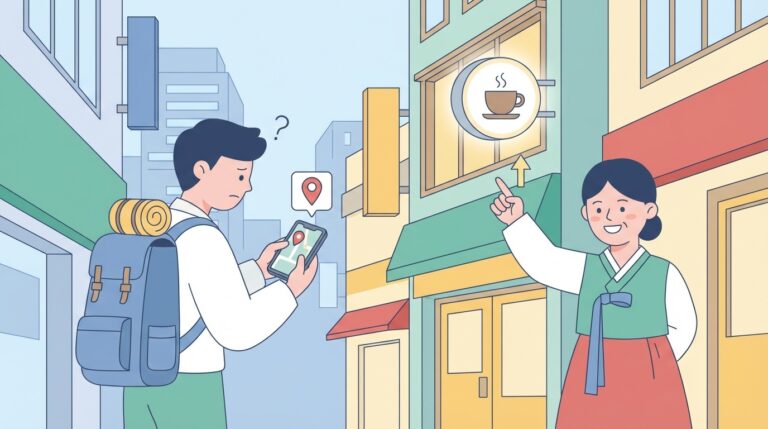
Picture this: You are standing right in the middle of Hongdae, Seoul’s trendiest neighborhood. Your map app (like Naver Map) says you have ‘Arrived’ at that famous aesthetic cafe you saw on Instagram. You look around, but all you see is a convenience store and a barbecue restaurant. You ask a passing student, ‘Cafe… where?’ They smile, point their finger to the sky, and say, ‘위에 있어요 (It’s up there)!’ You look up, and bam—there it is, hiding on the 3rd floor!
Seoul is a ‘vertical city.’ Because space is tight, many of the best K-Food spots, K-Beauty clinics, and K-Pop merch stores aren’t on the ground floor. If you don’t know how to look UP (위) or DOWN (아래), you might be walking in circles for hours! Today, we are going to learn the absolute basic location words so you can navigate Korea like a true local.
(Note: This guide is based on real SOS messages from my beginner students who got lost looking for underground subway stations and rooftop cafes!)
Phase 2: Core Expressions Deep Dive
Let’s master the two most important words for vertical navigation.
1. 위 (wi)
- Pronunciation: [wi] – Sounds exactly like the Nintendo ‘Wii’ or the English word ‘we’.
- Meaning: Up, top, above, upstairs.
- K-Culture Moment: You are in a K-Pop album store. The BTS albums are on the very top shelf, out of reach. The staff smiles and says, ‘위에 있어요’ (It’s on the top). Or think of the famous K-Drama The Penthouse—everyone is fighting to live at the ‘위’ (top)!
- Editor’s Insight: Just pointing up and saying ‘위, 위!’ (Up, up!) is perfectly understood when you’re in a hurry. It feels light and directional.
- Situation Spectrum:
- Casual with friends: ✅ (위에 있어!)
- Semi-formal (Store staff): ✅ (위에 있어요.)
- Formal (Boss/Elders): ✅ (위층에 있습니다.)
- 🤔 Think About It: In many languages, ‘up’ implies something positive or high status. Does your language associate ‘up’ with success, just like Korean dramas do with top-floor penthouses?
2. 아래 (arae) / 밑 (mit)
- Pronunciation: [ah-reh] / [meet] – ‘mit’ sounds like the English word ‘meat’, but make it short and snappy.
- Meaning: Down, below, underneath, bottom.
- K-Culture Moment: You drop your chopsticks at a busy Korean BBQ restaurant. The waiter brings you a new pair and points to the floor saying, ‘밑에 조심하세요’ (Careful down there). Or, you’re looking for the subway (지하철), and the sign points ‘아래’ (down).
- Editor’s Insight: ‘아래’ and ‘밑’ are mostly interchangeable for beginners. ‘밑’ often feels a bit more like ‘directly underneath’ (like under a table), while ‘아래’ is a broader ‘down/below’.
- Situation Spectrum:
- Casual with friends: ✅ (밑에 봐! – Look down!)
- Semi-formal (Public spaces): ✅ (아래로 가세요 – Go down.)
- Formal (Boss/Elders): ✅ (아래층에 있습니다 – It is downstairs.)
- 🤔 Think About It: Have you ever noticed how many Korean shopping malls have huge underground (지하 – below ground) sections? Why do you think underground spaces are so popular in Korea?
Phase 3: Textbook vs Real Korean
[Finding an item on a shelf]
* 📖 Textbook Korean: 책상 위에 있습니다. (chaeksang wie itseumnida. – It is on top of the desk.)
* 🗣️ Real Korean: 저기 위에요! (jeogi wieyo! – Up there!) While pointing.
* 💡 Why the difference?: Koreans love efficiency. In everyday speech, we completely drop the subject and verb if the context is obvious. Just say the location!
[Asking for directions to a cafe]
* 📖 Textbook Korean: 카페가 아래층에 있습니까? (kapega araecheunge itseumnikka? – Is the cafe on the lower floor?)
* 🗣️ Real Korean: 밑에 있어요? (mite isseoyo? – Is it down there?)
* 💡 Why the difference?: Adding ‘-에 있어요?’ (is it at…?) to a location word is the ultimate cheat code for beginners. It’s polite, natural, and super quick.
Bottom Note: For A1 beginners, don’t worry about complex grammar. Just attaching ‘에 있어요?’ (e isseoyo?) to ‘위’ or ‘밑’ is enough to survive and sound completely natural!
Phase 4: Cultural Context — K-Culture Deep Dive
4-1. Non-verbal Cue: The ‘Manner Hand’
When a Korean points ‘up’ or ‘down’ to show you a direction, especially if they are working in a store or hotel, notice their hands. They rarely point with just one index finger! Instead, they use their entire hand with the palm facing up. It’s a gesture of respect and politeness. Try doing this when you ask, ‘위에 있어요?’—you’ll look like a K-Culture pro!
4-2. The ‘Vertical City’ K-Travel Reality
If you’ve watched K-Dramas, you might notice that the wealthy characters always live in a ‘Penthouse’ overlooking the city, while struggling characters might live in a ‘Banjiha’ (반지하 – semi-basement), famously depicted in the movie Parasite. Space dictates status in media.
But for a traveler, the vertical city is simply a practical reality. Due to high rent, many amazing restaurants, PC Bangs (gaming cafes), and Coin Noraebangs (karaoke) are located on the 2nd, 3rd, or even 4th floors (위층), or deep in the basement (지하/아래층).
Pro tip: Stop looking just at eye level! Keep your eyes peeled on the vertical signboards attached to the sides of buildings.
Phase 5: Real-Life Roleplay Scenario
Setting: It’s a rainy Saturday afternoon in Myeongdong. You are inside a crowded Olive Young (Korea’s most famous health and beauty store). You’re looking for a specific viral K-Beauty pimple patch, but you can’t find it on the main display.
Characters:
– YOU: A beginner Korean learner, desperate for skincare.
– Sujin (수진): A very busy but friendly Olive Young staff member.
Dialogue:
YOU: 저기요… 이거 어디 있어요? 🥺
(jeogiyo… igeo eodi isseoyo?)
[Excuse me… where is this? (Showing a picture on your phone)]
(🎭 Stage Direction: Sujin squints at your phone and then smiles brightly)
Sujin: 아! 그거 2층에 있어요.
(a! geugeo icheunge isseoyo.)
[Ah! That’s on the 2nd floor.]
YOU: 2층이요?
(icheung-iyo?)
[The 2nd floor?]
Sujin: 네, 계단 위에 있어요.
(ne, gyedan wie isseoyo.)
[Yes, it’s up the stairs.]
🔀 Your Turn! How should you respond?
– A) 위… 위에요? 감사합니다! (wi… wieyo? gamsahamnida! – Up… up there? Thank you!) Pointing up
– B) 아래요? (araeyo? – Down there?)
– C) 안녕히 계세요. (annyeonghi gyeseyo. – Goodbye.)✅ Best Choice: A — Repeating the word ‘위’ while pointing confirms you understood! Sujin will likely nod enthusiastically.
⚠️ Choice B Analysis: If you say ‘아래’ (down), she might think you are confused and physically walk you to the stairs, which is nice, but means you failed the listening test!
Phase 6: 10-Second Shadowing Drill
Let’s practice saying these like a local. Follow the rhythm and emotions!
😊 저기 / 위에 / 있어요!
(jeogi / wi-e / isseoyo!)
[It’s up over there! – Bright and helpful tone]
👇 바로 / 밑에 / 있어요.
(baro / mit-e / isseoyo.)
[It’s right underneath. – Pointing down clearly]
Phase 7: K-Culture Mini Dictionary
| Korean | Romanization | English | Context/Explanation |
|---|---|---|---|
| 위층 | wi-cheung | Upstairs / Upper floor | You’ll see ‘층’ (floor) everywhere in elevators! |
| 아래층 | arae-cheung | Downstairs / Lower floor | Good for navigating multi-level cafes. |
| 지하 | ji-ha | Basement / Underground | ‘지하철’ (ji-ha-cheol) means subway. Literally ‘underground iron’. |
| 옥상 | ok-sang | Rooftop | Very romantic in K-Dramas! Many cafes have a ‘옥상’ level. |
Phase 8: Traveler Survival Kit
Navigating multi-story buildings in Korea can be confusing. Keep these phrases handy!
🆘 Survival Phrase #1
– 🇰🇷 “위층이에요?” (wicheung-ieyo?)
– 🗣️ Pronunciation: wi-cheung-ee-eh-yo?
– 📍 Where to use: Asking if a cafe or store is upstairs.
– 💡 Pro Tip: If you show a map to a local and ask this, they will usually nod YES or point DOWN.🆘 Survival Phrase #2
– 🇰🇷 “지하에 있어요?” (jiha-e isseoyo?)
– 🗣️ Pronunciation: jee-ha-eh ees-so-yo?
– 📍 Where to use: Looking for subway stations, underground malls, or food courts (which are almost always in department store basements!).
📌 Editor’s Travel Note:
– Map Apps: Google Maps doesn’t work well for walking directions in Korea. Download Naver Map or KakaoMap. However, even these apps struggle to tell you what floor you are on. If the GPS says you are there but you don’t see it, look 위 (Up)!
Phase 9: Critical Thinking — “One Step Deeper”
🧠 Think Deeper: The Space and the Language
Korea is mountainous, and Seoul is incredibly densely populated. Because they couldn’t build outward, they built up and down. This hyper-dense urban planning reflects directly in the language and daily lifestyle. When you learn ‘위’ and ‘아래’, you aren’t just learning directions; you are learning how Koreans navigate a 3D living space. The entire cafe culture, gaming culture, and dining culture have adapted to exist above and below the street level, creating a unique, multi-layered urban exploration experience.
💬 Your Turn: Does your home city have a lot of underground malls or rooftop cafes? How do people utilize vertical space in your culture? Share in the comments!
Phase 10: FAQ & Avoiding Misunderstandings
Q: Can I use ‘위’ (up) and ‘아래’ (down) to talk about people?
A: NO! Be careful here. In Korean culture, age and status are very important. But we do NOT say ‘That person is below (아래) me’ in casual conversation to mean they are younger or junior. It sounds extremely arrogant and rude! Stick to using ‘위’ and ‘아래’ strictly for objects, places, and physical directions for now.
❌ Common Mistake #1: Confusing 위 (wi – up) and 뒤 (dwi – behind).
✅ How to fix: They sound similar to beginners! Remember ‘wi’ sounds like ‘Wii’ (play your console looking UP at the TV), and ‘dwi’ has a hard ‘D’ sound.❌ Common Mistake #2: Looking for the ‘1st floor’ when you enter a building.
✅ How to fix: In Korea, the ground floor is the 1st floor (1층). There is no separate ‘Ground Floor’ button in the elevator. The floor above ground is 2층 (2nd floor).
Phase 11: Summary & Action Items
One-Liner Summary: To survive Seoul’s vertical city, remember to look UP (위) and DOWN (아래) when searching for your destination!
Action Mission:
– 🥉 Bronze (Solo): Look at your ceiling and say ‘위’, then look at your floor and say ‘아래’ 3 times.
– 🥈 Silver (Online): Go to a K-Pop MV on YouTube, find a scene where someone is on a rooftop, and comment ‘위에 있어요!’.
– 🥇 Gold (Real Life): Next time you are in an elevator with a Korean speaker, point to the buttons and ask, ‘위층이에요?’ (Is it upstairs?).
K-Culture Mission: Open Google Street View (or Naver Map street view) for ‘Hongdae Street’. Try to spot how many store signs are located on the 2nd or 3rd floors (‘위’). You’ll be amazed!
Phase 12: Interactive Quiz
1. You are looking for a K-Pop store. The building directory says ‘B1’. Where should you go?
A) 위 (Up)
B) 지하 (Basement / Underground)
C) 옥상 (Rooftop)
2. True or False: In Korea, it is common to find popular cafes on the 3rd or 4th floors.
– True / False
3. Fill in the blank:
You dropped your phone under the table. You point and say: “바로 ___에 있어요!”
A) 위 (wi)
B) 밑 (mit)
(Answers: 1: B, 2: True, 3: B)
Great job today! Next time you travel to Korea, you won’t be lost on the ground floor. See you in the next lesson!
Frequently Asked Questions (FAQ)
Q: What does "위 (wi)" mean in Korean and how do you pronounce it?
A: In Korean, "위 (wi)" is pronounced [wi] and means: Up, top, above, upstairs.
Q: What does "아래 (arae) / 밑 (mit)" mean in Korean and how do you pronounce it?
A: In Korean, "아래 (arae) / 밑 (mit)" is pronounced [ah-reh] and means: Down, below, underneath, bottom.







