

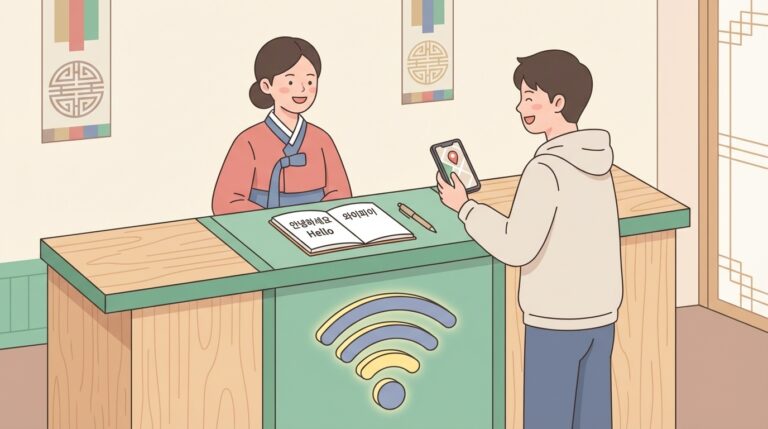
Phase 1: Empathy – The First Thing You Need After Landing
Hello! I’m your Daily Hangul editor.
Imagine this: You’ve just survived a 14-hour flight. You successfully navigated the subway from Incheon Airport, dragging your heavy suitcase all the way to your beautiful boutique hotel in Seoul. You drop your bags on the floor. You want to text your family “I’m safe!” or check your favorite K-Pop idol’s latest update on Weverse. But wait… international roaming is ridiculously expensive.
You need Wi-Fi. Fast.
In K-Dramas, you often see characters checking their phones the second they walk into a cafe or hotel lobby. That’s because Korea is a “Wi-Fi wonderland.” It’s everywhere! But to unlock this magic, you often need to ask the hotel front desk one simple, powerful question.
If you use the textbook phrase, the staff might look at you like you’re reading a Shakespeare play. Let’s learn how to ask for Wi-Fi exactly like a local Korean friend would! This guide is based on real struggles my beginner students face on their first day in Seoul.
Phase 2: Core Expressions Deep Dive
Let’s look at the absolute must-know phrases for your hotel stay.
1. 와이파이 되나요? (Is Wi-Fi available?)
- Pronunciation: [wa-i-pa-i doe-na-yo?]
(Tip:* ‘doe’ sounds like the ‘dwe’ in ‘dwell’, not like a female deer! And remember, there is no ‘F’ sound in Korean, so Wi-Fi becomes Wa-i-Pa-i!)*- Meaning: Literal = “Does Wi-Fi work/happen?” | Real nuance = “Is Wi-Fi available here?”
- K-Culture Moment: You will hear this phrase literally everywhere in Korea. Cafes, restaurants, even at the hair salon!
- Editor’s Insight: The magic word here is 되나요? (doe-na-yo?). It’s an incredibly useful chunk. You can put almost anything in front of it to ask “Is [X] available/allowed?”
- Situation Spectrum:
- Friends (Casual): ✅ (Just drop the ‘yo’: 와이파이 돼?)
- Hotel Staff/Strangers (Semi-formal): ✅ (Perfect!)
- Formal/Elders (Formal): ✅ (Still very polite)
- 🤔 Think About It: Koreans rarely say “Do you have Wi-Fi?” They ask “Does the Wi-Fi work/become available?” (되나요?). How does this reflect a culture focused on things functioning smoothly?
2. 비밀번호가 뭐예요? (What is the password?)
- Pronunciation: [bi-mil-beon-ho-ga mwo-ye-yo?]
(Tip:* ‘mwo’ sounds like ‘mwuh’.)*- Meaning: Literal = “What is the secret number?” | Real nuance = “What’s the password?”
- K-Culture Moment: In a K-Drama, when a spy breaks into a safe, they are looking for the ‘비밀번호’. But in everyday life, it’s just the Wi-Fi password!
- Editor’s Insight: 비밀 (Secret) + 번호 (Number). Isn’t that cute? Instead of a “password,” you are asking for their “secret number.”
- Situation Spectrum:
- Friends (Casual): ✅ (비밀번호 뭐야?)
- Hotel Staff (Semi-formal): ✅
- Formal/Elders (Formal): ✅
- 🤔 Think About It: Why do you think Koreans use the word “number” (번호) for passwords? Hint: Most Korean door locks and passwords heavily rely on number pads!
Phase 3: Textbook vs. Real Korean
[Asking if they have Wi-Fi]
* 📖 Textbook Korean: 와이파이를 사용할 수 있습니까? (Can I use the Wi-Fi?)
* 🗣️ Real Korean: 와이파이 되나요? (Is Wi-Fi available?)
* 💡 Why it’s different: Efficiency! Korea is famous for its “Palli-palli” (빨리빨리 – Hurry up) culture. “되나요?” is shorter, faster, and perfectly polite.
[Asking for the password]
* 📖 Textbook Korean: 비밀번호를 알려주세요. (Please inform me of the password.)
* 🗣️ Real Korean: 비번 뭐예요? (What’s the pw?)
* 💡 Why it’s different: Koreans love abbreviations. “비밀번호” (Bi-mil-beon-ho) is often shortened to “비번” (Bi-beon) in casual settings or among younger people.
Bottom Note: Since you are at an A1 (Absolute Beginner) level, sticking to “비밀번호가 뭐예요?” is the safest and most polite choice when talking to hotel staff!
Phase 4: Cultural Context — K-Culture Deep Dive
4-1. Non-verbal Communication: The Art of “Nunchi”
When asking for the Wi-Fi at a busy hotel desk, use a bit of Nunchi (눈치 – the ability to read the room). If the staff is typing furiously, wait a brief second. When you ask, make soft eye contact, maybe give a tiny head nod (a mini-bow), and ask, “저기요… 와이파이 되나요?” (Excuse me… is Wi-Fi available?).
4-2. The “Palli-Palli” Internet Infrastructure
If you watch K-Travel vlogs, you’ll notice foreigners are always shocked by Korea’s internet speed. Free Wi-Fi is considered almost a basic human right in Seoul! You’ll find it in subways, buses, and even public parks. Because of the Palli-palli (hurry up) culture, a slow internet connection is considered a national tragedy. So, never feel shy about asking for Wi-Fi in Korea; they expect you to want it instantly!
Phase 5: Real-Life Roleplay Scenario
Setting: 3:00 PM. The lobby of a trendy, neon-lit boutique hotel in Hongdae, Seoul. You are exhausted but excited. You just received your room key.
Characters:
– YOU: A beginner Korean learner, desperate to connect to the internet to use Google Maps.
– Ji-eun (25, Hotel Front Desk Staff): Friendly, efficient, and welcoming.
Dialogue:
Ji-eun: 객실 키 여기 있습니다. 체크아웃은 11시입니다. 🔑
(gaek-sil ki yeo-gi it-seum-ni-da. che-keu-a-u-seun yeol-han-si-im-ni-da.)
[Translation] Here is your room key. Check-out is at 11 AM.
YOU: 감사합니다. 저기요…
(gam-sa-ham-ni-da. jeo-gi-yo…)
[Translation] Thank you. Excuse me…
Ji-eun: 네, 손님. 더 필요한 거 있으세요?
(ne, son-nim. deo pi-ryo-han geo it-seu-se-yo?)
[Translation] Yes, guest. Is there anything else you need?
🔀 Your Turn! How do you ask for the Wi-Fi?
– A) “와이파이를 사용할 수 있습니까?” (Sounds like you’re reading a 1990s textbook)
– B) “와이파이 되나요?” (Natural, polite, and local)
– C) “와이파이 줘!” (Literally: Give me Wi-Fi! – Very rude!)✅ Best Choice: B — It’s the most natural way to ask.
⚠️ Choice C Analysis: Using “줘” (give me) without polite endings to a stranger will make you seem demanding and rude. Always use “요” (yo) at the end of your sentences!
(Continuing with B)
YOU: 와이파이 되나요?
(wa-i-pa-i doe-na-yo?)
[Translation] Is Wi-Fi available?
Ji-eun: 네, 무료 와이파이 가능합니다.
(ne, mu-ryo wa-i-pa-i ga-neung-ham-ni-da.)
[Translation] Yes, free Wi-Fi is available.
YOU: 비밀번호가 뭐예요?
(bi-mil-beon-ho-ga mwo-ye-yo?)
[Translation] What is the password?
(🎭 Stage Direction: You pull out your phone, ready to type)
Ji-eun: 카드키 케이스 뒷면에 적혀 있습니다!
(ka-deu-ki ke-i-seu dwin-myeo-ne jeo-kyeo it-seum-ni-da!)
[Translation] It’s written on the back of your key card case!
YOU: 아, 네! 감사합니다!
(a, ne! gam-sa-ham-ni-da!)
[Translation] Ah, yes! Thank you!
Phase 6: 10-Second Shadowing Drill
Let’s practice! Speak out loud and follow the feeling tags.
- 😊 밝게 (Brightly):
저기요, / 와이파이 / 되나요?
(jeo-gi-yo, / wa-i-pa-i / doe-na-yo?) - 🧐 궁금하게 (Curiously):
비밀번호가 / 뭐예요?
(bi-mil-beon-ho-ga / mwo-ye-yo?)
Phase 7: K-Culture Mini Dictionary
| Korean | Romanization | English | Context |
|---|---|---|---|
| 와이파이 | wa-i-pa-i | Wi-Fi | Notice the ‘p’ sound! There is no ‘F’ in Korean. |
| 비밀번호 | bi-mil-beon-ho | Password | Lit: Secret number. Often abbreviated to ‘비번’ (bi-beon). |
| 프론트 | peu-ron-teu | Front desk | Konglish! Koreans just say “front” for the hotel reception. |
| 빨리빨리 | palli-palli | Hurry up | The driving force behind Korea’s ultra-fast internet. |
| 데이터 | de-i-teo | Mobile Data | What you run out of when you watch too many K-Dramas on 5G. |
Phase 8: Traveler’s Survival Kit
Because you’re at a hotel, here are 3 more essential phrases you will absolutely need!
🆘 Survival Phrases for the Hotel
1. 🇰🇷 이거 무료예요? (i-geo mu-ryo-ye-yo?)
– 🗣️ Meaning: Is this free? (Essential before drinking that minibar water!)
2. 🇰🇷 충전기 있어요? (chung-jeon-gi it-seo-yo?)
– 🗣️ Meaning: Do you have a charger? (Many Korean hotels will lend you one!).
3. 🇰🇷 체크아웃 몇 시예요? (che-keu-a-ut myeot si-ye-yo?)
– 🗣️ Meaning: What time is check-out?📌 Editor’s Travel Note
– Finding the PW: You usually don’t even need to ask! In Korean hotels and cafes, the Wi-Fi password is almost always printed on your room key sleeve or at the bottom of your receipt (영수증).
– Public Wi-Fi: Seoul has “Public WiFi Free” almost everywhere, but it’s unsecured. If you’re buying concert tickets or doing banking, use your hotel’s secure network!
Phase 9: Critical Thinking Corner — “One Step Deeper”
Global Era & Konglish (English Loanwords in Korean)
Did you notice that “Wi-Fi” is just “와이파이” (wa-i-pa-i)? Korea uses hundreds of English loanwords, known as Konglish. However, because the Korean alphabet (Hangeul) has different sounds than English, the pronunciation changes entirely. There is no ‘F’, ‘V’, or ‘Z’ in Korean!
🧠 Think Deeper:
Some learners think Konglish makes learning Korean easier because the vocabulary is similar. Others find it confusing because they have to re-learn how to pronounce words from their own native language.💬 Your Turn: Do you find words like ‘와이파이’ (Wi-Fi) and ‘프론트’ (Front desk) helpful or confusing? Let us know in the comments!
Phase 10: FAQ & Avoiding Misunderstandings
- Q: Can I use the slang ‘비번’ (Bi-beon) with the hotel staff?
- Maybe, but better not. It’s slang. A young staff member at a hip hostel might smile, but a manager at a 5-star hotel might find it too casual. Stick to the full word “비밀번호” (bi-mil-beon-ho) to be safe and polite!
❌ Common Mistake #1: Trying to pronounce Wi-Fi with a strong English ‘F’ sound.
✅ Do this instead: Koreans might not understand you if you bite your lip to say “Fi”. Say it with a clean ‘P’ sound: “Wa-E-Pa-E”.❌ Common Mistake #2: Asking “Do you have…” by translating it directly.
✅ Do this instead: Use “~ 되나요?” (Is ~ available?) for services, and “~ 있어요?” (Does ~ exist?) for physical items (like a charger).
Phase 11: Summary & Action Items
- One-Liner Summary: To ask for Wi-Fi in Korea, forget the textbook and ask naturally: “와이파이 되나요? 비밀번호가 뭐예요?”
Action Mission:
– 🥉 Bronze (Solo): Stand in front of your mirror and practice saying “와이파이 되나요?” 3 times with a confident smile.
– 🥈 Silver (Online): Look around the room you are in right now. Pretend it’s a Korean cafe and say the phrase out loud.
– 🥇 Gold (Real Life): Next time you visit a Korean restaurant or grocery store in your country, ask the owner, “사장님, 와이파이 되나요?”
K-Culture Mission:
Watch one episode of your favorite K-Drama today. Look closely at the cafes or restaurants they visit. Can you spot a little sign on the wall or counter that says “Wi-Fi / 와이파이” with the password underneath?
Phase 12: Interactive Quiz
Let’s test what you’ve learned!
1. Situation Judgment: You are at a fancy hotel in Gangnam. You need the internet. What is the most natural and polite way to ask the staff?
– A) 와이파이 줘!
– B) 와이파이 되나요?
– C) 비번 뭐야?
2. Fill in the Blank:
“Excuse me, what is the password?”
“저기요, __________가 뭐예요?”
3. True or False – K-Culture Edition:
If you pronounce “Wi-Fi” with a perfect American ‘F’ sound, Koreans will understand you better. (T / F)
(Scroll down for answers!)
(Answers: 1. B – It’s polite and natural. A and C are too casual/rude. / 2. 비밀번호 / 3. False! You need to use the Korean ‘P’ sound: 와이파이 (wa-i-pa-i)!)
Frequently Asked Questions (FAQ)
Q: What does "와이파이 되나요? (Is Wi-Fi available?)" mean in Korean and how do you pronounce it?
A: In Korean, "와이파이 되나요? (Is Wi-Fi available?)" is pronounced [wa-i-pa-i doe-na-yo?] and means: Literal = "Does Wi-Fi work/happen?" | Real nuance = "Is Wi-Fi available here?"
Q: What does "비밀번호가 뭐예요? (What is the password?)" mean in Korean and how do you pronounce it?
A: In Korean, "비밀번호가 뭐예요? (What is the password?)" is pronounced [bi-mil-beon-ho-ga mwo-ye-yo?] and means: Literal = "What is the secret number?" | Real nuance = "What's the password?"







