

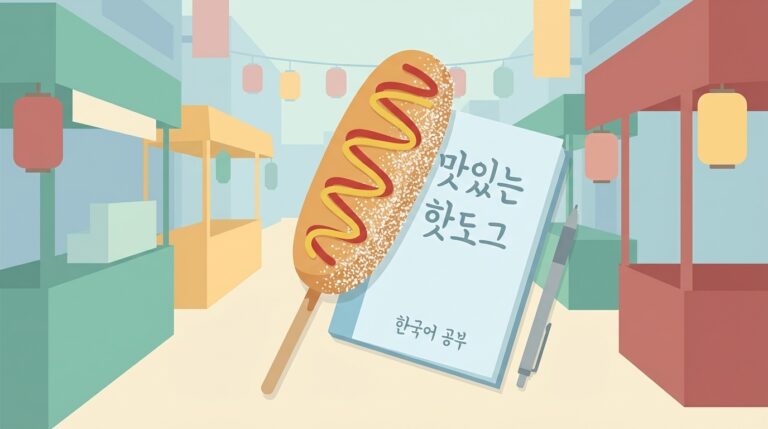
Why Sugar on a Hotdog? The Ultimate Korean Street Food Survival Guide
Phase 1: Empathy & K-Culture Cold Open
Hi there! I’m your Daily Hangul Editor.
Picture this: You are exploring the vibrant, neon-lit streets of Myeongdong or Hongdae. The smell of fried food is calling your name. You spot a stall selling “Hotdogs” (핫도그) and eagerly point to one.
But wait! The friendly stall owner (Ahjumma) picks up your freshly fried, crispy corndog and asks: “Seoltang balla deurilkkayo?”
Before you can process what she said, she rolls your savory sausage in… white sugar?!
If you grew up eating American hotdogs, sugar on a sausage might sound like a crime against food. But in Korea? It is the absolute law of street food! In K-Dramas like Start-Up, you’ve probably seen characters happily munching on these sweet, crispy, ketchup-drizzled treats.
If you don’t know the expressions we are covering today, you might end up with a sugary shock—or worse, miss out on the ultimate Korean “Dan-jjan” (Sweet & Salty) experience. Don’t worry! This guide is based on real moments my tutoring students have faced. Let’s learn how to order like a true Seoulite!
Phase 2: Core Expressions Deep Dive
Let’s look at the absolute must-know phrases for customizing your Korean corndog!
1. 설탕 묻혀주세요. (Please coat it in sugar.)
- Pronunciation: seoltang muchyeo-juseyo + [Sounds like: soul-tang moo-chyo joo-say-yo]
- Meaning: Literal: Please smear/coat sugar. / Real nuance: Roll it in sugar, please!
- K-Culture Moment: You are standing at a famous “Myungrang Hotdog” stall. The worker pulls your hotdog from the fryer. Saying this phrase confidently tells them you understand the true K-Food way.
- Editor’s Insight: The verb 묻히다 (muchida) means to coat or smear something lightly. It sounds so much more natural and native than using the word for “add” (추가하다).
- Situation Spectrum:
- Casual with friends: ✅ (설탕 묻혀줘!)
- Semi-formal (to stall owners): ✅ (설탕 묻혀주세요)
- Formal: 🚫 (Not needed for street food)
- 🤔 Think About It: Why does Korean food blend sweet and savory so often? The “Dan-jjan” (단짠) flavor profile is a huge trend in Korea because the sweetness cuts through the greasy/salty flavors, making you want to eat more! Does your culture have a similar sweet-and-salty combo?
2. 설탕은 빼주세요. (Please leave out the sugar.)
- Pronunciation: seoltangeun ppae-juseyo + [Sounds like: soul-tang-eun ppeh joo-say-yo]
- Meaning: Literal: Please remove the sugar. / Real nuance: No sugar for me, please.
- K-Culture Moment: Sometimes, you just want a classic savory bite. If you don’t say this, they might roll it in sugar automatically!
- Editor’s Insight: ‘빼주세요’ (ppae-juseyo) is your ultimate survival word in Korea! You can use it to remove anything you don’t like: onions (양파), spicy paste (고추장), or ice (얼음). The ‘pp’ sound is strong—like the sound you make when spitting out a watermelon seed!
- Situation Spectrum:
- Casual: ✅
- Semi-formal: ✅
- Formal: 🚫
- 🤔 Think About It: In Korea, customizing your order is very common and accepted. It reflects the fast, service-oriented “Pali-pali” (Hurry, hurry) culture where customer preference is handled instantly.
3. 소스는 제가 뿌릴게요. (I will put the sauce on myself.)
- Pronunciation: so-seu-neun jega ppurilge-yo + [Sounds like: so-seu-neun jay-ga poo-ril-ggeh-yo]
- Meaning: Literal: As for the sauce, I will sprinkle it. / Real nuance: I’ll handle the sauce!
- K-Culture Moment: In many Korean street food stalls, they have a whole “sauce station” with 5 different sauces. If you want to make an artistic zig-zag of ketchup and mustard for your Instagram photo, use this phrase!
- Editor’s Insight: 뿌리다 (ppurida) means to sprinkle or spray. You use this for sauces, perfume, or even watering plants!
- Situation Spectrum:
- Casual: ✅
- Semi-formal: ✅
- Formal: 🚫
Phase 3: Textbook vs Real Korean
[Situation 1: Approaching the Food Stall]
* 📖 Textbook Korean: 핫도그 하나 주십시오. (Please give me one hotdog. – Very stiff)
* 🗣️ Real Korean: 이모님~ 여기 핫도그 하나요! (Auntie~ One hotdog here!)
* 💡 Why the difference?: Calling friendly stall owners “이모님” (Auntie) builds instant rapport and reflects Korea’s relationship-based community culture.
[Situation 2: Asking for more sugar]
* 📖 Textbook Korean: 설탕을 더 첨가해 주시겠어요? (Would you please add more sugar?)
* 🗣️ Real Korean: 설탕 듬뿍 묻혀주세요! (Please coat it with plenty of sugar!)
* 💡 Why the difference?: Using the descriptive adverb “듬뿍” (deump-puk – generously/plenty) makes your Korean sound incredibly natural and cute!
Bottom Note: For A2 learners, using “~주세요” (Please give me / Please do for me) is the golden rule. It’s polite, safe, and works everywhere!
Phase 4: Cultural Context — K-Culture Deep Dive
4-1. Non-verbal cues: The “Nunchi” of Street Food
When you approach a bustling street food cart, use your Nunchi (눈치 – the subtle art of reading the room). If there’s a long line, decide your order before you reach the front. When taking your hotdog, try to receive it with two hands, or at least lightly support your right arm with your left hand. It’s a subtle sign of respect that stall owners deeply appreciate!
4-2. K-Food Connection: The “Dan-jjan” Philosophy
The Korean corndog isn’t just a snack; it’s the embodiment of “Dan-jjan” (단짠 – Sweet and Salty). You’ll see this everywhere in K-Culture: honey butter chips, sweet garlic fried chicken, and sugary garlic bread. In K-Dramas, sharing a sweet and salty street food is a classic bonding moment between friends or lovers. It represents finding comfort and joy in the little things. Just remember, in Korea, a “hotdog” (핫도그) means a corndog on a stick. If you want an American hotdog in a bun, you need to look for a “hotdog sandwich” or go to a specific bakery!
Phase 5: Real-Life Roleplay Scenario
Setting: It is 8:00 PM on a crisp Friday evening in the Hongdae Street Food Alley. The air is filled with indie music and the scent of fried batter. You step up to a popular stall.
Characters:
– YOU: A foreign traveler eager to try authentic K-Food.
– 이모님 (Imonim): A warm, energetic stall owner in her 50s wearing an apron.
Dialogue:
이모님: 어서 오세요! 뭐 드릴까요? 😊
(eoseo oseyo! mwo deurilkkayo?)
[Welcome! What can I get for you?]
YOU: 핫도그 하나 주세요.
(hatdogeu hana juseyo.)
[One hotdog, please.]
이모님: 네~ (Fryer sizzling) 자, 다 튀겼어요. 설탕 발라 드릴까요?
(ne~ ja, da twigyeosseoyo. seoltang balla deurilkkayo?)
[Okay~ Here, it’s fully fried. Shall I coat it in sugar?]
🔀 Your Turn! How will you respond?
– A) “네! 설탕 듬뿍 묻혀주세요!” (Yes! Please coat it with plenty of sugar!)
– B) “아니요, 설탕은 빼주세요.” (No, please leave the sugar out.)
– C) “설탕이요? 대박…” (Sugar? Jackpot/Crazy…)✅ Best Choice for K-Food Experience: A — If you want the true Korean street food experience, you must try it with sugar at least once!
⚠️ Choice B Analysis: Perfectly fine if you have a sweet tooth aversion, but you’re missing out on the magic!
⚠️ Choice C Analysis: A bit too casual for ordering, though the owner might chuckle at your reaction.
(Assuming you chose A)
이모님: 네! 맛있게 해줄게요. 소스는 어떻게 할래요?
(ne! masitge haejulgeyo. soseuneun eotteoke hallaeyo?)
[Yes! I’ll make it delicious. What about the sauce?]
YOU: 소스는 제가 뿌릴게요!
(soseuneun jega ppurilgeyo!)
[I’ll put the sauce on myself!]
(🎭 Stage Direction: You step over to the sauce station and artistically squeeze ketchup and mustard over the glittering sugar)
이모님: 맛있게 먹어요~!
(masitge meogeoyo~!)
[Enjoy your food~!]
YOU: 감사합니다! 많이 파세요!
(gamsahamnida! mani paseyo!)
[Thank you! Sell a lot! (A polite goodbye to vendors)]
Phase 6: 10-Second Shadowing Drill
Let’s practice the flow and intonation! Follow the slash (/) for pauses.
😊 이모님, / 설탕은 / 듬~~~뿍 / 묻혀주세요! (imo-nim, / seoltangeun / deum~~~ppuk / muchyeo-juseyo!)
Emotion: Speak brightly and playfully, extending the “듬” for emphasis!
😤 저는 / 단 거 싫어해요. / 설탕은 / 빼주세요. (jeo-neun / dan geo sileohaeyo. / seoltangeun / ppae-juseyo.)
Emotion: Firm but polite.
Phase 7: K-Culture Mini Dictionary
| Korean | Romanization | English | Cultural Context |
|---|---|---|---|
| 단짠 | dan-jjan | Sweet & Salty | A massive food trend in Korea. A combination of 달다 (sweet) and 짜다 (salty). |
| 이모님 | imo-nim | Auntie | Polite/affectionate way to address middle-aged women working at restaurants or stalls. |
| 포장마차 | pojang-macha | Street food tent | Traditional Korean street food stalls, often covered with orange or red tarps. |
| 핫도그 | hatdogeu | Corndog | In Korea, this strictly refers to a sausage on a stick coated in batter and deep-fried. |
Phase 8: Traveler Survival Kit
Even if you aren’t eating a hotdog, these phrases will save you at ANY street food stall in Korea!
🆘 Survival Expression #1
– 🇰🇷 “이거 얼마예요?” (igeo eolmayeyo?)
– 🗣️ English Sound: ee-go ohl-mah-yay-yo?
– 📍 Context: Pointing at food to ask “How much is this?”
– 💡 Pro Tip: If you can’t understand the Korean numbers they reply with, just hand them your phone with the calculator app open!🆘 Survival Expression #2
– 🇰🇷 “계좌이체 되나요?” (gyejwa-iche doenayo?)
– 🗣️ English Sound: gyeh-jwa-ee-chey dweh-nah-yo?
– 📍 Context: Asking “Can I do a bank transfer?”
– 💡 Pro Tip: Many street stalls prefer cash or local bank transfers over credit cards. Look for a sign with a bank logo and account number!📌 Editor’s Travel Note
– Apps: Use Naver Map or KakaoMap to find famous food alleys (like Gwangjang Market or Myeongdong).
– Trash: There are very few public trash cans in Korea! Usually, you hand your empty skewer or cup back to the stall you bought it from. They will happily throw it away for you.
Phase 9: Critical Thinking — “A Step Deeper”
Food & Identity: The Bonding Power of Street Food
Have you ever noticed in K-Dramas how characters always seem to eat together at food stalls after a long, hard day? In Korean culture, food is rarely an isolated experience. Eating street food—sharing a hotdog, splitting a plate of spicy Tteokbokki, or pouring fish cake soup for each other—is a profound way of breaking down social walls. It’s a quick, accessible equalizer. Even a CEO and an entry-level worker can share a laugh over a sugary corndog on the street.
🧠 Think Deeper:
The evolution of the “Dan-jjan” (sweet and salty) corndog shows how Korea adapts global concepts (the Western hotdog) and completely reinvents them to fit local tastes.💬 Your Turn: Does your country have a “fast food” or “street food” that is traditionally shared to build friendships? Tell us in the comments!
Phase 10: FAQ & Avoiding Misunderstandings
Q: Can I call ANY older woman “이모님” (Imonim)?
A: Maybe. It’s perfectly fine in casual restaurants and street food stalls. However, NEVER use it in a formal setting, an upscale restaurant, or a corporate office. In those places, use “저기요” (Excuse me) or their official title.
Q: Do I tip the street food vendor if they give me extra sauce or food?
A: NO! Korea is strictly a no-tip culture. If you try to give them extra money, they will chase you down the street thinking you forgot your change! A bright “감사합니다!” (Thank you!) is the best tip you can give.
❌ Common Mistake #1: Asking for a “Hotdog” and expecting a sausage in a bun.
✅ How to fix: If you want an American hotdog, you must go to a convenience store or bakery and ask for a “핫도그 샌드위치” (Hotdog Sandwich). On the street, “핫도그” is ALWAYS a fried corndog on a stick.
Phase 11: Summary & Action Items
One-Liner Summary: To enjoy a Korean hotdog like a local, confidently ask for sugar using “설탕 묻혀주세요” (Please coat it in sugar) or say “빼주세요” (Leave it out) to customize!
Action Mission 3 Steps:
– 🥉 Bronze (Solo): Stand in front of your mirror and practice saying “설탕은 빼주세요” 3 times with a polite smile.
– 🥈 Silver (Online): Go to a K-Food mukbang video on YouTube, find a corndog, and comment “설탕 듬뿍!” (Lots of sugar!).
– 🥇 Gold (Real Life): Visit a local Korean hotdog chain (like Myungrang Hotdog) in your city and order using today’s phrases!
🌟 Special K-Culture Mission:
Next time you watch a K-Drama set in Seoul, look closely at the street food scenes. Can you spot the sugar on their hotdogs?
Phase 12: Quiz — Interactive Challenge
Test your new K-Food street smarts!
1. You are at a stall. You hate sweet things on your savory food. What should you say?
A) 설탕 듬뿍 묻혀주세요. (seoltang deumppuk muchyeojuseyo)
B) 소스는 제가 뿌릴게요. (soseuneun jega ppurilgeyo)
C) 설탕은 빼주세요. (seoltangeun ppaejuseyo)
2. True or False: If the food is really cheap and delicious, you should leave a 2,000 won tip for the Ahjumma.
– T / F
3. Fill in the blank:
“The popular Korean flavor profile that mixes sweet and salty is called [ ____ ].”
(Answers: 1. C (A means lots of sugar, B is about sauce), 2. False! No tipping in Korea! 3. 단짠 / Dan-jjan)
What’s your favorite street food from your home country? Drop a comment below, and I might feature it in our next Daily Hangul lesson!
Frequently Asked Questions (FAQ)
Q: What does "설탕 묻혀주세요. (Please coat it in sugar.)" mean in Korean and how do you pronounce it?
A: In Korean, "설탕 묻혀주세요. (Please coat it in sugar.)" is pronounced [seoltang muchyeo-juseyo + [Sounds like: soul-tang moo-chyo joo-say-yo] and means: Literal: Please smear/coat sugar. / Real nuance: Roll it in sugar, please!
Q: What does "설탕은 빼주세요. (Please leave out the sugar.)" mean in Korean and how do you pronounce it?
A: In Korean, "설탕은 빼주세요. (Please leave out the sugar.)" is pronounced [seoltangeun ppae-juseyo + [Sounds like: soul-tang-eun ppeh joo-say-yo] and means: Literal: Please remove the sugar. / Real nuance: No sugar for me, please.
Q: What does "소스는 제가 뿌릴게요. (I will put the sauce on myself.)" mean in Korean and how do you pronounce it?
A: In Korean, "소스는 제가 뿌릴게요. (I will put the sauce on myself.)" is pronounced [so-seu-neun jega ppurilge-yo + [Sounds like: so-seu-neun jay-ga poo-ril-ggeh-yo] and means: Literal: As for the sauce, I will sprinkle it. / Real nuance: I'll handle the sauce!







