

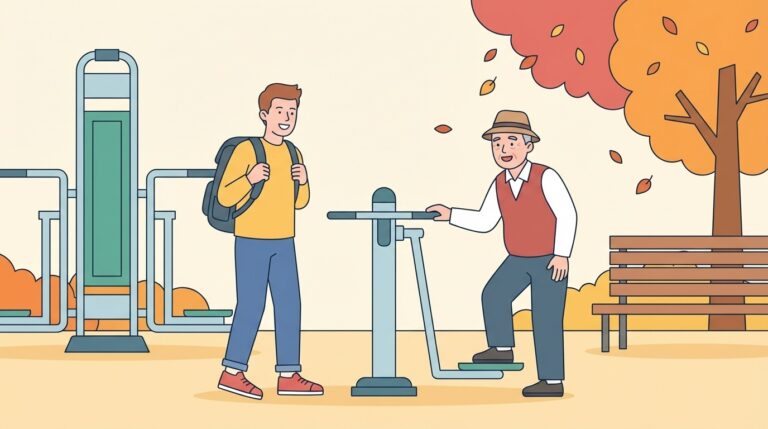
Phase 1: Empathy & K-Culture Cold Open
Hello! It’s your Daily Hangul Editor here.
Imagine this: It’s a breezy autumn evening in Seoul. You’re walking along the Han River after binge-watching a K-Drama where the main characters go for a night jog and end up having a heart-to-heart on a park bench. Suddenly, you spot a cluster of yellow, green, and blue metal contraptions.
An Ahjumma (middle-aged woman) is vigorously walking backwards on a path, clapping her hands. An Ahjussi (middle-aged man) is swinging on a waist-twisting machine with Olympic-level intensity. Welcome to the legendary 공스장 (Gongsjang – Park Gym)!
You decide you want to try the chest press machine to work off that delicious Chimaek (chicken and beer) you had earlier. But there’s a small towel draped over the handle. Is someone using it? Is it abandoned? Do you just stand there awkwardly, or do you point and gesture?
For many expats and travelers, these local public facilities can feel like a cultural obstacle course. If you don’t know the unwritten rules and the right phrases, you might accidentally offend a neighborhood elder. But if you know just a few lines? You’ll instantly earn insider status.
This guide is based on real SOS messages from my B1-level students who wanted to work out like locals but didn’t know how to navigate the “gym politics” of Korean parks!
Phase 2: Deep Dive into Core Expressions
Let’s look at the top 3 expressions you absolutely need when using public exercise equipment.
1. 여기 쓰시는 건가요?
- Pronunciation: yeogi sseusineun geongayo? (yeo-gi / sseu-shee-neun / geon-ga-yo? — The ‘eu’ in sseu sounds like the disgusted sound you make when stepping in gum!)
- Meaning: (Literal) Are you using here? / (Real Nuance) Excuse me, is anyone currently using this equipment?
- K-Culture Moment: You’ll hear this exactly when someone left a water bottle on a machine. In K-Dramas, this is often the ice-breaker line before two neighborhood characters start gossiping.
- Editor’s Insight: Notice the
-(으)시inserted in the middle? At the B1 level, you know this is the honorific marker. You are elevating the stranger (often an elder). It feels polite, cautious, and respectful. Asking “이거 당신 건가요?” (Is this yours?) sounds like you’re interrogating a suspect!- Situation Spectrum:
- Close Friends (Casual): 🚫 (Too formal)
- Strangers at the park (Semi-formal): ✅
- Direct Boss (Formal): ⚠️ (A bit too casual for the boardroom, but perfect for the park)
- 🤔 Think About It: Why do Koreans ask “Are you using here (여기)” instead of “Are you using this (이것)”? It shows how the Korean language often focuses on the shared space rather than the specific object.
2. 얼마나 남으셨어요?
- Pronunciation: eolmana nameuseosseoyo? (eol-ma-na / na-meu-shyeot-sseo-yo?)
- Meaning: (Literal) How much is left for you? / (Real Nuance) How many more sets/minutes do you have left?
- K-Culture Moment: You’re waiting for the only pull-up bar in the park. The person has been hanging there for 5 minutes. You politely ask this to claim your spot next in line.
- Editor’s Insight: This is the ultimate “Nunchi” (reading the room) question. You aren’t telling them to hurry up. You are merely gathering information so you can plan your workout. It’s gentle pressure wrapped in extreme politeness.
- Situation Spectrum:
- Close Friends (Casual): 🚫 (You’d just say “언제 끝나?” – When are you done?)
- Strangers at the park: ✅
- 🤔 Think About It: In your culture, is it normal to ask a stranger how much longer they will take, or is it considered rude to interrupt their workout?
3. 아, 먼저 하세요.
- Pronunciation: a, meonjeo haseyo. (ah / meon-jeo / ha-se-yo.)
- Meaning: (Literal) Ah, do it first. / (Real Nuance) Oh, please go ahead. I’ll wait.
- K-Culture Moment: You and an elder approach the elliptical machine at the exact same time. The elder hesitates. You hit them with a warm smile and this phrase. Instant respect points earned!
- Editor’s Insight: Koreans love offering the first turn as a sign of respect (양보 – yielding). Even if you were there a millisecond earlier, offering the spot to an older person is peak Korean manners.
- Situation Spectrum:
- Close Friends (Casual): 🚫 (Use “너 먼저 해” instead)
- Strangers/Elders: ✅
- Boss/Seniors: ✅
Phase 3: Textbook vs. Real Korean
Let’s compare what you learn in a classroom with what actually happens at a Seoul neighborhood park.
[Situation 1: Asking to use the equipment]
* 📖 Textbook Korean: 이 기구를 사용해도 됩니까? (May I use this equipment? – Extremely robotic)
* 🗣️ Real Korean: 저기요, 다 하신 건가요? (Excuse me, are you all done?)
* 💡 Why the difference?: Real spoken Korean focuses on confirming the other person’s status rather than directly asking for permission. It’s less imposing.
[Situation 2: Warning someone to be careful]
* 📖 Textbook Korean: 조심하십시오. (Please be careful. – Sounds like an automated subway announcement)
* 🗣️ Real Korean: 아이고, 조심해요! (Oh my, careful!)
* 💡 Why the difference?: Adding “아이고” (Aigo) injects instant emotion and empathy. It shows you care about their safety like a real neighbor.
Bottom Note: At the B1 level, moving away from the stiff
-(스)ㅂ니다endings and mastering the soft-(으)신 건가요?or-(으)세요endings makes you sound vastly more fluent and approachable.
Phase 4: Cultural Context — K-Culture Deep Dive
4-1. Non-Verbal Elements: Nunchi at the Park
Language isn’t just about words. In a Korean park, 눈치 (Nunchi – the subtle art of reading the room) is everything. If you see a half-empty water bottle, a small towel, or even a cell phone resting on a machine, it means the spot is occupied, even if the person is wandering around 10 meters away stretching. Do not touch the items! Instead, make eye contact with people nearby and use expression #1.
4-2. The “Sanseujang” & K-Drama Connection
You’ve definitely seen this in K-Dramas: the neighborhood park where characters go when they are stressed, thinking about their crush, or hiding from their parents.
In reality, these parks are communal hubs for the older generation. They are affectionately called 산스장 (Sanseujang) if they are on a mountain trail (Mountain + Gym) or 공스장 (Gongsjang) in a park (Park + Gym).
Critical View: While dramas often show young, beautiful leads working out alone at night, the reality is that daytime park gyms are dominated by Korean elders doing highly unconventional workouts (like aggressively bumping their backs against trees for blood circulation). Embracing this quirky reality is part of the true Korean experience!
Phase 5: Real-Life Roleplay Scenario
Setting: 7:00 PM on a Tuesday at a local park in Mapo-gu, Seoul. The autumn air is crisp. You want to use the “air walker” machine, but an older gentleman (Ahjussi) has his arm resting on the handle while talking to his friend. He hasn’t moved the machine for 5 minutes.
Characters:
– YOU: An expat living in Seoul, trying to get a quick workout in.
– Ahjussi (60s): Friendly neighborhood elder, currently deep in conversation about local real estate.
Dialogue:
YOU: 저기요… (Jeogiyo…)
(Excuse me…)
(🎭 Stage Direction: You approach cautiously, giving a slight bow)
Ahjussi: 네? 무슨 일이에요? (Ne? Museun irieyo?)
(Yes? What is it?)
YOU: 혹시… 여기 쓰시는 건가요? (Hoksi… yeogi sseusineun geongayo?)
(By any chance… are you using this?)
Ahjussi: 아유, 아니야 아니야. 그냥 기대고 있었어요. (Ayu, aniya aniya. Geunyang gidaego isseosseoyo.)
(Oh my, no, no. I was just leaning on it.)
🔀 YOUR TURN! How should you respond?
– A) “아, 그럼 비키세요!” (Ah, then move out of the way!)
– B) “네, 먼저 하세요.” (Yes, please go first.)
– C) “아, 그럼 제가 먼저 쓸게요. 감사합니다!” (Ah, then I’ll use it first. Thank you!)✅ Best Choice: C — You politely acknowledge his answer, announce your intention, and thank him.
⚠️ Choice A Analysis: NEVER say 비키세요 (Move) to an elder. It is extremely rude and aggressive!
⚠️ Choice B Analysis: He just said he isn’t using it, so telling him to “go first” will create a confusing, infinite loop of politeness.
(Bonus K-Drama Roleplay)
Imagine you bump into your K-Pop bias who is secretly working out at the Han River disguised in a hoodie and mask.
You: 헉… 혹시… (Heok… hoksi… – Gasp… by any chance…)
Idol: 쉿! 네, 맞아요. 비밀로 해주세요. (Swit! Ne, majayo. Bimil-lo haejuseyo. – Shh! Yes, that’s me. Please keep it a secret.)
You: 대박… 운동 열심히 하세요! (Daebak… undong yeolsimi haseyo! – Awesome… work out hard!)
Phase 6: 10-Second Shadowing Drill
Practice these lines out loud. Pay attention to the pauses (/) and the emotions!
- 🥺 Cautiously: 혹시 / 여기 / 쓰시는 건가요? (hoksi / yeogi / sseusi-neun geongayo?)
- 😊 Friendly: 아유~ / 제가 / 금방 끝나요! (a-yu~ / jega / geum-bang kkeut-nayo! – Oh my~ I’ll be done very soon!)
- 😌 Respectfully: 천천히 하세요. / 제가 / 기다릴게요. (cheon-cheon-hi haseyo. / jega / gida-ril-geyo. – Please take your time. I will wait.)
Phase 7: K-Culture Mini Dictionary
| 한국어 (Korean) | Romanization | English Meaning | Context |
|---|---|---|---|
| 공스장 | gongsjang | Park Gym | A portmanteau of 공원 (park) and 헬스장 (gym). |
| 산스장 | sanseujang | Mountain Gym | Outdoor gym equipment located on hiking trails. |
| 아이고 | aigo | Oh my / Oops | The ultimate Korean exclamation used for surprise, pain, or empathy. |
| 눈치 | nunchi | Social sense | The ability to read the atmosphere and understand unspoken social cues. |
| 양보 | yangbo | Yielding / Concession | Giving up your seat or turn to someone else, usually an elder. |
Phase 8: Traveler’s Survival Kit
Even if you’re just visiting Korea for a week, you’ll likely walk through a park. Here are survival phrases if things go wrong!
🆘 Survival Phrases at Public Facilities
– 🇰🇷 “이거 고장 난 것 같아요.” (igeo gojang nan geot gatayo.)
– 🗣️ Pronunciation: [ee-geo / go-jang / nan-geot / ga-ta-yo]
– 📍 Meaning: I think this is broken.
- 🇰🇷 “가까운 화장실이 어디예요?” (gakkaun hwajangsiri eodiyeyo?)
- 🗣️ Pronunciation: [ga-kka-un / hwa-jang-shil-ee / eo-di-ye-yo?]
- 📍 Meaning: Where is the nearest restroom?
📌 Editor’s Travel Note
– Useful Apps: Use Naver Map or KakaoMap to find “공중 화장실” (Public Restrooms) near parks. Google Maps doesn’t work well for walking paths in Korea.
– Hygiene: Outdoor park equipment is exposed to the elements. Bring a small pack of 물티슈 (wet wipes) to wipe down the handles before you use them. Locals will look at you with deep respect for your preparation!
Phase 9: Critical Thinking — “A Step Deeper”
Language & Power: Space, Community, and Honorifics
In many Western cultures, public spaces are highly individualized. You pop your earbuds in, ignore everyone, and do your workout. But in Korea, the Gongsjang is a communal space, tightly bound by the rules of age and respect.
When we use expressions like “여기 쓰시는 건가요?” (Are you using this?), the honorific -(으)시 isn’t just a grammar rule; it’s a verbal acknowledgment of the social hierarchy. By elevating the elder through your language, you immediately dissolve any potential tension over sharing the space. The elder feels respected, and in return, they usually treat you with incredible warmth, often giving up their machine for you immediately.
🧠 Think Deeper:
The Korean language builds “invisible bridges” between strangers based on age and respect.
💬 Your Turn: In your home country, how do strangers interact when sharing limited public equipment? Do you have specific polite phrases, or is it mostly non-verbal? Let us know in the comments!
Phase 10: FAQ & Common Mistakes
Q: Can I ask an elder “나이가 어떻게 되세요?” (How old are you?) at the park to know if I should use honorifics?
Editor says: NO. While Koreans do ask about age quickly to establish hierarchy, doing this as a foreigner with a stranger at the park is too sudden. Assume anyone who looks older than you gets the -(으)세요 (honorific) treatment!
Q: Can I tap someone’s shoulder if they have earphones in?
Editor says: Maybe, but carefully. Physical touch between strangers is generally avoided. It’s better to step into their line of sight and wave gently, then ask your question.
❌ Common Mistake #1: Pointing at the machine and saying “당신 거?” (Your thing?)
✅ Do this instead: Use an open hand (not one pointing finger) to gesture at the machine and say “여기 쓰시는 건가요?”
Phase 11: Summary & Action Items
- One-Liner Summary: Mastering the Korean park gym requires high Nunchi and the polite, honorific phrase: “여기 쓰시는 건가요?”
-
Action Mission 3 Steps:
- 🥉 Bronze (Solo): Stand in front of your mirror and practice the 10-second shadowing drill with the correct polite body language (slight bow).
- 🥈 Silver (Online): Go to Naver Maps Street View, drop yourself in a park along the Han River, and imagine exactly where you would use today’s phrase.
- 🥇 Gold (Real Life): Next time you are in Korea, go to a Gongsjang, find an open machine next to a local, and use the phrase before you hop on!
Engagement: Did you ever have a funny encounter at an outdoor gym in Korea or your own country? Drop your story in the comments below!
Phase 12: Quiz — Interactive Challenge
1. Situational Judgment:
You approach a free bench press in the park. A water bottle is sitting on it, but nobody is around. What should you do?
– A) Move the bottle and start lifting.
– B) Wait around, look for the owner, and ask “여기 쓰시는 건가요?”
– C) Throw the bottle away.
Answer: B! Remember the rule of Nunchi. An item means the spot is claimed! Moving it (A) is a big no-no.
2. Fill in the Blank:
You want to ask the Ajusshi how much longer he will be using the machine.
“얼마나 _________?” (How much longer do you have?)
Answer: 남으셨어요 (nameuseosseoyo)
3. True or False — K-Culture Edition:
“It is common to see Korean grandmothers walking backwards on park trails for their health.”
Answer: True! It’s believed to be great for balance and engaging different leg muscles. Just be careful not to bump into them!
Frequently Asked Questions (FAQ)
Q: What does "여기 쓰시는 건가요?" mean in Korean and how do you pronounce it?
A: In Korean, "여기 쓰시는 건가요?" is pronounced [yeogi sseusineun geongayo? (yeo-gi / sseu-shee-neun / geon-ga-yo? — The 'eu' in sseu sounds like the disgusted sound you make when stepping in gum!] and means: (Literal) Are you using here? / (Real Nuance) Excuse me, is anyone currently using this equipment?
Q: What does "얼마나 남으셨어요?" mean in Korean and how do you pronounce it?
A: In Korean, "얼마나 남으셨어요?" is pronounced [eolmana nameuseosseoyo? (eol-ma-na / na-meu-shyeot-sseo-yo?] and means: (Literal) How much is left for you? / (Real Nuance) How many more sets/minutes do you have left?
Q: What does "아, 먼저 하세요." mean in Korean and how do you pronounce it?
A: In Korean, "아, 먼저 하세요." is pronounced [a, meonjeo haseyo. (ah / meon-jeo / ha-se-yo.] and means: (Literal) Ah, do it first. / (Real Nuance) Oh, please go ahead. I'll wait.







