

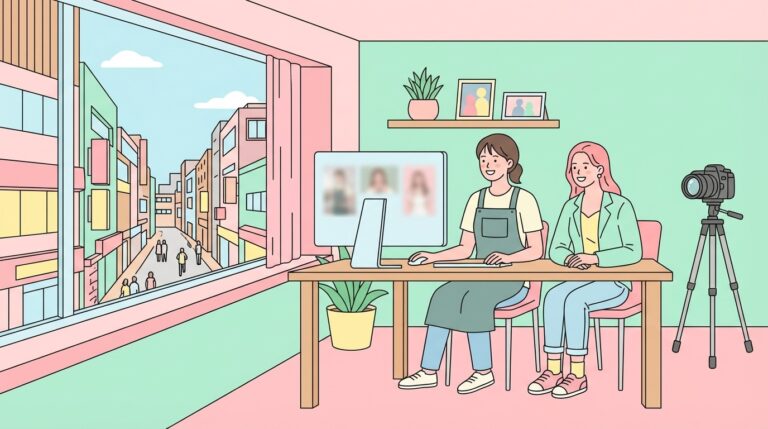
Phase 1: Empathy (The Magic of the Korean Photo Studio)
Hello! I’m your Daily Hangul Editor.
Let’s be honest. For most of us, taking a passport or ID photo back home is a traumatic experience. You sit under harsh fluorescent lights, and the result usually looks like a mugshot. But in Korea? It’s a completely different story.
Welcome to the magic of the Korean 사진관 (Sajingwan – Photo Studio)! Thanks to K-Beauty standards and world-class Photoshop skills, Korean ID photos (증명사진) are famous for making you look like the absolute best version of yourself. But what happens when the photographer is clicking away, and you want to ask them to fix that one annoying pimple or slim down your jawline just a tiny bit?
If you just say “Help me” or “Photoshop, please!” they might not understand exactly what you want. Today, I’ll teach you exactly how to ask for 보정 (Bo-jeong – Retouching) like a local, so you can walk out with a photo worthy of a K-Drama profile!
Phase 2: Core Expressions Deep Dive
Here are the top 3 phrases you need to communicate with your photo studio ‘magician.’
1. 보정 좀 해 주세요. (Please do some retouching.)
- Pronunciation: [bo-jeong jom hae ju-se-yo]
- Sound analogy: ‘bo’ like in ‘bow’, ‘jeong’ sounds like ‘jong’.
- Meaning: (Literal) Please do retouching a little. / (Real) Can you Photoshop this for me?
- K-Culture Moment: This is the magic word! Whether you are taking a passport photo, a profile picture, or taking selfies at a “Life Four Cuts” (인생네컷) photo booth, 보정 (bo-jeong) is the holy grail.
- Editor’s Insight: By adding 좀 (jom – a little), you make the request sound softer and more polite. It’s the linguistic cushion we use when asking for a favor.
- Situation Spectrum:
- Casual (Friends): ✅ (보정 좀 해 줘!)
- Semi-formal (Staff/Clerks): ✅ (보정 좀 해 주세요.)
- Formal (Boss): 🚫 (You wouldn’t ask your boss to photoshop you!)
- 🤔 Think About It: Why do Koreans prefer saying “do a little retouching” even when they want a lot of it done? It reflects the Korean value of modesty.
2. 피부 좀 깨끗하게 해 주세요. (Please clear up my skin.)
- Pronunciation: [pi-bu jom kkae-kkeu-ta-ge hae ju-se-yo]
- Meaning: (Literal) Please make skin clean. / (Real) Please smooth out my skin / remove blemishes.
- K-Culture Moment: Think of K-Drama actors with their flawless “glass skin.” When you ask for this, the photographer will erase blemishes, dark circles, and flyaway hairs to give you that glowing look.
- Editor’s Insight: You can replace ‘피부 (skin)’ with other parts. For example, 턱 (teok – jaw). If you want a V-line jaw, you can say “턱 좀 갸름하게 해 주세요” (Please make my jaw slimmer)!
- Situation Spectrum:
- Casual: ✅
- Semi-formal (To the photographer): ✅
3. 너무 과하지 않게, 자연스럽게 해 주세요. (Not too much, please make it natural.)
- Pronunciation: [neo-mu gwa-ha-ji an-ke, ja-yeon-seu-reop-ge hae ju-se-yo]
- Meaning: (Literal) Without being excessive, naturally do it please. / (Real) Please don’t make me look like an alien, keep it natural!
- K-Culture Moment: Sometimes, Korean photographers get a bit too enthusiastic with their editing skills, and you might not recognize yourself! Use this phrase to ensure you still look like you.
- Editor’s Insight: 자연스럽게 (naturally) is a favorite word in K-Beauty. Natural makeup, natural hair, natural retouching—it’s the ultimate compliment.
- Situation Spectrum:
- Casual: ✅
- Semi-formal: ✅
Phase 3: Textbook vs. Real Korean
How do real Koreans ask for edits at the studio?
[When asking to slim down your face]
* 📖 Textbook Korean: 얼굴을 작게 수정해 주시겠습니까? (Would you please modify my face to be smaller?)
* 🗣️ Real Korean: 턱 좀 깎아 주세요. (Please shave the jaw a bit.)
* 💡 Why the difference?: “깎다” literally means “to peel/shave” (like an apple). It sounds intense, but it’s the standard slang for “slimming down” the jawline in photos!
[When asking to fix flyaway hairs]
* 📖 Textbook Korean: 머리카락을 단정하게 만들어 주세요. (Please make my hair neat.)
* 🗣️ Real Korean: 잔머리 좀 정리해 주세요. (Please clean up my baby hairs.)
* 💡 Why the difference?: Photographers know exactly what “잔머리 (baby hairs/flyaways)” are. “정리하다 (to organize/clean up)” is widely used for fixing small messy details.
Bottom Note: For A2 learners, sticking to “[Noun] + 좀 해 주세요” is perfectly fine and polite!
Phase 4: Cultural Context — K-Culture Deep Dive
4-1. Non-verbal Communication: The 1:1 Editing Session
In Korea, many mid-to-high-end photo studios offer 1:1 보정 (1-on-1 retouching). The photographer will literally pull up a chair next to you. They will edit your face at lightning speed while you watch.
* Pro Tip: Don’t be shy! Point directly at the screen and say, “여기요 (Over here)” if you spot something you want changed. Koreans are very open about wanting to look good in photos.
4-2. The “Jeungmyeong Sajin” (ID Photo) Culture
If you watch K-Dramas, you might notice scenes where characters are preparing for job interviews. In Korea, submitting a photo with your resume was traditionally a strict requirement (though it’s changing now). Because a neat, trustworthy appearance was considered crucial, photo studios developed incredible skills to make job seekers look bright, sharp, and perfect. Getting your ID photo taken is almost considered an annual ritual for young Koreans!
Phase 5: Real-Life Roleplay Scenario
Setting: A trendy photo studio in Hongdae. You just finished taking your ID photos. The photographer (Sajang-nim) invites you to sit next to them at the computer for the 1:1 editing session.
Characters:
– YOU: An expat wanting a great photo for your new Korean resident card (ARC).
– Photographer (사장님): Fast, skilled, and eager to make you look like a K-Pop star.
Dialogue:
사장님: 사진 고를게요. 이 두 번째 사진이 제일 잘 나왔네요. 이걸로 할까요?
(sajin goreulgeyo. i du beonjjae sajini jeil jal nawatneyo. igeollo halkkayo?)
[I’ll choose the photo. This second one came out the best. Shall we go with this one?]
(🎭 Stage Direction: The photographer zooms in on your face on the huge monitor)
YOU: 네, 좋아요.
(ne, joayo.)
[Yes, I like it.]
사장님: 그럼 기본 보정 들어갈게요. 더 원하시는 곳 있으세요?
(geureom gibon bojeong deureogalgeyo. deo wonhasineun got isseuseyo?)
[Then I’ll start basic retouching. Is there anywhere else you want edited?]
🔀 Your Turn! How should you respond?
– A) “얼굴을 완전히 바꿔 주세요!” (Please completely change my face!)
– B) “피부 좀 깨끗하게 해 주시고, 자연스럽게 해 주세요.”
– C) “아니요, 그냥 프린트해 주세요.” (No, just print it.)✅ Best Choice: B — “Please clear up my skin, and make it look natural.” It’s polite, clear, and sets the right boundary.
⚠️ Choice A Analysis: You might end up looking like a completely different person! Your resident card photo might get rejected at immigration.
⚠️ Choice C Analysis: You’ll miss out on the legendary Korean photo magic! Let them do the basic retouching at least.
YOU: 피부 좀 깨끗하게 해 주시고, 자연스럽게 해 주세요.
(pibu jom kkae-kkeu-ta-ge hae ju-si-go, ja-yeon-seu-reop-ge hae ju-se-yo.)
[Please clear up my skin and make it look natural.]
사장님: 네~ 턱도 조금 깎아 드릴까요?
(ne~ teok-do jogeum kkakka deurilkkayo?)
[Okay~ Shall I shave down your jawline a bit too?]
YOU: 네! 조금만 해 주세요. 감사합니다!
(ne! jogeumman hae ju-se-yo. gam-sa-ham-ni-da!)
[Yes! Just a little bit please. Thank you!]
Phase 6: 10-Second Shadowing Drill
Let’s practice the flow! Pay attention to the pauses (/) and intonation.
- 🥺 Asking for a favor: 피부 좀 / 깨~~~끗하게 / 해 주세요.
(pibu jom / kkae~~~kkeutage / hae juseyo.) - 😤 Firm but polite: 너무 과하지 않게, / 자~연스럽게 해 주세요.
(neomu gwahaji anke, / ja~yeonseureopge hae juseyo.)
Phase 7: K-Culture Mini Dictionary
| Korean | Romanization | English | Contextual Meaning |
|---|---|---|---|
| 보정 | bo-jeong | Retouching | Any kind of digital photo editing to improve appearance. |
| 증명사진 | jeung-myeong-sa-jin | ID Photo | Literal translation: “Proof Photo.” Used for passports, IDs, and resumes. |
| 뽀샵 | ppo-syap | Photoshop | Slang for Photoshop. You can say “뽀샵해 주세요” (Please photoshop it). |
| 원본 | won-bon | Original File | The raw, unedited photo. Sometimes studios charge extra to give you the 원본. |
Phase 8: Traveler Survival Kit
Are you just visiting Korea and want to experience a trendy photo studio? Here are your survival phrases!
🆘 Survival Phrases for Photo Studios
– 🇰🇷 “얼마예요?” (eolmayeyo?) – How much is it?
– 🇰🇷 “언제 나와요?” (eonje nawayo?) – When will it be ready/come out?
– 🇰🇷 “이메일로 보내 주세요.” (imeillo bonae juseyo) – Please send it to my email.📍 Where to use: Photo studios, film development labs, “Life Four Cuts” booths (if you need help from staff).
💡 Pro Tip: In Korea, ID photos are usually printed AND emailed to you within 30 minutes to an hour!📌 Editor’s Travel Note
– Reservation: Popular studios (like Sihyunhada) require reservations weeks in advance via Naver or CatchTable!
– Makeup: Many studios have a “powder room” (파우더룸) with hair straighteners, hairspray, and sometimes even makeup you can use for free before your shoot.
Phase 9: Critical Thinking — “One Step Deeper”
🧠 Think Deeper: Media vs. Reality
Why is photo editing so deeply ingrained in Korean culture? In Korea’s highly competitive society, presenting a neat, well-groomed appearance is often viewed as a sign of diligence and respect for others. Photo retouching isn’t necessarily about “hiding” who you are; rather, it’s seen as presenting the most polished, ideal version of yourself. However, as the younger generation pushes back against strict beauty standards, natural and unedited profiles are slowly gaining popularity.💬 Your Turn: In your culture, is it common to heavily edit ID or resume photos? Or are strict “no filter” rules enforced? Let me know in the comments!
Phase 10: FAQ & Avoiding Mistakes
Q: “Can I ask them to edit my photo infinitely until I like it?”
A: Maybe… but read the room! (눈치 – nunchi). Most studios will happily make a few adjustments. However, if there are customers waiting, keeping the photographer for 30 minutes to fix one eyelash is considered rude.
Q: “Is ‘보정’ (bo-jeong) only used for faces?”
A: No! You can use it for anything. Color correction for landscape photos, adjusting lighting, or even editing audio can be called 보정.
❌ Common Mistake #1: Saying “포토샵 해 주세요” (Photoshop please) with a heavy English accent.
✅ Do this instead: They might understand, but saying “보정해 주세요 (bo-jeong-hae juseyo)” sounds much more natural and local.❌ Common Mistake #2: Assuming the printed photos are all you get.
✅ Do this instead: Always ask for the digital file! “파일로 받을 수 있나요?” (Can I get it as a file?) Most places provide a high-resolution JPG via email or a QR code.
Phase 11: Summary & Action Items
One-Liner Summary: When you want your Korean ID photo to look flawlessly natural, just ask the photographer: “자연스럽게 보정해 주세요!” (Please retouch it naturally!)
Your Action Missions:
– 🥉 Bronze (Solo): Look at your current ID photo and say out loud what you wish you could fix using today’s Korean phrases.
– 🥈 Silver (Online): Post a selfie on your favorite app and tag it with #보정 (It’s a very popular hashtag!).
– 🥇 Gold (Real Life): Visit a photo studio or a photo booth in Korea and ask the staff “원본 파일 받을 수 있나요?” (Can I get the original file?).
🎬 K-Culture Mission: Search for “Korean ID Photo Vlog” on YouTube and watch how the 1:1 retouching process looks in real life. It’s mesmerizing!
Phase 12: Interactive Quiz
Let’s test your new K-Photo Studio knowledge!
1. Fill in the Blank:
You want to ask the photographer to smooth out your skin.
“___ 좀 깨끗하게 해 주세요.”
– A) 머리 (Hair)
– B) 피부 (Skin)
– C) 옷 (Clothes)
2. True or False – K-Culture Edition:
In Korea, it takes about 3 days to get your printed ID photos after taking them.
– [True / False]
3. Situational Judgment:
The photographer edited your photo, but your eyes look huge and alien-like. What is the most polite and natural way to fix this?
– A) 너무 이상해요. (This is too weird.)
– B) 눈 보정해 주세요. (Retouch the eyes.)
– C) 조금 더 자연스럽게 해 주세요. (Please make it a bit more natural.)
(Answers: 1. B, 2. False – It usually takes less than an hour!, 3. C)
How did you do? Ready for your K-Beauty close-up? See you in the next Daily Hangul lesson! 😊
Frequently Asked Questions (FAQ)
Q: What does "보정 좀 해 주세요. (Please do some retouching.)" mean in Korean and how do you pronounce it?
A: In Korean, "보정 좀 해 주세요. (Please do some retouching.)" is pronounced [bo-jeong jom hae ju-se-yo] and means: a key conversational Korean expression covered in this lesson.
Q: What does "피부 좀 깨끗하게 해 주세요. (Please clear up my skin.)" mean in Korean and how do you pronounce it?
A: In Korean, "피부 좀 깨끗하게 해 주세요. (Please clear up my skin.)" is pronounced [pi-bu jom kkae-kkeu-ta-ge hae ju-se-yo] and means: (Literal) Please make skin clean. / (Real) Please smooth out my skin / remove blemishes.
Q: What does "너무 과하지 않게, 자연스럽게 해 주세요. (Not too much, please make it natural.)" mean in Korean and how do you pronounce it?
A: In Korean, "너무 과하지 않게, 자연스럽게 해 주세요. (Not too much, please make it natural.)" is pronounced [neo-mu gwa-ha-ji an-ke, ja-yeon-seu-reop-ge hae ju-se-yo] and means: (Literal) Without being excessive, naturally do it please. / (Real) Please don't make me look like an alien, keep it natural!







