

Phase 1: Empathy & K-Culture Cold Open
Hello! I’m your Daily Hangul editor.
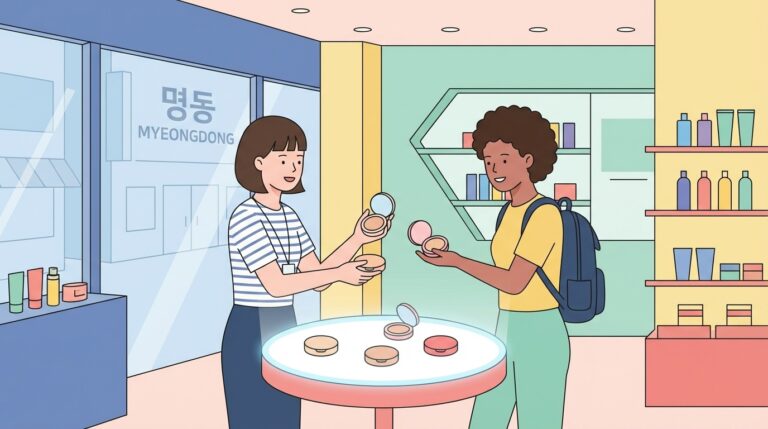
Picture this: You’re standing in the middle of Olive Young in Myeongdong. The bright lights are shining, a K-Pop hit is blasting from the speakers, and you are surrounded by walls of gorgeous cushion foundations. You want that flawless, dewy “glass skin” you saw on the lead actress in Queen of Tears.
But as you pick up a beautiful compact, you see the numbers: 13, 21, 23.
What do these numbers mean? You try to ask the incredibly stylish store clerk, but they start speaking rapid-fire Korean. You panic, grab a random box, and go home… only to realize it makes your face look like a pale ghost compared to your neck! 😱
Sound familiar? If you don’t know how to navigate a Korean Cosmetics Shop (화장품 가게) and ask for your foundation shade, K-Beauty shopping can turn into a nightmare. But don’t worry! This guide is based on real SOS messages from my beginner students who got lost in the foundation aisles. By the end of this post, you’ll be shopping like a K-Beauty insider.
Phase 2: Deep Dive into Core Expressions
Let’s master the top 3 expressions you need to find your perfect match.
1. 저한테 몇 호가 맞을까요?
- Pronunciation: jeo-hante myeot ho-ga maj-eul-kka-yo? [juh-hahn-teh myut ho-gah mah-jul-kkah-yo?]
- Meaning: (Literal) To me, which number will be correct? / (Real) Which shade suits me?
- K-Culture Moment: You look confused in front of the mirror. You make eye contact with the clerk, point to your cheek, and ask this. The clerk’s eyes light up, and they instantly bring over three different cushions to swatch on your jawline.
- Editor’s Insight: The word 호 (ho) means “number” or “size” in cosmetics. Unlike global brands that use names like “Sand” or “Ivory,” Korean brands famously use numbers.
- Situation Spectrum:
- Casual (Friends): ✅ (Drop the ‘yo’: 저한테 몇 호가 맞을까?)
- Semi-formal (Store Clerks): ✅
- Formal (Boss/Elders): 🚫 (You wouldn’t ask your boss this!)
- 🤔 Think About It: Why does Korea use numbers instead of descriptive names for shades? Does a number system feel more objective or limiting to you?
2. 이거 테스트해 봐도 돼요?
- Pronunciation: igeo teseuteu-hae bwado dwaeyo? [ee-guh teh-suh-teu-heh bwa-do dweh-yo?]
- Meaning: Can I test this?
- K-Culture Moment: You see a beautiful lip tint or foundation, but it looks brand new. In Korea, you should always ask or look for the “TESTER (테스터)” sticker before pumping a product.
- Editor’s Insight: Koreans use a lot of Konglish (Korean-English) in beauty! “테스트 (teseuteu)” is perfectly natural here.
- Situation Spectrum:
- Casual: ✅
- Semi-formal: ✅
- Formal: 🚫
- 🤔 Think About It: Notice how English words are adapted into everyday Korean? Can you think of any beauty terms in your language that came from another country?
3. 조금 더 어두운 거 / 밝은 거 있어요?
- Pronunciation: jogeum deo eo-du-un geo / bal-geun geo iss-eo-yo? [jo-geum duh uh-doo-oon guh / bal-geun guh iss-uh-yo?]
- Meaning: Do you have a slightly darker / brighter one?
- K-Culture Moment: The clerk applies shade 21 on your hand. It’s shockingly white. You smile politely and use this phrase.
- Editor’s Insight: 어두운 (eoduun) means dark, and 밝은 (balgeun) means bright. Use this when you need to adjust the shade.
- Situation Spectrum:
- Casual: ✅
- Semi-formal: ✅
- Formal: 🚫
Phase 3: Textbook vs. Real Korean
How does a textbook teach K-Beauty shopping versus what you actually hear in Myeongdong?
[Asking for a recommendation]
* 📖 Textbook Korean: 제 피부에 어울리는 색상을 추천해 주십시오. (Please recommend a color suitable for my skin.)
* 🗣️ Real Korean: 저한테 몇 호가 맞을까요? (Which shade suits me?)
* 💡 Why the difference?: Textbook Korean is too stiff! Busy retail clerks appreciate short, natural questions ending in “~까요?”
[Stating your preferred shade]
* 📖 Textbook Korean: 저는 23호를 사고 싶습니다. (I would like to buy shade 23.)
* 🗣️ Real Korean: 23호 주세요. / 23호 있어요? (Give me 23. / Do you have 23?)
* 💡 Why the difference?: In fast-paced Korean shops, simply stating the number and adding “있어요? (Do you have it?)” is the most efficient and natural way to shop.
Phase 4: Cultural Context — K-Beauty Deep Dive
4-1. Non-verbal Nuances: The “Jawline Swatch”
When you ask “몇 호가 맞을까요?”, don’t just point to your face. The standard K-Beauty practice is to offer your jawline or the back of your hand. The clerk will usually pump a tiny bit on their finger or a fresh sponge and gently tap it onto your skin.
4-2. The “Shade 21 Disease” (21호 병)
If you watch K-Dramas, you’ll notice the actors often have incredibly bright, pale skin. Historically, pale skin was a symbol of nobility in Korea (meaning you didn’t work in the sun). This evolved into the modern K-Beauty standard.
For years, Korean foundations came in exactly two shades: 21 (Bright/Light Beige) and 23 (Natural Beige). Many Koreans suffer from what the internet jokingly calls “Shade 21 Disease” (21호 병)—insisting on buying Shade 21 because they want to look brighter, even if their true match is 23 or 25! If a clerk recommends a darker shade, don’t be offended; they are actually trying to help you avoid the “floating face” look!
Phase 5: Real-Life Roleplay Scenario
Setting: Olive Young in Gangnam, 3:00 PM. Upbeat K-Pop is playing. You are looking for a famous cushion foundation.
Characters:
– YOU: A traveler exploring Seoul, hoping to buy some K-Beauty items.
– Clerk (Jimin, 20s): Friendly, energetic, speaks incredibly fast.
Dialogue:
Jimin: 어서오세요! 찾으시는 거 있으세요? 😊
(eoseo-oseyo! chajeusineun geo isseuseyo?)
[Welcome! Are you looking for anything?]
YOU: 네, 저 쿠션 파운데이션 찾고 있어요.
(ne, jeo kusyeon paundeisyeon chatgo isseoyo.)
[Yes, I’m looking for a cushion foundation.]
Jimin: 아, 이쪽으로 오세요. 이 제품이 요즘 제일 인기 많아요! 베스트셀러예요.
(a, ijjogeuro oseyo. i jepumi yojeum jeil ingi manayo! beseuteuselleoyeyo.)
[Ah, come this way. This product is the most popular lately! It’s a best-seller.]
YOU: 오, 좋아요. 저한테 몇 호가 맞을까요?
(o, joayo. jeohante myeot hoga majeulkkayo?)
[Oh, great. Which shade would fit me?]
Jimin: 고객님은 피부가 밝으셔서 21호 쓰시면 될 것 같아요.
(gogaengnimeun pibuga balgeusyeoseo isibil-ho sseusimyeon doel geot gatayo.)
[Since your skin is bright, I think you can use shade 21.]
YOU: 이거 테스트해 봐도 돼요?
(igeo teseuteuhae bwado dwaeyo?)
[Can I test this?]
Jimin: 네! 손등에 한번 발라보세요.
(ne! sondeunge hanbeon ballaboseyo.)
[Yes! Try applying it on the back of your hand.]
(🎭 Stage Direction: You pump the tester and put it on your hand. It’s blindingly white.)
🔀 Your Turn! How should you reply?
– A) “너무 하얘요! 귀신 같아요!” (It’s too white! I look like a ghost!)
– B) “조금 더 어두운 거 있어요?”
– C) “괜찮네요. 그냥 이거 살게요.” (It’s fine. I’ll just buy this.)✅ Best Choice: B — “조금 더 어두운 거 있어요?” (Do you have a slightly darker one?). It’s polite and directly solves your problem.
⚠️ Choice A Analysis: While funny, saying “I look like a ghost” might confuse the clerk or sound a bit too dramatic for a casual shopping interaction!
YOU: 음… 조금 더 어두운 거 있어요?
(eum… jogeum deo eoduun geo isseoyo?)
[Hmm… do you have a slightly darker one?]
Jimin: 아, 그럼 23호 테스트해 드릴게요. 이게 더 자연스럽네요!
(a, geureom isipsam-ho teseuteuhae deurilkkeyo. ige deo jayeonseureomneyo!)
[Ah, then I’ll let you test shade 23. This is more natural!]
YOU: 네, 이거 마음에 들어요. 이걸로 주세요!
(ne, igeo maeume deureoyo. igeollo juseyo!)
[Yes, I like this. I’ll take this one!]
Phase 6: 10-Second Shadowing Drill
Practice reading this out loud. Focus on the intonation and pauses!
😊 저한테 / 몇 호가 / 맞을까요?
(jeo-hante / myeot ho-ga / maj-eul-kka-yo?)
🥺 조금 더 / 어두운 거 / 있어요?
(jogeum deo / eo-du-un geo / iss-eo-yo?)
Phase 7: K-Culture Mini Dictionary
| Korean | Romanization | English | Context |
|---|---|---|---|
| 호 (호수) | ho (hosu) | Shade / Number | Used for foundation, lipstick numbers, and even apartment rooms! |
| 쌩얼 | ssaeng-eol | Bare face | No-makeup face. Often used in K-Pop when idols do live streams without makeup. |
| 쿠션 | kusyeon | Cushion foundation | Korea’s revolutionary makeup invention. A sponge soaked in foundation. |
| 올영 | ol-yeong | Olive Young | The short, slang name for Korea’s biggest drugstore chain. |
| 촉촉하다 | chok-chok-hada | Dewy / Moist | The ultimate goal of K-Beauty skincare (think “glass skin”). |
Phase 8: Traveler’s Survival Kit
If you are shopping for cosmetics in Korea, keep these lifesavers in your back pocket!
🆘 Survival Phrases TOP 3
– 🇰🇷 “이거 얼마예요?” (i-geo eol-ma-ye-yo?)
– 🗣️ Meaning: How much is this?
– 🇰🇷 “새 거 있어요?” (sae geo iss-eo-yo?)
– 🗣️ Meaning: Do you have a new one? (Don’t buy the tester!)
– 🇰🇷 “텍스프리 돼요?” (tek-seu-peu-ri dwae-yo?)
– 🗣️ Meaning: Is tax-free available?📌 Editor’s Travel Note
– Instant Tax-Free: Places like Olive Young offer immediate tax refunds at the counter if you spend over a certain amount (usually 30,000 KRW). Always bring your physical passport!
– Free Samples (샘플): If you buy a lot at a Myeongdong road shop, they might throw in a handful of free mask sheets or serum packets. Say “감사합니다!” (Thank you!)
Phase 9: Think Deeper — “One Step Further”
Korean in the Global Era: The Evolution of K-Beauty Shades
For a long time, the Korean cosmetics market was highly homogenous. If your skin tone didn’t fit into the magic numbers “21” or “23,” you simply couldn’t buy foundation in Korea. However, as K-Pop and K-Dramas exploded globally, Korean brands realized their global fans have beautifully diverse skin tones.
Today, global-facing K-Beauty brands offer up to 30 shades online! Yet, if you walk into a physical store in Seoul, you might still only see 3 or 4 bright shades on the display. This physical limitation reflects a society in transition—balancing its deep-rooted local beauty standards with its new identity as a global cultural powerhouse.
💬 Your Turn: Does your country have a specific beauty standard that influences how makeup is sold? Let me know in the comments!
Phase 10: FAQ & Avoiding Mistakes
Q: Can I just open any box to test the color?
No! 🚫 Only use the products that clearly have a “테스터” (TESTER) sticker on them. Opening a sealed box means you have to buy it.
Q: If the clerk says “Your skin is so white (하얘요),” is that an insult?
Not at all! In Korea, saying someone’s skin is “white” (하얗다) or “clear” (맑다) is considered a massive compliment.
❌ Common Mistake #1: Pumping the tester foundation directly onto your cheeks.
✅ Do this instead: Because hundreds of people use testers, it’s more hygienic to test it on the back of your hand or the very edge of your jawline.
Phase 11: Summary & Action Items
One-Liner Summary: To find your perfect K-Beauty foundation, remember the magic numbers (21, 23) and ask, “저한테 몇 호가 맞을까요?”
Your Action Missions:
– 🥉 Bronze (Solo): Look in the mirror and ask your reflection, “저한테 몇 호가 맞을까요?” three times.
– 🥈 Silver (Online): Look up your favorite K-Beauty brand online and see how many “호” (shades) they offer.
– 🥇 Gold (Real Life): Next time you pass by a Korean cosmetics store (or an Asian beauty market), go inside and ask the clerk about their foundation shades in Korean!
🎯 K-Culture Special Mission: Watch a “Get Ready With Me” (GRWM) vlog from your favorite K-Pop idol on YouTube. Listen closely—can you hear them mention what “호” (shade number) they use?
Phase 12: Interactive Quiz
Let’s test your K-Beauty shopping skills!
1. Fill in the blank:
You want to see if the store has a darker shade.
“조금 더 ______ 거 있어요?”
(A) 밝은 (balgeun)
(B) 비싼 (bissan)
(C) 어두운 (eoduun)
2. True or False — K-Culture Edition:
“In Korean cosmetic shops, it is totally fine to open a new, sealed box to check the color if you can’t find a tester.”
3. Situational Judgment:
The clerk applies shade 21 to your hand, but you want to try the classic “natural beige” shade instead. What number should you ask for?
(A) 13호 (13-ho)
(B) 23호 (23-ho)
(C) 99호 (99-ho)
🚨 Click here for the answers!
1. (C) 어두운 (eoduun) means dark. 밝은 means bright, and 비싼 means expensive.
2. False! Always look for the product with the “테스터” (TESTER) sticker. Opening a sealed product is a big no-no.
3. (B) 23호 (23-ho). In the Korean system, 21 is bright beige and 23 is natural beige!
Did you get them all right? Now you’re officially ready to conquer Myeongdong! See you in the next lesson! 💖
Frequently Asked Questions (FAQ)
Q: What does "저한테 몇 호가 맞을까요?" mean in Korean and how do you pronounce it?
A: In Korean, "저한테 몇 호가 맞을까요?" is pronounced [jeo-hante myeot ho-ga maj-eul-kka-yo? [juh-hahn-teh myut ho-gah mah-jul-kkah-yo?] and means: (Literal) To me, which number will be correct? / (Real) Which shade suits me?
Q: What does "이거 테스트해 봐도 돼요?" mean in Korean and how do you pronounce it?
A: In Korean, "이거 테스트해 봐도 돼요?" is pronounced [igeo teseuteu-hae bwado dwaeyo? [ee-guh teh-suh-teu-heh bwa-do dweh-yo?] and means: Can I test this?
Q: What does "조금 더 어두운 거 / 밝은 거 있어요?" mean in Korean and how do you pronounce it?
A: In Korean, "조금 더 어두운 거 / 밝은 거 있어요?" is pronounced [jogeum deo eo-du-un geo / bal-geun geo iss-eo-yo? [jo-geum duh uh-doo-oon guh / bal-geun guh iss-uh-yo?] and means: Do you have a slightly darker / brighter one?







