

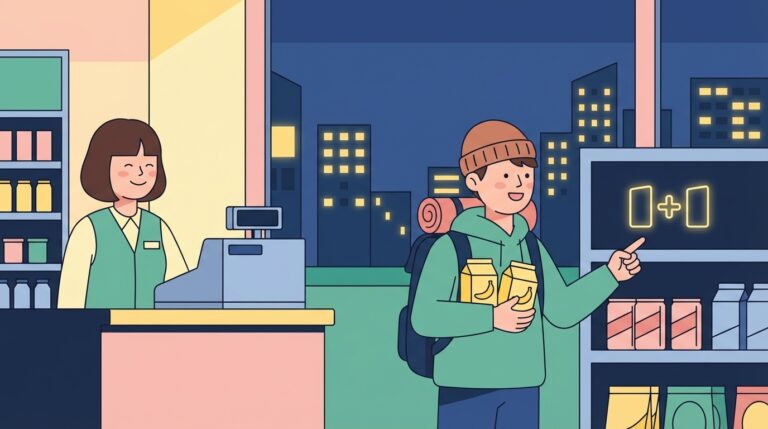
Crack the Code of Korean Convenience Stores: Never Miss a 1+1 Deal!
Phase 1: Empathy & The “Convenience Store” Magic
Hello! I’m your Daily Hangul Editor, your local Korean friend and veteran tutor.
Picture this: You’re watching your favorite K-Drama. The main characters are sitting outside a brightly lit convenience store at midnight, eating steaming cup ramen and drinking sweet banana milk. You finally travel to Korea, step into a local CU, GS25, or 7-Eleven, and feel the cool air conditioning. You see colorful tags everywhere saying “1+1” or “2+1”.
You grab one bag of chips and head to the counter. The cashier scans it, looks at you, says something incredibly fast in Korean, and points back to the snack aisle. You freeze. Did I do something wrong? Is my card declined?
Sound familiar? Don’t panic! I’ve seen countless beginners freeze at the counter. Today, we’re going to learn exactly what the cashier is saying and how you can shop like a true Korean local. By the end of this guide, you will never miss a free snack again!
Phase 2: Core Expressions Deep Dive
Let’s learn the most important phrases you need for “Buy One Get One” (BOGO) deals in Korea.
1. 이거 원플러스원이에요?
- Pronunciation: igeo won-peulleoseu-won-ieyo? [ee-guh won-plus-won ee-eh-yo?]
- Meaning: Is this Buy One Get One Free?
- K-Culture Moment: You bring a drink to the counter, but you’re not sure if the promotion tag was for this exact flavor. Asking this simple question makes you look like a savvy shopper!
- Editor’s Insight: Notice how Koreans use the English words “One Plus One” instead of a traditional Korean phrase! It’s a perfect example of Konglish (Korean + English) used in everyday life.
- Situation Spectrum:
- Casual (Friends): ✅ (Drop the ‘ieyo’ -> 이거 원플러스원이야?)
- Semi-formal (Clerks/Strangers): ✅ (Perfect!)
- Formal (Bosses/Elders): ⚠️ (You rarely talk about 1+1 deals with your CEO!)
- 🤔 Think About It: Why do you think Korea adopted the English phrase “1+1” instead of creating a new Korean word for “BOGO”? Does your language use English words for marketing?
2. 하나 더 가져오세요.
- Pronunciation: hana deo gajyeo-oseyo. [ha-na duh ga-jyeo-oh-se-yo]
- Meaning: Please bring one more.
- K-Culture Moment: This is the phrase the cashier will say when you only bring one item of a 1+1 deal to the counter. They are literally pausing the line to make sure you get your free item!
- Editor’s Insight: You don’t need to say this phrase, but you absolutely must understand it. If you hear “hana deo” (one more), just nod, run back to the aisle, and grab your freebie!
- Situation Spectrum:
- You will hear this from store clerks: ✅
- 🤔 Think About It: In some countries, if you don’t bring the free item, you just lose it. In Korea, the cashier almost always tells you to go get it. How does this reflect the Korean concept of Jeong (warm-heartedness/caring)?
Phase 3: Textbook vs. Real Korean
Let’s see how real life differs from your Korean textbook!
[Asking about a promotion]
* 📖 Textbook Korean: 하나를 사면 하나를 무료로 줍니까? (If I buy one, do you give one for free?)
* 🗣️ Real Korean: 이거 원플러스원이에요? (Is this 1+1?)
* 💡 Why the difference?: Efficiency! Convenience stores are fast-paced. “원플러스원” (won-peulleoseu-won) is instantly recognized by everyone, whereas the textbook phrase sounds like a robot from the 1980s.
[When the cashier asks if you want a bag]
* 📖 Textbook Korean: 비닐봉투가 필요하십니까? (Do you require a plastic bag?)
* 🗣️ Real Korean: 봉투 필요하세요? (bongtu piryohaseyo? – Need a bag?)
* 💡 Why the difference?: In fast interactions, Koreans drop unnecessary words like “plastic” or formal endings to keep the line moving quickly.
Bottom Note: For A1 beginners, don’t worry about speaking in long, perfect sentences. Short, polite phrases ending in “~요 (~yo)” are your best friends!
Phase 4: Cultural Context — K-Culture Deep Dive
4-1. Non-Verbal Elements (눈치 – Nunchi in the Store)
Korean convenience stores operate on speed. The cashier will scan your items in a flash. Have your physical card or Apple/Samsung Pay ready! You don’t need to bow deeply, but a quick head nod and a simple “감사합니다 (gam-sa-ham-ni-da)” when you take your receipt is the perfect display of good manners.
4-2. The K-Drama Late-Night Run
Have you noticed that K-Drama characters always go to the convenience store when they are sad, angry, or secretly dating? The convenience store (편의점 – pyeon-ui-jeom) is a core part of Korean modern life. They are open 24/7.
When a character buys a “2+1” (Buy 2 Get 1) item, they often keep two and give the third one to their friend or crush. Offering that “+1” item is a modern, subtle way of saying, “I care about you!”
Phase 5: Real-Life Roleplay Scenario
Setting: It’s 11:30 PM. You just finished a long day exploring Seoul. You walk into a brightly lit GS25 near your hotel. You crave something sweet and grab one bottle of Strawberry Milk.
Characters:
– YOU: A tired but happy traveler (A1 level Korean!).
– Ji-hoon (22): The part-time cashier. He is wearing a blue vest and moving very quickly.
(You place your one Strawberry Milk on the counter.)
Ji-hoon: 어서 오세요. (eoseo oseyo.)
[Welcome.]
(🎭 Stage Direction: Ji-hoon scans the milk. *BEEP)*
Ji-hoon: 손님, 이거 원플러스원이에요. 하나 더 가져오세요.
(sonnim, igeo won-peulleoseu-won-ieyo. hana deo gajyeo-oseyo.)
[Customer, this is 1+1. Please bring one more.]
(🎭 Stage Direction: Ji-hoon points back to the dairy section.)
YOU: 아! 원플러스원… 다른 맛도 돼요?
(Ah! won-peulleoseu-won… dareun mat-do dwaeyo?)
[Ah! 1+1… Can I get a different flavor?]
Ji-hoon: 네, 교차 가능해요. 초코 우유도 돼요.
(ne, gyocha ganeunghaeyo. choko uyu-do dwaeyo.)
[Yes, you can mix. Chocolate milk is okay too.]
YOU: 감사합니다!
(gamsahamnida!)
[Thank you!]
(🎭 Stage Direction: You run back and grab a Chocolate Milk. You place it on the counter.)
Ji-hoon: 봉투 필요하세요?
(bongtu piryohaseyo?)
[Do you need a bag?]
🔀 Your Turn! How do you answer Ji-hoon?
– A) “아니요, 괜찮아요.” (aniyo, gwaenchanayo. – No, it’s okay.)
– B) “네, 주세요.” (ne, juseyo. – Yes, please give me one.)
– C) “대박!” (daebak! – Awesome!)✅ Best Choice: A or B! If you have a backpack, “아니요, 괜찮아요” is perfect. If you need a bag (which usually costs 20 to 50 won), say “네, 주세요”.
⚠️ Choice C Analysis: Saying “Daebak!” when asked if you want a bag will make the cashier very confused. Save “Daebak” for when you see your favorite idol!
Bonus Roleplay: The Smart Shopper
(Sometimes you don’t want to carry the second item right now!)
YOU: 이거 나중에 받을 수 있어요?
(igeo najunge badeul su isseoyo? – Can I get this later?)
Cashier: 네, 앱 있으세요?
(ne, aep isseuseyo? – Yes, do you have the app?)
(K-Culture Fact: CU and GS25 have apps where you can save your “+1” item in a digital “fridge” to pick up another day!)
Phase 6: 10-Second Shadowing Drill
Let’s practice! Speak out loud like a confident traveler.
😊 이거 / 원플러스원 / 맞아요?
(igeo / won-peulleoseu-won / majayo?)
Imagine: You are happily asking to confirm your free snack.
😲 아! / 하나 더 / 가져올게요!
(Ah! / hana deo / gajyeo-olgeyo!)
Imagine: You realized your mistake and are rushing to get the free item.
Phase 7: K-Culture Mini Dictionary
| 한국어 | Romanization | English | Cultural Context |
|---|---|---|---|
| 편의점 | pyeon-ui-jeom | Convenience Store | The heart of Korean late-night culture. Open 24/7. |
| 원플러스원 | won-peulleoseu-won | 1+1 (BOGO) | The Konglish term used everywhere for “Buy 1 Get 1 Free”. |
| 투플러스원 | tu-peulleoseu-won | 2+1 | Buy 2, Get 1 Free. Very common for drinks and snacks! |
| 알바생 | alba-saeng | Part-time worker | From the German word “Arbeit”. Used for cashiers/servers. |
| 봉투 | bongtu | Plastic/Paper bag | Bags cost a few cents in Korea due to eco-laws. You must ask for them! |
Phase 8: Traveler’s Survival Kit
If you are traveling to Korea, you will visit a convenience store at least once a day. Memorize these survival phrases!
🆘 Survival Phrases for the Convenience Store
– 🇰🇷 “봉투 주세요.” (bongtu juseyo) -> Please give me a bag.
– 🇰🇷 “영수증 버려주세요.” (yeongsujeung beoryeojuseyo) -> Please throw away the receipt.
– 🇰🇷 “이거 전자레인지에 데워도 돼요?” (igeo jeonjareinjie dewodo dwaeyo?) -> Can I microwave this?📌 Editor’s Travel Note
– Payment: You can pay for almost EVERYTHING at a convenience store using a T-money transit card! If you don’t have exact cash, just tap your subway card.
– Trash: If you eat cup ramen at the store, you must separate your trash. Liquids go in a special bucket, and plastics go in the recycle bin.
– Tipping: There is absolutely NO tipping in Korea. If you leave money on the counter, the cashier will run down the street to return it to you!
Phase 9: Critical Thinking — “One Step Deeper”
Korean in the Global Era: The Power of Konglish
🧠 Think Deeper:
Why do Koreans say “원플러스원” (won-peulleoseu-won) instead of translating “Buy One Get One Free” into traditional Korean words? As Korea modernized rapidly and entered the global era, English words became symbols of modern marketing and convenience. Over time, these words transformed. “1+1” is technically English, but an American might not instantly understand it if someone says “One Plus One” in a US store! It has evolved into a uniquely Korean cultural concept. It shows how languages don’t just borrow words; they absorb and redesign them to fit their own society’s fast-paced rhythm.💬 Your Turn: Does your native language have English words that have been changed to mean something totally different? Share it in the comments below!
Phase 10: FAQ & Avoiding Mistakes
Q: “Is it rude if I just take the 1+1 item without asking the cashier?”
A: Not at all! In fact, the cashier prefers if you bring both items to the counter together. It saves time!
Q: “If I buy a 2+1 item, do I have to get the exact same flavor?”
A: Usually, no! This is called “교차 가능” (gyocha ganeung – cross selection available). As long as the price and brand are the same, you can mix chocolate, strawberry, and banana milk!
❌ Common Mistake #1: Leaving without your free item!
✅ How to fix it: Always look at the price tag on the shelf. If there is a bright red or yellow tag that says “1+1” or “2+1”, grab your free items before going to the counter.❌ Common Mistake #2: Assuming the promotion applies to everything.
✅ How to fix it: The tag must be placed exactly under the item. When in doubt, hold it up and ask: “이거 원플러스원 맞아요?” (Is this 1+1?)
Phase 11: Summary & Action Items
One-Liner Summary: Remember to look for “1+1” tags, bring both items to the counter, and use “원플러스원 맞아요?” to confirm your deals like a pro!
Action Mission 3 Steps:
– 🥉 Bronze (Solo): Look in the mirror and practice saying “이거 원플러스원이에요?” 3 times with a curious expression.
– 🥈 Silver (Online): Find a photo of a Korean convenience store on Google Images and try to spot a 1+1 or 2+1 tag!
– 🥇 Gold (Real Life): Next time you are in Korea (or at a Korean grocery store in your country), confidently buy a 1+1 item and successfully bring both to the register!
K-Culture Mission: Watch one episode of a modern K-Drama tonight. I guarantee you will see a convenience store scene within the first 3 episodes. Keep your eyes peeled for the bright promotional tags in the background!
Let’s Chat! What is your favorite K-Drama convenience store moment? Leave a comment below!
Phase 12: Quiz — Interactive Challenge
1. Fill in the Blank:
You bring one bag of chips to the counter. The cashier says “hana deo ____________-oseyo” (Please bring one more).
(Hint: It means “to bring”)
2. True or False — K-Culture Edition:
You should leave a $1 tip for the convenience store cashier if they were very fast and helpful. (T / F)
3. Situational Judgment:
The cashier asks: “봉투 필요하세요?” (bongtu piryohaseyo?). You have a big empty backpack with you. What is the most natural A1-level response?
A) 이거 원플러스원이에요?
B) 아니요, 괜찮아요.
C) 영수증 버려주세요.
(Answers: 1. gajyeo / 2. False. No tipping in Korea! / 3. B – No, it’s okay.)
Frequently Asked Questions (FAQ)
Q: What does "이거 원플러스원이에요?" mean in Korean and how do you pronounce it?
A: In Korean, "이거 원플러스원이에요?" is pronounced [igeo won-peulleoseu-won-ieyo? [ee-guh won-plus-won ee-eh-yo?] and means: Is this Buy One Get One Free?
Q: What does "하나 더 가져오세요." mean in Korean and how do you pronounce it?
A: In Korean, "하나 더 가져오세요." is pronounced [hana deo gajyeo-oseyo. [ha-na duh ga-jyeo-oh-se-yo] and means: Please bring one more.







