

Phase 1: Empathy (The K-Culture Cold Open)
Hello, learners! I’m your Lead Editor at Daily Hangul.
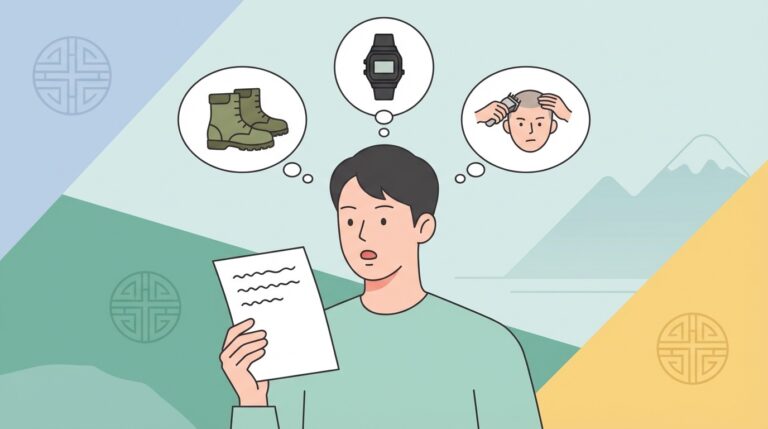
Picture this: You’re scrolling through Weverse or Instagram, and suddenly, your favorite K-Pop idol posts a selfie. The colorful, perfectly styled hair is gone, replaced by a stark, short buzz cut. The comment section is flooded with crying emojis and messages saying, “Serve well!” Or perhaps you remember that iconic scene in a K-Drama like D.P. or Crash Landing on You, where a young man is drinking Soju at a pojangmacha (tent bar), staring at a piece of paper with a heavy sigh, while his friends pat him on the back with a mix of pity and teasing.
For Korean men, receiving the 입영 통지서 (Ipyeong Tongjiseo – Enlistment Notice) is a universal rite of passage. It’s a moment that splits their youth into “before” and “after.” If you’re at the C2 level, you already know the formal term for military service (군대). But textbook Korean won’t prepare you for the raw, authentic ways Koreans actually talk about getting drafted and prepping for boot camp. If you have male Korean friends in their early 20s, or if you actively follow K-Pop/K-Actors, mastering this vocabulary is non-negotiable. It allows you to offer true empathy rather than robotic textbook responses.
Let’s dive into the real talk of Korean military enlistment.
Phase 2: Core Expressions Deep Dive
1. 영장이 날아왔다
- Pronunciation: [Yeongjang-i narawatda] (Sound-alike: Young-jang-ee nah-rah-waht-dah)
- Meaning:
- Literal: The warrant flew in.
- Real Nuance: “I got my draft notice.”
- K-Culture Moment: A friend walks into a cafe, throws his bag on the chair, and drops this line with a hollow laugh. It’s the ultimate “game over” statement for a Korean college student.
- Editor’s Insight: Notice the word “영장” (warrant). In legal terms, it’s used for arrest or search warrants. The fact that Koreans use this word for the military draft highlights the compulsory, inescapable nature of the service. The verb “날아왔다” (flew in) adds a sense of suddenness, like a bird of prey swooping down on their freedom.
- Situation Spectrum:
- Casual with friends: ✅ (Perfect)
- Semi-formal (colleagues): ⚠️ (Use ‘입영 통지서 받았습니다’ instead)
- Formal/Elders: 🚫
- 🤔 Think About It: Why do you think Korean society uses such a forceful word (“warrant”) for national duty? How does your culture talk about mandatory civic duties?
2. 머리 밀러 간다
- Pronunciation: [Meori milleo ganda] (Sound-alike: Muh-ree meel-luh gahn-dah)
- Meaning:
- Literal: I’m going to push my hair.
- Real Nuance: “I’m going to shave my head (for the military).”
- K-Culture Moment: The day before enlistment, a guy goes to the barbershop with his best friends. They usually record a video of the barber taking the first swipe of the clippers down the middle of his head.
- Editor’s Insight: You won’t hear “머리를 자르다” (cut hair) in this context. “밀다” means to push, referring to pushing the electric clippers across the scalp. It conveys the total removal of hair, symbolizing the stripping away of civilian identity.
- Situation Spectrum:
- Casual with friends: ✅
- Semi-formal: ✅ (Widely accepted even among colleagues)
- Formal/Elders: ⚠️ (Better to say “머리를 짧게 깎으러 갑니다”)
- 🤔 Think About It: Hair holds significant cultural weight in Korea (historically tied to Confucianism). What does the collective act of shaving heads represent in the context of creating military uniformity?
3. 국방부 시계는 거꾸로 매달아도 간다
- Pronunciation: [Gukbangbu sigyeneun geokkuro maedarado ganda]
- Meaning:
- Literal: The Ministry of Defense clock ticks even if you hang it upside down.
- Real Nuance: “Time in the military will pass eventually, no matter how hard it seems.”
- K-Culture Moment: When a younger friend is panicking about spending 18 months in the army, an older friend who has already served (군필 – Gunpil) will say this to comfort (or playfully mock) him.
- Editor’s Insight: This is the ultimate Korean military proverb. It’s deeply ingrained in the culture. It acknowledges the agony of slow-passing time in the military while offering a stoic, philosophical reassurance that all things end.
- Situation Spectrum:
- Casual with friends: ✅
- Semi-formal: ✅
- Formal/Elders: ⚠️
- 🤔 Think About It: Is there an idiom in your language used exclusively to comfort someone enduring a long, mandatory hardship?
Phase 3: Textbook vs. Real Korean
Here’s how the textbook isolates you, and how real Korean integrates you.
[Receiving the Notice]
* 📖 Textbook: 병무청에서 입영 통지서를 받았습니다. (I received the enlistment notice from the Military Manpower Administration.)
* 🗣️ Real Korean: 나 영장 나왔어. / 나 다음 달에 군대 끌려가. (My draft notice came out. / I’m getting dragged to the military next month.)
* 💡 Why the difference?: Young men often use self-deprecating humor (“끌려가다” – being dragged away) as a coping mechanism for the interruption of their civilian lives.
[Preparing Items for Boot Camp]
* 📖 Textbook: 훈련소에 가져갈 물건들을 샀습니다. (I bought things to take to the training center.)
* 🗣️ Real Korean: 야, 입대 필수템 다 챙겼냐? 푹신한 깔창 무조건 사라. (Hey, did you pack all your enlistment must-haves? Buy cushiony insoles, no matter what.)
* 💡 Why the difference?: “필수템” (Must-have item, a portmanteau of 필수 + item) is universal modern slang. Specifically, “깔창” (shoe insoles) is the most advised item by veterans to survive long marches in hard combat boots (군화).
Bottom Note for C2 Learners: At your level, understanding the socio-linguistic irony of words like “끌려가다” (to be dragged) shows high cultural intelligence. It’s not meant to be genuinely anti-government; it’s a culturally accepted bonding complaint.
Phase 4: Cultural Context — K-Culture Deep Dive
4-1. Non-Verbal Elements: The Art of the “Silent Pour”
When someone announces their enlistment, the immediate non-verbal response is a deep, empathetic sigh, followed by pouring them a drink. This is called the 입대주 (Ipdaeju – Enlistment Drink). Eye contact is maintained with a look of shared sorrow. It’s a moment of high 눈치 (Nunchi)—you do not talk about how great your own life is going at this moment.
4-2. The K-Pop Connection: Gomusin & Weverse Goodbyes
If you’re deeply into K-Pop, you know the drill. When an idol’s agency releases the official statement (“Our artist will fulfill his mandatory military service…”), the fandom enters the 고무신 (Gomusin) phase.
– Gomusin literally means “rubber shoes.” Historically, it referred to a woman who waits for her boyfriend to finish his military service. If she breaks up with him while he’s serving, she “puts her rubber shoes on backward” (고무신을 거꾸로 신다).
– Fandoms have adopted this! Fans proudly call themselves “Gomusin” while waiting, and when the idol is discharged, they celebrate wearing 꽃신 (Kkotsin – Flower shoes).
– Critical View: Idols usually leave a highly curated, polite handwritten letter (손편지) for fans. But in real life, a 20-year-old Korean guy’s goodbye to his friends is usually a boisterous, slightly drunken affair filled with slang and roasting.
Phase 5: Real-Life Roleplay Scenario
Setting: Friday night, 8 PM. A noisy, smoke-filled Samgyeopsal (pork belly) restaurant near Sinchon. Soju bottles line the table. You are drinking with two Korean university friends.
Characters:
– YOU: A foreign exchange student (C2 Korean level) who knows the culture well.
– Ji-hoon (21): Your younger friend. He looks depressed, staring at his phone.
– Min-su (24): The older friend who already finished his military service (Gunpil). He is grilling the meat.
Dialogue:
Ji-hoon: 하아… 형, 나 다음 달 15일 논산 간대요.
(Haa… Hyeong, na daeum dal siboil nonsan gandaeyo.)
[Sigh… Bro, it says I’m going to Nonsan on the 15th of next month.]
(🎭 Stage Direction: Ji-hoon drops his phone on the table. The screen shows a KakaoTalk message from the Military Manpower Administration.)
Min-su: ㅋㅋㅋ 드디어 영장 날아왔냐? 축하한다 짜식아. 이제 진짜 어른 돼야지.
(Kkk deudieo yeongjang narawatnya? Chukahanda jjasiga. Ije jinjja eoreun dwaeyaji.)
[Hahaha, the draft notice finally flew in? Congrats, punk. Time to become a real adult.]
Ji-hoon: 장난치지 마요. 진짜 우울하니까. 아, 머리 언제 밀지…
(Jangnanchiji mayo. Jinjja uulhanikka. Ah, meori eonje milji…)
[Don’t joke around. I’m seriously depressed. Ah, when should I shave my head…]
Min-su: 야, 입대 전날 밀어. 그리고 훈련장 갈 때 깔창이랑 전자시계 무조건 챙겨. 없으면 지옥을 맛볼 거다.
(Ya, ipdae jeonnal mireo. Geurigo hunyeonjang gal ttae kkalchang-irang jeonjasigye mujogeon chaenggyeo. Eopseumyeon jiogeul matbol geoda.)
[Hey, shave it the day before. And when you go to the training center, make sure you pack insoles and a digital watch. If you don’t, you’ll taste hell.]
🔀 Your Turn! How do you respond to Ji-hoon?
– A) “군대 생활이 당신에게 좋은 경험이 될 것입니다.” (Textbook, robotic, lacks empathy)
– B) “우와! 멋있다! 축하해!” (Extremely inappropriate; military service is a duty, not a joyous achievement for the conscript.)
– C) “지훈아, 너무 걱정 마. 국방부 시계는 돌아간다잖아. 오늘 고기랑 술은 내가 쏠게!”✅ Best Choice: C — You use the cultural proverb (“The DoD clock ticks”) and offer to buy the “Ipdaeju” (enlistment drinks). This is peak native-level empathy. Min-su will likely respect you, and Ji-hoon will feel comforted.
Phase 6: 10-Second Shadowing Drill
Let’s practice the rhythm of the ultimate comfort phrase. Pay attention to the pauses!
😤 야! / 너무 걱정하지 마. / 국방부 시계는 / 거꾸로 매달아 놔도 / 돌아가니까!
(Ya! / neomu geokjeonghaji ma. / gukbangbu sigyeneun / geokkuro maedara nwado / doraganikka!)
[Hey! Don’t worry too much. The Ministry of Defense clock ticks even if you hang it upside down!]
Voice Note: Start strong and assertive (😤) on “Ya!”, then soften into a reassuring tone.
Phase 7: K-Culture Mini Dictionary
| 한국어 (Korean) | Romanization | English | Cultural Context |
|---|---|---|---|
| 미필 / 군필 | mipil / gunpil | Unfulfilled / Fulfilled (Service) | A crucial social divide among Korean men. Gunpil men often share a bond over shared suffering. |
| 까까머리 | kkakkamori | Buzz cut | A cute/teasing term for a freshly shaved head. |
| 깔창 | kkalchang | Shoe insoles | The #1 gift for someone enlisting. Army boots are notoriously hard on the feet. |
| 입대주 | ipdaeju | Enlistment drinks | The farewell drinking session before someone leaves. Lots of meat and Soju are involved. |
| 눈치 | nunchi | Social awareness | Knowing not to brag about your upcoming Europe trip to a guy who enlists tomorrow. |
Phase 8: Traveler / Expat Survival Kit
As a foreigner, you might not get drafted, but what if you’re in Korea and a Korean friend is enlisting?
🆘 Survival Phrases for Gifting
– 🇰🇷 “군대 갈 때 필요한 거 있어? 내가 하나 사줄게.”
(Gundae gal ttae piryohan geo isseo? Naega hana sajulge.)
– 🗣️ Meaning: Do you need anything for the military? I’ll buy you one.
– 🇰🇷 “훈련소 입소 필수템 추천해 주세요.” (At a military supply shop)
(Hunnyeonso ipso pilsutem chucheonhae juseyo.)
– 🗣️ Meaning: Please recommend must-have items for boot camp.
– 📍 Where to use: Online shopping malls, or military supply stores near military bases (like in Itaewon or near Nonsan Training Center).📌 Editor’s Culture Note
If you want to buy a gift for a Korean friend enlisting, do not buy expensive luxury goods. They cannot take them in. The best gifts are: A cheap, durable digital watch (like a Casio G-Shock with a backlight), high-quality cushioned shoe insoles, or blister band-aids.
Phase 9: Critical Thinking — “One Step Deeper”
Language & Power: The Linguistic Transformation of Korean Men
Have you ever wondered why Korean men in corporate settings often sound distinctly different from women, frequently using the rigid “~다/까” (~da/kka) formal endings even in semi-casual situations? The answer lies in the military.
During their 18+ months of service, men are strictly forbidden from using the softer “~요” (~yo) ending. They are linguistically retrained to speak exclusively in the “합쇼체” (highest formal level). This military hierarchy embeds itself into their language, which they then carry into the corporate hierarchy. For C2 learners, observing how a Korean man shifts from casual “요” to rigid “다/까” when speaking to a senior male colleague offers a fascinating glimpse into how military conscription shapes the unseen power dynamics and gendered language of Korean society.
💬 Your Turn: Does your country have mandatory military service? If so, does it create a unique socio-linguistic culture or slang like it does in Korea? Share in the comments!
Phase 10: FAQ & Avoiding Misunderstandings
❓ “Can I say ‘축하해요’ (Congratulations) when they get their draft notice?”
No. Absolutely not. While serving is honorable, being drafted interrupts their education or career. Saying “congratulations” sounds deeply sarcastic. Use expressions of solidarity like “고생하겠네” (You’re going to suffer/work hard) or “밥 한 번 쏠게” (Let me buy you a meal).
❓ “Do K-Pop idols go to different boot camps?”
No, they receive the exact same draft notice and go through the same basic training (usually in Nonsan). However, fans often gather outside the training center, which is why idols often quietly enlist to avoid causing a public nuisance.
❌ Common Mistake #1: Asking “군대 언제 가요?” (When are you going to the military?) to a male friend who is intentionally delaying his service to study. It can cause immense stress. A better, softer approach is: “입대 계획은 어떻게 돼가요?” (How are your enlistment plans going?)
Phase 11: Summary & Action Items
One-Liner Summary: A Korean draft notice isn’t just a piece of paper; it’s a cultural earthquake requiring deep empathy, a buzz cut, and a good pair of insoles.
Action Mission:
– 🥉 Bronze: Look in the mirror and practice the ultimate comforting sigh + “국방부 시계는 돌아간다!”
– 🥈 Silver: Go to X (Twitter) or Weverse, find a K-Pop idol’s enlistment announcement, and read the Korean comments to spot words like Gomusin or Kkotsin.
– 🥇 Gold: Next time a Korean male friend mentions his military service, ask him, “영장 나왔을 때 기분이 어땠어?” (How did you feel when your draft notice flew in?) and listen to his story!
Phase 12: Interactive Quiz
1. Situational Judgment: Your friend Min-hyuk just texted you a picture of his shaved head and the date he has to report to Nonsan. What is the most culturally appropriate response?
– A) “머리스타일 멋진데? 축하해!” (Nice hairstyle! Congrats!)
– B) “아이고… 영장 날아왔구나. 내가 입대주 쏠게, 언제 볼까?” (Oh man… the draft notice flew in. I’ll buy your enlistment drinks, when should we meet?)
– C) “군대에서 한국어를 많이 배우고 와!” (Learn a lot of Korean in the military!)
2. Fill in the Blank:
To survive long marches in the military, veterans always recommend buying a high-quality pair of __________.
– A) 넥타이 (Neckties)
– B) 깔창 (Insoles)
– C) 고무신 (Rubber shoes)
(Answers: 1. B – Empathetic and offers the cultural norm of buying a meal/drink. 2. B – Insoles are the absolute must-have.)
Enjoyed this deep dive into Korean culture? Leave a comment below, and don’t forget to practice your new expressions!
Frequently Asked Questions (FAQ)
Q: What does "영장이 날아왔다" mean in Korean and how do you pronounce it?
A: In Korean, "영장이 날아왔다" is pronounced [Yeongjang-i narawatda] and means: Literal: The warrant flew in.
Q: What does "머리 밀러 간다" mean in Korean and how do you pronounce it?
A: In Korean, "머리 밀러 간다" is pronounced [Meori milleo ganda] and means: Literal: I'm going to push my hair.
Q: What does "국방부 시계는 거꾸로 매달아도 간다" mean in Korean and how do you pronounce it?
A: In Korean, "국방부 시계는 거꾸로 매달아도 간다" is pronounced [Gukbangbu sigyeneun geokkuro maedarado ganda] and means: Literal: The Ministry of Defense clock ticks even if you hang it upside down.







