

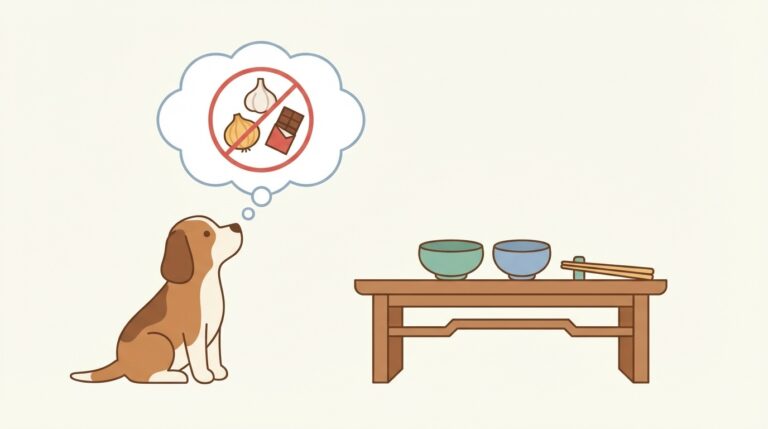
Hello! I’m your Daily Hangul Editor.
Picture this: It’s a breezy Friday evening at a Han River Park (한강공원). You and your Korean friends are sitting on a picnic mat, enjoying the ultimate Korean soul food—Chimaek (fried chicken and beer). Your dog is sitting right beside you, deploying the ultimate weapon: weaponized puppy eyes.
One of your friends laughs, says, “Aigoo, he looks so hungry!” and reaches out to toss him a piece of garlic-soy seasoned chicken.
Your heart drops. In a split second, you need to stop them politely but urgently. You want to scream “NO!”, but wait… how do you navigate this without ruining the mood, respecting the Korean culture of sharing food (정 – Jeong), and saving your furry best friend from a garlic-induced trip to the ER?
If you live in Korea or interact with Korean pet owners, knowing how to talk about pet care at a highly nuanced level isn’t just about vocabulary; it’s about navigating a culture where food is deeply tied to affection, and where garlic and onions are practically in the air we breathe.
Let’s dive into the real, C2-level Korean you need to protect your dog, sound like a local, and handle these delicate social situations with absolute finesse.
Phase 2: Core Expressions Deep Dive
1. 강아지한테 이거 주면 큰일 나요.
- Pronunciation: [Gangaji-hante igeo jumeyeon keunil nayo.]
- Tip: ‘으’ (eu) in ‘큰’ sounds like the disgusted sound you make when you step in a puddle with socks on.
- Meaning: (Literal) If you give this to the puppy, big work will happen. / (Real Nuance) It’s extremely dangerous to feed this to the dog.
- K-Culture Moment: You’re at an outdoor Korean BBQ (고기집). The lovely restaurant owner (이모님 – Auntie) walks over with a piece of unseasoned pork belly, but you know your dog has a strict diet. You drop this phrase to show the gravity of the situation without sounding aggressive.
- Editor’s Insight: Koreans rarely say “It is dangerous” (위험해요) in daily conversation for these situations. “큰일 나다” (big trouble occurs) is the ultimate, slightly dramatic but highly effective way to signal “Please don’t do that, or disaster will strike.”
- Situation Spectrum:
- Friends (Casual): ✅ (Drop the ‘요’: 주면 큰일 나!)
- Coworkers (Semi-formal): ✅
- Elders/Boss (Formal): ⚠️ (Use with softer tone: “아이고, 주시면 큰일 납니다~”)
- 🤔 Think About It: Why does Korean use “big work/trouble” (큰일) to describe danger or emergencies? Does your native language downplay danger in a similar, idiomatic way to avoid sounding too harsh?
2. 양파나 마늘 들어간 음식은 절대 안 돼요.
- Pronunciation: [Yangpana maneul deureogan eumsigeun jeoldae an dwaeyo.]
- Meaning: (Literal) Food with onions or garlic entered is absolutely no. / (Real Nuance) Foods containing onions or garlic are strictly forbidden.
- K-Culture Moment: Explaining your dog’s diet to a Korean pet-sitter or a friend who wonders why your dog can’t eat a tiny bit of Bulgogi.
- Editor’s Insight: Garlic (마늘) and onions (양파) are the backbone of Korean cuisine. A C2 learner knows that you can’t just say “No human food.” You must specifically point out these ingredients because many Koreans subconsciously don’t even register garlic as an ‘extra’ ingredient—it’s just a given.
- Situation Spectrum:
- Friends (Casual): ✅
- Coworkers (Semi-formal): ✅
- Elders/Boss (Formal): ✅
- 🤔 Think About It: Notice the grammatical structure “들어간” (entered). In English, we say food “contains” something. In Korean, the ingredient “goes into” the food. How does this spatial metaphor change the way we visualize cooking?
3. 애가 몰래 초콜릿을 주워 먹은 것 같은데, 바로 응급 진료 가능한가요?
- Pronunciation: [Aega mollae chokolliseul juwo meogeun geot gateunde, baro eunggeup jillyo ganeunghangayo?]
- Meaning: (Literal) It seems the kid secretly picked up and ate chocolate, is emergency treatment possible right away? / (Real Nuance) My dog accidentally ate chocolate, can we come in for an emergency visit now?
- K-Culture Moment: Pure panic mode. You are calling a 24-hour veterinary hospital (동물병원) in Gangnam at 11 PM.
- Editor’s Insight: Notice the use of “애” (kid/child) instead of “개” (dog). Modern Korean pet owners refer to their pets as “our baby” (우리 애기) or “kid” (애). Also, “주워 먹다” (to pick up and eat) is a highly native-sounding compound verb that describes the sneaky, accidental nature of the incident perfectly.
- Situation Spectrum:
- Vet Clinic / Professional setting: ✅
Phase 3: Textbook vs. Real Korean
[Warning someone not to feed your dog]
* 📖 Textbook Korean: 개에게 음식을 주지 마십시오. (Do not give food to the dog.)
* 🗣️ Real Korean: 헉, 그거 애기 주시면 안 돼요! (Gasp, you shouldn’t give that to the baby!)
* 💡 Why the difference?: The textbook version sounds like a warning sign at a zoo. Using “애기” (baby) softens the rejection, appealing to the person’s affection rather than commanding them.
[Explaining an emergency to the vet]
* 📖 Textbook Korean: 개가 초콜릿을 섭취했습니다. (The dog has ingested chocolate.)
* 🗣️ Real Korean: 선생님, 우리 애가 초콜릿을 먹어버렸어요! (Doctor, our kid ended up eating chocolate!)
* 💡 Why the difference?: The auxiliary verb “-어/아 버리다” expresses the speaker’s feeling of regret, loss of control, and dismay—perfect for conveying the urgency of the accident.
Phase 4: Cultural Context — K-Culture Deep Dive
4-1. Non-verbal Communication & Nunchi
When an older Korean person (like a friendly neighborhood grandpa) tries to give your dog a piece of sausage, simply saying “No” is culturally abrasive. It violates Nunchi (social tact).
Instead, use the “Apologetic Body Block”: Smile warmly, bow slightly, gently put your hand between the food and your dog, and say, “아이고, 감사한데 애가 아파서요~” (Oh my, thank you, but he’s a bit sick~). A “white lie” about the dog having a bad stomach that day is socially acceptable and protects their Kibun (pride) while saving your dog.
4-2. The “Jeong” (정) vs. Pet Safety Dilemma
In K-Dramas, you often see characters placing a prime piece of meat on someone else’s rice bowl. This is Jeong (정)—deep, communal affection expressed through food. When Koreans see a cute dog, their instinctual Jeong activates. They want to share what they are eating.
However, because Korean food is heavily seasoned with soy sauce, sesame oil, garlic, and onions, this beautiful cultural trait becomes a lethal hazard for dogs. As an expat, mastering the language to decline this food while acknowledging the Jeong behind it is the true mark of a C2 speaker.
Phase 5: Real-Life Roleplay Scenario
Setting: A trendy, pet-friendly cafe in Yeonnam-dong. It’s a sunny Saturday afternoon. You are hanging out with Minji, your Korean friend, and your dog.
Characters:
– YOU: An expat pet owner navigating Korean social norms.
– Minji (28): Your Korean friend. Loves dogs, but has never owned one. She just ordered a massive slice of rich, dark chocolate cake.
Dialogue:
Minji: 와, 이 케이크 진짜 꾸덕하다. 대박! 🍰
(Wa, i keikeu jinjja kkudeokada. Daebak!)
[Wow, this cake is so dense and fudgy. Amazing!]
(🎭 Stage Direction: Minji takes a bite and looks down at your dog, who is staring at her intensely)
Minji: 앗, 너도 먹고 싶어? 쪼끔만 떼어 줄까?
(At, neodo meokgo sipeo? Jjokkeumman tte-eo julkka?)
[Aw, do you want some too? Should I break off a tiny piece for you?]
YOU: 헉, 민지야, 안 돼! 초콜릿은 강아지한테 완전 독이야.
(Heok, Minji-ya, an dwae! Chokolliseun gangajihante wanjeon dogiya.)
[Gasp, Minji, no! Chocolate is absolute poison to dogs.]
Minji: 아 진짜? 코코아 파우더 조금 들어간 것도 안 돼?
(A jinjja? Kokoa paudeo jogeum deureogan geotdo an dwae?)
[Oh really? Not even if it just has a little cocoa powder?]
🔀 Your Turn! How do you respond?
– A) “네, 개는 초콜릿을 먹으면 죽습니다.” (Yes, dogs die if they eat chocolate.)
– B) “응, 조금만 먹어도 병원 가야 돼. 큰일 나!”
– C) “알 바 아니야. 내 개한테 주지 마.” (None of your business. Don’t give it to my dog.)✅ Best Choice: B. “응, 조금만 먹어도 병원 가야 돼. 큰일 나!” (Yeah, even a little bit means a trip to the vet. It’s a huge deal!)
Reasoning: At a C2 level, you maintain the casual intimacy with your friend (반말) while clearly expressing the severity using the native phrase “큰일 나” (big trouble). Choice A sounds like a Wikipedia article. Choice C is extremely rude and will end the friendship instantly.
Minji: 헐, 미안해! 나 진짜 몰랐어. 하마터면 큰일 날 뻔했네.
(Heol, mianhae! Na jinjja mollasseo. Hamateomyeon keunil nal ppeonhaenne.)
[Omg, I’m sorry! I really didn’t know. That could have been a disaster.]
YOU: 괜찮아! 대신 우리 애기용 간식 하나 줄래?
(Gwaenchana! Daesin uri aegi-yong gansik hana jullae?)
[It’s okay! Do you want to give him one of his doggy treats instead?]
Phase 6: 10-Second Shadowing Drill
Master the intonation to sound urgent but polite. Follow the pauses (/) and the emotion tags!
😲 헉! / 그거 / 강아지한테 주시면 / 큰~~일 나요!
(heok! / geugeo / gangajihante jusimyeon / keun~~il nayo!)
Tip: Drag out the “큰~~” (keun) to emphasize just how big the trouble is!
🥺 죄송해요~ / 우리 애가 / 장이 좀 안 좋아서요.
(joesonghaeyo~ / uri aega / jangi jom an joaseoyo.)
Tip: The ‘~요’ at the end should drag slightly, showing an apologetic and soft tone.
Phase 7: K-Culture Mini Dictionary
| Korean | Romanization | English | Context |
|---|---|---|---|
| 댕댕이 | daengdaeng-i | Doggo / Pupper | A cute internet slang for dogs. The letters 댕 look like 멍 (meong – woof). |
| 펫티켓 | pettiket | Pet-tiquette | A portmanteau of Pet + Etiquette. Highly emphasized in modern Korean society. |
| 산책 | sanchaek | Walk / Stroll | Taking a dog for a walk. “산책 갈까?” is the magic phrase for dogs in Korea. |
| 견주 | gyeonju | Dog owner | The formal term used in news or by veterinarians. Literally “Dog Master.” |
| 양파 중독 | yangpa jungdok | Onion toxicity | A common medical term at vets due to dogs accidentally eating Korean food. |
Phase 8: Traveler’s Survival Kit
Traveling to Korea with your furry friend? Whether you are going to Jeju Island or walking around Seoul, emergency situations require fast communication.
🆘 Survival Phrases for Pet Emergencies
– 🇰🇷 “근처에 24시간 동물병원 있나요?” (Geuncheoe isipsasigan dongmulbyeongwon innayo?)
– 🗣️ Meaning: Is there a 24-hour vet hospital nearby?
– 📍 Where to use: Asking hotel concierges, taxi drivers, or locals if an emergency happens.
- 🇰🇷 “아이가 이물질을 삼켰어요.” (Aiga imuljireul samkyeosseoyo.)
- 🗣️ Meaning: The child (dog) swallowed a foreign object.
- 📍 Where to use: At the reception desk of the vet clinic.
📌 Editor’s Travel Note
– Apps to use: Search for “동물병원” (Dongmul byeongwon) on Naver Map or KakaoMap. Don’t rely on Google Maps in Korea for real-time operating hours!
– Transportation: If you need to rush to the vet, regular taxis might refuse dogs not in a carrier. Use Kakao T and select the “Pet” option (카카오 T 펫) for dedicated pet-friendly rides.
Phase 9: Critical Thinking Corner — “One Step Deeper”
Food & Identity: The Collision of ‘Jeong’ and Modern Pet Parenting
For decades in Korea, feeding a dog meant giving it leftovers (잔반) from the family dinner table. The dog was part of the yard, eating rice mixed with whatever stew was left. Today, the linguistic paradigm has shifted entirely. Dogs are now called “반려견” (companion dogs) or “우리 애기” (our baby). Yet, the older generation’s cultural instinct remains: “If I eat something delicious, I must share it with those I love.”
When an expat stops a Korean elder from sharing their K-BBQ with a dog, it’s not just a dietary intervention—it’s a clash between the traditional agrarian notion of communal survival (Jeong) and the modern, scientifically-driven concept of individual pet welfare.
💬 Your Turn: Does your culture have a strong tradition of sharing food from the table with pets? How do older generations in your country react to modern, strict pet diets? Share in the comments!
Phase 10: FAQ & Preventing Misunderstandings
Q: Is it okay to say “내 개” (my dog) when talking to the vet?
A: While grammatically correct, it sounds a bit cold or detached to modern Koreans. It is much more natural to say “우리 강아지” (our puppy) or “우리 애” (our kid), even if the dog is 12 years old.
Q: What if someone tries to feed my dog, but I freeze and can’t remember the Korean phrase?
A: Body language is universal. A polite, quick “Ah!” while gently covering your dog’s mouth/head, followed by a slight bow and “Sorry, sick” (아파요 – Apayo) will work perfectly.
❌ Common Mistake #1:
Translating “He is allergic to onions” directly as “그는 양파 알레르기가 있습니다.”
✅ Do this instead: First, don’t use “그” (he) for animals. Say “우리 강아지가 양파를 먹으면 안 돼요” (Our dog shouldn’t eat onions) or “양파 먹으면 큰일 나요” (It’s a big deal if they eat onions).
Phase 11: Summary & Action Items
One-Liner Summary: To protect your dog from Korea’s garlic-heavy food culture, politely but firmly use “큰일 나요” (big trouble occurs) while understanding the deep-rooted culture of food sharing (Jeong).
Action Mission 3 Steps:
– 🥉 Bronze (Solo): Stand in front of a mirror and practice the apologetic body block while saying, “아이고, 주시면 큰일 나요~” 3 times.
– 🥈 Silver (Online): Find a Korean pet video on YouTube and leave a comment using “댕댕이” or “애기”.
– 🥇 Gold (Real-world): Next time you visit a Korean mart or restaurant, mentally identify all the dishes that contain garlic and onions. Realize almost everything is off-limits for dogs!
🐾 Special K-Culture Mission:
Go to a Korean convenience store (편의점) and find the pet snack section. Look at the ingredients on the back of a Korean dog treat. You might be surprised to see things like sweet potato (고구마) or pollack (황태)—healthy Korean superfoods for dogs!
Phase 12: Quiz — Interactive Challenge
1. Situational Judgment:
You are walking your dog near the Han River. A friendly older man approaches with a piece of dried squid (오징어) and tries to give it to your dog. What is the most culturally appropriate and effective response?
– A) “먹이지 마시오.”
– B) “아이고, 저희 애가 장이 안 좋아서요. 마음만 감사히 받을게요!”
– C) “경찰 부를 거예요!”
2. Fill in the Blank:
“헉, 초콜릿 먹었어? 당장 병원 가야 돼. 안 그러면 완전 (_____) 나!”
3. True or False (K-Culture Edition):
In modern Korea, it is common and polite to refer to your dog as “우리 애기” (our baby) when talking to a veterinarian. (T / F)
Answers (Click to reveal)
- B. It gently declines the food by using a “white lie” about the dog’s stomach (장이 안 좋아서요) and gracefully accepts the intention behind the gesture (마음만 감사히 받을게요). A is too rigid/robotic, C is absurdly aggressive.
- 큰일 (keunil – big trouble).
- True. Anthropomorphizing pets is the norm in modern Korean society, especially at vet clinics and pet cafes.
What did you think of today’s lesson? Have you ever had a scary moment where your dog almost ate something they shouldn’t have? Let me know in the comments below! 🐾
Frequently Asked Questions (FAQ)
Q: What does "강아지한테 이거 주면 큰일 나요." mean in Korean and how do you pronounce it?
A: In Korean, "강아지한테 이거 주면 큰일 나요." is pronounced [Gangaji-hante igeo jumeyeon keunil nayo.] and means: a key conversational Korean expression covered in this lesson.
Q: What does "양파나 마늘 들어간 음식은 절대 안 돼요." mean in Korean and how do you pronounce it?
A: In Korean, "양파나 마늘 들어간 음식은 절대 안 돼요." is pronounced [Yangpana maneul deureogan eumsigeun jeoldae an dwaeyo.] and means: (Literal) Food with onions or garlic entered is absolutely no. / (Real Nuance) Foods containing onions or garlic are strictly forbidden.
Q: What does "애가 몰래 초콜릿을 주워 먹은 것 같은데, 바로 응급 진료 가능한가요?" mean in Korean and how do you pronounce it?
A: In Korean, "애가 몰래 초콜릿을 주워 먹은 것 같은데, 바로 응급 진료 가능한가요?" is pronounced [Aega mollae chokolliseul juwo meogeun geot gateunde, baro eunggeup jillyo ganeunghangayo?] and means: (Literal) It seems the kid secretly picked up and ate chocolate, is emergency treatment possible right away? / (Real Nuance) My dog accidentally ate chocolate, can we come in for an emergency visit now?







