

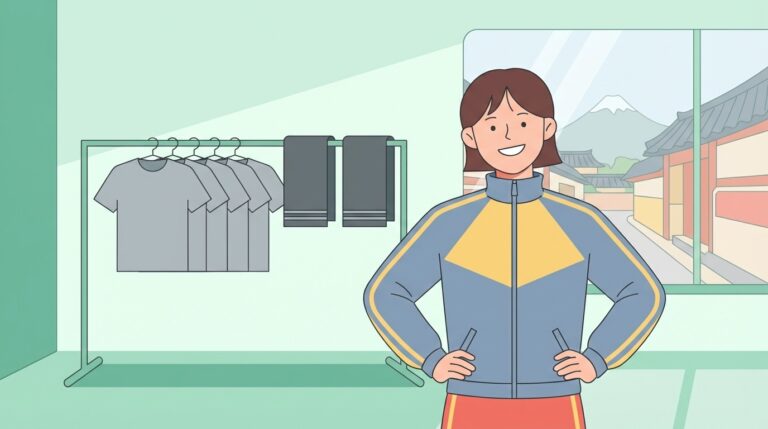
Phase 1: Empathy & The K-Culture Cold Open
Hello! I’m your lead editor and cultural navigator at Daily Hangul.
You’ve probably seen it on Instagram or in a K-Drama: your favorite K-Pop idol posts a sweaty but flawless mirror selfie in the gym, captioned with a single hashtag—#오운완 (#o-un-wan). Or maybe you’ve seen a K-Drama where the wealthy CEO aggressively runs on a treadmill whenever he’s stressed.
Inspired by this, you decide to join a local Korean gym (called a hel-seu-jang). But the moment you walk through the glass doors, panic sets in. You hear the rhythmic clanking of weights, people scanning barcodes, and a trainer happily greeting you in rapid Korean. What do you say? How do you ask for the price? And wait, why is everyone wearing the exact same grey t-shirt?
If you’re an A1 beginner, stepping into a Korean gym can be intimidating. But don’t worry! As someone who has helped hundreds of expats navigate Seoul, I’m here to give you the exact survival phrases you need. Let’s get that #오운완!
Phase 2: Deep Dive into Core Expressions
1. 한 달에 얼마예요? (How much is it for a month?)
- Pronunciation: [han dal-e eol-ma-ye-yo?]
- Sound-alike guide: ‘han’ (Han Solo) + ‘dal’ (doll) + ‘e’ (egg) + ‘eol’ (like ‘all’ but with an ‘uh’ sound) + ‘ma’ (mama) + ‘ye-yo’ (yay-yo!).
- Meaning:
- Literal: In one month, how much is it?
- Real nuance: How much is a one-month membership?
- K-Culture Moment: Korean gyms love long-term commitments. If you ask this, the trainer will likely pull out a calculator and show you that while 1 month is 100,000 KRW, 6 months is basically the same price! It’s a classic Korean sales tactic.
- Editor’s Insight: This is the ultimate A1 survival phrase. You can replace “한 달” (one month) with anything. Want to buy a coffee? “이거 얼마예요?” (How much is this?)
- Situation Spectrum:
- Friends (Casual): 🚫 (Use with staff, not friends)
- Gym Staff/Clerks (Formal/Polite): ✅
- 🤔 Think About It: In Korea, prices at local gyms are often not listed on their websites. You have to visit and ask. Why do you think Korean businesses prefer this face-to-face consultation style?
2. 운동복 있어요? (Do you have gym clothes?)
- Pronunciation: [un-dong-bok is-seo-yo?]
- Sound-alike guide: ‘un’ (oo-n) + ‘dong’ (dong) + ‘bok’ (book, but with an ‘o’) + ‘is’ (ees) + ‘seo’ (so) + ‘yo’ (yo).
- Meaning:
- Literal: Gym clothes exist?
- Real nuance: Do you provide gym clothes? / Are gym clothes included?
- K-Culture Moment: Unlike many Western gyms where everyone brings their own trendy activewear, local Korean gyms provide uniform T-shirts and shorts. You’ll see K-Drama characters working out in these matching, slightly oversized gym clothes.
- Editor’s Insight: Don’t worry about complete sentences. Just saying the noun + “있어요?” (is-seo-yo? = do you have?) is the magic formula for beginners.
- Situation Spectrum:
- Friends (Casual): ⚠️ (Friends don’t usually hand out gym clothes)
- Gym Staff/Clerks (Formal/Polite): ✅
- 🤔 Think About It: Why does Korea have a culture of gyms providing clothes? It reflects the “ppali-ppali” (hurry up) culture—people want to go straight from the office to the gym without carrying heavy bags!
3. 수건 어디 있어요? (Where are the towels?)
- Pronunciation: [su-geon eo-di is-seo-yo?]
- Sound-alike guide: ‘su’ (sue) + ‘geon’ (gun) + ‘eo-di’ (uh-dee) + ‘is-seo-yo’ (ees-so-yo).
- Meaning:
- Literal: Towel where exists?
- Real nuance: Where can I grab a towel?
- K-Culture Moment: After a hard workout, you head to the shower room. Korean gyms always provide small towels. But finding them on your first day can be a maze.
- Editor’s Insight: “어디 있어요?” (Where is it?) is your best friend when navigating Korea. Use it for restrooms (화장실 어디 있어요?), the subway, or finding the dumbbell rack.
- Situation Spectrum:
- Anyone, anywhere when asking for directions: ✅
- 🤔 Think About It: In many Western countries, you must bring your own towel. The provision of towels and clothes in Korea shows a strong emphasis on customer convenience (서비스 – Service).
Phase 3: Textbook vs. Real Korean
[Asking for a Daily Pass]
* 📖 Textbook Korean: “하루 이용권을 구매하고 싶습니다.” (I would like to purchase a one-day pass.)
* 🗣️ Real Korean: “일일권 되나요?” (Is a daily pass possible? – il-il-gwon doe-na-yo?)
* 💡 Why the difference?: Koreans prefer short, efficient phrases. “되나요?” (Is it possible/Does it work?) is incredibly versatile.
[Leaving the Gym]
* 📖 Textbook Korean: “안녕히 계십시오.” (Please stay in peace.)
* 🗣️ Real Korean: “수고하세요!” (Keep up the good work! – su-go-ha-se-yo!)
* 💡 Why the difference?: Acknowledging someone’s hard work (“수고”) is the most common and polite way to say goodbye to service workers in Korea.
Phase 4: Cultural Context — K-Culture Deep Dive
4-1. Non-Verbal Tips: The “Two-Hand” Rule
When the gym staff hands you your membership card or locker key, always receive it with two hands, or with your right hand while lightly supporting your right elbow with your left hand. This is a basic rule of respect in Korea. Also, read the room (눈치 – Nunchi): if everyone is quietly wiping down machines after use, make sure you do too!
4-2. The Golden Rule: Indoor Shoes (실내화)
If you connect gym culture to Korean daily life, there is one absolute rule: No street shoes indoors.
Just like you take off your shoes when entering a Korean home or a traditional restaurant, you must bring a separate pair of clean indoor sneakers (실내용 운동화) to wear inside the gym. Do not wear the sneakers you wore outside on the streets! The gym manager will definitely run over to stop you if you do.
Phase 5: Real-Life Roleplay Scenario
Setting: Tuesday evening, 7 PM. You walk into “Star Fitness” in Gangnam. K-Pop is blasting from the speakers. People are scanning their phones at a turnstile. You walk up to the front desk to ask about a membership.
Characters:
– YOU: An expat in Seoul, hoping to get fit but nervous about speaking Korean.
– Trainer Park (28, Male): Enthusiastic, wears a tight polo shirt, eager to get a new member.
Dialogue:
Trainer Park: 안녕하세요! 처음 오셨어요? 😊
(an-nyeong-ha-se-yo! cheo-eum o-syeos-seo-yo?)
[Hello! Is it your first time here?]
YOU: 네, 안녕하세요. 한 달에 얼마예요?
(ne, an-nyeong-ha-se-yo. han dal-e eol-ma-ye-yo?)
[Yes, hello. How much is it for a month?]
Trainer Park: 아, 한 달은 10만 원인데, 3개월 하시면 할인돼요!
(a, han dal-eun sim-man won-in-de, sam-gae-wol ha-si-myeon hal-in-dwae-yo!)
[Ah, one month is 100,000 won, but if you do 3 months, there’s a discount!]
YOU: 음… 일단 한 달만 할게요.
(eum… il-dan han dal-man hal-ge-yo.)
[Hmm… I’ll just do one month for now.]
Trainer Park: 네, 알겠습니다! 결제 도와드릴게요.
(ne, al-get-seum-ni-da! gyeol-je do-wa-deu-ril-ge-yo.)
[Yes, understood! I’ll help you with the payment.]
(🎭 Stage Direction: You hand over your credit card with two hands)
YOU: 저기… 운동복 있어요?
(jeo-gi… un-dong-bok is-seo-yo?)
[Excuse me… do you have gym clothes?]
Trainer Park: 네! 저쪽 라커룸 앞에 사이즈별로 있어요.
(ne! jeo-jjok ra-keo-rum ap-e sa-i-jeu-byeol-lo is-seo-yo.)
[Yes! They are in front of the locker room over there, sorted by size.]
YOU: 아, 감사합니다. 수건 어디 있어요?
(a, gam-sa-ham-ni-da. su-geon eo-di is-seo-yo?)
[Ah, thank you. Where are the towels?]
Trainer Park: 수건도 운동복 옆에 있습니다! 바로 운동하시나요?
(su-geon-do un-dong-bok yeop-e it-seum-ni-da! ba-ro un-dong-ha-si-na-yo?)
[Towels are next to the gym clothes too! Are you going to work out right now?]
YOU: 네!
(ne!)
[Yes!]
(🎭 Stage Direction: You start walking into the weight room wearing the sneakers you wore from the subway)
Trainer Park: 앗! 회원님, 잠시만요!
(at! hoe-won-nim, jam-si-man-yo!)
[Wait! Member, hold on a second!]
🔀 Your Turn! How should you react?
– A) “왜요?” (Why?) and keep walking.
– B) “아, 실내용 운동화!” (Ah, indoor shoes!) and quickly step back out.
– C) “저 영어만 해요.” (I only speak English.)✅ Best Choice: B — You remembered the golden rule! You must change into indoor shoes before stepping onto the gym floor.
⚠️ Choice A Analysis: Ignoring the trainer and walking in with street shoes is a major faux pas in Korean gyms.
Phase 6: 10-Second Shadowing Drill
Practice out loud! Pay attention to the slashes for pausing and the emotion tags.
- 😊 안녕하세요! / 한 달에 / 얼마예요?
(an-nyeong-ha-se-yo! / han dal-e / eol-ma-ye-yo?) - 🥺 저기요… / 운동복 / 어디 있어요?
(jeo-gi-yo… / un-dong-bok / eo-di is-seo-yo?) - 😤 오늘 / 운동 끝! / 오운완!
(o-neul / un-dong kkeut! / o-un-wan!)
Phase 7: K-Culture Mini Dictionary
| Korean | Romanization | English | Cultural Context |
|---|---|---|---|
| 헬스장 | hel-seu-jang | Gym / Fitness Center | Konglish for “Health Club”. The most common word for a gym. |
| 오운완 | o-un-wan | Workout of the day complete | An acronym for 오늘 운동 완료. A mandatory hashtag for Korean gym-goers on Instagram. |
| 피티 | pi-ti | PT (Personal Training) | Very common in Korea. Trainers will often try to sell you “PT” sessions. |
| 실내화 | sil-nae-hwa | Indoor shoes | Shoes dedicated strictly for indoor use. Essential for gyms and schools. |
| 눈치 | nunchi | Social awareness | The ability to “read the room.” Used when sharing gym equipment or following unspoken rules. |
Phase 8: Traveler’s Survival Kit
Even if you’re just visiting Korea for a week, you might want to use a local gym. Here are the top survival phrases for travelers!
🆘 Survival Phrases for the Gym
– 🇰🇷 “일일권 있어요?” (il-il-gwon is-seo-yo?)
– 🗣️ Meaning: Do you have a daily pass?
– 📍 Where to use: Any gym front desk.
– 💡 Pro Tip: Daily passes usually cost between 15,000 KRW and 25,000 KRW.📌 Editor’s Travel Note
– Finding a Gym: Open Naver Map or KakaoMap and search for “헬스장” near your hotel.
– Payment: Korea is a cashless society. Almost all gyms accept foreign Visa/Mastercard credit cards.
– Etiquette: Don’t talk loudly on your phone on the gym floor. Koreans generally work out very quietly!
Phase 9: Critical Thinking Corner — “Going Deeper”
Media vs. Reality: The K-Drama Gym Look
If you watch K-Dramas, you might think everyone in Korea works out in perfectly styled, expensive athleisure wear. But when you step into a neighborhood hel-seu-jang, you will see 80% of the people wearing identical, baggy, slightly faded grey t-shirts provided by the gym.
Why? It reflects Korean society’s high value on efficiency and convenience (편리함). Rather than packing a gym bag, doing extra laundry, and worrying about gym fashion, Koreans prefer the practicality of walking in, grabbing a uniform, working out, and leaving. It’s a beautiful contrast to the hyper-stylized image portrayed in media.
💬 Your Turn: Does your country have gyms that provide workout clothes? Or is gym fashion an important part of the workout culture where you live? Let us know in the comments!
Phase 10: FAQ & Common Mistakes
Q: Can I use “얼마예요?” (How much is it?) with older people?
Yes! “얼마예요?” ends in “~요” (yo), which makes it polite (존댓말). You can safely use it with gym staff, taxi drivers, and market vendors regardless of their age.
Q: Do I really need to bring separate shoes? Can I just wipe the bottom of my sneakers?
No! Wiping them is not enough. You must carry a completely separate pair of shoes in your bag and change into them inside the locker room.
❌ Common Mistake #1: Saying “안녕!” (an-nyeong) to the gym staff.
✅ Do this instead: “안녕” is strictly for close friends. Always say “안녕하세요!” (an-nyeong-ha-se-yo) to staff.❌ Common Mistake #2: Tipping the personal trainer.
✅ Do this instead: There is NO tipping culture in Korea. If you tip, they will run after you thinking you forgot your change!
Phase 11: Summary & Action Items
- One-Liner Summary: Remember your indoor shoes, ask “한 달에 얼마예요?” to sign up, and don’t forget to post your #오운완 selfie!
-
Action Mission 3 Steps:
- 🥉 Bronze (Solo): Stand in front of your mirror and practice saying “운동복 있어요?” 3 times.
- 🥈 Silver (Online): Post a workout picture today on your social media and use the hashtag #오운완.
- 🥇 Gold (Real Life): Open Naver Map, search “헬스장”, and look at the photos to see if you can spot the uniform gym clothes!
Phase 12: Interactive Quiz
Let’s test your new knowledge!
1. You want to ask where the locker room is. What is the correct phrase?
A) 라커룸 한 달에 얼마예요?
B) 라커룸 어디 있어요?
C) 라커룸 오운완!
2. True or False: It is completely fine to wear the sneakers you wore outside on the subway straight onto the Korean gym floor.
True / False
3. You are leaving the gym and want to politely say goodbye to the trainer working at the desk. What is the most natural Korean phrase?
A) 수고하세요! (su-go-ha-se-yo!)
B) 안녕! (an-nyeong!)
C) 얼마예요? (eol-ma-ye-yo?)
(Answers: 1. B – Where is the locker room?, 2. False – You must bring separate indoor shoes!, 3. A – Keep up the good work!)
Frequently Asked Questions (FAQ)
Q: What does "한 달에 얼마예요? (How much is it for a month?)" mean in Korean and how do you pronounce it?
A: In Korean, "한 달에 얼마예요? (How much is it for a month?)" is pronounced [han dal-e eol-ma-ye-yo?] and means: a key conversational Korean expression covered in this lesson.
Q: What does "운동복 있어요? (Do you have gym clothes?)" mean in Korean and how do you pronounce it?
A: In Korean, "운동복 있어요? (Do you have gym clothes?)" is pronounced [un-dong-bok is-seo-yo?] and means: a key conversational Korean expression covered in this lesson.
Q: What does "수건 어디 있어요? (Where are the towels?)" mean in Korean and how do you pronounce it?
A: In Korean, "수건 어디 있어요? (Where are the towels?)" is pronounced [su-geon eo-di is-seo-yo?] and means: a key conversational Korean expression covered in this lesson.







