

Hello! It’s your Daily Hangul Editor here.
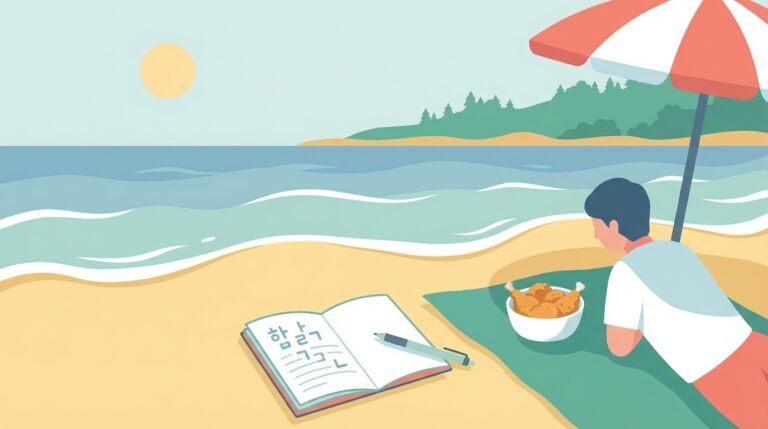
Imagine this: You’ve just arrived at the stunning East Coast of Korea—maybe Sokcho, Gangneung, or the surfer’s paradise, Yangyang. The sun is blazing, the waves are crashing, and you step onto the sizzling white sand ready for your K-Drama summer vacation moment.
You spot endless rows of vibrant, colorful parasols neatly lined up. You confidently march up to an empty one, lay down your towel, and… wait. Suddenly, an Ahjussi (older gentleman) wearing a wide-brimmed hat and holding a clipboard approaches you. He says something in rapid-fire Korean. Panic sets in. Are you in trouble? Did you steal someone’s spot?
Don’t worry! You haven’t committed a crime. You’ve just encountered Korea’s unique beach parasol culture. If you don’t know the unspoken rules—and the right phrases—you might end up wandering the hot sand forever. But if you master today’s expressions, you won’t just secure the best shade on the beach; you’ll be ordering fried chicken delivered directly to your beach chair like an absolute insider.
This guide is crafted from real panicked texts my foreign students sent me from Gyeongpo Beach. Let’s dive in!
Phase 2: Core Expressions Deep Dive
Here are the top phrases you need to survive and thrive under the East Coast sun.
1. 파라솔 하나 빌리려고 하는데요.
- Pronunciation: Parasol hana billiryeogo handeyo. [Pah-rah-sol ha-na bil-li-ryeo-go ha-neun-deh-yo]
- Meaning:
- Literal: I am intending to borrow one parasol.
- Real Nuance: I’d like to rent a parasol, please.
- K-Culture Moment: You approach the beach association tent (usually marked ‘마을 번영회’). You don’t just say “Give me a parasol.” You state your intention softly. It’s polite, non-demanding, and immediately gets the staff to show you the available spots.
- Editor’s Insight: In Korean, we rarely use the direct verb “to rent” (대여하다) in casual speech. We use “빌리다” (to borrow), even when we are paying for it! Also, ending with “-는데요” leaves the sentence slightly open-ended, waiting for the listener’s response. It’s the ultimate polite-but-casual conversation starter.
- Situation Spectrum:
- Casual with friends: 🚫 (You wouldn’t say this to a friend)
- Semi-formal (Beach Staff): ✅
- Highly formal: ⚠️ (A bit too casual for a strict business meeting, but perfect here)
- 🤔 Think About It: Why does Korean soften requests with “I am planning to/thinking of…” (-려고 하다) instead of “I want” (-고 싶다)? How does this reflect the Korean concept of Nunchi (reading the room) and avoiding absolute demands?
2. 혹시 개인 돗자리 깔아도 되나요?
- Pronunciation: Hoksi gaein dotjari kkarado doenayo? [Hok-shee gae-in dot-jah-ree kkah-rah-doh dweh-nah-yo?]
- Meaning:
- Literal: By any chance, is it okay if I lay out a personal picnic mat?
- Real Nuance: Can I set up my own mat here for free?
- K-Culture Moment: Korean beaches are divided into “Rental Zones” and “Free Zones.” If you bring your own cute checkered mat (돗자리), you can’t just throw it under a paid parasol. Asking this saves you from an awkward scolding!
- Editor’s Insight: The word “혹시” (By any chance) is your magical shield. It softens any potentially rule-breaking question. If the answer is no, the “혹시” makes the rejection feel less personal.
- Situation Spectrum:
- Casual: 🚫
- Semi-formal (Asking permission): ✅
- Formal: ✅
- 🤔 Think About It: In many cultures, public beaches are entirely free to use however you want. In Korea, local communities manage specific zones to keep the beach clean and safe. How does this “managed public space” concept compare to your home country?
3. 여기 15번 파라솔인데요, 배달 되나요?
- Pronunciation: Yeogi sibobeon parasorindeyo, baedal doenayo? [Yeo-gee shee-boh-beon pah-rah-so-rin-deh-yo, bae-dal dweh-nah-yo?]
- Meaning:
- Literal: Here is parasol number 15, does delivery happen?
- Real Nuance: I’m at parasol #15. Can you deliver here?
- K-Culture Moment: This is the peak K-Summer flex. You’re under your parasol, looking at the ocean, and you call a local fried chicken joint. Instead of a street address, your address is literally your parasol number. Twenty minutes later, a delivery rider finds you in a sea of 500 identical umbrellas. It’s magic.
- Editor’s Insight: Notice we use “-인데요” again. It sets the background information before asking the main question. “This is my situation, so based on this, can you help me?”
- Situation Spectrum:
- Ordering food: ✅
- Formal: ⚠️
- 🤔 Think About It: Korea’s delivery infrastructure is so advanced that “Parasol 15” is considered a valid GPS coordinate. What does this say about the Korean expectation of service and speed (Bbali-Bbali culture)?
Phase 3: Textbook vs. Real Korean
Forget the stiff robot translations. Here is how actual Koreans talk at the beach.
[Situation 1: Asking the price of a rental]
* 📖 Textbook Korean: 파라솔 대여료가 얼마입니까? (How much is the parasol rental fee?)
* 🗣️ Real Korean: 사장님, 파라솔 하나에 얼마예요? (Boss, how much for one parasol?)
* 💡 Why it’s different: We love calling business owners “사장님” (Boss/Owner) to build rapport. It’s much warmer than asking a dry, transactional question.
[Situation 2: Telling your friend where you are]
* 📖 Textbook Korean: 저는 지금 해수욕장 해변에 앉아 있습니다. (I am currently sitting on the beach of the bathing resort.)
* 🗣️ Real Korean: 나 빨간 파라솔 쪽이야! 매점 앞! (I’m by the red parasols! In front of the snack stand!)
* 💡 Why it’s different: Efficiency! East Coast beaches are massive. Landmarks (colors, convenience stores) are the only way you’ll ever find each other.
Bottom Note: At a B2 level, you shouldn’t just know the grammar; you should know who you are talking to. Using “사장님” instead of “저기요” (Excuse me) when haggling or renting will instantly make you look like a seasoned expat.
Phase 4: Cultural Context — K-Culture Deep Dive
4-1. Non-Verbal Cues & Nunchi
When negotiating a spot at the beach, Nunchi (눈치) is crucial. If the beach manager tells you a spot is reserved, don’t argue or demand to see proof. Simply nod and ask, “그럼 어디가 좋아요?” (Then where is a good spot?). Letting them guide you often gets you a better, less crowded area. Also, when handing over cash or your credit card, use two hands—or support your right elbow with your left hand. It shows respect to the older locals running the beach.
4-2. The K-Food Connection: Beach Delivery
If you’ve watched K-Dramas, you’ve seen characters eating Chimaek (Chicken & Beer) by the Han River. But in summer, this culture migrates to the East Coast.
When ordering, you will often use delivery apps (like Baedal Minjok), but at the beach, there are usually flyers attached to the parasol poles. You just call the number. The delivery driver will literally ride their scooter onto the boardwalk or sand and yell out, “반반 무많이 시키신 분!” (Who ordered the half-and-half with extra radishes?!).
Critical View: Why do Koreans obsess over eating a full, hot meal at the beach instead of just packing a cold sandwich? In Korea, eating together is the core of bonding (정 – Jeong). A vacation isn’t a vacation unless you are sharing a lavish meal. The beach is just a massive outdoor dining room with a great view!
Phase 5: Real-Life Roleplay Scenario
Let’s put you in the driver’s seat.
- Setting: 1:00 PM, Saturday at Sokcho Beach. The sun is scorching. The sand is burning your feet. You are with two friends, and you desperately need shade and a floatie before you melt.
- Characters:
- YOU: An international student on your first East Coast trip, trying to impress your friends with your Korean.
- Manager Park (60s): The local beach association manager. Gruff exterior, but actually very friendly.
Manager Park: 어서 오세요. 파라솔 찾으세요? ⛱️
(Eoseo oseyo. Parasol chajeuseyo?)
[Welcome. Are you looking for a parasol?]
YOU: 네, 파라솔 하나 빌리려고 하는데요.
(Ne, parasol hana billiryeogo handeyo.)
[Yes, I’d like to rent a parasol.]
Manager Park: 몇 분이세요?
(Myeot buniseyo?)
[How many people?]
YOU: 세 명이에요. 혹시 저기 바다 앞자리 비었나요?
(Se myeong-ieyo. Hoksi jeogi bada ap-jari bieonnayo?)
[Three people. By any chance, is the spot right in front of the water empty?]
Manager Park: 거기는 예약이요. 저기 두 번째 줄로 가요.
(Geogineun yeyagiyo. Jeogi du beonjjae jullo gayo.)
[That one is reserved. Go to the second row over there.]
🔀 Your Turn! You also want to rent a large inner tube (튜브). How do you ask?
– A) “튜브도 줘요.” (Give me a tube too.)
– B) “저기요, 튜브 얼마예요?” (Excuse me, how much is a tube?)
– C) “사장님, 저희 튜브도 빌릴 건데 같이 하면 좀 깎아주세요~” (Boss, we’re going to rent a tube too, if we do it together can you give us a little discount~)✅ Best Choice: C. At B2 level, you can attempt light, playful bargaining! Coastal tourist spots often allow slight negotiations if you bundle rentals. Calling him ‘사장님’ with a friendly tone (애교) works wonders.
⚠️ Choice A Analysis: Too abrupt and rude. Never use direct imperative forms with elders.
(🎭 Stage Direction: Manager Park chuckles at your fluent Korean.)
Manager Park: 허허, 한국말 잘하네. 알았어요, 튜브 하나 서비스로 줄게!
(Heoheo, hangungmal jalhane. Arasseoyo, tyubeu hana seobiseuro julge!)
[Haha, you speak Korean well. Alright, I’ll give you one tube as “service” (for free)!]
Phase 6: 10-Second Shadowing Drill
Practice this until it flows naturally. Pay attention to the pauses (/) and the mood!
😊 사장님, / 파라솔 하나 / 빌리려고 하는데요. (Sajangnim, / parasol hana / billiryeogo handeyo.)
🥺 저희 튜브도 빌릴 건데, / 좀 깎아주시면 / 안 될까요~? (Jeohui tyubeudo billil geonde, / jom kkakkajusimyeon / an doelkkayo~?)
Tip: Drag out the “요~” at the end slightly to sound more native and friendly.
Phase 7: K-Culture Mini Dictionary
| Korean | Romanization | English | Context |
|---|---|---|---|
| 눈치 | nunchi | Social awareness | The vital skill of knowing when to grab an empty spot or wait for the manager. |
| 피서 | piseo | Escaping the heat | The Korean word for summer vacation, literally “avoiding the heat.” |
| 치맥 | chimaek | Chicken & Beer | The holy grail of Korean beach food. |
| 튜브 | tyubeu | Inner tube / Floatie | You rent these right next to the parasols. Essential for East Coast waves. |
| 바가지 | bagaji | Rip-off / Overcharging | A big issue in the past at beaches, though mostly fixed now with official price boards (정찰제). |
| 서비스 | seobiseu | On the house / Freebie | If you’re polite, you might get a free bottle of water or a tube as “service”! |
Phase 8: Traveler Survival Kit
Heading to Gangneung or Sokcho this weekend? Save this cheat sheet.
🆘 Survival Phrases for the Beach
– 🇰🇷 “계좌이체 되나요?” (Gyejwa-iche doenayo?)
– Meaning: Can I pay by bank transfer?
– Pro Tip: Many small beach stands prefer direct bank transfers over cards. If you have a Korean bank app, this is a lifesaver!
– 🇰🇷 “여기 와이파이 비번이 뭐예요?” (Yeogi waipai bibeoni mwoyeyo?)
– Meaning: What’s the Wi-Fi password here? (Check the convenience stores behind the beach).
– 🇰🇷 “가장 가까운 화장실/샤워실이 어디예요?” (Gajang gakkaun hwajangsil/shawosiri eodiyeyo?)
– Meaning: Where is the nearest restroom/shower room?📌 Editor’s Travel Note
– Useful Apps: KakaoMap or Naver Map. Google Maps doesn’t work well in Korea, especially for finding tiny beachside paths.
– Trust Society: Koreans will leave their $1,000 smartphones and wallets on their beach mat while swimming in the ocean. No one touches them. It’s part of the high-trust society!
– Trash: There are strictly designated recycling zones (분리수거장) at the beach exits. DO NOT leave your chicken boxes under the parasol!
Phase 9: Critical Thinking Corner — “One Step Deeper”
🧠 Think Deeper: Food, Space, and Identity
Have you ever wondered why Korean beaches are perfectly gridded with identical parasols, and why multiple delivery riders are constantly weaving through them? This reflects a fascinating mix of Korea’s “communal space” mindset and its ultra-advanced logistics. In Korea, an outdoor space isn’t just nature to be viewed quietly; it’s an extension of the living room. Eating a full meal together (Chicken, Pizza, or even Jajangmyeon) on a beach mat reinforces social bonds. The fact that the delivery system caters to “Parasol #42” shows a society that prioritizes ultimate convenience and shared experiences over strict boundaries.
💬 Your Turn: In your culture, do people order hot food deliveries directly to a beach or a park? Or is a beach strictly for quiet sunbathing? Share your thoughts in the comments!
Phase 10: FAQ & Avoiding Misunderstandings
Q: “Can I just bring my own camping tent and set it up anywhere?”
No! This is a classic mistake. Most major East Coast beaches have designated “Free Tent Zones” (개인 그늘막 설치 구역). If you set up a tent in the commercial parasol zone, you will be asked to move.
Q: “Do I need to tip the guy who sets up my parasol?”
Absolutely not. Korea is a strictly zero-tip culture. Tipping him might cause confusion or even make him feel awkward.
❌ Common Mistake #1: Saying “파라솔 사고 싶어요” (I want to BUY a parasol).
✅ Do this instead: Use “빌리고 싶어요” (I want to borrow/rent) or “대여할게요” (I will rent). You don’t want to accidentally buy a massive 50kg umbrella!❌ Common Mistake #2: Throwing normal trash into any bin.
✅ Do this instead: Korea has strict recycling. Look for 일반쓰레기 (General), 플라스틱 (Plastic), and 캔/병 (Cans/Bottles).
Phase 11: Summary & Action Items
One-Liner Summary: To secure your beach oasis and order that crispy fried chicken, remember to softly state your intentions: “파라솔 하나 빌리려고 하는데요.”
Action Mission:
– 🥉 Bronze (Solo): Stand in front of your mirror and practice ordering a parasol and a tube out loud 3 times.
– 🥈 Silver (Online): Go to a Korean language community or our comment section and write: “저는 이번 여름에 [Beach Name] 해수욕장에 가려고 하는데요!”
– 🥇 Gold (Real-Life): Head to the East Coast this weekend, rent a parasol in Korean, and successfully order a delivery to your exact spot!
🌟 K-Culture Mission: Go to YouTube, search “강릉 해수욕장 브이로그” (Gangneung Beach Vlog). Try to spot the rows of parasols and listen carefully. Can you hear the word “대여” (rental) or “자리” (spot) in the video?
How did you like today’s lesson? Have you ever had a funny misunderstanding at a Korean beach? Tell me your story below! 👇
Phase 12: Quiz — Interactive Challenge
1. Situational Judgment:
You are at Sokcho Beach and want to know if you can lay your own mat down for free. What is the most natural B2-level way to ask?
– A) “내 돗자리 깔아.”
– B) “혹시 개인 돗자리 깔아도 되나요?”
– C) “돗자리 깔고 싶어요.”
(Answer: B. “혹시” softens the question, and “-도 되나요?” politely asks for permission. A is informal/rude, C is too direct and child-like.)
2. Fill in the Blank:
Calling the chicken place: “사장님, 여기 7번 __________인데요, 양념 치킨 하나 갖다주세요.”
(Answer: 파라솔 (Parasol). They need your number to find you!)
3. True or False – K-Culture Edition:
“If you leave your wallet on your beach mat while swimming in the Korean ocean, it is highly likely to be stolen within 5 minutes.”
(Answer: FALSE. Welcome to Korea! While you should always be careful, Korea’s high-trust culture means people generally leave their phones and bags unattended without worry.)
4. Roleplay Consequence:
In Phase 5, if you chose Option A (“튜브도 줘요”), what would Manager Park likely do?
(Answer: He might give it to you, but with a very grumpy face. Using 반말 (informal speech) or demanding tones to an elder is a massive faux pas in Korea!)
Frequently Asked Questions (FAQ)
Q: What does "파라솔 하나 빌리려고 하는데요." mean in Korean and how do you pronounce it?
A: In Korean, "파라솔 하나 빌리려고 하는데요." is pronounced [Parasol hana billiryeogo handeyo. [Pah-rah-sol ha-na bil-li-ryeo-go ha-neun-deh-yo] and means: Literal: I am intending to borrow one parasol.
Q: What does "혹시 개인 돗자리 깔아도 되나요?" mean in Korean and how do you pronounce it?
A: In Korean, "혹시 개인 돗자리 깔아도 되나요?" is pronounced [Hoksi gaein dotjari kkarado doenayo? [Hok-shee gae-in dot-jah-ree kkah-rah-doh dweh-nah-yo?] and means: Literal: By any chance, is it okay if I lay out a personal picnic mat?
Q: What does "여기 15번 파라솔인데요, 배달 되나요?" mean in Korean and how do you pronounce it?
A: In Korean, "여기 15번 파라솔인데요, 배달 되나요?" is pronounced [Yeogi sibobeon parasorindeyo, baedal doenayo? [Yeo-gee shee-boh-beon pah-rah-so-rin-deh-yo, bae-dal dweh-nah-yo?] and means: Literal: Here is parasol number 15, does delivery happen?







