

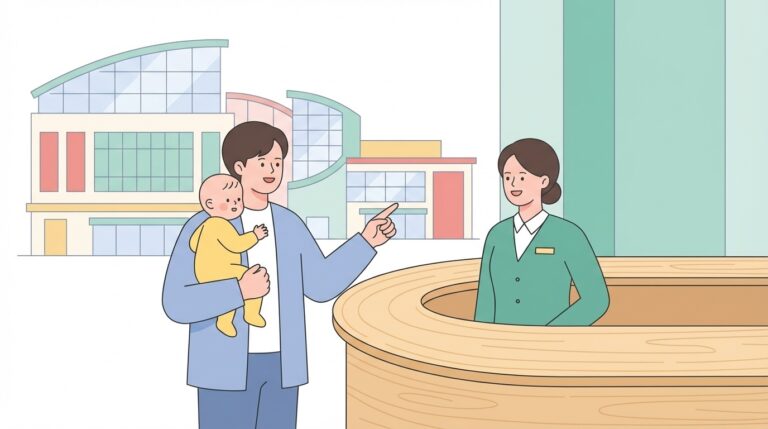
Phase 1: Empathy (The K-Culture Cold Open)
Hello! It’s your Daily Hangul Editor, back with another real-life Korean survival guide.
Picture this: You’re exploring the massive, beautifully designed COEX Mall or the bustling Hyundai Seoul department store. Suddenly, the unthinkable happens. Your baby starts crying at the top of their lungs, and a diaper disaster is imminent. In a K-Drama, this is the exact moment the camera would zoom in on the protagonist’s sweating face with a dramatic soundtrack playing in the background. The subtitles might simply read “Oh no,” but the real panic is real.
You need a nursing room or a diaper changing station, and you need it now. Sure, map apps are great, but when you’re holding a crying baby in one arm and a diaper bag in the other, typing on your phone is the last thing you want to do. You need to ask a human.
Knowing exactly how to ask for baby facilities in Korea won’t just save your clothes from a mess—it will unlock access to some of the most luxurious, VIP-level family lounges you’ve ever seen (seriously, Korean department store nursing rooms are top-tier!). Let’s dive into the essential phrases that will make you look like a pro parent in Korea. Everything here is based on questions from real expat and traveler parents!
Phase 2: Core Expressions Deep Dive
1. 수유실이 어디예요? (Where is the nursing room?)
- Pronunciation: su-yu-sil-i eo-di-ye-yo? [soo-yoo-shil-ee uh-dee-yeh-yo?]
(Tip: ‘su’ sounds like ‘sue’, ‘yu’ sounds like ‘you’, and ‘sil’ sounds like ‘shil’ in ‘shield’.) - Meaning: Where is the nursing room? (Literal: Nursing room where is it?)
- K-Culture Moment: Picture a busy weekend at Lotte Department Store. Families are everywhere. A desperate parent runs up to the gleaming information desk, bypassing all the fancy cosmetics, just to ask this one life-saving question.
- Editor’s Insight: The word 수유 (suyu) literally means ‘lactation’ or ‘nursing’, and 실 (sil) means ‘room’. In Korea, a ‘수유실’ isn’t just for breastfeeding; it’s a general baby care room where you can feed your baby, change diapers, and warm up baby food.
- Situation Spectrum:
- Casual (Friends): ✅ (수유실 어딨어?)
- Semi-formal (Staff/Strangers): ✅ (수유실이 어디예요?)
- Formal (Boss/Elders): ⚠️ (Use ‘수유실이 어디에 있나요?’)
- 🤔 Think About It: Why do you think Korean public spaces combine breastfeeding rooms, diaper stations, and baby food kitchens into one massive “Family Lounge” rather than keeping them separate? How is it in your home country?
2. 기저귀 갈 곳이 필요해요. (I need a place to change a diaper.)
- Pronunciation: gi-jeo-gwi gal go-si pi-ryo-hae-yo. [gee-juh-gwee gal go-shee pee-ryo-heh-yo.]
(Tip: The ‘eu’ in ‘gi-jeo-gwi’ sounds a bit like the disgusted sound you make when stepping in gum. Just purse your lips and say ‘uh’.) - Meaning: I need to change a diaper. (Literal: Diaper change place is needed.)
- K-Culture Moment: You’re at a hip, trendy cafe in Seongsu-dong (the Brooklyn of Seoul). It’s beautiful, but tiny. You ask the barista this question, and they kindly point you to a hidden restroom in the back.
- Editor’s Insight: 기저귀 교환대 (gi-jeo-gwi gyo-hwan-dae) is the formal term for ‘diaper changing station’, but it’s a mouthful. Saying “I need a place to change a diaper” is much more natural when speaking to cafe or restaurant staff.
- Situation Spectrum:
- Casual: ✅
- Semi-formal: ✅
- Formal: 🚫 (A bit too direct for very formal business settings, but you wouldn’t usually bring a baby there anyway!)
- 🤔 Think About It: Koreans tend to use indirect phrases like “I need a place to…” instead of “Where is the diaper table?” How does this reflect the culture’s emphasis on being polite and unobtrusive?
3. 유모차 빌릴 수 있나요? (Can I rent a stroller?)
- Pronunciation: yu-mo-cha bil-lil su in-na-yo? [yoo-mo-cha beel-leel soo een-nah-yo?]
- Meaning: Can I borrow/rent a stroller?
- K-Culture Moment: You arrive at an amusement park like Everland or Lotte World. Your toddler refuses to walk anymore. Finding the stroller rental desk is your only hope of enjoying the rest of the day.
- Editor’s Insight: 유모차 (yumocha) means stroller. Most large malls, museums, and amusement parks in Korea offer free or very cheap stroller rentals. Just ask this at the main info desk!
- Situation Spectrum:
- Casual: ✅
- Semi-formal: ✅
- Formal: ⚠️
- 🤔 Think About It: The word 유모차 originally came from Chinese characters meaning “nanny cart.” Recently, some groups in Korea are pushing to change it to 유아차 (yuacha, meaning “infant cart”) to be more gender-neutral. Language evolves with society!
Phase 3: Textbook vs. Real Korean
[Situation 1: Asking for the nursing room at a mall]
* 📖 Textbook Korean: 실례합니다. 수유실은 어디에 위치해 있습니까? (Excuse me. Where is the nursing room located?)
* 🗣️ Real Korean: 저기요, 수유실 어디예요? (Excuse me, where’s the nursing room?)
* 💡 Why the difference?: Textbook Korean uses the highly formal “-습니다” ending, which sounds like a news anchor. In daily life, the “-예요” ending is perfectly polite and much more efficient.
[Situation 2: Asking to borrow a stroller]
* 📖 Textbook Korean: 유모차 대여소는 어디입니까? (Where is the stroller rental facility?)
* 🗣️ Real Korean: 혹시 유모차 빌릴 수 있어요? (By any chance, can I borrow a stroller?)
* 💡 Why the difference?: Koreans love using “혹시” (hok-si, by any chance) to soften a request. It shows consideration for the other person, just in case they don’t offer the service.
Phase 4: Cultural Context — K-Culture Deep Dive
4-1. Non-verbal Cues: The Art of “Nunchi”
When looking for baby facilities, 눈치 (Nunchi)—the subtle art of reading the room—is crucial.
– Dad’s entry: In Korean department stores, the “Family Lounge” (유아휴게실) is open to both moms and dads. Dads can use the diaper stations and kitchen areas. However, inside the lounge, there is usually a smaller, private room marked “수유실” (Nursing Room) strictly for breastfeeding moms. Dads walking in there is a major faux pas!
– Polite approaching: When asking staff, a slight bow of the head and making brief eye contact before saying “저기요” (Excuse me) will get you much friendlier service.
4-2. K-Travel Connection: The Luxury of Korean “Family Lounges”
If you’re traveling in Korea, you must know this: Korean department stores (Shinsegae, Lotte, The Hyundai) treat parents like VIPs. Their “유아휴게실” (Infant Resting Rooms) are phenomenal. They often feature bottle sterilizers, microwaves, high-end air purifiers, private sleeping pods for babies, and sometimes even complimentary baby lotions. If you are out traveling and your baby has a meltdown, skip the subway bathrooms and head straight to the nearest major department store!
Phase 5: Real-Life Roleplay Scenario
Setting: A bustling Saturday afternoon at The Hyundai Seoul. The mall is gorgeous, but it’s massive. Your baby is crying for a bottle, and your arms are tired. You approach the sleek, white Information Desk.
Characters:
– YOU: An exhausted but determined expat parent.
– Staff: Ji-yoon (20s), a polite and helpful information desk attendant.
Dialogue:
Staff: 어서 오십시오. 무엇을 도와드릴까요?
(eo-seo o-sip-si-o. mu-eo-seul do-wa-deu-ril-kka-yo?)
[Welcome. How can I help you?]
YOU: 저기요, 아기 수유실이 어디예요?
(jeo-gi-yo, a-gi su-yu-si-ri eo-di-ye-yo?)
[Excuse me, where is the baby nursing room?]
(🎭 Stage Direction: You bounce your baby slightly, looking a bit urgent.)
Staff: 아, 수유실은 5층 유아동 코너 안쪽에 마련되어 있습니다.
(a, su-yu-si-reun 5-cheung yu-a-dong ko-neo an-jjo-ge ma-ryeon-doe-eo it-seum-ni-da.)
[Ah, the nursing room is located inside the children’s section on the 5th floor.]
YOU: 5층이요? 유모차가 있는데 엘리베이터는 저쪽인가요?
(5-cheung-i-yo? yu-mo-cha-ga in-neun-de el-li-be-i-teo-neun jeo-jjok-in-ga-yo?)
[5th floor? I have a stroller, so is the elevator over there?]
Staff: 네, 저기 오른쪽으로 가시면 넓은 엘리베이터가 있습니다.
(ne, jeo-gi o-reun-jjok-eu-ro ga-si-myeon neol-beun el-li-be-i-teo-ga it-seum-ni-da.)
[Yes, if you go to the right over there, there is a spacious elevator.]
YOU: 감사합니다. 혹시 유모차도 하나 더 빌릴 수 있을까요?
(gam-sa-ham-ni-da. hok-si yu-mo-cha-do ha-na deo bil-lil su it-seul-kka-yo?)
[Thank you. By any chance, could I borrow one more stroller?]
🔀 Your Turn! How does the staff reply? (Decision Point)
– A) “아니요, 안 됩니다.” (No, you can’t.)
– B) “네, 1층 정문 안내데스크에서 대여 가능합니다.” (Yes, rental is available at the main gate info desk on the 1st floor.)
– C) “대박! 빌려줄게요.” (Awesome! I’ll lend it to you.)✅ Best Choice: B — Korean department stores almost always offer stroller rentals, but usually at specific spots (like the 1st floor).
⚠️ Choice C Analysis: “대박” (Daebak) is very casual slang. A staff member at a luxury mall would never use this with a customer!
🎁 Bonus K-Culture Roleplay: The Helpful Ahjumma
You’re on the street looking confused with a stroller. A friendly Korean auntie (Ahjumma) spots you.
Ahjumma: “아이고, 아기 예쁘다! 길 잃어버렸어요?” (Oh my, the baby is so pretty! Are you lost?)
YOU: “네… 혹시 근처에 기저귀 갈 곳이 있을까요?” (Yes… by any chance, is there a place to change a diaper nearby?)
Ahjumma: “저기 저 카페 들어가 봐요. 화장실 넓어!” (Go into that cafe over there. The bathroom is spacious!)
Phase 6: 10-Second Shadowing Drill
Practice this until it becomes muscle memory! Focus on the pauses (/) and the emotion.
🥺 저기요, / 아기 수유실 / 어디예요?
(jeo-gi-yo, / a-gi su-yu-sil / eo-di-ye-yo?)
Emotion: Urgent but polite, slight panic but hopeful.
😊 혹시 / 유모차 / 빌릴 수 있어요?
(hok-si / yu-mo-cha / bil-lil su i-sseo-yo?)
Emotion: Polite, asking for a favor, bright.
Phase 7: K-Culture Mini Dictionary
| Korean | Romanization | English | Context |
|---|---|---|---|
| 수유실 | su-yu-sil | Nursing Room | The specific room for breastfeeding. |
| 유아휴게실 | yu-a-hyu-ge-sil | Infant Lounge / Family Lounge | The larger area with diaper tables, kitchen, and resting spots. |
| 유모차 | yu-mo-cha | Stroller | Essential for traveling! |
| 기저귀 | gi-jeo-gwi | Diaper | Often sold in convenience stores if you run out. |
| 안내데스크 | an-nae-de-seu-keu | Information Desk | Your best friend in Korean malls. |
| 몇 층 | myeot cheung | Which floor | Essential when malls are 10+ stories high! |
Phase 8: Traveler’s Survival Kit
Traveling with a baby means expecting the unexpected. Keep these survival phrases saved on your phone!
🆘 Survival Phrases for Parent Travelers
– 🇰🇷 “엘리베이터 어딨어요?” (el-li-be-i-teo eo-di-sseo-yo?)
– 🗣️ Where is the elevator?
– 📍 Where to use: Subway stations. Subways are great, but finding the elevator for your stroller can be a maze!
– 🇰🇷 “아기 의자 있나요?” (a-gi ui-ja in-na-yo?)
– 🗣️ Do you have a baby chair (high chair)?
– 📍 Where to use: Restaurants and cafes.
– 🇰🇷 “전자레인지 좀 쓸 수 있을까요?” (jeon-ja-re-in-ji jom sseul su i-sseul-kka-yo?)
– 🗣️ Can I use the microwave? (to warm baby food)
– 📍 Where to use: Convenience stores or restaurants.📌 Editor’s Travel Note
– Useful Apps: Map apps like Naver Map or KakaoMap are essential. You can actually search “수유실” in the app to find nearby facilities!
– Subway Tip: In subway stations, elevators are sometimes hidden. Look for the wheelchair/stroller signs, or ask station staff.
– No Tip Needed: Korean staff will help you with a smile, but remember, there is absolutely no tipping culture in Korea. Just a warm “감사합니다” (Thank you) is enough!
Phase 9: Critical Thinking Corner — “Going One Step Deeper”
🧠 Think Deeper: Family Infrastructure vs. The Reality of Korea
When you visit Korea, you will be amazed by the ultra-premium baby facilities in department stores, airports, and malls. The “Family Lounges” are beautifully designed and impeccably clean. However, this highlights an interesting paradox. Korea currently has the lowest birth rate in the world. As a result, businesses are competing fiercely to attract the few families that do exist by offering hyper-luxurious, stress-free environments. The language reflects this too; phrases have shifted from simple “restrooms” to “premium infant care lounges.” It’s a fascinating look at how a demographic crisis creates a hyper-premium market for family care in public spaces.
💬 Your Turn: Does your country have dedicated “Family Lounges” in public spaces, or do parents mostly rely on standard restrooms? Share your experience in the comments!
Phase 10: FAQ & Avoiding Mistakes
Q: Can dads go into the ‘수유실’ (Nursing Room)?
A: Generally, NO. Dads are welcome in the broader “유아휴게실” (Family Lounge) to change diapers or feed baby food. However, the specific room labeled “수유실” inside the lounge is strictly for nursing mothers. Look for signs!
Q: If I’m at a small restaurant, can I change a diaper at the table?
A: Absolutely not. This is considered very rude in Korea. Always ask “기저귀 갈 곳이 있나요?” (Is there a place to change a diaper?). If they don’t have a designated spot, they will direct you to the restroom.
❌ Common Mistake #1: Asking for a “베이비룸” (Baby Room) when you need a nursing room. In Korea, “베이비룸” usually refers to a plastic playpen fence you put in your living room, not a public nursing facility!
✅ Do this instead: Always use the word “수유실” (su-yu-sil).
Phase 11: Summary & Action Items
- One-Liner Summary: When baby panic strikes, head to a department store and ask, “수유실이 어디예요?” (Where is the nursing room?).
🚀 Action Mission: Choose Your Challenge!
– 🥉 Bronze (Solo): Look in the mirror with a slightly panicked face and say “수유실 어디예요?” three times.
– 🥈 Silver (Online): Open Naver Map (or Google Maps) on your phone, move to Seoul, and search “수유실”. See how many pop up!
– 🥇 Gold (Real Life): Next time you are at a Korean mall or airport, confidently approach the Info Desk and ask for the nursing room in Korean!
🎭 K-Culture Mission:
Watch an episode of the famous Korean variety show “The Return of Superman” (슈퍼맨이 돌아왔다) where celebrity dads take care of their kids. Listen closely to see if you can catch them using words like “기저귀” (diaper) or “수유실”!
Phase 12: Interactive Quiz
1. Situational Judgment: Your toddler just spilled juice all over themselves and you need to change them. You are at a large mall. What is the most natural thing to ask the staff?
– A) 베이비룸이 어디에 위치해 있습니까?
– B) 저기요, 수유실 어디예요?
– C) 기저귀 주세요.
2. Fill in the Blank:
You want to borrow a stroller at the amusement park.
“혹시 _____ 빌릴 수 있어요?”
3. True or False – K-Culture Edition:
In Korean department stores, dads are not allowed to enter the general “유아휴게실” (Family Lounge) at all. (T/F)
(Scroll down for answers!)
…
…
…
Answers:
1. B (A is too stiff and uses the wrong “Konglish” word, C means “Give me a diaper”).
2. 유모차 (yu-mo-cha / stroller)
3. False. Dads ARE allowed in the general “유아휴게실” (to change diapers/feed), but they are NOT allowed in the specific “수유실” (nursing/breastfeeding room) located inside the lounge.
Frequently Asked Questions (FAQ)
Q: What does "수유실이 어디예요? (Where is the nursing room?)" mean in Korean and how do you pronounce it?
A: In Korean, "수유실이 어디예요? (Where is the nursing room?)" is pronounced [su-yu-sil-i eo-di-ye-yo? [soo-yoo-shil-ee uh-dee-yeh-yo?] and means: Where is the nursing room? (Literal: Nursing room where is it?)
Q: What does "기저귀 갈 곳이 필요해요. (I need a place to change a diaper.)" mean in Korean and how do you pronounce it?
A: In Korean, "기저귀 갈 곳이 필요해요. (I need a place to change a diaper.)" is pronounced [gi-jeo-gwi gal go-si pi-ryo-hae-yo. [gee-juh-gwee gal go-shee pee-ryo-heh-yo.] and means: I need to change a diaper. (Literal: Diaper change place is needed.)
Q: What does "유모차 빌릴 수 있나요? (Can I rent a stroller?)" mean in Korean and how do you pronounce it?
A: In Korean, "유모차 빌릴 수 있나요? (Can I rent a stroller?)" is pronounced [yu-mo-cha bil-lil su in-na-yo? [yoo-mo-cha beel-leel soo een-nah-yo?] and means: Can I borrow/rent a stroller?







