

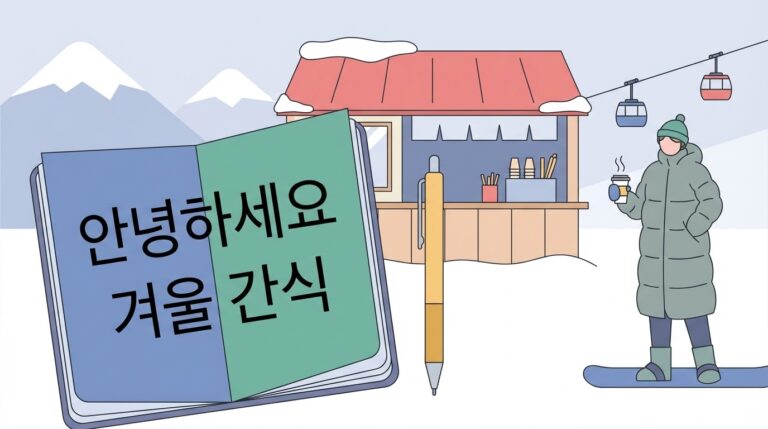
Surfing the Snow: Your Ultimate Korean Guide to PyeongChang Winter Olympic Venues
Hello! I’m the Lead Editor of Daily Hangul.
Imagine this: You are standing at the top of a snow-covered mountain in PyeongChang, the very place where the 2018 Winter Olympics took place. The crisp, freezing air hits your face, and the bright white slopes look exactly like that romantic scene from your favorite K-Drama. You’re ready to carve the snow… but then you realize you need to rent skis, find the lift, and figure out where to get that steaming bowl of instant Ramyeon everyone is eating.
Don’t worry! I’ve taught countless expats who traveled to Korean ski resorts only to be baffled by the rapid-fire Korean at the rental shops. Today, we’re going to equip you with the exact phrases and cultural nuances you need to navigate Korea’s Winter Sports scene like a true local.
This guide isn’t just about textbook grammar—it’s built on real questions from B2-level learners who wanted to sound less like a translation app and more like a savvy traveler.
Phase 2: Core Expressions Deep Dive
1. 스키 장비 대여소는 어디에 있나요?
- Pronunciation: [seuki jangbi daeyeosoneun eodie innayo?] + [skee jahng-bee dae-yeo-so-neun uh-dee-eh een-nah-yo?]
- Meaning: Where is the ski gear rental shop? (Literal: As for the ski equipment rental office, where is it?)
- K-Culture Moment: You’ll often see groups of friends in reality shows or V-logs wandering around huge ski resorts like Alpensia or Yongpyong looking for the gear shop. ‘장비’ (jangbi) means equipment/gear, and it’s a word you’ll hear gamers use for their setups, too!
- Editor’s Insight: To sound even more natural and casual, Koreans often drop ‘대여소’ (rental shop) and just say “스키 장비 어디서 빌려요?” (Where do I borrow ski gear?).
- Situation Spectrum:
- Casual with friends: ✅ (스키 장비 어디서 빌려?)
- Asking staff (Semi-formal): ✅
- Formal/Elders: ✅
- 🤔 Think About It: Why do Koreans use ‘빌리다’ (to borrow) for renting things you pay for, instead of a distinct word for ‘rent’? Does your language have separate words for borrowing from a friend versus renting from a business?
2. 리프트권 종일권으로 두 장 주세요.
- Pronunciation: [ripeuteugwon jongilgweoneuro du jang juseyo.] + [ree-peu-teu-gwon jong-il-gwon-eu-ro doo jahng joo-seh-yo.]
- Meaning: Two all-day lift tickets, please.
- K-Culture Moment: Purchasing tickets in Korea is all about efficiency. ‘종일권’ (jong-il-gwon) means ‘all-day pass’. You’ll also see ‘오전권’ (morning pass) or ‘오후권’ (afternoon pass) or even ‘야간권’ (night pass) because night skiing under the massive floodlights is a huge part of Korean ski culture!
- Editor’s Insight: Compound words ending in ‘-권’ (ticket/pass) are everywhere in Korea, from gym memberships (헬스장 회원권) to buffet tickets (식사권). Mastering this suffix instantly boosts your B2 vocabulary.
- Situation Spectrum:
- Casual with friends: 🚫 (You wouldn’t order from a friend)
- Asking staff (Semi-formal): ✅
- Formal/Elders: 🚫
- 🤔 Think About It: Koreans love categorizing time slots (Morning, Afternoon, Night, All-day). This reflects the fast-paced, highly structured ‘Palli-palli’ lifestyle.
3. 초급자 코스로 가려면 어떻게 가야 돼요?
- Pronunciation: [chogeupja koseuro garyeomyeon eotteoke gaya dwaeyo?] + [cho-geup-jah ko-seu-ro gah-ryuh-myun uh-dduh-keh gah-yah dwae-yo?]
- Meaning: How do I get to the beginner’s slope?
- K-Culture Moment: In K-Dramas, the male lead usually takes the female lead to the beginner’s slope (초급자 코스) to romantically hold her hands and teach her how to ski. In reality, it’s packed with people in colorful snowsuits falling over!
- Editor’s Insight: The grammar pattern ‘-(으)려면’ (if you intend to…) combined with ‘어떻게 가야 돼요?’ (how should I go/get there) is the ultimate lifesaver formula for asking for directions anywhere in Korea.
- Situation Spectrum:
- Casual with friends: ✅ (초급자 코스 어떻게 가?)
- Asking staff (Semi-formal): ✅
- Formal/Elders: ✅
Phase 3: Textbook vs. Real Korean
| Situation | 📖 Textbook Korean | 🗣️ Real Korean | 💡 Why the difference? |
|---|---|---|---|
| Renting equipment | 스키를 대여하고 싶습니다. (I would like to rent skis.) | 장비 빌리려고요. (I’m intending to borrow gear.) | Koreans prefer the softer intent marker ‘-려고요’ over the direct ‘-고 싶습니다’ to sound more conversational. |
| Complaining about the cold | 날씨가 매우 춥습니다. (The weather is very cold.) | 와, 진짜 얼어 죽을 것 같아요! (Wow, I feel like I’m going to freeze to death!) | Exaggeration is a key element in casual Korean. ‘죽을 것 같다’ (feels like dying) is used for everything from hunger to cold. |
| Checking on someone who fell | 넘어졌습니까? 괜찮습니까? (Did you fall? Are you okay?) | 헐, 괜찮아요? 조심해요! (Heol, are you okay? Be careful!) | ‘헐’ (Heol) is a natural exclamation of surprise, empathy, or shock. |
Phase 4: Cultural Context — K-Culture Deep Dive
4-1. Non-Verbal Cues on the Slopes
When handing over your ID card to rent gear or showing your lift pass, try to use two hands—or at least support your right elbow with your left hand. Even when you are wearing thick ski gloves, this slight gesture of respect goes a long way with the Korean staff working in the freezing cold.
4-2. The “Gungnul” of K-Food at Ski Resorts
Let’s talk about a Korean societal rule that isn’t written down but everyone follows: 국룰 (Gungnul – National Rule).
When you go to a ski resort in Korea, no matter how high-end the restaurant is, the ultimate ‘Gungnul’ is eating hot Cup Ramyeon and Eomuk (fish cake skewers) at the outdoor snack bar.
In a K-Drama, the protagonists will share a hot bowl of soup with steam rising between them, wrapping their freezing hands around the paper cup. Eating hot, spicy broth in sub-zero temperatures isn’t just about getting full; it’s about the shared experience of fighting the cold together. When you say, “우리 라면 먹으러 갈까요?” (Shall we go eat Ramyeon?) at a ski resort, you are officially embracing Korean winter culture.
Phase 5: Real-Life Roleplay Scenario
Setting: Saturday afternoon at Alpensia Ski Resort in PyeongChang. The temperature is -5°C. Upbeat K-Pop is blasting from the resort speakers. You are with Minsoo, your Korean coworker who promised to show you the ropes.
Characters:
* YOU: An expat in Korea, excited but slightly nervous about skiing.
* Minsoo (32): Your friendly coworker who thinks he’s a pro snowboarder.
Dialogue:
Minsoo: 와, 오늘 눈 진짜 좋다! 장비부터 빌리러 갈까요?
(Wa, oneul nun jinjja jota! Jangbibuteo billireo galkkayo?)
(Wow, the snow is really great today! Shall we go rent gear first?)
YOU: 네! 스키 장비 대여소는 저쪽인가요?
(Ne! Seuki jangbi daeyeosoneun jeojjogingayo?)
(Yes! Is the ski gear rental shop over there?)
Minsoo: 맞아요. 가서 보드 탈 건지 스키 탈 건지 말하면 돼요.
(Majayo. Gaseo bodeu tal geonji seuki tal geonji malhamyeon dwaeyo.)
(That’s right. Just go and tell them if you’re snowboarding or skiing.)
(🎭 Stage Direction: You both walk to the counter.)
Staff: 어서 오세요. 어떤 거 빌려드릴까요?
(Eoseo oseyo. Eotteon geo billyeodeurilkkayo?)
(Welcome. What can I rent for you?)
YOU: 스키 장비 하나랑 보드 장비 하나 빌리려고요.
(Seuki jangbi hanarang bodeu jangbi hana billiryeogoyo.)
(I intend to rent one ski gear and one snowboard gear.)
Staff: 네, 신분증 맡겨주시고요. 리프트권도 같이 구매하시나요?
(Ne, sinbunjeung matgyeojusigoyo. Ripeuteugwondo gachi gumaehasinayo?)
(Yes, please leave your ID here. Are you buying lift tickets together?)
YOU: 네, 리프트권 종일권으로 두 장 주세요.
(Ne, ripeuteugwon jongilgweoneuro du jang juseyo.)
(Yes, two all-day lift tickets, please.)
Minsoo: 아싸! 티켓도 샀으니까, 바로 상급자 코스로 갈까요? 저기 경사 장난 아니에요!
(Assa! Tiketdo sasseunikka, baro sanggeupja koseuro galkkayo? Jeogi gyeongsa jangnan anieyo!)
(Awesome! We got the tickets, should we head straight to the advanced slope? The steepness there is no joke!)
🔀 Your Turn! How should you respond to Minsoo?
* A) “상급자 코스요? 좋아요! 갑시다!” (Advanced slope? Sounds good! Let’s go! – But you are a beginner!)
* B) “아니요, 저는 초급자 코스로 가려면 어떻게 가야 돼요?” (No, how do I get to the beginner’s slope?)
* C) “민수 씨 혼자 가세요. 저는 떡볶이 먹을래요.” (Go by yourself, Minsoo. I want to eat Tteokbokki.)✅ Best Choice: B — You firmly but naturally state your need to find the beginner’s slope using the grammar we learned.
⚠️ Choice C Analysis: While hilarious and grammatically correct, telling a coworker “Go by yourself” (혼자 가세요) might be a bit too blunt unless you are very close friends!
Bonus RP: Snack Time!
After 2 hours of skiing, you are freezing.
YOU: 너무 추워서 따뜻한 국물 먹고 싶어요. (It’s so cold, I want warm soup.)
Minsoo: 오! 역시 스키장에선 어묵 국물이 국룰이죠. 매점 갑시다! (Oh! As expected, Eomuk broth is the national rule at ski resorts. Let’s hit the snack bar!)
Phase 6: 10-Second Shadowing Drill
Read these sentences out loud, paying attention to the pauses (/) and emotions!
- 😊 밝게 (Brightly): 스키 장비 / 대여소는 / 어디에 있나요?
(seuki jangbi / daeyeosoneun / eodie innayo?) - 😤 단호하게 (Firmly): 리프트권 / 종일권으로 / 두 장 주세요.
(ripeuteugwon / jongilgweoneuro / du jang juseyo.) - 🥺 애교 섞어서 (Cute & Pleading): 너무 추워서 / 따뜻한 국물 / 먹고 싶어요~
(neomu chuwoseo / ttatteuthan gungmul / meokgo sipeoyo~)
Phase 7: K-Culture Mini Dictionary
| Korean | Romanization | English | Context |
|---|---|---|---|
| 국룰 | gungnul | National Rule | An unwritten social consensus everyone agrees on (e.g., eating Ramyeon at a ski resort). |
| 슬로프 | seulropeu | Slope | The ski run. Koreans use the English loanword ‘slope’ heavily in winter sports. |
| 롱패딩 | rongpaeding | Long Padding | A long puffer jacket reaching the calves. The ultimate survival winter uniform in Korea. |
| 따뜻한 국물 | ttatteuthan gungmul | Warm Broth/Soup | The ultimate comfort food concept during Korean winters to thaw a frozen body. |
Phase 8: Traveler’s Survival Kit
If you are traveling to PyeongChang, you’ll likely take the KTX (High-Speed Train) and shuttle buses. Here are your lifesaver phrases:
🆘 Survival Phrases for PyeongChang Transit
* 🇰🇷 “평창행 KTX 타는 곳이 어디예요?” (pyeongchanghaeng KTX taneun gosi eodiyeyo?)
* 🗣️ Meaning: Where is the boarding area for the KTX to PyeongChang?
* 🇰🇷 “스키장 가는 셔틀버스는 언제 와요?” (seukijang ganeun syeoteulbeoseuneun eonje wayo?)
* 🗣️ Meaning: When does the shuttle bus to the ski resort arrive?
* 🇰🇷 “물품 보관함 있어요?” (mulpum bogwanham isseoyo?)
* 🗣️ Meaning: Are there coin lockers?📌 Editor’s Travel Note
* Transport App: You MUST use Naver Map or Kakao T. Google Maps cannot give you walking/driving directions inside Korea.
* KTX Pass: If you are a tourist, look into the ‘Korail Pass’. It can save you a lot of money when traveling to PyeongChang and back to Seoul!
* Cash for Snacks: While Korea is a cashless society, having a 10,000 KRW bill in your pocket is handy if the outdoor snack stall’s card machine freezes in the cold!
Phase 9: Critical Thinking — “One Step Deeper”
Media vs. Reality: The K-Drama Ski Myth
If you watch a Korean drama featuring a winter getaway, you’ll notice the ski slopes are practically empty. The main characters wear stylish, slim wool coats instead of bulky ski gear, and they effortlessly glide down the snow while a romantic OST plays in the background.
However, the reality of Korean ski resorts is a vibrant, chaotic burst of energy. Slopes are packed with people wearing neon-colored Long Padding (puffer jackets), loud EDM or trendy K-Pop echoes through the valleys, and the most romantic thing you’ll experience is successfully carrying two cups of hot Ramyeon through the snow without spilling. This contrast shows how Korean media heavily curates aesthetics, while actual Korean life prioritizes energetic communal experiences and practicality (staying warm!).
💬 Your Turn: Have you ever visited a famous location you saw in a movie or drama, only to find the reality was completely different? Share your experience in the comments!
Phase 10: FAQ & Mistake Prevention
Q: Can I use “야!” (Hey!) to get someone’s attention if they are blocking the slope?
No! Unless they are your close friend, yelling “야!” is considered extremely rude and aggressive. Instead, yell “지나갈게요!” (I’m passing by!) or “잠시만요!” (Excuse me!).
Q: In English, we say “I’m cold.” Can I say “저는 차갑습니다” (jeoneun chagapseumnida)?
❌ Common Mistake #1: Confusing 춥다 (Weather/Environment is cold) and 차갑다 (Object is cold to the touch).
✅ Do this instead: To say “I am cold,” you must describe the weather affecting you: “(날씨가) 너무 추워요!” (It is so cold!). Only use 차갑다 for a cold drink or a cold surface.
Phase 11: Summary & Action Items
One-Liner Summary: Today, you learned how to navigate PyeongChang’s ski resorts, rent gear, ask for slopes, and embrace the ‘Gungnul’ of winter K-Food!
Action Mission 3 Steps:
* 🥉 Bronze (Solo): Read the 10-second shadowing drill phrases out loud in front of a mirror while pretending to shiver from the cold.
* 🥈 Silver (Online): Post a picture of snow or your favorite winter sport in your Korean study group with the caption: “빨리 스키 타러 가고 싶어요!” (I want to go skiing soon!)
* 🥇 Gold (Real Life): Next time you eat something hot on a very cold day, take a picture and say to a Korean friend: “역시 추울 땐 따뜻한 국물이 국룰이죠!”
PyeongChang Special Mission:
Go to Google Maps or Naver Map, drop a Street View pin at Alpensia Ski Resort, look around the resort layout, and find where you would hypothetically ask: “스키 장비 대여소는 어디에 있나요?”
Phase 12: Interactive Quiz — Test Your B2 Instincts
1. Situational Judgment:
You are freezing after 3 hours of snowboarding. You walk up to the snack bar. What is the most natural Korean thing to say to your friend?
A) 날씨가 차갑습니다. 온도를 올립시다.
B) 너무 추워서 따뜻한 국물 먹고 싶어요.
C) 저는 국룰을 파괴하겠습니다.
2. True or False — K-Culture Edition:
“Koreans love wearing thin, stylish wool coats when actually skiing to look like K-Drama stars.” (T/F)
3. Fill in the Blank:
You want to ride the ski lift all day. “리프트권 ______으로 한 장 주세요.”
(Hint: All-day pass)
(Answers: 1. B – A uses the wrong ‘cold’, C means ‘I will destroy the national rule’. 2. False – Long Padding is the survival uniform! 3. 종일권)
Enjoyed this guide? Don’t forget to bookmark it for your next trip to Korea. Stay warm and happy studying!
Frequently Asked Questions (FAQ)
Q: What does "스키 장비 대여소는 어디에 있나요?" mean in Korean and how do you pronounce it?
A: In Korean, "스키 장비 대여소는 어디에 있나요?" is pronounced [seuki jangbi daeyeosoneun eodie innayo?] and means: Where is the ski gear rental shop? (Literal: As for the ski equipment rental office, where is it?)
Q: What does "리프트권 종일권으로 두 장 주세요." mean in Korean and how do you pronounce it?
A: In Korean, "리프트권 종일권으로 두 장 주세요." is pronounced [ripeuteugwon jongilgweoneuro du jang juseyo.] and means: Two all-day lift tickets, please.
Q: What does "초급자 코스로 가려면 어떻게 가야 돼요?" mean in Korean and how do you pronounce it?
A: In Korean, "초급자 코스로 가려면 어떻게 가야 돼요?" is pronounced [chogeupja koseuro garyeomyeon eotteoke gaya dwaeyo?] and means: How do I get to the beginner's slope?







