

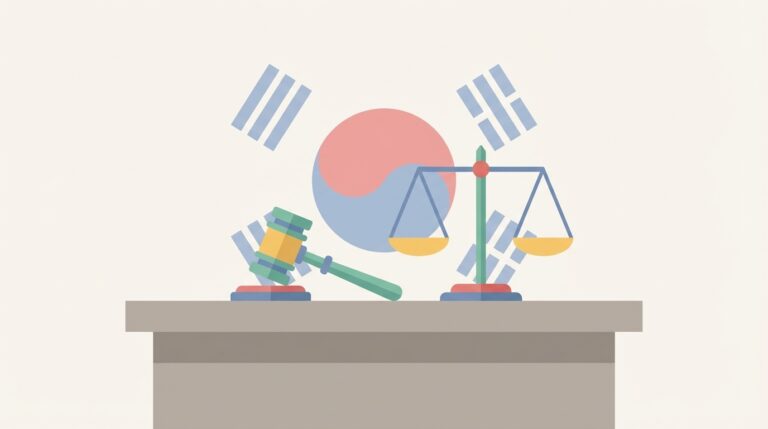
Phase 1: Empathy & The Hook
Hello! Daily Hangul Editor here.
Imagine this: You are watching a gripping Korean legal thriller. A young culprit sits in the interrogation room, gives a chilling smirk, and says to the veteran detective, “I’m under 14, so I can’t go to jail, right?” The detective clenches his fists in frustration.
If you’ve watched K-Dramas like Juvenile Justice, you’ve definitely seen this scene. But did you know this isn’t just a dramatic Hollywood-style trope? It’s a reflection of one of the most hotly debated societal issues in South Korea today: the Chokbeop-sonyeon (Criminal Minors) controversy.
As an advanced (C1) Korean learner, your goal isn’t just to order an iced Americano anymore. You want to understand the society, watch the news without subtitles, and maybe even share your thoughts with your Korean colleagues over a glass of Soju. But if you don’t know the specific vocabulary Koreans use to discuss these issues, you might find yourself completely lost when the evening news comes on at the local pub.
Today, we are going to dive deep into the real-world Korean used to discuss crime, justice, and the Juvenile Act. Trust me, mastering these terms will instantly upgrade your Korean from ‘Textbook’ to ‘Local Insider.’ Let’s get started!
Phase 2: Core Expressions Deep Dive
Here are the top 3 expressions you absolutely need to know to discuss this topic.
1. 촉법소년 (Criminal Minor)
- Pronunciation: [chok-beop-so-nyeon] / Sounds like: “choke” + “bop” + “so” + “nyun” (like ‘nun’ with a Y).
- Meaning: (Literal) Law-touching boy/youth. (Real Nuance) A juvenile offender (typically aged 10-13) who is exempt from criminal punishment and only subject to protective measures.
- K-Culture Moment: This is the exact word the news anchors use with a grave tone. When Koreans hear this word, you’ll often hear a collective sigh or a click of the tongue (쯧쯧) in the room.
- Editor’s Insight: This word carries a lot of social weight. It isn’t just a legal term anymore; it has almost become a symbol of the loopholes in the justice system.
- Situation Spectrum:
- Casual with friends: ✅ (Discussing the news)
- Semi-formal (Coworkers): ✅
- Formal (Debate/News): ✅
- 🤔 Think About It: Why does a single legal term evoke such strong emotions in Korea? How does the concept of ‘age of criminal responsibility’ work in your country?
2. 솜방망이 처벌 (A Slap on the Wrist)
- Pronunciation: [som-bang-mang-i cheo-beol] / ‘Som’ (like ‘some’) + ‘bang’ + ‘mang’ + ‘ee’.
- Meaning: (Literal) Cotton-club punishment. (Real Nuance) A punishment that is too light or lenient; a slap on the wrist.
- K-Culture Moment: Picture a bustling Korean BBQ restaurant. The news shows a criminal getting a suspended sentence. The uncle at the next table slams his Soju glass down and yells, “아휴, 또 솜방망이 처벌이네!” (Ugh, a cotton-club punishment again!)
- Editor’s Insight: This is a highly visual and satisfying idiom. A ‘bangmangi’ is a club or bat. Imagine hitting someone with a bat made of cotton—it doesn’t hurt at all! It perfectly captures the public’s frustration.
- Situation Spectrum:
- Casual with friends: ✅
- Semi-formal (Coworkers): ✅
- Formal (Academic Paper): 🚫 (Use ‘가벼운 처벌’ or ‘미약한 처벌’ instead)
- 🤔 Think About It: Koreans love visual metaphors in their idioms. What’s the equivalent of a “cotton club” in your native language?
3. 소년법을 개정하다 (To Revise the Juvenile Act)
- Pronunciation: [so-nyeon-beop-eul gae-jeong-ha-da]
- Meaning: (Literal) To revise the Juvenile Act.
- K-Culture Moment: You’ll see this phrase printed in bold letters on the banners of protesters in Gwanghwamun Square or in the headlines of major portals like Naver.
- Editor’s Insight: While ‘바꾸다’ (to change) is perfectly fine, ‘개정하다’ is the C1-level vocabulary you need to sound educated and serious when discussing laws.
- Situation Spectrum:
- Casual with friends: ⚠️ (A bit stiff, friends might just say ‘법을 바꿔야 돼’)
- Semi-formal (Coworkers): ✅
- Formal (News/Debates): ✅
Phase 3: Textbook vs. Real Korean
| Situation | 📖 Textbook Korean | 🗣️ Real Korean | 💡 Why the difference? |
|---|---|---|---|
| Discussing a young offender | 법을 어긴 어린아이 (A child who broke the law) | 촉법소년 (Criminal minor) | Using the exact legal term shows you are aware of current social issues. |
| Complaining about a light sentence | 처벌이 너무 가벼워요. (The punishment is too light.) | 완전 솜방망이 처벌이네요. (It’s a total cotton-club punishment.) | Metaphorical idioms carry more emotional weight and empathy in daily conversations. |
| Suggesting a change | 법을 바꿔야 합니다. (We must change the law.) | 소년법을 뜯어고쳐야 돼요. / 개정해야 돼요. (We need to tear apart and fix / revise the Juvenile Act.) | ‘뜯어고치다’ (tear and fix) shows intense frustration, commonly used by locals. |
Phase 4: Cultural Context — K-Culture Deep Dive
4-1. The Non-Verbal ‘Nunchi’ of Serious Topics
When discussing heavy topics like juvenile crime, body language matters. Unlike debating sports, Koreans tend to lower their voice slightly and use expressions of empathy like clicking their tongue (“쯧쯧”) or sighing (“아휴”). Smiling or laughing while discussing a serious news event shows a severe lack of Nunchi (social awareness) and can make you seem insensitive.
4-2. Media vs. Reality: The K-Drama Trope
If you’ve watched K-Dramas, you might think Korean courtrooms are always filled with screaming judges and smirking teenagers. Dramas intentionally amplify these cases to maximize tension and critique the system.
However, in reality, the debate isn’t just about “good vs. evil.” It’s a complex societal struggle. Child psychologists and human rights activists argue for 교화 (Gyohwa – rehabilitation), while the outraged public demands 엄벌 (Eombeol – severe punishment) for the victims’ sake. Knowing this duality allows you to discuss the topic with much more depth than a simple “he’s a bad kid” narrative.
Phase 5: Real-life Roleplay Scenario
Setting: Friday evening, 7:30 PM. You are at a noisy Korean pub (호프집) having fried chicken and beer (Chimaek) with your Korean coworker, Minsu. The TV on the wall is blaring the evening news. A report comes on about a 13-year-old stealing a car and avoiding jail time.
Characters:
– YOU: An expat working in Seoul, comfortable with Korean but wanting to fit in.
– Minsu (32): Your friendly Korean coworker who loves to chat about current events.
Dialogue:
Minsu: 아휴, 저 뉴스 또 나오네. 진짜 소년법 좀 어떻게 해야 되는 거 아니에요? 📺
(Ahyu, jeo nyuseu tto naone. Jinjja sonyeonbeop jom eotteoke haeya doeneun geo anieyo?)
[Ugh, that news is on again. Seriously, shouldn’t they do something about the Juvenile Act?]
(🎭 Stage Direction: Minsu puts down his beer glass and frowns at the TV.)
YOU: 제 말이요. 볼 때마다 너무 답답해요.
(Je mariyo. Bol ttaemada neomu dapdaphaeyo.)
[That’s what I’m saying. It’s so frustrating every time I watch it.]
Minsu: 그러니까요. 저게 완전 솜방망이 처벌이니까 애들이 법을 무서워하지를 않잖아요.
(Geureonilkkayo. Jeoge wanjeon sombangmangi cheobeorinikka aedeuri beobeul museowohajireul anchanayo.)
[Exactly. It’s a total slap on the wrist, so the kids aren’t even scared of the law.]
🔀 Your Turn! How do you respond?
– A) “경찰에 당장 신고하세요!” (Report it to the police right now!)
– B) “맞아요. 촉법소년 연령을 낮추든지 개정이 필요해 보여요.”
– C) “진짜 대박 사건이네요! 완전 헐이에요.”✅ Best Choice: B — “You’re right. It seems they need to either lower the age of criminal minors or revise the law.” This shows empathy, advanced vocabulary, and perfectly matches the serious tone.
⚠️ Choice A Analysis: Too literal. Minsu is complaining about society, not asking you to solve a crime in the pub.
⚠️ Choice C Analysis: “대박” (Jackpot/Awesome) and “헐” (OMG) are too light and slangy for a tragic news story. It makes you sound insensitive.
Phase 6: 10-Second Shadowing Drill
Practice this sentence to sound like a native passionately discussing the news! Pay attention to the pauses (/) and the emotion.
😤 단호하게 (Firmly and frustrated):
촉법소년 제도는 / 이제 반드시 / 개정되어야 합니다!
(Chok-beop-so-nyeon je-do-neun / i-je ban-deu-si / gae-jeong-doe-eo-ya ham-ni-da!)
[The criminal minor system / must now absolutely / be revised!]
Phase 7: K-Culture Mini Dictionary
| Korean | Romanization | English | Context |
|---|---|---|---|
| 촉법소년 | chokbeop-sonyeon | Criminal minor | Minors under 14 exempt from criminal liability. |
| 소년원 | sonyeon-won | Juvenile detention center | Where young offenders are sent instead of prison. |
| 교화 | gyohwa | Rehabilitation / Edification | The concept of reforming a criminal rather than just punishing them. |
| 경각심 | gyeonggak-sim | Alertness / Awareness | Often used as “경각심을 가지다” (to raise awareness/stay alert) regarding crimes. |
| 국민청원 | gungmin-cheong-won | National Petition | A system where citizens petition the government; juvenile crime is a frequent topic here. |
Phase 8: Traveler’s Survival Kit (C1 Pro Edition)
As a C1 learner, your “travel survival” isn’t just asking for directions. It’s about building rapport with locals. One of the most common situations where you’ll hear the news being discussed is inside a Korean taxi.
🚕 Survival Expressions: The Chatty Taxi Driver
– 🇰🇷 “기사님, 요즘 뉴스 보면 참 흉흉하죠?” (Gisanim, yojeum nyuseu bomyeon cham hyunghyunghajo?)
– 🗣️ Meaning: Driver, the news is so bleak/scary these days, isn’t it?
– 📍 Where to use: In a taxi, when the driver is listening to a serious news broadcast.
– 💡 Pro Tip: Korean taxi drivers love it when foreign passengers speak advanced Korean. Agreeing with them (“그러게 말입니다” – I completely agree) is a great way to enjoy a friendly ride.📌 Editor’s Travel Note: Is Korea Safe?
Despite the heavy news topics, South Korea remains one of the safest countries in the world for travelers. The intense media focus on these specific juvenile cases is actually a byproduct of the overall low crime rate—when violent crimes do happen, they shock the entire nation.
Phase 9: Critical Thinking — “One Step Deeper”
Media vs. Reality: The K-Drama Lens
Korean dramas are globally renowned for their gripping narratives, but they often act as a magnifying glass for social anxieties. Dramas dealing with Chokbeop-sonyeon intentionally highlight the most extreme, remorseless cases to fuel the narrative of a “broken system.” While this brings necessary attention to legal loopholes, it can also overshadow the less sensational reality of juvenile rehabilitation. As an advanced Korean speaker, recognizing the gap between dramatic portrayals and complex judicial realities allows you to consume K-Media with a much sharper, critical eye.
💬 Your Turn: How does your native country handle crimes committed by young minors? Do you think the focus should be on severe punishment (엄벌) or rehabilitation (교화)? Share your thoughts in the comments!
Phase 10: FAQ & Avoiding Common Mistakes
Q: Can I talk about politics and crime with Koreans I just met?
A: Maybe. It’s generally best to avoid heavy political topics right away. However, topics like juvenile crime or safe driving are usually considered “universal social concerns” rather than divisive partisan politics. If a Korean brings it up first (like Minsu did in the roleplay), it is perfectly fine to agree and share your thoughts.
❌ Common Mistake #1: Using “웃기다” (It’s funny/ridiculous) to describe a lenient sentence.
✅ Do this instead: In English, we might say “This sentence is a joke.” But in Korean, using “웃기다” in the context of a crime sounds like you are literally amused. Use “말도 안 돼요” (It makes no sense) or “어이가 없네요” (I’m speechless/baffled) instead.
Phase 11: Summary & Action Items
One-Liner Summary: To discuss Korea’s juvenile justice controversy like a local, remember the trifecta: 촉법소년 (Criminal minors) getting 솜방망이 처벌 (A slap on the wrist) leads to demands for 소년법 개정 (Revising the Juvenile Act).
Your Action Missions:
– 🥉 Bronze: Stand in front of a mirror and read the Phase 6 Shadowing Drill with your best serious news-anchor face.
– 🥈 Silver: Leave a comment below in Korean using the word “솜방망이 처벌.”
– 🥇 Gold: Next time you are in a Korean taxi or pub and the news is on, casually drop “요즘 뉴스가 참 답답하네요” (The news is so frustrating lately) and see how the locals react!
🎬 K-Culture Mission: Watch an episode of a Korean legal drama (like Juvenile Justice or Law School) and keep your ears open. Count how many times you hear the words “촉법소년” or “소년법”!
Phase 12: Quiz — Interactive Challenge
1. Fill in the Blank:
“판사님, 이건 너무 가벼운 ( _________ ) 처벌 아닙니까?”
(A) 무방비
(B) 솜방망이
(C) 철방망이
2. True or False — K-Culture Edition:
“In Korean culture, it is considered polite to smile warmly when discussing a tragic news event with a coworker to keep the mood light.”
(True / False)
(Answers: 1: B – Sombangmang-i / 2: False – Smiling during serious news shows a lack of Nunchi and empathy. Match the grave tone of the room!)
Frequently Asked Questions (FAQ)
Q: What does "촉법소년 (Criminal Minor)" mean in Korean and how do you pronounce it?
A: In Korean, "촉법소년 (Criminal Minor)" is pronounced [chok-beop-so-nyeon] and means: (Literal) Law-touching boy/youth. (Real Nuance) A juvenile offender (typically aged 10-13) who is exempt from criminal punishment and only subject to protective measures.
Q: What does "솜방망이 처벌 (A Slap on the Wrist)" mean in Korean and how do you pronounce it?
A: In Korean, "솜방망이 처벌 (A Slap on the Wrist)" is pronounced [som-bang-mang-i cheo-beol] and means: (Literal) Cotton-club punishment. (Real Nuance) A punishment that is too light or lenient; a slap on the wrist.
Q: What does "소년법을 개정하다 (To Revise the Juvenile Act)" mean in Korean and how do you pronounce it?
A: In Korean, "소년법을 개정하다 (To Revise the Juvenile Act)" is pronounced [so-nyeon-beop-eul gae-jeong-ha-da] and means: (Literal) To revise the Juvenile Act.







