

Phase 1: Empathy
Hello there! I’m your lead editor at Daily Hangul.
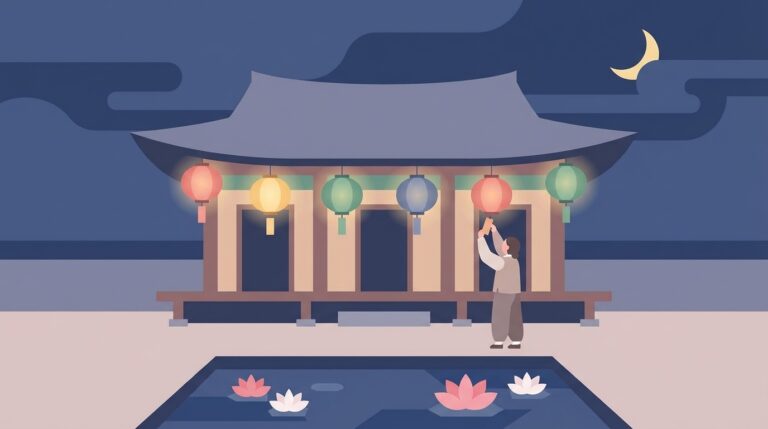
Imagine this: You are watching a breathtaking historical K-Drama (think Alchemy of Souls or Love in the Moonlight). The main characters are walking under a night sky completely illuminated by thousands of glowing, colorful lotus lanterns. They stop, close their eyes, put their hands together, and whisper a secret wish.
If you visit Korea around May, especially places like Jogyesa Temple or Bongeunsa Temple in Seoul, you won’t just see this on a screen—you’ll step right into it! Buddha’s Birthday (Seokga Tansinil) turns the country into a festival of lights.
But here is a local secret: those lanterns aren’t just for Instagram photos. Look closely, and you’ll see small paper tags attached to the bottom. Every single lantern holds a personal story, a prayer, or a wish written by someone.
Many foreign travelers just take pictures and leave, thinking, “I’m not Buddhist, so I shouldn’t touch anything.” But that’s a huge missed opportunity! In Korea, hanging a lantern is a widespread cultural event that welcomes everyone. Today, we are going to learn exactly how to ask for a lantern, what to write on it, and how to make a wish like a true local. Let’s dive in!
Phase 2: Core Expressions Deep Dive
Here are the top 3 expressions you need to know when making a wish at a Korean temple.
1. 연등 하나 달고 싶어요. (I want to hang a lotus lantern.)
- Pronunciation: yeondeung hana dalgo sipeoyo. (yeon-deung / ha-na / dal-go / shi-peo-yo)
- Sound-alike guide: ‘eu’ in ‘deung’ sounds like the disgusted grunt you make when stepping in gum.
- Meaning: I’d like to hang/purchase a lotus lantern.
- K-Culture Moment: You walk up to the temple’s information desk or volunteer booth. The colorful lanterns are stacked up. This is the magic phrase to start your cultural experience.
- Editor’s Insight: The verb 달다 means “to hang” or “to attach.” In Korean, you don’t “buy” (사다) a lantern in a spiritual context; you “hang” it as an offering.
- Situation Spectrum:
- Temple volunteers/monks (Formal/Polite): ✅
- Friends (Casual): ⚠️ (You would say “연등 달자!” – Let’s hang a lantern!)
- 🤔 Think About It: Why do you think Koreans avoid using words related to “buying” or “money” when at a temple, even though you do pay a donation for the lantern?
2. 소원 빌어봐. (Make a wish.)
- Pronunciation: sowon bireoba. (so-won / bi-reo-ba)
- Meaning: Literal = Try wishing a wish. / Real nuance = Make a wish!
- K-Culture Moment: You’ve just hung your lantern. Your Korean friend gently nudges you with a smile and says, “소원 빌어봐.” This is the exact phrase used when blowing out birthday candles or looking at a full moon!
- Editor’s Insight: 빌다 means to pray or wish, and ~어/아 보다 means “to try doing” something. It sounds soft and encouraging.
- Situation Spectrum:
- Friends/Close peers (Casual): ✅
- Work colleagues (Semi-formal): ⚠️ (Use “소원 빌어보세요”)
- Elders/Strangers (Formal): 🚫
- 🤔 Think About It: In English, “make a wish” is a command but feels magical. In Korean, adding “try” (~어/아 보다) makes it sound less like an order and more like a gentle suggestion. Does your language soften commands this way?
3. 가족이 다 건강하게 해주세요. (Please let my family be healthy.)
- Pronunciation: gajogi da geonganghage haejuseyo. (ga-jo-gi / da / geon-gang-ha-ge / hae-ju-se-yo)
- Meaning: Please make all my family members healthy.
- K-Culture Moment: If you peek at the tags hanging from the lanterns, 80% of them say this. Health and family are the ultimate priorities in Korean society.
- Editor’s Insight: ~게 해주세요 means “please make it so that…” It’s the standard sentence ending when praying to Buddha, the universe, or a deity.
- Situation Spectrum:
- Written on a temple tag/prayer: ✅
- Spoken during a prayer: ✅
Phase 3: Textbook vs. Real Korean
[Making a Wish]
* 📖 Textbook Korean: 소원을 비십시오. (Please make a wish.)
* 🗣️ Real Korean: 소원 빌어봐! / 소원 빌자! (Make a wish! / Let’s make a wish!)
* 💡 Why the difference?: Textbooks teach the formal imperative (-십시오), which sounds like a pre-recorded broadcast. Real life is much more intimate and uses the “let’s” (-자) or “try to” (-어/아 보다) forms.
[Writing on the Lantern Tag]
* 📖 Textbook Korean: 저의 소망은 부자가 되는 것입니다. (My wish is to become rich.)
* 🗣️ Real Korean: 우리 가족 건강하게 해주세요! / 로또 1등 당첨! (Please keep my family healthy! / Winning 1st place in Lotto!)
* 💡 Why the difference?: Koreans use bullet points or direct outcome requests on prayer tags for efficiency. Also, “우리” (our) is always used instead of “저의” (my) when talking about family.
Bottom Note: At a B1 level, practice making wishes using the ~게 해주세요 (Please let [something] happen) structure! It’s polite, natural, and sounds very local.
Phase 4: Cultural Context — K-Culture Deep Dive
4-1. Non-verbal Communication: Hapjang (합장)
When you are at a temple, language isn’t just spoken; it’s physical. When greeting a monk or standing before the main hall, place your palms together at your chest and bow slightly. This is called 합장 (Hapjang). Also, employ your Nunchi (눈치): lower your voice, silence your phone, and avoid walking directly through the center path of the main temple hall (it’s reserved for monks and the Buddha!).
4-2. K-Drama Connection: The Magical Trope
The “Lantern Wish” is a classic K-Drama trope. Usually, the male and female leads are at a night festival. One of them is staring at the beautiful lights, and the other stares at them.
The reality? Real lantern festivals are extremely crowded! While it looks perfectly quiet and romantic on TV, in real life, you’ll be bumping shoulders with cute grandmas and families eating temple food. Embrace the lively, warm chaos!
Phase 5: Real-Life Roleplay Scenario
Setting: Early May, 7:30 PM at Jogyesa Temple in the heart of Seoul. The sky is dark blue, and thousands of lotus lanterns are glowing overhead. The smell of incense fills the air. You are with your Korean friend, Minho.
Characters:
– YOU: A traveler falling in love with Korea’s night views.
– Minho (28): Your energetic local guide and language exchange partner.
Dialogue:
Minho: 우와, 연등 진짜 예쁘죠? 🏮
(Uwa, yeondeung jinjja yeppeujo?)
[Wow, the lotus lanterns are really pretty, right?]
YOU: 네, 너무 아름다워요! 저 종이들은 뭐예요?
(Ne, neomu areumdawoyo! Jeo jong-ideureun mwoyeyo?)
[Yes, it’s so beautiful! What are those papers?]
Minho: 아, 사람들의 소원이 적혀 있어요. 우리도 하나 달까요?
(A, saramdeurui sowoni jeokhyeo isseoyo. Urido hana dalkkayo?)
[Ah, people’s wishes are written on them. Should we hang one too?]
YOU: 저 불교 신자 아닌데… 괜찮아요?
(Jeo bulgyo sinja aninde… gwaenchanayo?)
[I’m not a Buddhist… is that okay?]
Minho: 당연하죠! 한국에서는 문화 축제 같은 거예요. 가서 물어봐요!
(Dangyeonhajo! Hangugeseoneun munhwa chukje gateun geoyeyo. Gaseo mureobwayo!)
[Of course! In Korea, it’s like a cultural festival. Let’s go ask!]
(You both walk up to the volunteer booth)
YOU: 안녕하세요. 연등 하나 달고 싶어요.
(Annyeonghaseyo. Yeondeung hana dalgo sipeoyo.)
[Hello. I want to hang a lotus lantern.]
Volunteer (Grandma): 네~ 꼬리표에 소원 적어보세요.
(Ne~ Kkoripyoe sowon jeogeoboseyo.)
[Yes~ Try writing your wish on the tail tag.]
(You grab a marker. Minho peeks over your shoulder)
Minho: 뭐 적을 거예요?
(Mwo jeogeul geoyeyo?)
[What are you going to write?]
🔀 Your Turn! How do you reply?
– A) “우리 가족 건강하게 해주세요.” (Classic, respectful, very Korean.)
– B) “부자 되게 해주세요! 로또 대박!” (Funny, honest, a great conversation starter.)
– C) “비밀이에요!” (Secret! Playful and slightly dramatic.)✅ Best Choice: All are great! A is the most traditional. B will definitely make Minho laugh, as it’s a very common “modern” Korean wish.
Minho: (Laughs) 좋아요! 다 적었으면 저기 달고, 소원 빌어봐요!
(Joayo! Da jeogeosseumyeon jeogi dalgo, sowon bireobwayo!)
[Good! When you’re done writing, hang it over there, and make a wish!]
YOU: 네! 제 소원이 꼭 이루어지면 좋겠어요. 😊
(Ne! Je sowoni kkok irueojimyeon jokesseoyo.)
[Yes! I really hope my wish comes true.]
Phase 6: 10-Second Shadowing Drill
Speak out loud! Follow the pacing (/) and the emotional cues.
🙏 진심을 담아서 (Sincere)
우리가족이 / 다 건강하게 / 해주세요!
(u-ri-ga-jo-gi / da geon-gang-ha-ge / hae-ju-se-yo!)
😊 밝게 (Brightly)
저기요, / 연등 하나 / 달고 싶어요.
(jeo-gi-yo, / yeon-deung ha-na / dal-go shi-peo-yo.)
Phase 7: K-Culture Mini Dictionary
| Korean | Romanization | English | Context |
|---|---|---|---|
| 연등 | yeondeung | Lotus Lantern | Lit up during Buddha’s Birthday to brighten the darkness of the world. |
| 소원 | sowon | Wish/Prayer | What you write on the lantern tag (꼬리표). |
| 석가탄신일 | seokga tansinil | Buddha’s Birthday | A massive national holiday in Korea, usually in May. |
| 합장 | hapjang | Palms together | The traditional greeting in Buddhism. |
| 템플스테이 | tempeulseutei | Temple Stay | A cultural program where you sleep at a temple and experience monk life. |
Phase 8: Traveler’s Survival Kit
Since temples are highly visited tourist spots, here are your essential survival phrases:
🆘 Survival Phrases at the Temple
– 🇰🇷 “입장료가 얼마예요?” (ipjangnyoga eolmayeyo?)
– Meaning: How much is the entrance fee? (Note: Many major temples recently became free!)
– 🇰🇷 “사진 찍어도 돼요?” (sajin jjigeodo dwaeyo?)
– Meaning: Is it okay to take pictures here?
– 🇰🇷 “어디서 기도해요?” (eodiseo gidohaeyo?)
– Meaning: Where do I pray?📌 Editor’s Travel Note
– The Threshold Rule: When walking through traditional temple doors, step over the wooden threshold on the floor, not on it. Stepping on it is considered bad luck and disrespectful!
– Temple Etiquette: Never use flash photography inside the main hall where people are actively bowing and praying.
Phase 9: Critical Thinking Corner — “A Step Deeper”
🧠 Think Deeper: Religion & Modern Identity in Korea
South Korea is famous for its Pali-pali (hurry-hurry) culture, skyscrapers, and high-tech lifestyle. Yet, right in the middle of Seoul’s busiest business district (Gangnam), you will find Bongeunsa Temple.
Interestingly, more than half of Koreans identify as non-religious. So why do so many people, including young Gen Z workers, flock to temples to hang lanterns or do Temple Stays? In Korea, temples serve as a cultural “pause button.” It’s less about strict religious dogma and more about finding mental peace, reconnecting with history, and wishing for the well-being of loved ones in a highly competitive society.
💬 Your Turn:
Does your country have a tradition or place where even non-religious people go to find peace or make a wish? Share it in the comments!
Phase 10: FAQ & Avoiding Mistakes
Q: Do I have to write my wish in Korean?
No! The monks say that sincerity translates across all languages. Write your wish in English, Spanish, or your native tongue. The universe will understand!
Q: How much does it cost to hang a lantern?
It varies by temple and the size/location of the lantern. Usually, standard lanterns cost around 10,000 to 30,000 KRW as a donation (보시).
❌ Common Mistake: Walking through the main middle door of the temple hall (Daeungjeon).
✅ Do this instead: The large center doors are symbolically for the Buddha and monks. Visitors should use the side doors on the left or right to enter the hall respectfully.
Phase 11: Summary & Action Items
- One-Liner Summary: Use “연등 달고 싶어요” to participate in the beautiful lantern culture, and wish for health using “~게 해주세요”.
-
Action Mission 3 Steps:
- 🥉 Bronze: Say “우리가족 건강하게 해주세요” out loud 3 times today.
- 🥈 Silver: Leave a comment below with your personal wish using the Korean structure
[Your Wish] + 게 해주세요! - 🥇 Gold: If you visit Korea, go to Jogyesa Temple, pay the donation, and confidently write your wish on a lantern tag!
- K-Culture Mission: Search for “Jogyesa Lotus Lantern Festival (조계사 연등회)” on YouTube or Google Images right now. Pick the color of the lantern you want to hang in the future!
Phase 12: Quiz — Interactive Challenge
1. Fill in the Blank:
Your friend wants to hang a lantern with you. They point to the lanterns and say: “Let’s make a wish!”
=> 소원 ___________!
(Hint: ‘Try’ making a wish in casual Korean)
2. True or False – K-Culture Edition:
You must be a registered Buddhist to hang a lantern and make a wish at a Korean temple.
3. Situational Judgment:
You are writing on your lantern tag. You want to ask for your family’s health. Which is the most natural Korean phrasing?
– A) 나의 가족 안 아프게 명령합니다.
– B) 우리 가족 건강하게 해주세요.
– C) 가족 건강을 삽니다.
(Answers: 1. 빌어봐, 2. False! Everyone is welcome. 3. B)
Frequently Asked Questions (FAQ)
Q: What does "연등 하나 달고 싶어요. (I want to hang a lotus lantern.)" mean in Korean and how do you pronounce it?
A: In Korean, "연등 하나 달고 싶어요. (I want to hang a lotus lantern.)" is pronounced [yeondeung hana dalgo sipeoyo. (yeon-deung / ha-na / dal-go / shi-peo-yo] and means: a key conversational Korean expression covered in this lesson.
Q: What does "소원 빌어봐. (Make a wish.)" mean in Korean and how do you pronounce it?
A: In Korean, "소원 빌어봐. (Make a wish.)" is pronounced [sowon bireoba. (so-won / bi-reo-ba] and means: Literal = Try wishing a wish. / Real nuance = Make a wish!
Q: What does "가족이 다 건강하게 해주세요. (Please let my family be healthy.)" mean in Korean and how do you pronounce it?
A: In Korean, "가족이 다 건강하게 해주세요. (Please let my family be healthy.)" is pronounced [gajogi da geonganghage haejuseyo. (ga-jo-gi / da / geon-gang-ha-ge / hae-ju-se-yo] and means: Please make all my family members healthy.







