

Hello! It’s your Daily Hangul editor, your veteran tutor and local culture navigator in Seoul.
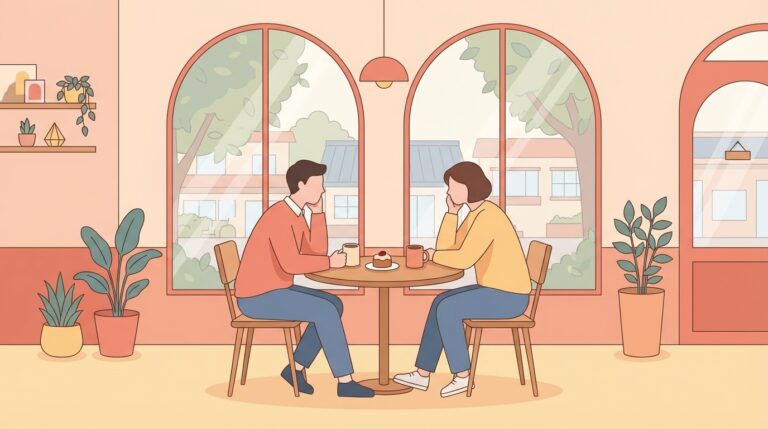
Picture this: You’re at a chic, aesthetic cafe in Yeonnam-dong. The ambient K-R&B music is playing softly in the background. Sitting across from you is someone your Korean friend set you up with. In K-Dramas, this is the exact moment the romantic OST kicks in, and the camera pans in slow motion.
But in reality? Your palms are sweating. Your mind is going blank. You’re desperately trying to remember how to say “Do you like coffee?” without sounding like a robotic textbook from Chapter 1.
Welcome to 소개팅 (Sogaeting – Blind Date), a massive pillar of Korean dating culture! If you don’t know the natural flow of these conversations, you might sound like you’re conducting a job interview. But don’t worry! This guide is based on real questions my students have asked after actual blind dates in Seoul. Let’s turn you into a charming insider!
Phase 2: Core Expressions – Deep Dive
Let’s look at the absolute must-know phrases for a Korean blind date.
1. 어떤 음식 좋아하세요?
- Pronunciation: [eotteon eumsik joahaseyo?]
Sound-alike guide: uh-tton oom-shik jo-ah-ha-seh-yo?- Meaning:
- Literal: What kind of food do you like?
- Real nuance: Let’s find a restaurant to eat at together.
- K-Culture Moment: Usually, sogaeting starts at a cafe. After about an hour of chatting over coffee, if things are going well, one person will drop this line. It’s the ultimate green light that means, “I’m enjoying this, let’s move to a restaurant for dinner.”
- Editor’s Insight: This phrase feels polite, considerate, and shows you care about their preferences. It’s much softer than just saying “Let’s eat.”
- Situation Spectrum:
- Casual (Friends): ⚠️ (Too polite)
- Semi-formal (Blind Date): ✅
- Formal (Boss): ✅
- 🤔 Think About It: Why is food usually the first thing we ask about on a Korean date? How does sharing a meal connect to the Korean concept of “Jeong” (affection/bonding)?
2. 쉬는 날 보통 뭐 하세요?
- Pronunciation: [swineun nal botong mwo haseyo?]
Sound-alike guide: shwee-neun nal bo-tong mwo ha-seh-yo?- Meaning:
- Literal: On resting days, what do you usually do?
- Real nuance: What do you do for fun? / What are your hobbies?
- K-Culture Moment: You’ll hear this in almost every dating reality show like Single’s Inferno or Heart Signal when participants are trying to figure out each other’s lifestyles.
- Editor’s Insight: If you ask “취미가 뭐예요?” (What is your hobby?), it sounds super stiff, like an interrogation. Asking what they do on their “days off” sounds genuinely curious and relaxed.
- Situation Spectrum:
- Casual: ⚠️ (Use Banmal instead: 쉬는 날 뭐 해?)
- Semi-formal: ✅
- Formal: ⚠️
- 🤔 Think About It: Does your native language have a difference between asking “What is your hobby?” and “What do you do in your free time?”
3. 연락처 좀 알려주시겠어요?
- Pronunciation: [yeollakcheo jom allyeojusigesseoyo?]
Sound-alike guide: yull-lak-cho jom al-lyuh-joo-shi-gess-uh-yo?- Meaning:
- Literal: Could you please inform me of your contact info?
- Real nuance: Can I get your KakaoTalk / number?
- K-Culture Moment: The date is ending. You’re walking them to the subway station. The breeze is blowing. You pull out your phone and ask this. It’s the ultimate “I want to see you again” move.
- Editor’s Insight: Notice the word 좀 (jom – a little). Koreans use this word constantly to soften a request. Without it, the sentence sounds too direct or demanding.
- Situation Spectrum:
- Casual: 🚫
- Semi-formal: ✅
- Formal: ✅
- 🤔 Think About It: Why do Koreans prefer exchanging “KakaoTalk IDs” rather than phone numbers right away on a date?
Phase 3: Textbook vs. Real Korean
[Asking about their job]
* 📖 Textbook Korean: 직업이 무엇입니까? (What is your occupation?)
* 🗣️ Real Korean: 무슨 일 하세요? (What kind of work do you do?)
* 💡 Why the difference?: The textbook version uses the “-ㅂ니다/까” form, which belongs in a police station or a boardroom, not a romantic cafe! “무슨 일 하세요?” is polite but conversational.
[Offering to pay the bill]
* 📖 Textbook Korean: 제가 계산하겠습니다. (I will calculate/pay.)
* 🗣️ Real Korean: 이번엔 제가 살게요! (I’ll buy it this time!)
* 💡 Why the difference?: Adding “이번엔” (this time) is a genius K-Dating trick. It subtly implies there will be a “next time” (다음엔), securing a second date!
Phase 4: Cultural Context — K-Culture Deep Dive
4-1. Non-Verbal Communication: Nunchi on a Date
Don’t treat eye contact like a staring contest. In Korean culture, unbroken eye contact can feel slightly aggressive or burdensome to a stranger. Glance at your coffee, smile, look at them while they speak, and nod frequently (“아, 진짜요?” – Oh, really?).
Also, the famous Nunchi (눈치) comes into play when the bill arrives. Traditionally, the person who asked for the date pays, or they split it by rounds (e.g., Person A pays for dinner, Person B pays for the cafe). Read the room!
4-2. The K-Drama Connection
Have you ever seen a K-Drama where the male lead suddenly says, “I need to go to the restroom,” but he actually sneaks off to the counter to pay the bill in advance? This is a classic Korean dating trope! It’s seen as a smooth, well-mannered move to prevent the awkward “card battle” at the register. While you don’t have to do this, if your date does it, be sure to say: “잘 먹었습니다! 다음엔 제가 살게요” (I ate well! I’ll buy next time).
Phase 5: Real-Life Roleplay Scenario
Setting: A cozy pasta restaurant near Gangnam Station. It’s 7 PM on a Friday. You’ve been chatting with your blind date for an hour.
Characters:
– YOU: A foreign professional working in Seoul. You’re eager to make a good impression.
– Min-soo / Min-ji (NPC): Your blind date. Polite, a bit shy, but smiling brightly.
(Dialogue)
Min-soo/Min-ji: 음식 입에 맞으세요? 🍝
(eumsik ibe majeuseyo?)
[Does the food suit your taste?]
YOU: 네! 진짜 맛있어요.
(ne! jinjja masisseoyo.)
[Yes! It’s really delicious.]
Min-soo/Min-ji: 다행이네요. 아, 주말에는 보통 뭐 하세요?
(dahaengineyo. a, jumareneun botong mwo haseyo?)
[That’s a relief. Oh, what do you usually do on the weekends?]
YOU: 저는 한강에서 자전거 타는 거 좋아해요.
(jeoneun hangangeseo jajeongeo taneun geo joahaeyo.)
[I like riding a bike at the Han River.]
Min-soo/Min-ji: 우와, 저도 자전거 타는 거 엄청 좋아해요!
(uwa, jeodo jajeongeo taneun geo eomcheong joahaeyo!)
[Wow, I really love riding bikes too!]
(🎭 Stage Direction: The meal is over, and the waiter brings the check to the table. Min-soo/Min-ji reaches for their wallet.)
🔀 Your Turn! What do you say?
– A) “더치페이 해요!” (Let’s do Dutch pay!)
– B) “감사합니다. 잘 먹겠습니다!” (Thank you, I will eat well!)
– C) “오늘은 제가 살게요! 커피는 민수/민지 씨가 사세요.”✅ Best Choice: C — “I’ll buy today! You can buy the coffee.”
Why? This is the golden rule of Korean dates! It relieves the pressure of paying for an expensive meal while organically securing a second location (the cafe) to continue the date.
⚠️ Choice A Analysis: While splitting the bill (Dutch pay) is common among friends, saying “더치페이 해요” on a first date can sometimes kill the romantic mood or sound too transactional.
Phase 6: 10-Second Shadowing Drill
Let’s practice the flow and intonation. Follow the slashes for pauses!
😊 쉬는 날 / 보통 / 뭐~~~ 하세요?
(shwee-neun nal / bo-tong / mwo~~~ ha-seh-yo?)
(Smile politely, elongate the ‘mwo’ slightly to sound curious and friendly!)
🥺 연락처 / 좀 / 알려주시겠어요?
(yull-lak-cho / jom / al-lyuh-joo-shi-gess-uh-yo?)
(Use a soft, slightly shy tone. End with an upward intonation.)
Phase 7: K-Culture Mini Dictionary
| 한국어 (Korean) | Romanization | English | Context |
|---|---|---|---|
| 소개팅 | sogaeting | Blind Date | A date arranged by a mutual friend. “Soga” means introduction, “ting” comes from meeting. |
| 주선자 | juseonja | Matchmaker | The mutual friend who set you up. You usually have to buy them a meal if the date is successful! |
| 썸 | sseom | “Talking stage” | The ambiguous romantic phase before officially dating. Derived from the English word “something.” |
| 카톡 | katok | KakaoTalk | Korea’s #1 messaging app. Getting someone’s “Katok” is the goal of a first date. |
Phase 8: Traveler Survival Kit (Date Location Edition)
If you’re going on a date, you need to find the meeting spot!
🆘 Survival Phrases #1: Finding the Spot
– 🇰🇷 “여기 어떻게 가요?” (yeogi eotteoke gayo?)
– 🗣️ English Guide: yuh-gee uh-tuh-keh gah-yo?
– 📍 Where to use: Asking people on the street while showing your phone map.
– 💡 Pro Tip: Show them the screen! It crosses all language barriers.📌 Editor’s Travel Note
– Essential App: Do NOT use Google Maps in Korea for walking directions; it barely works! Download KakaoMap or Naver Map.
– Paying: Korea is a card heaven. Even small cafes take international cards, but carrying 10,000 won in cash is safe just in case.
– Tipping: NO tipping in Korea! Leaving cash on the table will confuse the staff, and they might chase you down the street to return your “lost money.”
Phase 9: Think Deeper — Language & Power
🧠 Think Deeper: The Distance of Politeness
Why do we use formal language (존댓말 – Jondaetmal) on a first date, even if you are the same age? In Korean, honorifics aren’t just about showing “respect” to elders; they also create a safe, polite “distance” between strangers. Using casual language (반말 – Banmal) right away implies you are extremely close, which can feel invasive on a first date. The beautiful part of Korean dating is the slow, exciting transition from formal to casual language as you grow closer.💬 Your Turn: In your culture, how do you show politeness on a first date? Do you change your vocabulary, or is it mostly body language? Share in the comments!
Phase 10: FAQ & Common Mistakes
Q: Can I ask their age on the first date?
Yes! In many Western cultures, asking age is taboo. In Korea, it’s actually important because it establishes the social hierarchy and determines how you speak to each other later. Just ask politely: “실례지만, 나이가 어떻게 되세요?” (Excuse me, but how old are you?)
Q: Can I use the word “당신 (Dangsin – You)”?
❌ NO! NEVER!
❌ Common Mistake #1: Translating “You” directly to “당신 (Dangsin).”
✅ Do this instead: In Korean, we drop the word “you.” If you must address them, use their name + 씨 (ssi).
Example: “민수 씨는 커피 좋아하세요?” (Min-soo ssi, do you like coffee?)
Phase 11: Summary & Action Items
✨ One-Liner Summary: A successful Korean blind date relies on soft questions, observing the nunchi of the room, and suggesting a “next time” naturally.
🎯 Action Missions:
– 🥉 Bronze (Solo): Stand in front of a mirror and practice asking “쉬는 날 보통 뭐 하세요?” with a gentle smile.
– 🥈 Silver (Online): Leave a comment below answering this question in Korean: 어떤 음식 좋아하세요?
– 🥇 Gold (Real Life): If you are in Korea, try offering to pay at a cafe with your friends using “제가 살게요!”
🍿 K-Culture Mission:
Turn on a modern romantic K-Drama (like Queen of Tears or Business Proposal). Look out for the scene where they exchange contacts. Listen closely—can you hear them say “연락처 (contact)”?
Phase 12: Interactive Quiz
1. Fill in the blank!
Date: “I will pay for dinner!”
You: “Thank you! Then, [ ]!”
Answer: 커피는 제가 살게요 (I will buy the coffee)
2. True or False: K-Culture Edition
It is incredibly rude to ask someone their age on a blind date in Korea.
Answer: FALSE. It is actually very normal and sometimes necessary to figure out the social dynamic, as long as it’s asked politely!
3. Situational Judgment
You want to ask “Do you like movies?” Which sounds most natural on a first date?
A) 당신은 영화 좋아합니까?
B) 영화 보는 거 좋아하세요?
C) 영화 좋아해?
Answer: B. “A” sounds like a robot because of ‘당신’ and ‘-합니까’. “C” is Banmal (too casual for a first meeting). “B” is perfectly polite and natural!
Frequently Asked Questions (FAQ)
Q: What does "어떤 음식 좋아하세요?" mean in Korean and how do you pronounce it?
A: In Korean, "어떤 음식 좋아하세요?" is pronounced [eotteon eumsik joahaseyo?] and means: Literal: What kind of food do you like?
Q: What does "쉬는 날 보통 뭐 하세요?" mean in Korean and how do you pronounce it?
A: In Korean, "쉬는 날 보통 뭐 하세요?" is pronounced [swineun nal botong mwo haseyo?] and means: Literal: On resting days, what do you usually do?
Q: What does "연락처 좀 알려주시겠어요?" mean in Korean and how do you pronounce it?
A: In Korean, "연락처 좀 알려주시겠어요?" is pronounced [yeollakcheo jom allyeojusigesseoyo?] and means: Literal: Could you please inform me of your contact info?







