

Hello! I’m your Daily Hangul Editor.
Imagine this: You are in Seoul, and your Korean friends invite you to a famous, traditional Korean BBQ restaurant. You open the sliding door, and the smell of roasting pork belly hits you. You step inside, excited… but suddenly, the restaurant owner sighs, and your friends look a bit embarrassed. You look down. Your shoes are scattered right in the middle of the entrance, pointing in all directions. Oops!
In K-Dramas, you might have noticed scenes where the camera lingers on a neatly arranged pair of shoes at an entryway. It might seem like a small detail, but in Korea, what you do with your shoes is the very first test of your manners.
Today, we are going to learn how to perfectly navigate the Korean “Shoe Etiquette” so you can impress your Korean friends before you even say “Hello!”
Phase 2: Core Expressions — Mastering the Entryway
Before we talk about how to arrange them, let’s learn what you will hear when you arrive.
1. 신발을 벗어 주세요
- Pronunciation: sinbareul beoseo juseyo [sin-ba-reul beo-seo joo-se-yo]
- Meaning: Please take off your shoes.
- K-Culture Moment: You will hear this from the staff at a traditional restaurant (좌식 식당 – floor seating) or when visiting a Korean home. It’s polite and standard.
- Editor’s Insight: The word ‘벗다’ (beot-da) means ‘to take off’. Think of it as leaving the stress of the outside world at the door.
- Situation Spectrum:
- Casual (Friends): ⚠️ (Too formal)
- Semi-formal (Staff to customer): ✅
- Formal (Elders): ✅
- 🤔 Think About It: Why are Koreans so strict about taking off shoes? It traces back to the Ondol (underfloor heating) culture. The floor is where Koreans traditionally eat, sleep, and relax. Would you walk on your bed with outdoor shoes?
2. 신발을 가지런히 놓으세요
- Pronunciation: sinbareul gajireonhi noeuseyo [sin-ba-reul ga-ji-reon-hi no-eu-se-yo]
- Meaning: Please arrange your shoes neatly.
- K-Culture Moment: A mother scolding her kids in a K-Drama for making a mess at the door. You won’t hear this often as an adult, because it’s expected that you already know to do it!
- Editor’s Insight: ‘가지런히’ (gajireonhi) means ‘neatly’ or ‘evenly’. It has a very calming, organized vibe to it.
- Situation Spectrum:
- Casual: ✅ (Usually shortened)
- Semi-formal: ⚠️
- Formal: 🚫 (It sounds like a command)
- 🤔 Think About It: Arranging your shoes isn’t just about being neat. It shows respect for the space and the people hosting you.
3. 실내화로 갈아신으세요
- Pronunciation: sillaehwaro garasineuseyo [sil-lae-hwa-ro ga-ra-si-neu-se-yo]
- Meaning: Please change into indoor slippers.
- K-Culture Moment: When visiting a school, a dentist’s office, or even some cafes, you’ll see a rack of cozy slippers.
- Editor’s Insight: ‘실내화’ (sillaehwa) literally means ‘indoor shoes’. Even though the floor is clean, Koreans love keeping their feet warm and keeping an extra layer of cleanliness.
- Situation Spectrum:
- Casual: ⚠️
- Semi-formal: ✅
- Formal: ✅
Phase 3: Textbook vs. Real Korean
[Entering a Friend’s House]
* 📖 Textbook Korean: 신발을 가지런히 정리해 주시겠습니까? (Would you please arrange your shoes neatly?)
* 🗣️ Real Korean: 신발 예쁘게 놔~ (Put your shoes nicely~)
* 💡 Why the difference?: Friends use casual language (Banmal). Saying “예쁘게” (prettily/nicely) is a cute, common way to say “neatly” among friends.
[At a Busy Restaurant]
* 📖 Textbook Korean: 손님, 이곳은 신발을 벗고 들어오는 곳입니다. (Customer, this is a place where you enter after taking off your shoes.)
* 🗣️ Real Korean: 신발 벗고 들어오세요~! (Take off your shoes and come in~!)
* 💡 Why the difference?: Efficiency! Restaurant owners are busy, so they use polite but direct phrasing to guide you quickly.
Phase 4: Cultural Context — K-Culture Deep Dive
4-1. The Golden Rule of Arranging Shoes (Non-verbal Nunchi)
Taking off your shoes isn’t enough. The ultimate Nunchi (social sense) is how you place them.
When you take off your shoes, you must turn them around so the toes are pointing towards the door (outward).
Why? It means when you are ready to leave, you can just slip your feet in and walk out gracefully. It shows consideration for your future self, and it looks incredibly neat to the host. If you leave them pointing inside, it looks messy and unprepared.
4-2. The “Holey Sock” Danger in K-Travel
If you travel to Korea, you will be taking your shoes on and off multiple times a day. At a Hanok guesthouse, at traditional restaurants, or even in some fitting rooms!
Pro Tip: Always wear clean, nice socks in Korea. A common expat comedy moment is going to a fancy Korean restaurant only to realize you have a massive hole in your toe! In Korea, your socks are basically your indoor shoes.
Phase 5: Real-Life Roleplay Scenario
Setting: Friday night, 7 PM. You are at a famous, traditional Hanok-style restaurant in Insadong with your Korean friend, Minji. The entrance is a wooden step (Maru). You see a shoe rack next to the step.
Characters:
– YOU: An expat excited for some authentic Korean food.
– Minji (28): Your helpful Korean friend.
– Restaurant Owner (50s): Busy, welcoming, but keeps an eye on the floor.
Dialogue:
Minji: 여기 진짜 맛집이야! 빨리 들어가자. 😊
(yeogi jinjja matjibiya! ppalli deureogaja.)
[This place is really delicious! Let’s go in quickly.]
YOU: 우와, 분위기 너무 좋다!
(uwa, bunwigi neomu jota!)
[Wow, the atmosphere is so good!]
Owner: 어서 오세요! 신발 벗고 올라오세요~
(eoseo oseyo! sinbal beotgo ollaoseyo~)
[Welcome! Please take off your shoes and come up~]
(🎭 Stage Direction: You step up onto the wooden floor. Now, what do you do with your shoes?)
🔀 Your Turn! What is your next move?
– A) Just leave them exactly where you stepped out of them, pointing inside.
– B) Kick them to the side so they aren’t in the way.
– C) Turn around, place the left and right shoe neatly together, pointing towards the outside door.✅ Best Choice: C — This is the ultimate Korean etiquette. The owner will instantly think, “Wow, this foreigner knows Korean culture!”
⚠️ Choice A & B Analysis: Leaving them messy means the owner or the staff will eventually have to come and arrange them for you, which is bad manners.
Minji: 오~ 너 한국 문화 잘 아네! 완벽해.
(o~ neo hanguk munhwa jal ane! wanbyeokhae.)
[Oh~ You know Korean culture well! Perfect.]
Phase 6: 10-Second Shadowing Drill
Let’s practice the most common phrase you will hear and need to understand immediately.
😊 어서 오세요! / 신발 벗고 / 들어오세요~
(eoseo oseyo! / sinbal beotgo / deureo-oseyo~)
(Brightly) Welcome! / Take off your shoes and / come in~
Phase 7: K-Culture Mini Dictionary
| Korean | Romanization | English | Context |
|---|---|---|---|
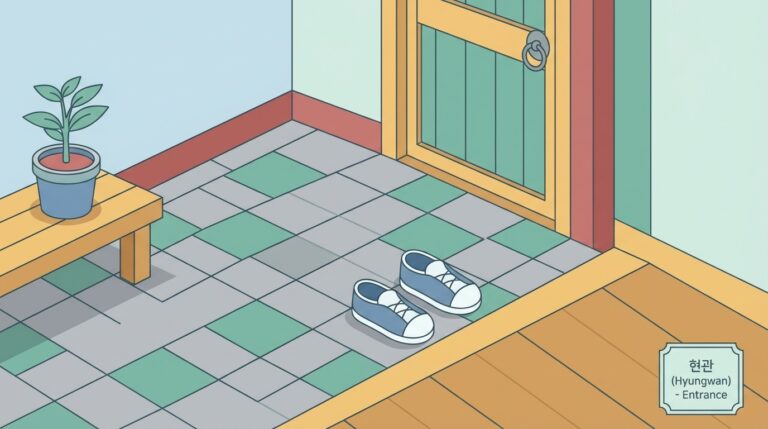
| 현관 | hyeongwan | Entryway | The small area by the door where you take off shoes. It is usually a slightly lower level than the main floor. |
| 신발장 | sinbaljang | Shoe rack/cabinet | Where you store shoes. Always place your shoes here if available! |
| 맨발 | maenbal | Bare feet | Going barefoot in someone else’s house can sometimes be seen as slightly impolite. Better to wear socks! |
| 온돌 | ondol | Underfloor heating | The traditional Korean heating system that makes the floors incredibly warm in winter. |
Phase 8: Traveler’s Survival Kit
Are you traveling to Korea soon? Here are the survival phrases regarding shoes!
🆘 Survival Phrases
– 🇰🇷 “여기 신발 벗나요?” (yeogi sinbal beonnayo?)
– 🗣️ Pronunciation: [yeo-gi sin-bal beon-na-yo?]
– 📖 Meaning: Do I take off my shoes here?
– 📍 Where to use: Small restaurants, cafes with floor seating, clinics.
– 💡 Pro Tip: If you see a small step up from the entryway to the main floor, 99% of the time, it means “Take off your shoes!”📌 Editor’s Travel Note
– Slip-ons are your best friend: When traveling in Korea, wear shoes that are easy to slip on and off. Lace-up boots will make you sweat every time you go to a traditional restaurant!
– Shoe Locks: At very busy, old-school restaurants, you might see small lockers for your shoes with keys. Use them! It prevents accidental “shoe swapping” after a few bottles of Soju.
Phase 9: Critical Thinking — “One Step Deeper”
🧠 Think Deeper: Space and Boundary (공간과 경계)
In Korean culture, the entryway (Hyeongwan) is more than just a place to put umbrellas. It acts as a physical and psychological boundary between the dirty, chaotic outside world and the clean, peaceful inside sanctuary. Because Koreans traditionally sit, sleep, and eat on the floor (Ondol), the floor is treated like a piece of furniture—like a bed or a dining table. Arranging your shoes neatly at the boundary shows respect for the sanctuary you are entering. It is a silent promise that you will treat the home with care.
💬 Your Turn: Does your culture have a strict “no shoes indoors” rule? How do people in your country react if someone wears shoes inside? Let me know in the comments!
Phase 10: FAQ & Avoiding Mistakes
Q: “Is it okay if my shoes are pointing inside instead of outside?”
It’s not a crime, but pointing them outside is the “Gold Standard” of manners. If you point them inside, an older Korean person might quietly turn them around for you (which means you failed the etiquette test!).
Q: “What if I’m not wearing socks?”
In the summer, many people wear sandals. However, if you are visiting an elder’s house or a somewhat formal traditional setting, bringing a spare pair of socks in your bag to slip on is considered extremely polite.
❌ Common Mistake #1: Stepping on the Hyeongwan (the dirty entryway level) with your socks on, and then stepping onto the clean floor.
✅ How to fix it: Step out of your shoes directly onto the clean floor level without letting your socks touch the dirty entryway tiles!
Phase 11: Summary & Action Items
- One-Liner Summary: Always take off your shoes at the step, and arrange them neatly pointing towards the door to show ultimate respect!
-
Action Mission:
- 🥉 Bronze (Solo): Look at your own entryway at home. Arrange your shoes neatly pointing towards the door right now!
- 🥈 Silver (Online): Find a K-Drama scene where someone enters a house. Watch closely what they do with their shoes.
- 🥇 Gold (Real Life): Next time you go to a Korean restaurant or a friend’s house, arrange your shoes perfectly and wait for their impressed reaction.
- K-Culture Mission: Watch an episode of “Reply 1988” (응답하라 1988) or any family K-Drama. Count how many times you see the characters sitting, eating, or sleeping on the floor. You’ll understand why clean floors are so important!
Phase 12: Quiz — Interactive Challenge
1. You are invited to your Korean boss’s house. You take off your shoes. What is the most polite way to arrange them?
A) Leave them as they are.
B) Turn them around so the toes point toward the outside door.
C) Hide them in your bag.
(Answer: B. It shows you are respectful and ready to leave gracefully later.)
2. True or False: It is completely fine to walk barefoot in a formal traditional Korean setting.
(Answer: False. While acceptable among close friends, wearing socks is much safer and more polite in formal settings.)
3. Fill in the blank: At a restaurant, the owner says “( ) 벗고 들어오세요!” (Take off your shoes and come in!)
A) 모자 (mo-ja / hat)
B) 안경 (an-gyeong / glasses)
C) 신발 (sin-bal / shoes)
(Answer: C)
How did you do? Now you are ready to step into Korea with confidence! See you in the next lesson.
Frequently Asked Questions (FAQ)
Q: What does "신발을 벗어 주세요" mean in Korean and how do you pronounce it?
A: In Korean, "신발을 벗어 주세요" is pronounced [sinbareul beoseo juseyo [sin-ba-reul beo-seo joo-se-yo] and means: Please take off your shoes.
Q: What does "신발을 가지런히 놓으세요" mean in Korean and how do you pronounce it?
A: In Korean, "신발을 가지런히 놓으세요" is pronounced [sinbareul gajireonhi noeuseyo [sin-ba-reul ga-ji-reon-hi no-eu-se-yo] and means: Please arrange your shoes neatly.
Q: What does "실내화로 갈아신으세요" mean in Korean and how do you pronounce it?
A: In Korean, "실내화로 갈아신으세요" is pronounced [sillaehwaro garasineuseyo [sil-lae-hwa-ro ga-ra-si-neu-se-yo] and means: Please change into indoor slippers.







