

Phase 1: Empathy & The K-Culture Cold Open
Hello! This is your lead editor at Daily Hangul.
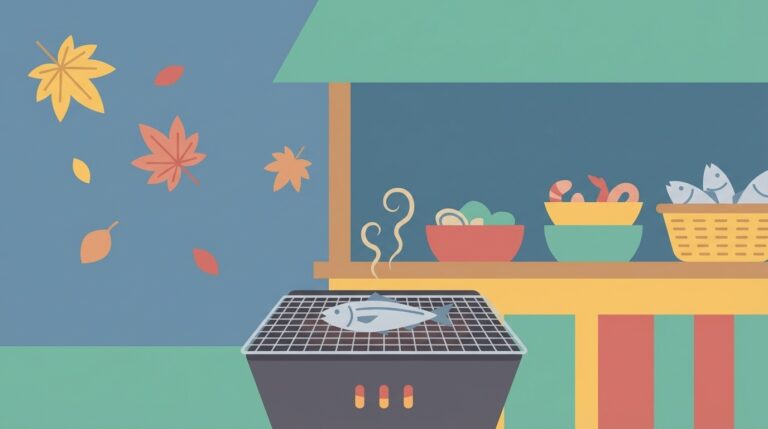
Imagine this: It’s late October. You are walking through the bustling alleys of a traditional Korean market, or perhaps watching a classic K-Drama scene where the characters are drinking Soju at a Pojangmacha (tent bar). The air is crisp, and a rich, smoky, mouth-watering scent fills the street.
Suddenly, your Korean friend takes a deep breath, points to a fish grilling on the charcoal, and says, “Ah! The runaway daughter-in-law is coming back!”
Wait… what? 😳
Are we suddenly in an intense family K-Drama? Is someone’s wife hiding in the market? Nope! They are simply talking about a fish.
If you translate this literally, it makes zero sense. But if you understand the cultural context behind this idiom, you instantly level up from a “textbook learner” to a true Korean insider. Autumn in Korea isn’t just about beautiful maple leaves; it’s about food. Let’s dive into why a simple grilled fish holds so much drama, and how you can use seasonal Korean expressions like a local!
Phase 2: Core Expressions Deep Dive
1. 가을 전어는 집 나간 며느리도 돌아온다
- Pronunciation: [Gaeul jeoneo-neun jip nagan myeoneuri-do doraonda]
Sound guide: ‘Gaeul’ sounds like ‘gah-ool’, and ‘jeoneo’ sounds like ‘jaw-naw’. - Meaning:
- Literal: Autumn gizzard shad makes even a runaway daughter-in-law return.
- Real Nuance: This fish is so incredibly delicious when roasted in the fall that its smell alone could tempt someone to return to a difficult situation just to eat it.
- K-Culture Moment: You will hear this on every Korean cooking show, variety show, and news broadcast the moment September hits. It’s the ultimate hype phrase for autumn seafood.
- Editor’s Insight: This isn’t a phrase you use in everyday casual chatting about pizza. It’s a culturally rich idiom used playfully when smelling or eating Jeoneo (gizzard shad).
- Situation Spectrum:
- Casual with friends: ✅ (Playful and natural)
- Semi-formal (Co-workers): ✅ (Great for small talk!)
- Formal (Boss/Elders): ✅ (Elders love it when foreigners know this phrase!)
- 🤔 Think About It: Why a “runaway daughter-in-law”? In traditional Korean society, the dynamic between a mother-in-law (si-eomeoni) and daughter-in-law (myeoneuri) was notoriously difficult (a trope you still see in K-Dramas today). Running away was a desperate escape. This idiom humorously exaggerates how delicious the fish must be to overcome that hardship. Does your culture have food idioms involving family drama?
2. 제철 음식
- Pronunciation: [Jecheol eumsik]
Sound guide: ‘Je’ (like jelly) – ‘cheol’ (like chill with an ‘uh’) – ‘eum’ (like the disgusted sound you make stepping in gum + m) – ‘sik’ (seek). - Meaning: Seasonal food / Food in season.
- K-Culture Moment: Koreans are obsessed with eating things at their peak season. In autumn, it’s Jeoneo (shad) and Daeha (jumbo shrimp). Winter is for Bangeo (yellowtail). Asking “Have you eaten seasonal food?” is almost like asking “How are you?”
- Editor’s Insight: If you want to impress a Korean foodie, don’t just say “I like Korean food.” Say “I love finding jecheol eumsik.”
- Situation Spectrum:
- Casual with friends: ✅
- Semi-formal (Co-workers): ✅
- Formal (Boss/Elders): ✅
- 🤔 Think About It: Korea has four very distinct seasons, which shaped its agricultural history. How does the climate of a country shape its language around food?
3. 냄새가 끝내주네요!
- Pronunciation: [Naemsaega kkeut-nae-ju-ne-yo!]
- Meaning: The smell is killer! / The smell is amazing!
- K-Culture Moment: Walking past a K-BBQ restaurant or a street food vendor. You close your eyes, inhale, and say this.
- Editor’s Insight: Kkeut-nae-juda literally means “to finish it off” or “to end it,” but it’s used as slang for “it’s the ultimate/killer.” It’s highly expressive and natural.
- Situation Spectrum:
- Casual with friends: ✅ (You can just say: 냄새 끝내준다!)
- Semi-formal (Co-workers): ✅
- Formal (Boss/Elders): ⚠️ (A bit too expressive for highly formal settings, use ‘냄새가 정말 좋네요’ instead).
Phase 3: Textbook vs. Real Korean
Let’s see how you can sound less like a textbook and more like someone who actually lives in Seoul.
[Situation 1: Recommending autumn food]
* 📖 Textbook Korean: 가을에는 전어를 먹어야 합니다. (You must eat gizzard shad in autumn.)
* 🗣️ Real Korean: 가을 전어는 못 참지! (You can’t resist autumn gizzard shad!)
* 💡 Why the difference?: “~은/는 못 참지” (Can’t resist ~) is a massively popular internet slang that transitioned into real life. It shows you know exactly what hits the spot.
[Situation 2: Expressing how delicious something is]
* 📖 Textbook Korean: 아주 맛있습니다. (It is very delicious.)
* 🗣️ Real Korean: 완전 밥도둑이에요! (It’s a total rice thief!)
* 💡 Why the difference?: “Rice thief” (밥도둑) is a beloved term for salty, savory foods (like soy-marinated crabs or grilled fish) that make you eat bowls of rice without realizing it. It’s deeply tied to Korea’s rice-centric dining culture.
Bottom Note: For B1 (Lower Intermediate) learners, “못 참지” and “밥도둑” are the perfect level of trendy slang. They are widely understood by all generations and aren’t overly informal!
Phase 4: Cultural Context — K-Culture Deep Dive
4-1. Non-Verbal Cues: The Art of Anticipation
When a Korean person uses the “runaway daughter-in-law” idiom, they don’t just say it blankly. It requires acting!
Imagine the Nunchi (social sense) of a dinner table. When the fish arrives, you shouldn’t just start eating. The polite and socially expected reaction is to lean in, smell the air, widen your eyes, and enthusiastically praise the food before taking a bite. Food in Korea is a shared communal experience; your outward joy enhances the taste for everyone else at the table.
4-2. K-Food Connection: The Social Power of Sharing
Why is food so central to Korean idioms? In Korea, eating alone (Honbap) is a recent trend, but historically, food was the ultimate community binder. Asking “Have you eaten?” (밥 먹었어요?) means “How are you?”.
When autumn arrives, colleagues will organize Hoesik (company dinners) specifically to eat Jeoneo or jumbo shrimp. It’s an excuse to gather. If you understand the “runaway daughter-in-law” proverb, you understand that Korean food isn’t just sustenance—it’s a narrative of family, seasons, and survival.
Critical POV: Notice how the proverb highlights traditional gender roles? While modern Korean families are changing rapidly, these idioms preserve a snapshot of the harsh historical reality for women, wrapping it in the comforting guise of culinary nostalgia.
Phase 5: Real-Life Roleplay Scenario
Setting: Friday evening, 7:00 PM. A bustling seafood restaurant near Noryangjin Fish Market. The air is thick with the savory smoke of grilling fish. You are having dinner with your Korean co-worker.
Characters:
* YOU: An expat working in Seoul, always eager to try local culture.
* Min-su (32): Your friendly Korean colleague who prides himself on knowing the best local restaurants.
Dialogue:
Min-su: 와, 사람 진짜 많네요. 역시 가을이라 다들 전어 먹으러 왔나 봐요.
(Wa, saram jinjja manneyo. Yeoksi gaeurira dadeul jeoneo meogeureo wanna bwayo.)
[Wow, there are so many people here. As expected of autumn, everyone must be here to eat Jeoneo.]
(🎭 Stage Direction: Min-su grabs a menu and waves at the waiter)
YOU: 냄새가 벌써 끝내주는데요?
(Naemsaega beolsseo kkeunnae-juneundeyo?)
[The smell is already killer!]
Min-su: 그렇죠? 한국에서는 가을 전어 굽는 냄새에 집 나간 며느리도 돌아온다고 해요. 들어봤어요?
(Geureochyo? Hangugeseoneun gaeul jeoneo gupneun naemsaee jip nagan myeoneurido doraondago haeyo. Deureobwasseoyo?)
[Right? In Korea, they say the smell of grilling autumn Jeoneo brings back even a runaway daughter-in-law. Have you heard that?]
YOU: 네! 인터넷에서 봤어요. 얼마나 맛있길래 며느리가 돌아와요? ㅋㅋ
(Ne! Inteoneseseo bwasseoyo. Eolmana masitgillae myeoneuriga dorawayo? haha)
[Yes! I saw it on the internet. How delicious is it that the daughter-in-law comes back? lol]
Min-su: 오늘 직접 먹어보면 알 거예요. 이모님! 여기 전어구이 하나랑 소주 주세요!
(Oneul jikjeop meogeobomyeon al geoyeyo. Imonim! Yeogi jeoneogui hanarang soju juseyo!)
[You’ll know once you try it yourself today. Auntie! One grilled Jeoneo and Soju here, please!]
(🎭 Stage Direction: The sizzling fish arrives on the table.)
Min-su: 자, 나왔습니다. 뼈째로 씹어 먹는 게 제맛이에요. 한번 먹어봐요!
(Ja, nawasseumnida. Ppyeojjaero ssibeo meongneun ge jemasieyo. Hanbeon meogeobwayo!)
[Here it is. Chewing it whole with the bones is the real flavor. Give it a try!]
🔀 Your Turn! How should you respond after taking a bite?
* A) “맛있네요. 생선이 참 좋아요.” (It’s delicious. The fish is very good.)
* B) “와, 진짜 며느리가 돌아올 맛이네요! 완전 밥도둑이에요!” (Wow, it really tastes like the daughter-in-law would return! It’s a total rice thief!)
* C) “윽, 뼈가 너무 많아서 제 스타일은 아니에요.” (Ugh, there are too many bones, it’s not my style.)✅ Best Choice: B — Why? You are using the idiom he just taught you AND adding “rice thief” (밥도둑). Min-su will likely be incredibly impressed by your Korean skills!
⚠️ Choice C Analysis: It’s okay to dislike the bones (many foreigners do!), but in Korean dining culture, it’s better to be polite first. You could say, “맛있는데 뼈 먹는 건 아직 조금 어렵네요!” (It’s delicious, but eating the bones is still a bit hard for me!).
Phase 6: 10-Second Shadowing Drill
Time to practice! Follow the slashes for pausing and pay attention to the emotional tags.
- 😊 밝게 (Brightly, as if smelling something amazing)
- 와~ / 냄새가 / 끝~~~내주네요! / 가을엔 역시 / 전어죠!
- (Wa~ / naemsaega / kkeut~~~nae-ju-ne-yo! / gaeuren yeoksi / jeo-neo-jyo!)
- [Wow~ the smell is killer! Autumn is definitely for Jeoneo!]
Phase 7: K-Culture Mini Dictionary
| Korean | Romanization | English | Context |
|---|---|---|---|
| 며느리 / 시어머니 | myeoneuri / sieomeoni | Daughter-in-law / Mother-in-law | Often depicted in K-Dramas as a complex, sometimes tense relationship. |
| 제철 음식 | jecheol eumsik | Seasonal food | A cornerstone of Korean culinary pride. Ingredients eaten at their peak. |
| 포장마차 | pojangmacha | Tent bar | Street-side tents selling street food and Soju. Very popular in autumn. |
| 밥도둑 | bapdoduk | Rice thief | Slang for incredibly delicious, savory food that makes you eat a lot of rice. |
| 뼈째(로) | ppyeojjae(ro) | With the bones | Jeoneo is famous for being eaten Sekkosi style (sliced with the soft bones intact). |
Phase 8: Traveler Survival Kit (Market Edition)
If you visit Korea in the autumn, you MUST visit a traditional market like Gwangjang Market or a seafood market to experience the vibe. Here are the survival phrases you need:
🆘 Survival Phrases for Traditional Markets
1. 🇰🇷 “지금 제철인 게 뭐예요?” (Jigeum jecheorin ge mwoyeyo?)
🗣️ “What is in season right now?” (Ask this to the vendor for the best recommendation!)
2. 🇰🇷 “조금만 맛볼 수 있을까요?” (Jogeumman matbol su isseulkkayo?)
🗣️ “Could I just taste a little bit?”
3. 🇰🇷 “뼈 빼고 주실 수 있나요?” (Ppyeo ppaego jusil su innayo?)
🗣️ “Can you serve it without the bones?” (Crucial if you hate eating fish bones!)📌 Editor’s Travel Note
* Bone-in vs Bone-out: Jeoneo is traditionally eaten with the bones (Sekkosi). The bones are soft, but if you aren’t used to it, it can be scary! Use survival phrase #3.
* Cash vs Card: While Korea is a “card heaven,” having physical cash (Korean Won) in traditional markets can sometimes score you extra portions (called Deom / 덤)!
Phase 9: Critical Thinking Corner — “One Step Deeper”
🧠 Think Deeper: Food & Cultural Identity
Have you noticed how fiercely protective Koreans are about their food? The idiom of the “runaway daughter-in-law” isn’t just a funny joke; it’s a testament to how food acts as the emotional anchor of Korean society. In a country that went through rapid modernization and hardship, shared meals—especially seasonal ingredients provided by nature—were a rare comfort. The proverb implies that the joy of a good meal can heal deep family rifts and overcome social hierarchies. Food isn’t just calories; it’s medicine, apology, and community.
💬 Your Turn: Does your culture have a dish so good that it supposedly solves arguments or brings people together? How do you express “This food is incredibly delicious” using an idiom in your language? Share it in the comments!
Phase 10: FAQ & Avoiding Mistakes
Q1: Can I use this “daughter-in-law” proverb in front of my actual Korean mother-in-law?
Maybe! If she has a good sense of humor and you are eating Jeoneo, she will probably laugh and think you are brilliant. But if there is actual family tension… maybe just say “It’s delicious!” (맛있어요!).
Q2: I don’t eat fish. Is there an equivalent phrase for meat?
There isn’t a famous ancient proverb like this for pork belly, but you can definitely use the slang “이건 못 참지!” (I can’t resist this!) or “완전 밥도둑!” (Total rice thief!) for any delicious food.
❌ Common Mistake #1: Pronouncing 전어 as “Jeon – eo” with a hard stop.
✅ Do this instead: In Korean, the bottom consonant carries over to the empty vowel. Pronounce it smoothly as “Jeo-neo” (저너).❌ Common Mistake #2: Refusing food directly by saying “맛없어요” (It tastes bad) if you don’t like the fish bones.
✅ Do this instead: Say “제 입맛에는 조금 안 맞아요” (It doesn’t quite suit my taste). It’s much more polite!
Phase 11: Summary & Action Items
- One-Liner Summary: Autumn in Korea means eating Jeoneo (gizzard shad), a seasonal dish so legendary that its smell supposedly brings back runaway family members!
Action Mission 3-Steps:
* 🥉 Bronze (Solo): Stand in front of a mirror and practice saying: “가을 전어는 며느리도 돌아오게 한대요!”
* 🥈 Silver (Online): Go to a K-Drama or K-Food YouTube video about autumn food and leave a comment using “냄새 끝내주네요!”
* 🥇 Gold (Real Life): Next time you go to a Korean restaurant in autumn, ask the staff: “지금 제철 음식이 뭐예요?” (What is the seasonal food right now?)
K-Culture Special Mission:
Go to Google Maps (or Kakao Map) and search for “Noryangjin Fish Market” (노량진 수산시장). Look at the street view and imagine yourself walking through, looking for the legendary runaway daughter-in-law fish!
Phase 12: Quiz — Interactive Challenge
1. Fill in the Blank:
When autumn arrives, Koreans love to eat _________ (seasonal food). The most famous one is _________ (gizzard shad).
(Answer: 제철 음식 (jecheol eumsik) / 전어 (jeoneo))
2. True or False: K-Culture Edition
In traditional Korean markets, giving a tip to the stall owner who gave you extra food (Deom) is considered polite.
(Answer: FALSE! Korea does not have a tipping culture. A big smile, saying “감사합니다!”, and promising to come back is the best tip you can give!)
3. Situational Judgment:
You are at a K-BBQ place. The meat is sizzling and smells heavenly. What is the most natural, native-like expression to use?
A) 아주 맛있는 냄새입니다.
B) 냄새가 끝내주네요!
C) 집에 가고 싶어요.
(Answer: B! A is grammatically correct but sounds like a robot. C means “I want to go home.” B makes you sound like a local foodie!)
Frequently Asked Questions (FAQ)
Q: What does "가을 전어는 집 나간 며느리도 돌아온다" mean in Korean and how do you pronounce it?
A: In Korean, "가을 전어는 집 나간 며느리도 돌아온다" is pronounced [Gaeul jeoneo-neun jip nagan myeoneuri-do doraonda] and means: Literal: Autumn gizzard shad makes even a runaway daughter-in-law return.
Q: What does "제철 음식" mean in Korean and how do you pronounce it?
A: In Korean, "제철 음식" is pronounced [Jecheol eumsik] and means: Seasonal food / Food in season.
Q: What does "냄새가 끝내주네요!" mean in Korean and how do you pronounce it?
A: In Korean, "냄새가 끝내주네요!" is pronounced [Naemsaega kkeut-nae-ju-ne-yo!] and means: The smell is killer! / The smell is amazing!







