

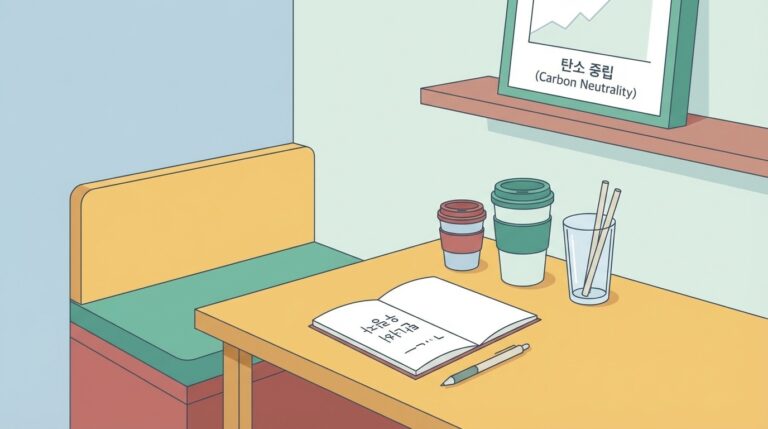
Phase 1: Empathy & K-Culture Cold Open
Hello there! This is your Daily Hangul Editor.
Imagine this: You are watching a high-stakes K-Drama. The young, reform-minded CEO is clashing with the stubborn board of directors over the company’s new ‘ESG (Environmental, Social, and Governance) Management’ strategy. The tension is palpable. The subtitles simply read, “That’s an unrealistic goal.” But if you listen closely to the Korean, the characters are using razor-sharp, sophisticated idioms to tear each other’s arguments apart.
At a C2 (Advanced) level, you already know how to say “The weather is getting hotter due to climate change” (기후 변화로 날씨가 더워지고 있습니다). But how do you debate the Feasibility of the 2050 Carbon Neutrality Scenario (탄소 중립 2050 시나리오의 실현 가능성)? How do you express skepticism about a government policy or call out corporate ‘greenwashing’ without sounding like a translated textbook?
If you want to hold your own in a heated discussion with Korean intellectuals over a glass of Makgeolli, or understand the deep societal critiques hidden in modern Korean news and K-Pop fandom activism, you need the real, unfiltered vocabulary of the Korean intelligentsia. Let’s dive in!
Phase 2: Core Expressions Deep Dive
Here are three advanced expressions Koreans use when debating ambitious policies like Carbon Neutrality.
1. 전형적인 탁상공론 (jeonhyeongjeogin taksanggongnon)
- Pronunciation: [jeon-hyeong-jeo-gin tak-sang-gong-non] (Sound-alike: jun-hyung-juh-ghin tahk-sahng-gong-non)
- Meaning: Literal: Typical desk-bound empty theory / Real nuance: An armchair theory; an impractical plan made by bureaucrats who don’t know the reality on the ground.
- K-Culture Moment: You’ll hear this in news interviews or K-Drama boardroom scenes. When the government announces a sweeping “2050 Carbon Neutrality” plan without concrete support for small factory owners, citizens will sigh and say, “이거 또 전형적인 탁상공론이네.” (This is just another typical armchair theory.)
- Editor’s Insight: This phrase carries a heavy dose of cynicism. It implies the policymakers are sitting at comfortable desks (탁상) making empty arguments (공론) while ignoring real-world consequences.
- Situation Spectrum:
- Casual Debate with Friends: ✅
- Academic/Professional Discussion: ✅
- Saying this directly to your Boss about their idea: 🚫 (Unless you want to get fired!)
- 🤔 Think About It: Why does Korean have so many four-character Hanja idioms (사자성어) to criticize authority? How does using Hanja elevate the intellectual weight of a critique in Korean society?
2. 실효성에 의문이 듭니다 (silhyoseonge uimuni deumnida)
- Pronunciation: [sil-hyo-seong-e ui-mu-ni deum-ni-da] (Sound-alike: shil-hyo-sung-eh oo-ee-moo-nee deum-nee-dah)
- Meaning: Literal: A question arises regarding its effectiveness / Real nuance: I seriously doubt this will actually work.
- K-Culture Moment: During a corporate meeting discussing the banning of plastic cups in franchises, a pragmatic manager might cautiously raise their hand and say this to challenge the idealists.
- Editor’s Insight: This is the ultimate “polite but lethal” phrase. You aren’t saying “This is a stupid idea” (이건 바보 같은 생각입니다). Instead, you are “questioning its effectiveness,” which makes you sound objective, analytical, and highly professional.
- Situation Spectrum:
- Casual with friends: ⚠️ (Too formal, sounds stiff)
- Workplace / Formal Debates: ✅
- Academic essays: ✅
- 🤔 Think About It: Notice the passive structure (A question arises in me). Why do Koreans prefer passive or indirect phrasing when presenting a strong counter-argument?
3. 뜬구름 잡는 소리 (tteungeureum jamneun sori)
- Pronunciation: [tteun-gu-reum jam-neun so-ri] (Sound-alike: ddeun-goo-reum jahm-neun soh-ree)
- Meaning: Literal: The sound of catching floating clouds / Real nuance: Talking about a pipe dream; unrealistic nonsense.
- K-Culture Moment: Two friends are drinking Soju at a Pocha. One is talking about how Korea will seamlessly transition to 100% renewable energy by 2030. The other friend pours a shot and laughs, “야, 뜬구름 잡는 소리 하지 마.” (Hey, stop talking about pipe dreams.)
- Editor’s Insight: ‘뜬구름’ (floating clouds) represents something impossible to grasp. This expression is vivid, slightly dismissive, and very native.
- Situation Spectrum:
- Close Friends / Casual Debates: ✅
- With younger colleagues: ⚠️ (Can sound condescending)
- Formal/Professional: 🚫
- 🤔 Think About It: Water and nature metaphors are incredibly common in Korean idioms. Does your language have a similar metaphor for an unrealistic goal?
Phase 3: Textbook vs Real Korean
Let’s see how C2 learners can upgrade their vocabulary from ‘textbook perfect’ to ‘native intellectual’.
[Situation 1: Discussing the Corporate Shift to Eco-Friendly Practices]
* 📖 Textbook Korean: 기업들은 환경을 보호하는 척만 하고 있습니다. (Companies are only pretending to protect the environment.)
* 🗣️ Real Korean: 다 전형적인 그린워싱(Greenwashing)이죠. 위장 환경주의예요. (It’s all typical greenwashing. Fake environmentalism.)
* 💡 Why the difference?: At the C2/professional level, Koreans actively use imported jargon (‘그린워싱’) or exact academic terms (‘위장 환경주의’) to sound culturally attuned to global socio-economic trends.
[Situation 2: Doubting the 2050 Carbon Neutrality Timeline]
* 📖 Textbook Korean: 2050년까지 목표를 달성하는 것은 불가능합니다. (Achieving the goal by 2050 is impossible.)
* 🗣️ Real Korean: 2050 시나리오는 현실적으로 시기상조(시기상조)라는 지적이 많습니다. (There is much criticism that the 2050 scenario is realistically premature.)
* 💡 Why the difference?: Instead of flat-out saying “it’s impossible” (불가능하다), professionals use ‘시기상조’ (premature) and frame it as third-party criticism (‘~라는 지적이 많다’) to sound objective and avoid absolute statements.
Bottom Note: For C2 learners, mastering Hanja words (like 실효성, 탁상공론, 시기상조) is the key to unlocking high-level intellectual and professional circles in Korea.
Phase 4: Cultural Context — K-Culture Deep Dive
4-1. Non-verbal Element: The “Debate Nunchi” (눈치)
When debating sensitive topics like government policies or climate feasibility in Korea, Nunchi is crucial. Even if you completely disagree with a senior colleague’s view on carbon neutrality, you should never attack their point immediately.
Pro Tip: Inhale slightly, tilt your head in a thoughtful way, and start with: “과장님 말씀도 일리가 있습니다만…” (Your point is valid, Manager, however…) before delivering your counter-argument.
4-2. K-Culture Connection: The K-Pop Fandom’s Climate Activism
If you think Carbon Neutrality is only discussed by politicians, think again! In recent years, K-Pop fandoms have become massive players in the climate debate.
- The Reality: K-Pop agencies produce multiple versions of physical albums with randomized photocards, leading fans to buy dozens of albums and dump the plastic CDs into the trash.
- The Pushback: Fandoms have started movements like ‘Kpop4Planet’, demanding agencies provide “digital-only” eco-friendly albums. They use terms like 플라스틱 발자국 (Plastic footprint) and call out agencies for 그린워싱 (Greenwashing) when they claim to be eco-friendly but still sell excessive merchandise.
- Critique: The gap between an idol’s speech on a global stage about climate change and the agency’s mass-production of plastic goods is a hot topic of debate among Korean Gen Z.
Phase 5: Real-Life Roleplay Scenario
Setting: It’s a rainy Friday evening in Jongno. You are at a traditional Makgeolli tavern with two Korean colleagues from your Environmental Tech startup. The rain is pouring outside (a perfect nod to changing weather patterns!), and the debate gets heated over a plate of seafood pancake.
Characters:
* YOU: An expat consultant working in Seoul. Pragmatic but passionate.
* Min-su (34): A cynical realist who thinks the government’s plans are just for show.
* Ji-yoon (29): An idealistic researcher who believes in radical change.
Dialogue:
Min-su: 솔직히 2050년까지 탄소 중립? 그거 다 보여주기식 행정 아니야? 전형적인 탁상공론이지.
(soljiki 2050nyeonkkaji tanso jungnip? geugeo da boyeojugisik haengjeong aniya? jeonhyeongjeogin taksanggongnoniji.)
[Honestly, carbon neutrality by 2050? Isn’t that all just administrative window dressing? It’s a typical armchair theory.]
(🎭 Stage Direction: Min-su aggressively pours another bowl of Makgeolli)
Ji-yoon: 선배님, 그래도 목표라도 높게 잡아야 기업들이 눈치라도 보면서 바뀌죠. 재생에너지 전환은 필수예요!
(seonbaenim, geuraedo mokpyorado nopge jabaya gieopdeuri nunchirado bomyeonseo bakkwijyo. jaesaengeoneoji jeonhwaneun pilssuyeyo!)
[Senior, still, we have to set the goal high so companies will at least read the room and change. The transition to renewable energy is essential!]
Min-su: 우리나라 제조업 비중이 얼만데… 당장 실효성에 의문이 든다니까.
(urinara jejoeop bijungi eolmande… dangjang silhyoseonge uimuni deundanikka.)
[Do you know how high the proportion of manufacturing is in our country… I’m telling you, I immediately doubt its effectiveness.]
🔀 Your Turn! How do you respond to Min-su?
– A) 민수 씨 말이 맞아요. 한국에선 불가능해요. (Min-su is right. It’s impossible in Korea.)
– B) 민수 씨 우려도 이해는 가지만, 글로벌 규제 때문에라도 피할 수 없는 흐름 아닌가요?
– C) 뜬구름 잡는 소리 하지 마세요!✅ Best Choice: B — “I understand your concern, Min-su, but isn’t it an unavoidable trend even just because of global regulations?” This is the perfect C2 response. It validates his feeling (“우려도 이해는 가지만”) while offering a strong, macro-level counter-argument (“글로벌 규제”, “피할 수 없는 흐름”).
⚠️ Choice C Analysis: Telling a senior colleague to “stop talking pipe dreams” directly to their face is a quick way to ruin the team dynamic!
[Bonus K-Culture Scenario: At the Eco-Friendly K-Cafe]
Barista: 손님, 저희 매장은 다회용기 전용 매장입니다. 텀블러 있으신가요?
(sonnim, jeohui maejangeun dahoeyonggi jeonyong maejangimnida. teombeulleo isseusingayo?)
[Customer, our store is exclusively for reusable containers. Do you have a tumbler?]
YOU: 아, 오늘은 안 가져왔는데… 그럼 보증금 내고 리유저블 컵으로 할게요.
(a, oneureun an gajyeowanneunde… geureom bojeunggeum naego riyujeobeul keobeuro halgeyo.)
[Ah, I didn’t bring it today… Then I’ll pay the deposit and use a reusable cup.]
Phase 6: 10-Second Shadowing Drill
Let’s practice the rhythm of a C2 intellectual debate. Pay attention to the pauses (/) and intonation!
😤 솔직히 말해서 / 2050년 탄소 중립은 / 현실적으로 / 무리라고 봅니다.
(soljiki malhaeseo / 2050nyeon tanso jungnibeun / hyeonsiljeogeuro / murirago bomnida.)
“Honestly speaking, I view carbon neutrality by 2050 as realistically out of reach.”
Voice Coach Tip: Drop your pitch at the end of “봅니다” to sound authoritative and resolute. Emphasize “현실적으로” (realistically) to show you are a pragmatist.
Phase 7: K-Culture Mini Dictionary (Green Edition)
Here are advanced vocabulary words you will encounter in Korean news and daily life regarding the climate:
| 한국어 | Romanization | English | 맥락 설명 (Context) |
|---|---|---|---|
| ESG 경영 | ESG gyeongyeong | ESG Management | A massive buzzword in Korean corporate culture. Every major Chaebol is currently obsessed with this. |
| 줍깅 | jupging | Plogging | A portmanteau of ‘줍다’ (to pick up) + ‘조깅’ (jogging). A popular eco-trend among Korean youth. |
| 다회용기 | dahoeyonggi | Reusable container | You’ll see this word on delivery apps like Baemin, which now have a “request reusable container” option. |
| 탄소발자국 | tanso baljaguk | Carbon footprint | Frequently used in policy debates and environmental campaigns. |
| 친환경 | chin-hwangyeong | Eco-friendly | Added as a prefix to everything: 친환경 포장 (eco-packaging), 친환경 자동차 (eco-car). |
Phase 8: Traveler Survival Kit
Even if you are discussing high-level policy, as a traveler or expat in Korea, you must navigate the country’s highly structured environmental rules. Korea ranks among the highest globally for waste recycling!
🆘 Survival Expressions for the Eco-Conscious Traveler
– 🇰🇷 “텀블러 할인 되나요?” (teombeulleo harin doenayo?)
– 🗣️ Meaning: Do you offer a tumbler discount?
– 📍 Where to use: Starbucks, local cafes (Many offer 300~500 won discounts!).
- 🇰🇷 “영수증은 버려주세요.” (yeongsujeungeun beoryeojuseyo.)
- 🗣️ Meaning: Please throw away the receipt. (Saves paper!)
🇰🇷 “이거 플라스틱에 버리면 되나요?” (igeo peullaseutige beorimyeon doenayo?)
- 🗣️ Meaning: Should I throw this in the plastic recycling bin?
📌 Editor’s Travel Note: The strict reality of ‘분리수거’ (Recycling)
If you stay at an Airbnb in Korea, you will face the daunting task of sorting your trash: General waste, Food waste, Plastics, Paper, Vinyl, Cans, and Glass. Do not mix food waste with general waste! You must buy specific district garbage bags (종량제 봉투) from the convenience store. Failing to do so can result in hefty fines. It’s the micro-level reality of Korea’s macro-level climate goals!
Phase 9: Critical Thinking Corner — “한 발 더 깊이”
Media vs Reality: The K-Pop Plastic Dilemma
🧠 Think Deeper:
K-Pop has immense global soft power, and many idol groups have become ambassadors for climate change, addressing the UN and promoting sustainability. However, the reality of the K-Pop industry is drastically different. To boost first-week sales figures on charts, entertainment companies release dozens of album variations with randomized “Photocards.” Fans buy hundreds of albums, extract the photocards, and literally throw boxes of plastic CDs into the trash. This blatant “Greenwashing” (그린워싱) has sparked a fierce debate among Korean Gen Z fans who demand digital albums. It asks a profound question: Can a culture built on mass consumerism truly champion Carbon Neutrality?💬 Your Turn: Does the entertainment or pop culture industry in your home country face similar criticisms regarding environmental impact? How do fans react? Share your thoughts in the comments!
Phase 10: FAQ & Avoiding Mistakes
- Q: Can I use “전형적인 탁상공론” to my professor or boss?
- A: NO. This phrase is a critique of authority. You can use it with your boss to criticize the government, but never use it to describe your boss’s ideas unless you are prepared to pack your bags.
- Q: How do I politely disagree with a senior’s view on a policy?
- A: Use the “Buffer & Pivot” technique. Start with “말씀하신 취지는 충분히 공감합니다만…” (I fully empathize with the intent of what you said, however…) then drop your counter-argument.
❌ Common Mistake:
Confusing ‘환경’ (Environment) with ‘자연’ (Nature) in academic debates.
✅ Do This Instead:
Use ‘자연’ when talking about beautiful landscapes (e.g., 자연이 아름답다). Use ‘환경’ (Environment) when discussing policies, pollution, and climate change (e.g., 환경 오염, 환경 정책).
Phase 11: Summary & Action Items
- One-Liner Summary: To debate the 2050 Carbon Neutrality Scenario like a native intellectual, leverage Hanja-based idioms like ‘탁상공론’ (armchair theory) and ‘실효성’ (effectiveness) to critique gracefully.
-
Action Mission:
- 🥉 Bronze (Solo): Read the 10-second shadowing drill aloud 3 times, focusing on an authoritative tone.
- 🥈 Silver (Online): Find a Korean news video on YouTube about ‘탄소 중립’ and try to spot the words we learned today in the comments or subtitles.
- 🥇 Gold (Real-world): Take your tumbler to a Korean cafe and ask, “텀블러 할인 되나요?”
- K-Culture Mission: Go to a Korean delivery app (like Baemin or Yogiyo) or a fast-food kiosk, and find the option that says “일회용 수저 포크 안 주셔도 돼요” (You don’t need to give me disposable spoons/forks). Check that box!
Phase 12: Quiz — Interactive Challenge
1. Situational Judgment: You are watching the news with your Korean father-in-law. The government announces a plan to build floating eco-cities by 2030, but provides no budget details. Your father-in-law scoffs. What is the most natural, high-level response you can give to agree with him?
* A) 맞아요. 진짜 바보 같아요. (Right. It’s really stupid.)
* B) 네, 전형적인 탁상공론이네요. 실효성이 의문이에요. (Yes, it’s a typical armchair theory. Its effectiveness is questionable.)
* C) 아버님, 환경을 보호해야죠! (Father, we must protect the environment!)
2. True or False – K-Culture Edition:
* In Korea, it is perfectly acceptable to throw paper coffee cups, plastic lids, and the remaining ice all into one single public trash can. (T/F)
👀 Click here for Answers!
1. Answer: B. It perfectly captures the cynical yet intellectual critique of an impractical policy using advanced vocabulary.
2. Answer: False. Korea has incredibly strict recycling (분리수거). You must empty the ice/liquid into a specific bucket, separate the plastic lid, the paper sleeve, and the cup!
What are your thoughts on the 2050 Carbon Neutrality goals? Let’s start a debate in the comments below using the Korean phrases we learned today! 👇
Frequently Asked Questions (FAQ)
Q: What does "전형적인 탁상공론 (jeonhyeongjeogin taksanggongnon)" mean in Korean and how do you pronounce it?
A: In Korean, "전형적인 탁상공론 (jeonhyeongjeogin taksanggongnon)" is pronounced [jeon-hyeong-jeo-gin tak-sang-gong-non] and means: Literal: Typical desk-bound empty theory / Real nuance: An armchair theory; an impractical plan made by bureaucrats who don't know the reality on the ground.
Q: What does "실효성에 의문이 듭니다 (silhyoseonge uimuni deumnida)" mean in Korean and how do you pronounce it?
A: In Korean, "실효성에 의문이 듭니다 (silhyoseonge uimuni deumnida)" is pronounced [sil-hyo-seong-e ui-mu-ni deum-ni-da] and means: Literal: A question arises regarding its effectiveness / Real nuance: I seriously doubt this will actually work.
Q: What does "뜬구름 잡는 소리 (tteungeureum jamneun sori)" mean in Korean and how do you pronounce it?
A: In Korean, "뜬구름 잡는 소리 (tteungeureum jamneun sori)" is pronounced [tteun-gu-reum jam-neun so-ri] and means: Literal: The sound of catching floating clouds / Real nuance: Talking about a pipe dream; unrealistic nonsense.







