

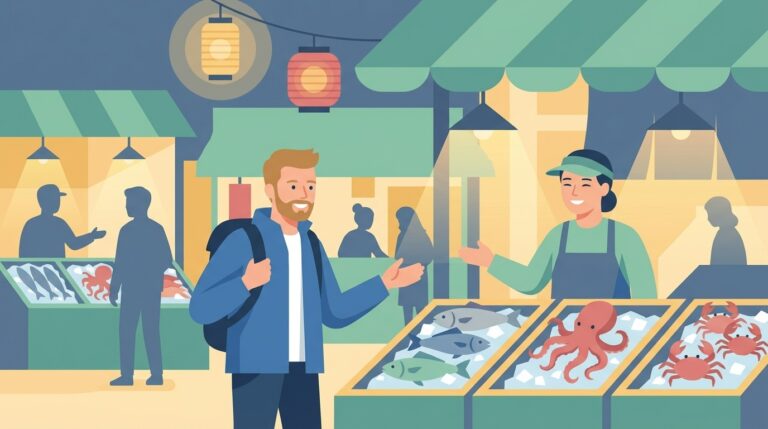
Phase 1: Empathy (The K-Culture Cold Open)
Hello! Your Daily Hangul Editor is here.
Picture this: You are watching a gritty Korean noir drama, or maybe a lively K-Variety show. The scene shifts to a cavernous, brightly lit hall. The floor is slick with water, the air smells of the ocean, and men in heavy rubber boots are shouting rapid-fire numbers that sound like an alien language.
Welcome to the Korean fish market auction (수산시장 경매) — places like Noryangjin in Seoul or Jagalchi in Busan.
As an advanced Korean learner, you might confidently walk in, ready to use your textbook “얼마예요? (How much is it?)”. But the moment you step up to a tank filled with massive King Crabs or thrashing Yellowtail, you realize standard Korean doesn’t quite cut it here. The vendors speak a dialect of commerce, speed, and subtle negotiation. If you use textbook phrases, you instantly mark yourself as a tourist. But if you drop a few market-specific idioms, you’ll earn a surprised grin from the vendor and maybe a few extra shrimp in your bag.
This guide is built from the real experiences of expats who survived the chaos of Noryangjin. Let’s dive into the deep end!
Phase 2: Core Expressions Deep Dive
1. 오늘 시세가 어떻게 돼요?
- Pronunciation: [oneul sisega eotteoke dwaeyo?] + [Oh-neul she-seh-gah uh-ttuh-keh dweh-yo?]
- Meaning: What is today’s market price? (Literal: How is the market price today?)
- K-Culture Moment: Unlike a supermarket, fish markets don’t always have fixed price tags. Prices fluctuate daily based on the early morning auctions. When locals walk up to a stall, they don’t ask “How much?” They ask for the Sise (시세), showing they understand the rules of the game.
- Editor’s Insight: This phrase instantly levels up your Korean. It tells the vendor, “I know prices change, and I’m treating you as a market professional.”
- Situation Spectrum:
- Casual with friends: 🚫 (Not used outside economics/markets)
- To Market Vendors (Semi-formal): ✅
- Formal/Corporate: ⚠️ (Used, but in a strictly business context)
- 🤔 Think About It: Why does Korean have a specific, everyday word for “fluctuating daily market price”? How does this reflect Korea’s history of fast-paced, dynamic trade?
2. 물 좋은 놈으로 실하게 쳐주세요.
- Pronunciation: [mul joeun nomeuro silhage chyeojuseyo.] + [Mool jo-eun no-meu-ro sheel-ha-geh chyuh-joo-seh-yo.]
- Meaning: Give me a really fresh, meaty one at a good value. (Literal: Treat me solidly with a guy that has good water.)
- K-Culture Moment: You’ll hear middle-aged Korean men (Ahjussis) say this while sharing a laugh with the vendor. Calling a fish “놈” (guy/dude) is an affectionate personification here, not an insult.
- Editor’s Insight: “물(이) 좋다” translates to “the water is good,” but it’s slang for “extremely fresh” (or, in clubbing contexts, a crowd full of good-looking people!). “실하다” means substantial or meaty.
- Situation Spectrum:
- Casual with friends: ✅ (When joking around)
- To Market Vendors (Semi-formal): ✅ (Perfect icebreaker)
- Workplace Boss: 🚫 (Too folksy and slangy)
- 🤔 Think About It: Using “놈” (guy) for a fish shows a casual, earthy relationship with food. Do you have a similar rugged, market-specific slang in your native language?
3. 사장님, 서비스(덤) 팍팍 얹어주세요!
- Pronunciation: [sajangnim, seobiseu(deom) pakpak eonjeojuseyo!] + [Sah-jang-neem, suh-bee-seu(dum) pak-pak un-juh-joo-seh-yo!]
- Meaning: Boss, throw in a lot of extras! (Literal: Put a lot of service/extras on top!)
- K-Culture Moment: You’ve agreed on the price for a large fish. Before they bag it, you hit them with this line. Suddenly, the vendor tosses in a handful of live shrimp, sea squirts, or clams for your seafood soup.
- Editor’s Insight: “팍팍” is an onomatopoeia for giving generously or without hesitation. In Korea, asking for a discount on the main item is sometimes frowned upon, but asking for Service (free extras) is a cultural pastime.
- Situation Spectrum:
- Market Vendors / Casual Eateries: ✅
- Fancy Restaurants: 🚫
- 🤔 Think About It: Why do Koreans prefer giving extra items (덤) rather than just lowering the price? How does this relate to the concept of “Jeong” (정)?
Phase 3: Textbook vs. Real Korean
At a C1 level, you know the grammar. Now it’s time to master the vibe.
[Asking the Price]
* 📖 Textbook: 이 신선한 광어는 한 마리에 얼마입니까? (How much is one of this fresh flatfish?)
* 🗣️ Real Korean: 사장님, 오늘 광어 시세 어떻게 돼요? (Boss, what’s the market price for flatfish today?)
* 💡 Why the difference?: Real market language skips the obvious (“fresh,” “one”) and focuses on the fluctuating daily reality (시세).
[Commenting on Quality]
* 📖 Textbook: 생선이 아주 신선해 보입니다. (The fish looks very fresh.)
* 🗣️ Real Korean: 와, 오늘 물 좋네요! (Wow, the ‘water’ is good today!)
* 💡 Why the difference?: Metaphorical slang (물 좋다) shows you belong to the in-group and understand Korean sensory expressions.
[Concluding the Deal]
* 📖 Textbook: 조금 깎아주실 수 있나요? (Can you give me a discount?)
* 🗣️ Real Korean: 매운탕 거리 좀 챙겨주세요~ (Please pack some scraps for spicy fish stew~)
* 💡 Why the difference?: Direct discounting can be awkward. Asking them to pack “Maeun-tang geori” (leftover bones/head for soup) is the universally accepted way to get more value without bruising egos.
Phase 4: Cultural Context — K-Culture Deep Dive
4-1. Non-Verbal Cues (Nunchi at the Market)
In a chaotic fish market, eye contact and confidence are everything. Don’t look too intimidated by the splashing water or loud voices. However, never touch the live fish or the water in the tanks unless the vendor invites you to. Use your chin or a pointed finger to indicate which “guy” (놈) you want.
4-2. The “Chojang-jib” (초장집) Phenomenon
This is a crucial K-Travel survival tip! If you watch K-Dramas or travel Vlogs, you’ll notice people buying raw fish on the 1st floor, then carrying a black plastic bag up to the 2nd floor.
Korean fish markets are split into two phases:
1. The Market (1st Floor): You negotiate and buy the raw seafood.
2. The Chojang-jib (2nd/3rd Floor): A “table-setting restaurant.” You bring your fish here, and for a small per-person fee (상차림비), they provide side dishes, lettuce wraps, sauces, and they will cook the leftover bones into a spicy stew (매운탕).
Critical perspective: This system separates the wholesale fish experts from the hospitality experts, keeping prices low but sometimes confusing foreigners who think the meal is fully paid for downstairs.
Phase 5: Real-World Roleplay Scenario
Setting: 5:30 PM, Noryangjin Fish Market. Neon lights reflect off the wet floors. You are planning to treat your Korean coworkers to King Crab and Sashimi.
Characters:
– YOU: Confident C1 Korean learner, ready to impress.
– Vendor Ahjumma (여사장님): Tough but warm-hearted, wearing a waterproof rubber apron.
Dialogue:
Vendor: 삼촌! (아가씨!) 이리 와봐. 오늘 킹크랩 수율 장난 아니야!
(Samchon! Iri wabwa. Oneul kingkeuraep suyul jangnan aniya!)
[Uncle! (Young lady!) Come here. The meat yield on King Crabs is no joke today!]
(🎭 Stage Direction: She lifts a massive crab, water splashing everywhere.)
YOU: 오, 진짜 실해 보이네요. 오늘 대게나 킹크랩 시세가 어떻게 돼요?
(O, jinjja silhae boineyo. Oneul daegena kingkeuraep sisega eotteoke dwaeyo?)
[Oh, it looks really meaty. What’s the market price for snow crab or king crab today?]
Vendor: 킹크랩은 키로당 8만 원, 대게는 6만 5천 원! 물 좋은 놈으로 줄게.
(Kingkeuraebeun kirodang palman won, daegeneun yungman ocheon won! Mul joeun nomeuro julge.)
[King crab is 80,000 won per kilo, snow crab is 65,000! I’ll give you a fresh one.]
YOU: 음… 킹크랩 2키로짜리 하나로 할게요. 잘 쳐주실 거죠?
(Eum… Kingkeuraep ikirojjari hanaro halgeyo. Jal chyeojusil geojyo?)
[Hmm… I’ll take a 2kg king crab. You’re going to give me a good deal, right?]
Vendor: 그럼! 내가 특별히 15만 원에 딱 맞춰줄게.
(Geureom! Naega teukbyeolhi siboman wone ttak matchwojulge.)
[Of course! I’ll round it out perfectly to 150,000 won specially for you.]
🔀 YOUR TURN! How do you close the deal?
– A) “감사합니다. 여기 카드요.” (Thank you. Here is my card.)
– B) “너무 비싸요. 13만 원으로 해주세요.” (Too expensive. Make it 130,000 won.)
– C) “우와, 감사합니다! 사장님, 그럼 새우랑 가리비 서비스 좀 팍팍 얹어주세요!”✅ Best Choice: C.
Why? A is fine but boring. B (aggressive discounting) might offend her, as she already rounded down from 160k. C is the Korean way: Accept the monetary price, but aggressively negotiate for delicious Service (free shrimp/scallops).
Vendor: (Laughs) 아유, 말 예쁘게 하네. 알았어, 낙지랑 새우 듬뿍 넣어줄 테니까 위층 7호집 가서 먹고 가!
(Ayu, mal yeppeuge hane. Arasseo, nakjirang saeu deumppuk neoeojul tenikka wicheung chilhojip gaseo meokgo ga!)
[(Laughs) Oh, you speak so prettily. Alright, I’ll put in plenty of octopus and shrimp, so go eat at restaurant #7 upstairs!]
Phase 6: 10-Second Shadowing Drill
Read this aloud to master the rhythm. Pay attention to the slashes for pausing and the emotion tags!
😊 사장님, / 오늘 대방어 / 시세가 어떻게 돼요? / 😤 물 좋은 놈으로 / 잘 쳐주세요! / 🥺 덤도 좀 주시고요!
(Sajangnim, / oneul daebangeo / sisega eotteoke dwaeyo? / Mul joeun nomeuro / jal chyeojuseyo! / Deomdo jom jusigoyo!)
Phase 7: K-Culture Mini Dictionary
| 한국어 | Romanization | English | Context/Meaning |
|---|---|---|---|
| 시세 | sise | Market price | Prices that fluctuate based on the daily auction. |
| 수율 | suyul | Meat yield | Crucial advanced vocab! Used for crabs to describe how much actual meat is inside the shell (e.g., 80% suyul). |
| 초장집 | chojangjip | Table-setting restaurant | The restaurants upstairs that cook the fish you bought downstairs. |
| 상차림비 | sangcharimbi | Table setting fee | The per-person cover charge at a Chojang-jib (usually 4,000~5,000 won). |
| 저울치기 | jeoulchigi | Scale scam | A dishonest practice where vendors weigh the heavy basket with water alongside the fish. Good to know to avoid it! |
Phase 8: Traveler Survival Kit
Even as a C1 learner, stepping into Noryangjin can be intimidating. Keep these in your back pocket:
🆘 Survival Phrases for the Fish Market
– 🇰🇷 “바구니 무게는 빼주시는 거죠?” (baguni mugeneun ppaejusineun geojyo?)
– 📍 Meaning: You’re excluding the weight of the basket, right? (Prevents ‘저울치기’).
– 🇰🇷 “먹고 갈 건데, 식당 연결해 주세요.” (meokgo gal geonde, sikdang yeongyeolhae juseyo.)
– 📍 Meaning: I’m going to eat here, please connect me to a restaurant upstairs.📌 Editor’s Travel Note
– Payment: Most stalls take credit cards now, but holding cash can sometimes give you leverage for better “Service.”
– Navigating: Noryangjin has a “New” building and an “Old” vibe. Don’t go in blind; check recent YouTube Vlogs to understand the current layout.
Phase 9: Critical Thinking — “A Step Deeper”
Food & Identity: The Economics of “Jeong” (정)
Have you ever wondered why Korean vendors prefer giving “Service” (서비스/덤) instead of just lowering the price? From a purely capitalistic view, 5,000 won off is the same as 5,000 won worth of free shrimp. But culturally, giving a discount is a cold, mathematical transaction. Giving extra food, however, is an act of care. It transforms a clinical buyer-seller exchange into a human relationship based on “Jeong” (affection/warmth). The vendor feels generous, the buyer feels special, and both share a moment of mutual appreciation.
💬 Your Turn:
Does your culture have a concept similar to “Jeong” or “Lagniappe” (a little extra) in marketplaces? Or is negotiation strictly about the numbers? Share your thoughts in the comments!
Phase 10: FAQ & Avoiding Misunderstandings
Q: Can I use “놈” (guy/dude) in a normal restaurant to describe my food?
No. Saying “물 좋은 놈” (a fresh guy) is highly contextual slang meant only for whole, raw ingredients at markets (fish, sometimes massive cuts of meat). If you say this about a cooked pork cutlet in a diner, you will sound bizarre.
Q: Do I tip the vendor if they give me a lot of “Service”?
Never. Korea is strictly a no-tip culture. Offering a tip will cause confusion or even offense. Your “tip” is simply saying “정말 감사합니다! 다음에 또 올게요!” (Thank you so much! I’ll come back next time!) and actually returning.
❌ Common Mistake: Buying the fish, paying the vendor, and then assuming your meal upstairs is totally free.
✅ Do This Instead: Remember that the upstairs restaurant (초장집) is a separate business. You will pay a table fee (상차림비) per person, plus extra for drinks, cooking fees (like steaming crabs), and spicy stew (매운탕).
Phase 11: Summary & Action Items
One-Liner Summary: To survive a Korean fish market, ask for the Sise (시세), compliment the freshness (물 좋다), and negotiate for extra Service (덤) instead of a discount.
Action Mission 3 Steps:
– 🥉 Bronze (Solo): Practice saying “사장님, 시세가 어떻게 돼요?” with confidence in the mirror 3 times.
– 🥈 Silver (Online): Look up “노량진 수산시장 브이로그” (Noryangjin Fish Market Vlog) on YouTube and listen for the words 시세 or 서비스.
– 🥇 Gold (Real World): Visit a traditional market in Korea and successfully ask a vendor for the daily price instead of just pointing and asking “how much!”
Phase 12: Quiz — Interactive Challenge
1. Situational Judgment: You are buying a 100,000 won sea bream. The vendor weighs it and says it’s exactly 100k. Which response is the most natural for a C1 speaker trying to get a good deal?
* A) “너무 비싸요. 8만 원에 주세요.” (Too expensive. Give it to me for 80k.)
* B) “매운탕 거리에 조개 좀 팍팍 얹어주세요!” (Throw in plenty of clams with the spicy stew scraps!)
* C) “물 좋은 놈이 아니네요.” (This isn’t a fresh guy.)
2. True or False — K-Culture Edition:
* If a vendor calls you “삼촌” (Uncle) or “이모” (Aunt), they are implying you look old and you should be offended. (T/F)
(Scroll down or click toggle for answers!)
Answers
1. B is correct. A is too direct and might kill the mood. C is insulting the vendor’s goods. B accepts the price but taps into the culture of “Jeong” and “Service.”
2. False. Using familial terms like Samchon (Uncle) or Imo (Aunt) is a standard, friendly way for vendors to address customers, regardless of actual age differences. It bridges the gap between strangers.
Frequently Asked Questions (FAQ)
Q: What does "오늘 시세가 어떻게 돼요?" mean in Korean and how do you pronounce it?
A: In Korean, "오늘 시세가 어떻게 돼요?" is pronounced [oneul sisega eotteoke dwaeyo?] and means: What is today's market price? (Literal: How is the market price today?)
Q: What does "물 좋은 놈으로 실하게 쳐주세요." mean in Korean and how do you pronounce it?
A: In Korean, "물 좋은 놈으로 실하게 쳐주세요." is pronounced [mul joeun nomeuro silhage chyeojuseyo.] and means: Give me a really fresh, meaty one at a good value. (Literal: Treat me solidly with a guy that has good water.)
Q: What does "사장님, 서비스(덤) 팍팍 얹어주세요!" mean in Korean and how do you pronounce it?
A: In Korean, "사장님, 서비스(덤) 팍팍 얹어주세요!" is pronounced [sajangnim, seobiseu(deom] and means: Boss, throw in a lot of extras! (Literal: Put a lot of service/extras on top!)







