

Phase 1: Empathy & K-Culture Cold Open
Hello! I’m the Lead Editor at Daily Hangul, your veteran tutor and Seoul-savvy friend.
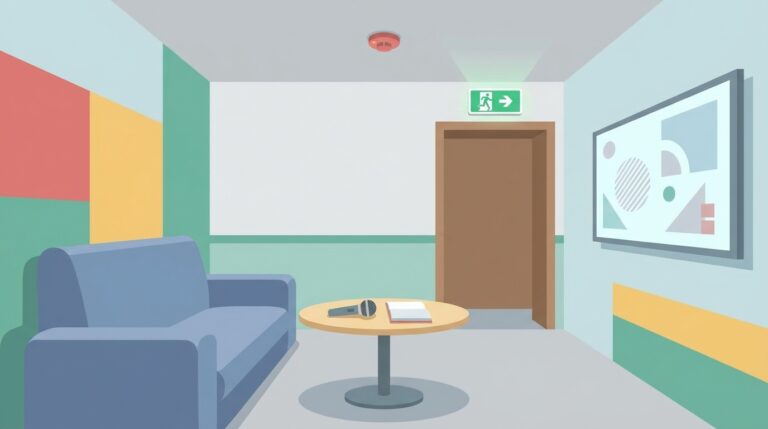
Picture this: You are living your best K-Travel life. You’re in Hongdae, singing your heart out to your favorite K-Pop song in a neon-lit Noraebang (karaoke room). Or maybe you’re sound asleep in a cozy rooftop Airbnb you saw in a K-Drama. Suddenly, BEEP BEEP BEEP. A siren blares, and a loud broadcast echoes through the building.
There are no subtitles here. Is it a real fire? A drill? Or just someone burning their Samgyeopsal (pork belly) in the restaurant downstairs?
If you don’t know basic emergency words, panic sets in fast. But don’t worry! This guide is based on real questions from my beginner students who experienced exactly this. Today, we will learn A1-level survival Korean so you can stay safe and act with confidence during a fire alarm.
Phase 2: Core Expressions Deep Dive
1. 불이야!
- Pronunciation: bul-i-ya! [Sounds like ‘bull’ + ‘E’ + ‘YAH!’]
- Meaning: Fire! (Literal: It is fire!)
- K-Culture Moment: In K-Dramas, when a villain sets a warehouse on fire, or someone causes a kitchen disaster, the characters will run out screaming “불이야!”. It’s the most urgent, universally understood shout for fire.
- Editor’s Insight: Forget honorifics here. You don’t need to be polite when the building is burning. Just shout it loudly! The ‘으’ (u) in ‘불’ should sound sharp.
- Situation Spectrum:
- Casual (Friends): ✅
- Semi-formal (Coworkers): ✅
- Formal (Boss/Elders): ✅ (Emergencies bypass all politeness rules!)
- 🤔 Think About It: Why doesn’t Korean use polite forms during life-threatening emergencies? It shows that survival and community safety override social hierarchy when it truly matters.
2. 비상구
- Pronunciation: bi-sang-gu [Bee-sang-goo]
- Meaning: Emergency Exit (Literal: Emergency door)
- K-Culture Moment: Whenever you enter a PC Bang, Noraebang, or K-BBQ restaurant, you will see a glowing green sign with a little man running. That is the 비상구. In underground subways, glowing arrows point to the 비상구.
- Editor’s Insight: You will read this word more often than you say it. Memorize the shape of these three letters!
- Situation Spectrum:
- Casual: ✅
- Semi-formal: ✅
- Formal: ✅
- 🤔 Think About It: South Korea’s strict safety laws require glowing 비상구 signs in every public building. Notice how the green running man is identical to the ones in many Western countries?
3. 빨리 나가요!
- Pronunciation: ppal-li na-ga-yo! [Ppal-lee (like ‘pal’ but tighter) nah-gah-yo]
- Meaning: Let’s get out quickly!
- K-Culture Moment: You’ll hear this constantly! Not just in emergencies, but when your friends want to leave a boring party or rush to catch the last train.
- Editor’s Insight: Korean Ppal-li Ppal-li (hurry hurry) culture shines in emergencies. It means “Hurry, let’s go out!” It’s slightly polite but highly urgent.
- Situation Spectrum:
- Casual: ✅
- Semi-formal: ✅
- Formal: ⚠️ (Saying this to a boss is okay in a fire, but usually you’d follow their lead.)
Phase 3: Textbook vs. Real Korean
[Hearing the Broadcast]
* 📖 Textbook Korean: 화재가 발생했습니다. (hwa-jae-ga bal-saeng-haet-seum-ni-da) – A fire has occurred.
* 🗣️ Real Korean: 불났어요! (bul-nat-seo-yo!) – There’s a fire!
* 💡 Why is it different?: Broadcast systems use highly formal, Sino-Korean vocabulary (화재/Hwa-jae). But real people use the shorter, native Korean word (불/Bul) to save time and breath.
[Telling Someone to Leave]
* 📖 Textbook Korean: 신속히 대피하십시오. (sin-sok-hi dae-pi-ha-sip-si-o) – Please evacuate swiftly.
* 🗣️ Real Korean: 빨리 나가요! (ppal-li na-ga-yo!) – Get out fast!
* 💡 Why is it different?: ‘대피’ (Evacuation) is a formal news word. In real life, “나가요” (go out) is much more direct and easier to shout.
Bottom Note: At the A1 level, if you hear “화재” (Hwa-jae) or “대피” (Dae-pi) over a loudspeaker, just remember: it means danger, so find the “비상구” (Bi-sang-gu)!
Phase 4: Cultural Context — K-Culture Deep Dive
4-1. Non-Verbal Elements: Survival Nunchi (눈치)
If an alarm goes off in a restaurant, don’t run blindly. Use your Nunchi (social sense). Look at the Koreans around you. Sometimes smoke from a BBQ grill triggers a false alarm. If the locals sigh, stay seated, and keep grilling their meat—it’s probably a false alarm. If the staff look panicked and people drop their chopsticks… it’s time to run!
4-2. K-Culture Connection: The Noraebang Maze
Noraebangs (Karaoke) and PC Bangs are often located underground or on high floors with narrow corridors.
* The K-Drama Trope: Have you seen those thriller dramas where the hero runs through dark, neon hallways? Real Noraebangs can be disorienting.
* Pro Tip: By law, every Noraebang room has a flashlight and a miniature escape map on the back of the door. When you start your singing session, just take a 2-second glance at the door to find the 비상구 (Emergency Exit).
Phase 5: Real-Life Roleplay Scenario
Setting: Friday night, 9:00 PM. A loud, neon-lit Noraebang in Hongdae. You and your Korean coworkers are singing K-Pop songs. Suddenly, the music cuts off. A loud siren rings, and you smell faint smoke.
Characters:
– YOU: A foreign traveler/worker. You know basic Korean.
– Minsu (30): Your fun Korean friend who was just holding the microphone.
Dialogue:
Minsu: 어? 노래가 왜 끊기지? 🎤
(eo? no-rae-ga wae kkeun-ki-ji?)
[Huh? Why did the song stop?]
(🎭 Stage Direction: Minsu taps the microphone, confused.)
YOU: 민수 씨, 저 소리 뭐예요?
(min-su ssi, jeo so-ri mwo-ye-yo?)
[Minsu, what is that sound?]
Minsu: 헉, 이거 화재 경보 아니에요?
(heok, i-geo hwa-jae gyeong-bo a-ni-e-yo?)
[Gasp, isn’t this a fire alarm?]
(🎭 Stage Direction: People start running in the hallway outside.)
YOU: 냄새도 나요! 빨리 가요!
(naem-sae-do na-yo! ppal-li ga-yo!)
[I smell it too! Let’s go quickly!]
Minsu: 지갑 챙겼어요? 비상구 쪽으로 뛰어요!
(ji-gap chaeng-gyeot-seo-yo? bi-sang-gu jjok-eu-ro ttwi-eo-yo!)
[Did you grab your wallet? Run towards the emergency exit!]
🔀 Your Turn! How should you respond to Minsu?
– A) “수고하셨습니다!” (Thank you for your hard work!)
– B) “네! 빨리 나가요!” (Yes! Let’s get out quickly!)
– C) “저기요~ 메뉴판 주세요.” (Excuse me, menu please.)✅ Best Choice: B — Why? It directly addresses the urgency.
⚠️ Choice A & C Analysis: Please do not thank your friend for his hard work or ask for a menu while the building is burning!
Phase 6: 10-Second Shadowing Drill
Practice these survival phrases out loud. Follow the slashes for pauses!
- 😤 Urgently: 불이야! / 불났어요! (bul-i-ya! / bul-nat-seo-yo!)
- 🏃♂️ Directly: 빨리 / 나가요! (ppal-li / na-ga-yo!)
- 😰 Loudly: 119에 / 전화해 주세요! (il-il-gu-e / jeon-hwa-hae ju-se-yo!) -> Please call 119!
Phase 7: K-Culture Mini Dictionary
| Korean | Romanization | English | Context |
|---|---|---|---|
| 비상구 | bi-sang-gu | Emergency exit | Always look for the green running man sign. |
| 소화기 | so-hwa-gi | Fire extinguisher | Usually bright red, found in hallways. |
| 빨리빨리 | ppal-li-ppal-li | Hurry up | The core speed of Korean culture, very useful in a crisis. |
| 눈치 | nun-chi | Situational awareness | Reading the room to see if it’s a real fire or a false alarm. |
Phase 8: Traveler’s Survival Kit
If you are traveling in Korea, this is the most important section to memorize.
🆘 Survival Expression #1: Calling for Help
– 🇰🇷 “살려주세요!” (sal-lyeo-ju-se-yo!)
– 🗣️ Sound guide: [sal-lyuh-joo-seh-yo]
– 📍 Where to use: Anytime your life is in danger.
– 💡 Pro Tip: Don’t just yell “Help” in English. “살려주세요” will immediately grab everyone’s attention in Korea.📌 Editor’s Travel Note: 911 vs. 119
– Emergency Numbers: In Korea, 911 does not work everywhere. You must dial 119 for Fire and Ambulance, and 112 for Police.
– Translators: If you call 119, they have English translators available. Just say “English please” and stay on the line!
– Public Transport: If there is a fire in the subway, look for cabinets with gas masks (방독면) on the platform.
Phase 9: Critical Thinking Corner — “One Step Deeper”
Community vs. Individual in a Crisis
🧠 Think Deeper:
Korean society places a heavy emphasis on community and collective action. When a disaster happens, you will often see Koreans helping each other evacuate rather than pushing past one another. The shared “우리” (We) mindset means even strangers become temporary family during an emergency. Furthermore, the famous “Ppal-li Ppal-li” (hurry hurry) culture, which can feel stressful in daily life, becomes an incredible asset for rapid, efficient evacuation during a crisis.💬 Your Turn: How do people in your culture react during a fire alarm? Does everyone follow the rules, or is it pure chaos? Let me know in the comments!
Phase 10: FAQ & Avoiding Mistakes
- “Is it rude to use casual language to elders during a fire?”
- No! In life-or-death situations, safety overrides Korean honorifics. Shouting “불이야!” (casual) is completely acceptable and preferred because it’s fast and loud.
- “Should I call 911 if my hotel is on fire?”
- No! Dial 119. Remember: 119 (Fire/Medical), 112 (Police).
❌ Common Mistake #1: Trying to formulate perfect, grammatically correct sentences like “Excuse me sir, I believe there is a fire.”
✅ Do this instead: Just point and yell “불이야!” (Bul-i-ya!) or “비상구!” (Bi-sang-gu!). Simplicity saves lives!
Phase 11: Summary & Action Items
- One-Liner Summary: When the alarm rings, use your Nunchi, find the green Bi-sang-gu (비상구), and yell Bul-i-ya (불이야) if you see fire!
-
Action Mission 3 Stages:
- 🥉 Bronze (Solo): Look around your room right now and say “빨리 나가요!” out loud.
- 🥈 Silver (Online): Save the numbers 119 and 112 in your phone’s contacts right now.
- 🥇 Gold (Field): The next time you visit a Korean restaurant or cafe, find the green 비상구 (Emergency Exit) sign before you sit down.
- K-Culture Mission: Watch a Korean action or disaster movie (like Exit or Train to Busan) and listen for the words “빨리!” or “비상구”.
Phase 12: Interactive Quiz
1. Situational Judgment: You are eating Korean BBQ, and the fire alarm rings. What is your first step?
– A) Scream and run outside instantly.
– B) Look at the staff and other locals using your Nunchi to see if it’s just BBQ smoke.
– C) Hide under the table.
(Answer: B. False alarms happen often due to grilling meat. Check the room’s vibe first!)
2. Fill in the Blank:
If you see a fire, you must yell: “____ 이야!”
(Answer: 불 (Bul))
3. True or False — K-Culture Edition:
In Korea, you should dial 911 for an ambulance.
(Answer: False. Dial 119 for Fire and Ambulance!)
Frequently Asked Questions (FAQ)
Q: What does "불이야!" mean in Korean and how do you pronounce it?
A: In Korean, "불이야!" is pronounced [bul-i-ya! [Sounds like 'bull' + 'E' + 'YAH!'] and means: Fire! (Literal: It is fire!)
Q: What does "비상구" mean in Korean and how do you pronounce it?
A: In Korean, "비상구" is pronounced [bi-sang-gu [Bee-sang-goo] and means: Emergency Exit (Literal: Emergency door)
Q: What does "빨리 나가요!" mean in Korean and how do you pronounce it?
A: In Korean, "빨리 나가요!" is pronounced [ppal-li na-ga-yo! [Ppal-lee (like 'pal' but tighter] and means: Let's get out quickly!







