

Phase 1: Empathy (Immersive Open)
Hello! Daily Hangul Editor here.
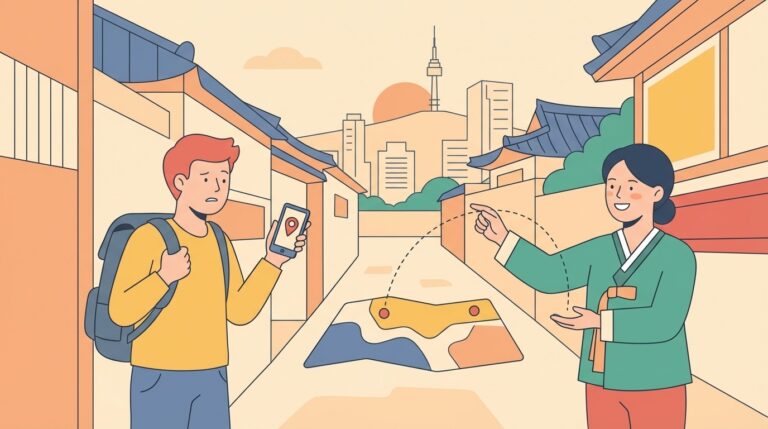
Let me paint a picture for you. You are standing right in the middle of Hongdae, Seoul’s bustling youth district. The neon signs are dazzling, K-Pop is blasting from every cosmetic shop, and your stomach is growling. Your map app says you have “Arrived” at the famous K-BBQ restaurant you saw on a Korean vlog. But… you look around, and there is no restaurant in sight. Just a maze of narrow alleyways.
You finally gather the courage to ask a friendly-looking local. They smile, pull out a napkin, and start drawing a rough map, or maybe they just draw imaginary lines in the air with their hands. They say a flurry of Korean words while pointing. You catch a few gestures, but you’re completely lost.
Sound familiar? Don’t worry! Navigating Korean alleys (골목, golmok) is a rite of passage for any traveler. Today, we’re going to decode exactly what locals say when they are giving you directions or drawing a quick map for you. Once you know these essential A2-level phrases, you won’t just find your destination—you’ll feel like a true insider!
Phase 2: Deep Dive into Core Expressions
1. 쭉 가세요 (Go straight)
- Pronunciation: jjuk gaseyo [Jjook gah-seh-yo]. The “jjuk” sounds like a tight, high-pitched version of “juke” (like in jukebox). Imagine stretching a long, tight rubber band!
- Meaning: Go straight / Keep going without stopping.
- K-Culture Moment: If you ask a Korean how to find the subway station, 9 times out of 10, they will chop the air with their hand and emphasize the word: “쭈우우욱~~ 가세요!” (Go strrraaaaight!). The longer they hold the “U” sound, the farther you have to walk.
- Editor’s Insight: This isn’t just a directional word; it’s a feeling! It implies an unwavering, continuous action. It feels much warmer and more natural than the robotic “go forward.”
- Situation Spectrum:
- Casual (Friends): ✅ (쭉 가! – jjuk ga!)
- Semi-formal (Strangers/Clerks): ✅ (쭉 가세요 – jjuk gaseyo)
- Formal (Boss/Elders): ✅ (쭉 가시면 됩니다 – jjuk gasimyeon doemnida)
- 🤔 Think About It: Koreans love the “빨리빨리” (Ppal-i ppal-i, hurry hurry) culture. How does the word “쭉” (straight, without hesitation) reflect this cultural desire for efficiency?
2. 오른쪽 / 왼쪽으로 도세요 (Turn right / left)
- Pronunciation: oreunjjog-euro doseyo [oh-reun-jjok-eu-ro doh-seh-yo] / oenjjog-euro doseyo [wen-jjok-eu-ro doh-seh-yo].
- Meaning: Literal: Turn to the right/left. Real Nuance: Take a right/left at the corner.
- K-Culture Moment: In K-Dramas, when the main character is driving and arguing with their partner, the navigation system in the background always interrupts with “잠시 후 오른쪽으로 도세요…” (In a moment, turn right…).
- Editor’s Insight: “오른쪽” (right) and “왼쪽” (left) are crucial. The verb “도세요” comes from “돌다” (to turn/spin). It gives the feeling of wrapping around a corner in a busy alley.
- Situation Spectrum:
- Casual: ✅
- Semi-formal: ✅
- Formal: ✅
- 🤔 Think About It: Why do Koreans often use landmarks (like “Turn right at the Olive Young”) instead of street names like “Turn right on Elm Street”? How does this reflect the history of Korean city layouts?
3. 길 건너편에 있어요 (It is across the street)
- Pronunciation: gil geonneopyeon-e isseoyo [geel gun-nuh-pyun-eh ee-suh-yo]. “Geonneo” sounds like you’re saying “gun” and “no” very quickly.
- Meaning: Literal/Real Nuance: It is located on the opposite side of the road.
- K-Culture Moment: You are looking for a specific café. The owner draws a map and points, saying “길 건너편에 있어요.” You look across the busy 8-lane road in Gangnam… and realize you have to find a crosswalk!
- Editor’s Insight: This phrase is a lifesaver. Often, the GPS will show you are right next to the place, but it’s actually across a giant boulevard.
- Situation Spectrum:
- Casual: ✅
- Semi-formal: ✅
- Formal: ✅
- 🤔 Think About It: In Korea, small streets often don’t have crosswalks, so people just cross when it’s safe (jaywalking in small alleys is common). Do you have strict crossing rules in your country?
Phase 3: Textbook vs. Real Korean
[Telling someone to go forward]
* 📖 Textbook Korean: 직진하십시오. (jikjin-hasipsio.)
* 🗣️ Real Korean: 앞으로 쭉 가세요. (apeuro jjuk gaseyo.)
* 💡 Why the difference?: “직진” (Jik-jin) is a Sino-Korean word mostly used by GPS navigations or driving instructors. “쭉” is a native Korean mimetic word that sounds much more human and friendly.
[Telling someone to turn]
* 📖 Textbook Korean: 우회전하세요 / 좌회전하세요. (uhoejeon-haseyo / jwahoejeon-haseyo.)
* 🗣️ Real Korean: 오른쪽으로 가세요 / 왼쪽으로 도세요. (oreunjjog-euro gaseyo / oenjjog-euro doseyo.)
* 💡 Why the difference?: Just like “Jik-jin,” these are driving terms. If you use them while walking, you might sound like a robot car!
[Describing a location nearby]
* 📖 Textbook Korean: 이 부근에 위치해 있습니다. (i bugeun-e wichihae itseumnida.)
* 🗣️ Real Korean: 요 근처에 있어요. (yo geuncheo-e isseoyo.)
* 💡 Why the difference?: “요 근처” (Yo geun-cheo) is a slightly cute, very natural way locals say “around here” in casual/semi-formal speech.
Bottom Note: At the A2 (Beginner) level, using “쭉 가세요” and “오른쪽/왼쪽” will immediately make you sound like you’ve been living in Seoul for months. Stick to these natural basics!
Phase 4: Cultural Context — K-Culture Deep Dive
4-1. Non-Verbal Cues (Body Language)
When Koreans draw a map for you or give directions, watch their hands!
– The “Full Hand” Point: In Korea, pointing with a single index finger can sometimes be seen as rude or aggressive, especially to an elder. Instead, Koreans often use their whole hand (palm open, fingers together) to gesture towards a direction.
– The Air Map: Koreans are visual communicators. Even if they don’t have paper, they will use their index finger to draw invisible squares (buildings) and lines (streets) on the palm of their other hand to show you the way.
4-2. K-Culture Connection: K-Travel & High-Context Navigation
If you’ve traveled to Korea, you know the struggle: Google Maps does NOT offer walking directions in South Korea due to national security laws.
Tourists are forced to use Naver Map or KakaoMap. While these apps are amazing, Korean alleys can be incredibly dense. Many businesses are located on the 2nd, 3rd, or even basement floors of buildings!
Because of this, Koreans navigate using Landmarks (Olive Young, GS25 convenience stores, Paris Baguette) rather than street names. When someone draws a map for you, they won’t say “Go down 3rd Street.” They will say, “Go past the Olive Young, and turn right at the GS25.” Understanding these “anchor points” is your key to surviving Korean streets!
Phase 5: Real-Life Roleplay Scenario
Setting: A chilly Friday evening. You are in the maze-like alleys of Hongdae. You are meeting some Korean language exchange friends for a famous K-BBQ dinner, but you are totally lost. You spot a friendly local student holding a coffee and decide to ask for help.
Characters:
– YOU: A traveler in Korea, hungry for pork belly, trying your best to use your A2 Korean.
– Min-su (22): A local university student. Friendly, helpful, and uses his hands a lot to explain.
Dialogue:
YOU: 저기요… 혹시 ‘돼지 클럽’ 식당 알아요? 🗺️
(jeogiyo… hoksi ‘dwaeji keulleop’ sikdang arayo?)
[Excuse me… by any chance, do you know the ‘Pig Club’ restaurant?]
(🎭 Stage Direction: You show Min-su your phone screen with the restaurant name.)
Min-su: 아! 돼지 클럽이요? 네, 알아요!
(A! Dwaeji keulleobiyo? Ne, arayo!)
[Ah! Pig Club? Yes, I know it!]
YOU: 지도를 보고 있는데, 길을 모르겠어요.
(jidoreul bogo inneunde, gireul moreugesseoyo.)
[I am looking at the map, but I don’t know the way.]
Min-su: 여기 골목이 좀 복잡하죠. 여기서 앞으로 쭉 가세요.
(yeogi golmogi jom bokjapajo. yeogiseo apeuro jjuk gaseyo.)
[The alleys here are a bit complicated, right? Go straight forward from here.]
(🎭 Stage Direction: Min-su points straight down the street with his whole hand.)
YOU: 쭉 가요? 그리고요?
(jjuk gayo? geurigoyo?)
[Go straight? And then?]
Min-su: 네, 쭉 가다가 올리브영이 보이면 오른쪽으로 도세요.
(ne, jjuk gadaga ollibeuyeongi boimyeon oreunjjog-euro doseyo.)
[Yes, keep going straight, and when you see Olive Young, turn right.]
YOU: 올리브영에서 오른쪽이요.
(ollibeuyeong-eseo oreunjjogiyo.)
[Right at Olive Young.]
Min-su: 네! 돌면 길 건너편에 식당이 바로 있어요.
(Ne! dolmyeon gil geonneopyeon-e sikdangi baro isseoyo.)
[Yes! When you turn, the restaurant is right across the street.]
🔀 Your Turn! How do you reply to Min-su?
– A) “아, 알겠습니다. 안녕히 가세요.” (Polite, but a bit cold.)
– B) “우와! 정말 감사합니다. 좋은 하루 보내세요!” (Enthusiastic and polite, perfect for a helpful stranger!)
– C) “오케이! 땡큐!” (Too casual for a stranger.)✅ Best Choice: B — Reason: Koreans love it when foreigners show bright appreciation. Saying “좋은 하루 보내세요” (Have a good day) leaves a great impression!
⚠️ Choice C Analysis: “Okay! Thank you!” is fine between close friends, but to a stranger who took the time to help you, it sounds a bit dismissive.
YOU: 우와! 정말 감사합니다. 좋은 하루 보내세요! 😊
(uwa! jeongmal gamsahamnida. joeun haru bonaeseyo!)
[Wow! Thank you so much. Have a good day!]
Min-su: 네, 맛있게 드세요!
(ne, masitge deuseyo!)
[Yes, enjoy your meal!]
🎬 K-Culture Bonus Roleplay: The Taxi Navigator
Sometimes, you aren’t walking—you’re in a taxi, and the driver asks for specifics!
Driver: 손님, 명동역 다 왔습니다. 어디서 세워 드릴까요?
(sonnim, Myeongdong-yeok da watseumnida. eodiseo sewo deurilkkayo?)
[Passenger, we’ve arrived at Myeongdong Station. Where should I pull over?]
YOU: 저기 편의점 앞에서 세워 주세요.
(jeogi pyeonijeom apeseo sewo juseyo.)
[Please pull over in front of that convenience store over there.]
Driver: 네, 알겠습니다!
(ne, algetseumnida!)
[Yes, understood!]
Phase 6: 10-Second Shadowing Drill
Practice speaking like a local! Focus on the pauses (/) and the emotion tags.
😤 Confidently: 여기서 / 앞으로 / 쭈우우욱~ 가세요!
(yeogiseo / apeuro / jjuuuuuk~ gaseyo!)😊 Brightly: 올리브영에서 / 오른쪽으로 / 도세요!
(ollibeuyeong-eseo / oreunjjog-euro / doseyo!)🥺 Asking for help: 저기요, / 이 길은 / 어떻게 가요?
(jeogiyo, / i gireun / eotteoke gayo?)
Phase 7: K-Culture Mini Dictionary
| Korean | Romanization | English | Cultural Context |
|---|---|---|---|
| 길치 | gilchi | Bad sense of direction | A slang word combining “길” (road) and “치” (fool). If you always get lost, you can cute-ly confess: “제가 길치라서요…” (Because I have a bad sense of direction…) |
| 사거리 | sageori | Intersection / Crossroads | “사” means 4, “거리” means street. A 4-way intersection. Very common landmark point. |
| 골목 | golmok | Alley | Korean alleys are famous for hidden aesthetic cafes and amazing local restaurants. |
| 랜드마크 | raendeumakeu | Landmark | Koreans use English words like this! “이 동네 랜드마크가 뭐예요?” (What’s the landmark of this neighborhood?) |
Phase 8: Traveler Survival Kit
Since asking for directions is the ultimate traveler experience, here are the absolute essentials you must save on your phone.
🆘 Survival Phrases TOP 3
1. 🇰🇷 “여기로 가려면 어떻게 가요?” (yeogiro garyeomyeon eotteoke gayo?)
– 🗣️ Meaning: How do I get here?
– 📍 Where to use: Show your phone map to a local and say this!
2. 🇰🇷 “이 근처에 지하철역이 있어요?” (i geuncheo-e jihacheol-yeogi isseoyo?)
– 🗣️ Meaning: Is there a subway station near here?
3. 🇰🇷 “여기서 멀어요?” (yeogiseo meoreoyo?)
– 🗣️ Meaning: Is it far from here?📌 Editor’s Travel Note
– Essential Apps: DELETE Google Maps for walking in Korea. Download Naver Map (네이버 지도) or KakaoMap (카카오맵). They both support English!
– The “Excuse me” Hack: Before asking a question, always start with “저기요…” (Jeogiyo – Excuse me) or “실례합니다” (Sillyehamnida – Pardon me). It softens the approach and gets their attention politely.
Phase 9: Critical Thinking Corner — “One Step Deeper”
🧠 Think Deeper: Media vs. Reality (The Romantic Lost Tourist)
If you watch K-Dramas, getting lost in Seoul always looks incredibly romantic. The protagonist drops their map, a handsome stranger picks it up, their eyes meet, and suddenly they are exploring the city together.
Reality check: Seoul is a fast-paced metropolis! If you stop in the middle of a busy subway transfer station looking confused, people trying to get to work might just bump into you. However, Koreans are surprisingly helpful to tourists. If you politely ask someone sitting at a cafe or a store clerk, they will often go out of their way—even pulling out their own phones to search the route for you. It might not end in a romance, but you will definitely experience Jeong (정, Korean warmth and connection).
💬 Your Turn: Have you ever gotten lost in a foreign country? How do people in your culture react to confused tourists asking for directions? Let us know in the comments!
Phase 10: FAQ & Avoiding Mistakes
Q: Can I just say “Right” and “Left” in English instead of 오른쪽/왼쪽?
A: Yes and No. Younger Koreans in their 20s and 30s will 100% understand “Right” and “Left.” However, if you are asking an older taxi driver or a street vendor, they might get confused. It is always safer (and more respectful) to use 오른쪽 and 왼쪽.
Q: Someone said “저기로 가세요” (Go over there) and pointed with their chin. Are they mad at me?
A: Not at all! Pointing with the chin or a slight head nod is actually a very common, casual way to indicate direction if someone’s hands are full or if the location is very close.
❌ Common Mistake #1: Saying “너 (You)” when asking a stranger for directions. (e.g., “너 지하철 알아?” – Do you know the subway?)
✅ Do This Instead: Omit the word “You” entirely! Korean language often drops the subject. Just ask the question directly: “지하철역 알아요?” (Do [you] know the subway station?)
Phase 11: Summary & Action Items
One-Liner Summary:
When lost in Korea, remember the magic trio: 쭉 가세요 (Go straight), 오른쪽/왼쪽으로 도세요 (Turn right/left), and 건너편 (Across the street)!
Action Mission:
– 🥉 Bronze (Solo): Stand in your hallway and give yourself directions in Korean out loud. “앞으로 쭉 가세요!”
– 🥈 Silver (Online): Open Google Street View, drop yourself in Seoul, and try to describe how to get from one building to the next using today’s words.
– 🥇 Gold (Real Life): Next time you visit a Korean restaurant or grocery store, ask the staff “화장실이 어디에 있어요?” (Where is the bathroom?) and listen to their directions!
K-Culture Mission:
Download Naver Map right now! Search for your favorite K-Pop agency building (like HYBE or JYP) and look at the “Street View” around the building. Imagine someone telling you: “쭉 가세요!”
Did you find this guide helpful? Have you ever had a funny experience getting lost on a trip? Share your story below! 👇
Phase 12: Quiz — Interactive Challenge
1. Situational Judgment: You are walking down a street and need to turn right at the corner. What should the local say?
– A) 앞으로 쭉 가세요.
– B) 오른쪽으로 도세요.
– C) 길 건너편에 있어요.
2. Fill in the Blank:
You want to ask a stranger for directions. What is the best word to start your sentence?
“__________, 홍대역이 어디에 있어요?”
– A) 안녕 (Annyeong)
– B) 야 (Ya)
– C) 저기요 (Jeogiyo)
3. True or False: K-Culture Edition
Google Maps is the best application to use for walking directions in South Korea.
– (True / False)
(Toggle for Answers)
1. B (오른쪽 means right, 도세요 means turn.)
2. C (저기요 means Excuse me, which is polite for getting attention. ‘안녕’ and ‘야’ are too casual.)
3. False! You should use Naver Map or KakaoMap because Google Maps cannot provide walking paths in Korea due to map data restrictions!
Frequently Asked Questions (FAQ)
Q: What does "쭉 가세요 (Go straight)" mean in Korean and how do you pronounce it?
A: In Korean, "쭉 가세요 (Go straight)" is pronounced [jjuk gaseyo [Jjook gah-seh-yo] and means: Go straight / Keep going without stopping.
Q: What does "오른쪽 / 왼쪽으로 도세요 (Turn right / left)" mean in Korean and how do you pronounce it?
A: In Korean, "오른쪽 / 왼쪽으로 도세요 (Turn right / left)" is pronounced [oreunjjog-euro doseyo [oh-reun-jjok-eu-ro doh-seh-yo] and means: Literal: Turn to the right/left. Real Nuance: Take a right/left at the corner.
Q: What does "길 건너편에 있어요 (It is across the street)" mean in Korean and how do you pronounce it?
A: In Korean, "길 건너편에 있어요 (It is across the street)" is pronounced [gil geonneopyeon-e isseoyo [geel gun-nuh-pyun-eh ee-suh-yo] and means: Literal/Real Nuance: It is located on the opposite side of the road.







