

Phase 1: Empathy (Immersive Opening)
Hello! I’m your Daily Hangul editor.
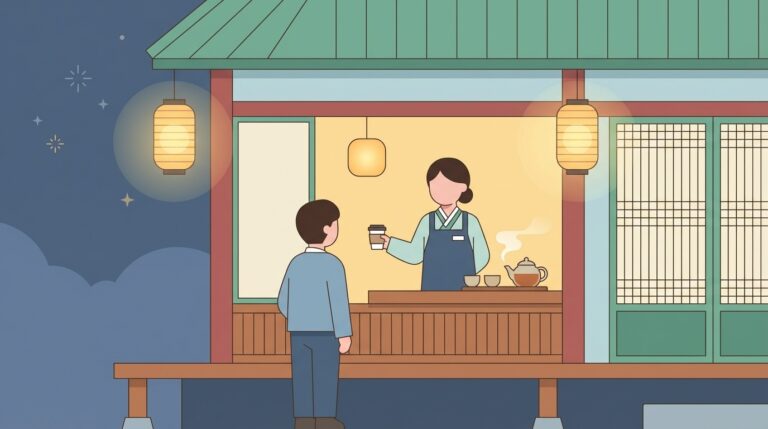
Picture this: It’s 9 PM in Seoul. You’ve just finished a hearty Korean BBQ dinner with friends, and someone suggests, “Let’s go to a cafe!” You end up in a stunning, aesthetically pleasing Hanok cafe in Bukchon. The vibe is immaculate—straight out of a K-Drama. But there’s a problem. You want to enjoy the atmosphere, but if you drink caffeine now, you’ll be staring at the ceiling until 4 AM.
You look at the menu. It’s fully in Korean. Americano, Cafe Latte, Earl Grey, Matcha… You panic. How do you politely ask the barista if they have anything that won’t keep you awake?
Many of my upper-intermediate (B2) students know how to order an Americano, but they freeze when they need to customize their order or ask for recommendations. Mastering cafe vocabulary isn’t just about survival; it’s about seamlessly blending into Korea’s massive cafe culture. Let’s dive into how to ask for caffeine-free tea like a true Seoulite!
Phase 2: Core Expressions Deep Dive
1. 카페인 없는 차 있나요?
- Pronunciation: Kapein eomneun cha innayo? [Kah-peh-een uhm-neun cha in-nah-yo?]
- Meaning: Do you have caffeine-free tea? (Literal: Caffeine-lacking tea, is there?)
- K-Culture Moment: You’re at a bustling trendy cafe in Seongsu-dong. The music is loud, the barista is busy, and you need a quick, direct answer before the line behind you gets impatient.
- Editor’s Insight: This is your bread-and-butter phrase. It’s direct but perfectly polite due to the ‘-요’ ending. Note the pronunciation of 없는 (eomneun)—the ‘ㅂ’ assimilates to an ‘ㅁ’ sound because of the following ‘ㄴ’.
- Situation Spectrum:
- Casual (Friends): ✅ (Drop the 요: 카페인 없는 차 있어?)
- Semi-formal (Staff/Colleagues): ✅
- Formal (Elders/Boss): ⚠️ (Use ‘있으신가요?’ to be extra polite)
- 🤔 Think About It: Why do Koreans often ask “Is there X?” (있나요?) instead of “Do you sell X?” (X 파나요?) It reflects a softer, less transactional approach to asking for a service.
2. 디카페인 음료 추천해 주실 수 있나요?
- Pronunciation: Dikapein eumnyo chucheonhae jusil su innayo? [Dee-kah-peh-een eum-nyo choo-chun-hae joo-shil soo in-nah-yo?]
- Meaning: Could you recommend a decaf drink?
- K-Culture Moment: You’re at a quieter, specialty teahouse (da-won). You want to engage the barista’s expertise.
- Editor’s Insight: “디카페인” (Decaf) is a Konglish word widely used in modern Korea. “추천해 주실 수 있나요?” (Could you recommend…) shows high-level linguistic tact. You’re not just demanding; you’re asking for a favor.
- Situation Spectrum:
- Casual (Friends): 🚫 (Too formal)
- Semi-formal (Staff/Colleagues): ✅
- Formal (Elders/Boss): ✅
- 🤔 Think About It: “주시다” means “to give,” but here it acts as an auxiliary verb meaning “to do something for someone.” How does this reflect the Korean cultural emphasis on mutual favor and respect?
3. 저녁에 마시기 좋은 차가 뭐예요?
- Pronunciation: Jeonyeoge masigi joeun chaga mwoyeyo? [Juh-nyuh-geh mah-shee-gee jo-eun cha-gah mwo-yeh-yo?]
- Meaning: What’s a good tea to drink in the evening?
- K-Culture Moment: You’re on a late-night cafe date. Instead of saying “I can’t drink caffeine,” you ask this to sound poetic and soft. It implies you want a relaxing, caffeine-free experience without making a fuss.
- Editor’s Insight: This is pure native speaker intuition! Koreans often prefer indirect communication (Nunchi). By asking what’s good for the “evening,” the barista immediately understands you want a caffeine-free, soothing option.
- Situation Spectrum:
- Casual (Friends): ✅ (뭐야? instead of 뭐예요?)
- Semi-formal (Staff/Colleagues): ✅
- Formal (Elders/Boss): ⚠️
- 🤔 Think About It: Indirectness is a key feature of Korean communication. Do you have phrases in your language that imply a meaning without stating it directly?
Phase 3: Textbook vs. Real Korean
| Situation | 📖 Textbook Korean | 🗣️ Real Korean | 💡 Why the difference? |
|---|---|---|---|
| Asking for Decaf | 카페인이 함유되지 않은 음료가 있습니까? | 혹시 디카페인 돼요? (By chance, is decaf possible?) | Efficiency. ‘돼요?’ (Is it possible/available) is the ultimate Korean shortcut. |
| Asking for a recommendation | 어떤 차를 추천하십니까? | 카페인 없는 걸로 추천 좀 해주세요. (Please recommend something without caffeine.) | Adding ‘좀’ (a little) softens the request, making it sound much less demanding. |
| Checking ingredients | 이 차에는 카페인이 들어 있습니까? | 이거 카페인 없죠? (This doesn’t have caffeine, right?) | Seeking confirmation (‘-죠?’) is a very common conversational habit to build quick rapport. |
Phase 4: Cultural Context — K-Culture Deep Dive
4-1. Non-verbal Nunchi at the Cafe
When receiving recommendations, don’t just stare intensely into the barista’s eyes (which can feel confrontational). Nod lightly (끄덕끄덕) as they speak. If they recommend a traditional tea, they might point to a menu. Follow their hand gesture. And remember, when taking your buzzer (진동벨 – jin-dong-bel) or your drink, reaching out with both hands (or one hand supporting the other arm) is the unspoken rule of politeness!
4-2. The “Korean Tea” Paradox (K-Food Connection)
If you watch K-Dramas, you’ll see characters drinking hot cups of brown liquid at home or in offices. You might think, “Wow, Koreans drink so much black tea!” But wait! It’s actually 보리차 (Barley tea) or 옥수수수염차 (Corn silk tea).
Historically, pure tea leaves (녹차/Green tea) were luxury items for monks and royalty. Ordinary people steeped roasted grains or dried fruits. The beautiful result? Korea has a massive culture of naturally caffeine-free “teas” (called daeyong-cha, or substitute teas). So, when you ask for caffeine-free tea at a traditional cafe, you won’t get decaf Earl Grey; you’ll get glorious, vibrant fruit teas like 유자차 (Yuzu tea), 매실차 (Plum tea), or 오미자차 (Schisandra berry tea)!
Phase 5: Real-Life Roleplay Scenario
Setting: Friday night, 8:30 PM. A beautifully lit traditional Hanok cafe in Insadong. You are with a Korean friend after eating spicy Tteokbokki, and you want a soothing drink to calm your stomach, but you need to sleep well tonight.
Characters:
– YOU: A B2-level Korean learner, excited but slightly sleepy.
– Barista (사장님): Mid-40s, warm, wearing a neat modern Hanbok apron.
Dialogue:
YOU: 안녕하세요! 혹시 카페인 없는 차 있나요?
(Annyeonghaseyo! Hoksi kapein eomneun cha innayo?)
[Hello! By any chance, do you have caffeine-free tea?]
사장님: 네, 어서 오세요! 전통차 종류는 대부분 카페인이 없어요.
(Ne, eoseo oseyo! Jeontong-cha jongnyuneun daebubun kapeini eopseoyo.)
[Yes, welcome! Most of our traditional teas are caffeine-free.]
YOU: 아, 다행이네요. 제가 밤에 커피를 마시면 잠을 잘 못 자서요.
(Ah, dahaeng-ineyo. Jega bame keopireul masimyeon jameul jal mot jaseoyo.)
[Ah, what a relief. If I drink coffee at night, I can’t sleep well.]
사장님: 그럼 따뜻한 차로 추천해 드릴까요?
(Geureom ttatteushan charo chucheonhae deurilkkayo?)
[Then shall I recommend a warm tea?]
🔀 Your Turn! How do you respond?
– A) “네, 따뜻한 차 주세요.” (Ne, ttatteushan cha juseyo.) – Standard and polite.
– B) “단맛이 덜 나는 걸로 추천 좀 해주세요.” (Danmasi deol naneun geollo chucheon jom haejuseyo.) – Advanced and specific!
– C) “아무거나 주세요.” (Amugeona juseyo.) – A bit rude/dismissive.✅ Best Choice: B — Korean fruit teas (like Yuja-cha) can be very sweet because they are made from fruit preserves (청). Specifying “something less sweet” (단맛이 덜 나는 것) proves you really know your Korean cafe culture!
(Assuming you chose B)
사장님: 단맛이 덜 나는 거면… 오미자차 어떠세요? 새콤달콤하고 소화에도 좋아요.
(Danmasi deol naneun geomyeon… Omija-cha eotteoseyo? Saekomdalkom-hago sohwa-edo joayo.)
[If you want something less sweet… how about Omija tea? It’s sweet and sour, and good for digestion.]
(🎭 Stage Direction: The barista points to a picture of a beautiful bright red tea)
YOU: 오, 소화에도 좋군요! 그럼 그걸로 따뜻하게 한 잔 주세요.
(Oh, sohwa-edo jokunyo! Geureom geugeollo ttatteusage han jan juseyo.)
[Oh, it’s good for digestion too! Then I’ll have a warm cup of that, please.]
사장님: 네, 알겠습니다. 드시고 가시나요?
(Ne, algesseumnida. Deusigo gasinayo?)
[Understood. Are you having it here?]
YOU: 네, 먹고 갈게요.
(Ne, meokgo galgeyo.)
[Yes, I’ll have it here.]
Phase 6: 10-Second Shadowing Drill
Let’s practice the rhythm! Pay attention to the pauses (/) and the emotion tags.
😊 저기요, / 혹시 디카페인 / 되나요?
(Jeogiyo, / hoksi dikapein / doenayo?)
Excuse me, / by any chance / is decaf available?🥺 밤에 마시기 좋은 / 부드러운 차 / 추천 좀 해주세요~
(Bame masigi joeun / budeureoun cha / chucheon jom haejuseyo~)
Please recommend / a soft tea / that is good to drink at night~
Phase 7: K-Culture Mini Dictionary
| Korean | Romanization | English | Context |
|---|---|---|---|
| 전통차 | jeontong-cha | Traditional tea | Often refers to teas made of fruits, roots, or grains (Yuja, Ginger, Ginseng). |
| 수제청 | suje-cheong | Handmade fruit preserves | The sugary fruit base used to make traditional fruit teas. |
| 다도 | dado | Tea ceremony | The traditional Korean way of preparing and drinking tea. |
| 진동벨 | jin-dong-bel | Buzzer | The vibrating disc they hand you to let you know your order is ready. |
| 얼죽아 | eol-juk-a | Eol-juk-a (Slang) | Acronym for “Even if I freeze to death, Iced Americano.” Koreans love iced drinks! |
Phase 8: Traveler’s Survival Kit
🆘 Survival Phrases for the Cafe Hopper
– 🇰🇷 “이거 디카페인으로 변경 되나요?” (Igeo dikapein-euro byeongyeong doenayo?)
– 🗣️ English meaning: Can I change this to decaf?
– 📍 Where to use: Franchise cafes (Starbucks, Mega Coffee, Ediya).
– 💡 Pro Tip: Not all independent cafes in Korea have decaf coffee beans. Always ask first!📌 Editor’s Travel Note
– Finding Cafes: Don’t use Google Maps in Korea; it’s notoriously outdated. Use Naver Map or KakaoMap. Search “분위기 좋은 카페” (Cafes with good atmosphere) or “전통 찻집” (Traditional teahouse).
– One Person, One Drink: Many Korean cafes have a strict “1인 1음료” (1 person, 1 drink) rule. You cannot order one tea and share it between two people to use the seating area.
– Tipping: Do not tip the barista! Korea is completely tip-free. Leaving money on the counter will only make the staff chase you down the street to return it!
Phase 9: Critical Thinking Corner — “One Step Deeper”
🧠 Think Deeper: The Global Era vs. Traditional Roots
When you order “Decaf” (디카페인) in Korea, you are participating in a modern, Westernized coffee culture that hit Korea rapidly in the 2000s. However, when you order traditional caffeine-free drinks like Barley tea (보리차) or Jujube tea (대추차), you are tapping into Korea’s agrarian history. Historically, tea leaves were expensive and mostly consumed by Buddhist monks. Commoners made “tea” out of whatever grains or fruits they harvested. Today, modern Koreans effortlessly jump between these two worlds—grabbing a “Decaf Oat Latte” in the morning and sipping “Omija-cha” at night. It shows how the Korean language and lifestyle absorb global trends while fiercely preserving local traditions.
💬 Your Turn: Does your culture have a traditional drink that naturally lacks caffeine? How do traditional drinks coexist with modern coffee culture in your country? Let me know in the comments!
Phase 10: FAQ & Avoiding Misunderstandings
Q: Can I ask for “decaf green tea” (디카페인 녹차)?
Editor says: No. While decaf coffee is common, decaf tea leaves (like green or black tea) are almost non-existent in Korean cafes. If you want no caffeine, you must switch to herbal (허브차) or traditional fruit teas (과일차).
Q: Is it rude to ask the barista lots of questions about the menu?
Editor says: Maybe. In a quiet, high-end teahouse, they love explaining the tea notes. But in a packed, busy franchise cafe during the 1 PM post-lunch rush? Use the shortcut: “제일 잘 나가는 카페인 없는 차 주세요” (Please give me your best-selling caffeine-free tea).
❌ Common Mistake #1: Assuming “밀크티” (Milk Tea) is caffeine-free.
✅ How to fix it: Milk tea in Korea usually means Earl Grey or Black Tea base. It has high caffeine! Always ask: “밀크티에 카페인 많나요?” (Does the milk tea have a lot of caffeine?)
Phase 11: Summary & Action Items
One-Liner Summary: To enjoy Seoul’s night cafes without losing sleep, master the magical phrase: “카페인 없는 차 있나요?” (Do you have caffeine-free tea?).
Action Mission 3 Steps:
– 🥉 Bronze (Solo): Read the Phase 5 roleplay dialogue out loud, pretending you are in a Hanok cafe.
– 🥈 Silver (Online): Look up the menu of a famous Korean cafe (like ‘Onion’ or ‘Osulloc’) online and find one caffeine-free drink.
– 🥇 Gold (Real World): Next time you visit a Korean cafe or restaurant, confidently ask for a recommendation using “추천해 주실 수 있나요?”
K-Culture Mission:
Head to your local Korean grocery store (or search online) and buy a jar of Yuja-cheong (유자청 – Citron tea base) or Omija-cheong. Make yourself a hot cup at home and enjoy a truly authentic, caffeine-free Korean cafe experience!
Did you try the K-Culture mission? What’s your favorite caffeine-free drink? Drop a comment below!👇
Phase 12: Quiz — Interactive Challenge
1. Situational Judgment:
You are at a busy cafe with a long line. You want a decaf coffee. What is the most natural, efficient way to ask?
A) 카페인이 함유되지 않은 음료가 있습니까?
B) 혹시 디카페인 돼요?
C) 밤에 마시기 좋은 차가 뭐예요?
2. Fill in the Blank:
“I can’t drink coffee at night, so please _________ something without caffeine.”
밤에 커피를 못 마셔서, 카페인 없는 걸로 ________ 좀 해주세요.
3. True or False – K-Culture Edition:
In Korea, it’s customary to leave a 10% tip for the barista if they recommend a really good traditional tea. (T / F)
🚨 Click to reveal answers!
- B (Efficiency is key in a busy Korean cafe! A is too textbook, C is too indirect for a busy line).
- 추천 (chucheon)
- False. Korea has a strict no-tipping culture. Just say “감사합니다!” (Thank you!) nicely.
Frequently Asked Questions (FAQ)
Q: What does "카페인 없는 차 있나요?" mean in Korean and how do you pronounce it?
A: In Korean, "카페인 없는 차 있나요?" is pronounced [Kapein eomneun cha innayo? [Kah-peh-een uhm-neun cha in-nah-yo?] and means: Do you have caffeine-free tea? (Literal: Caffeine-lacking tea, is there?)
Q: What does "디카페인 음료 추천해 주실 수 있나요?" mean in Korean and how do you pronounce it?
A: In Korean, "디카페인 음료 추천해 주실 수 있나요?" is pronounced [Dikapein eumnyo chucheonhae jusil su innayo? [Dee-kah-peh-een eum-nyo choo-chun-hae joo-shil soo in-nah-yo?] and means: Could you recommend a decaf drink?
Q: What does "저녁에 마시기 좋은 차가 뭐예요?" mean in Korean and how do you pronounce it?
A: In Korean, "저녁에 마시기 좋은 차가 뭐예요?" is pronounced [Jeonyeoge masigi joeun chaga mwoyeyo? [Juh-nyuh-geh mah-shee-gee jo-eun cha-gah mwo-yeh-yo?] and means: What's a good tea to drink in the evening?







