

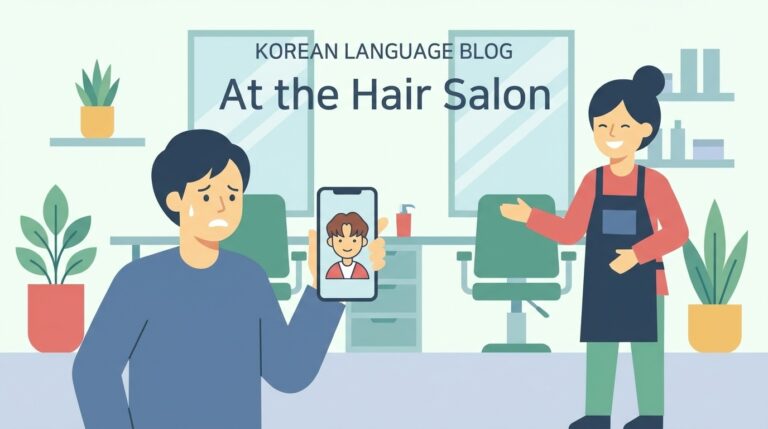
Phase 1: Empathy — Welcome to the Hongdae Salon\n\n안녕하세요! 매일한글 에디터입니다.\n\nImagine this: You finally made an appointment at a trendy hair salon in Hongdae. You’ve binge-watched K-Dramas and saved a screenshot of your favorite actor or idol. You want that perfect, effortless look. But as you sit in the stylish salon chair and the designer asks, “어떻게 해드릴까요?” (How would you like it?), your mind goes completely blank.\n\n”How do I say ‘Make me look like this picture’ without sounding completely awkward? What if they laugh at my photo?”\n\nDon’t worry! This is a universal struggle. Even Koreans get nervous showing photos of celebrities to their hairdressers. Today, we’re going to learn the exact, natural phrases you need to show your reference photo confidently. No more robotic textbook Korean—just the smooth, real-life expressions that will make your designer say, “Ah, I know exactly what you want!”\n\n—\n\n### Phase 2: Core Expressions Deep Dive\n\n> ### 1. 이 사진처럼 해주세요. (Please do it like this picture.)\n>\n> – Pronunciation: i sajincheoreom hae juseyo. + [ee sah-jin-chuh-rum hae joo-seh-yo]\n> – Meaning: Literal = Please do like this photo. / Real nuance = I want my hair to look like this reference.\n> – K-Culture Moment: You open your KakaoTalk or photo gallery, nervously point to a photo of an idol, and say this. The designer will usually smile and lean in to analyze the cut and color.\n> – Editor’s Insight: This is your golden ticket. The word “처럼” means “like” or “similar to.” It’s polite, direct, and exactly what designers want to hear.\n> – Situation Spectrum:\n> – Casual (친구 사이): 🚫 (You wouldn’t say this to a friend)\n> – Semi-formal (디자이너에게): ✅\n> – Formal (상사에게): 🚫\n> – 🤔 Think About It: Why do Koreans use “해주세요” (Please do it for me) instead of “I want to cut it like this”? It shows a level of trust in the designer’s skills, giving them the authority over the service.\n\n> ### 2. 이 느낌으로 잘라주세요. (Please cut it with this vibe/feeling.)\n>\n> – Pronunciation: i neukkimeuro jallajuseyo. + [ee noo-kim-oo-ro jal-la-joo-seh-yo]\n> – Meaning: Literal = Please cut it with this feeling. / Real nuance = I want this overall style/vibe, even if it’s not exactly identical.\n> – K-Culture Moment: This is the true “insider” phrase. K-Beauty is all about the mood (무드) and vibe (느낌). When you say this, the designer knows you understand that your hair might not be 100% identical to the K-Pop idol’s, but you want that same elegant or edgy energy.\n> – Editor’s Insight: Using “느낌” (feeling/vibe) instantly bumps your Korean level from A2 to B1! It sounds incredibly natural.\n> – Situation Spectrum:\n> – Casual: 🚫\n> – Semi-formal (디자이너에게): ✅ (Best choice!)\n> – Formal: 🚫\n> – 🤔 Think About It: Does your language have a word for “vibe” when talking about haircuts? How does focusing on the “vibe” reduce the pressure on both you and the hairdresser?\n\n> ### 3. 머리 조금만 다듬어주세요. (Please just trim it a little.)\n>\n> – Pronunciation: meori jogeumman dadeumeojuseyo. + [muh-ree jo-geum-mahn dah-deu-muh-joo-seh-yo]\n> – Meaning: Literal = Please tidy up my hair a little. / Real nuance = I just want a trim, don’t chop it all off!\n> – K-Culture Moment: You show a photo, but your hair is already similar. You just want to maintain it. If you say “잘라주세요” (cut), they might take off 5 inches! “다듬다” (trim/tidy) is your lifesaver.\n> – Editor’s Insight: The word ‘다듬다’ feels like gently sweeping a garden rather than chopping down a tree. It’s safe and subtle.\n> – Situation Spectrum:\n> – Casual: 🚫\n> – Semi-formal (디자이너에게): ✅\n> – Formal: 🚫\n> – 🤔 Think About It: Why is it so terrifying to get a haircut in a foreign language? Language holds the power over our physical appearance!\n\n—\n\n### Phase 3: Textbook vs Real Korean\n\n| 상황 | 📖 교과서 한국어 | 🗣️ 진짜 한국어 | 💡 왜 다를까? |\n|—|—|—|—|\n| Showing the photo | 이 머리 모양으로 자르고 싶습니다. | 이 사진처럼 해주세요. | “모양”(shape) sounds like you are making clay. “사진처럼” is natural. |\n| Explaining the style | 이 머리의 분위기를 원합니다. | 이 느낌으로 갈게요. | Koreans love using “느낌” (vibe/feeling) in beauty and fashion. |\n| Asking for a trim | 제 머리카락의 끝을 조금 자르세요. | 조금만 다듬어주세요. | “다듬다” is the specific verb for trimming and refining. |\n\nBottom Note: Don’t stress about complex grammar at the salon. Pointing and saying “이 느낌” (this vibe) is often better than a perfectly constructed 10-word sentence!\n\n—\n\n### Phase 4: Cultural Context — K-Culture Deep Dive\n\n#### 4-1. Non-verbal Nunchi (눈치) at the Salon\nWhen showing a photo, don’t just shove your phone in their face! Hold it with both hands or hand it gently to the designer so they can zoom in. If the designer slightly tilts their head and goes “쓰읍…” (inhales through teeth), use your Nunchi—it means your hair condition might not support that style (e.g., it’s too damaged for a perm).\n\n#### 4-2. The “Son-i-go” (손이고) Reality Check (K-Pop/K-Drama Tie-in)\nHave you ever brought a picture of a K-Drama actress’s gorgeous, natural-looking wavy hair, hoping to get a perm just like it? Prepare for the most famous phrase in K-Beauty: \n“손님, 이건 고데기예요.” (Customer, this is a curling iron.)\n\nShortened to “손이고 (Son-i-go)”, this phrase means that the effortless K-Drama look wasn’t achieved with a permanent perm, but by a stylist spending 2 hours with a curling iron (godegi). Idols and actors have professionals styling them every single day! Don’t be disappointed if the designer tells you a perm won’t look exactly like the picture.\n\n—\n\n### Phase 5: Real-Life Roleplay Scenario\n\nSetting: Saturday afternoon, a bright, modern hair salon in Apgujeong. Pop music is playing in the background. You’re sitting in the chair wearing a silky salon cape. \nCharacters:\n- YOU: A foreigner who wants to try a trendy K-style.\n- Min-ji (Designer): A friendly 28-year-old stylist with perfectly layered hair.\n\nDialogue:\n\nMin-ji: 안녕하세요! 오늘 어떤 스타일로 해드릴까요?\n(annyeonghaseyo! oneul eotteon seutailleo haedeurilkkayo?)\n(Hello! What kind of style would you like today?)\n\nYOU: (Handing over your phone) 😊 이 사진처럼 해주세요.\n(i sajincheoreom hae juseyo.)\n(Please do it like this picture.)\n\nMin-ji: (Looking closely) 아~ 레이어드 컷이네요. 너무 예쁘죠.\n(a~ reieodeu keosineyo. neomu yeppeujyo.)\n(Ah~ It’s a layered cut. So pretty.)\n\nMin-ji: 그런데 손님, 파마도 같이 하실 건가요?\n(geureonde sonnim, pamado gachi hasil geongayo?)\n(By the way customer, are you going to get a perm too?)\n\nYOU: 네, 파마하면 이 느낌 나오나요?\n(ne, pamahamyeon i neukkim naonayo?)\n(Yes, if I get a perm, will I get this vibe?)\n\nMin-ji: 아… 손님, 이건 고데기예요. (Son-i-go!)\n(a… sonnim, igeon godegiyeyo.)\n(Ah… Customer, this is a curling iron.)\n\nMin-ji: 파마로는 똑같이 안 나오고, 매일 아침 드라이를 하셔야 해요. 괜찮으세요?\n(pamaroneun ttokgachi an naogo, maeil achim deurairul hasyeoya haeyo. gwaenchaneuseyo?)\n(It won’t come out exactly the same with a perm, and you’ll have to blow-dry it every morning. Is that okay?)\n\n> 🔀 Your Turn! How do you respond?\n> – A) “아니요! 무조건 똑같이 해주세요!” (No! Make it exactly the same no matter what!)\n> – B) “아, 그럼 파마 말고 그냥 다듬어만 주세요.” (Ah, then skip the perm and just trim it please.)\n> – C) “아침에 바빠서요. 관리가 편한 스타일 추천해 주시겠어요?” (I’m busy in the morning. Could you recommend a style that’s easy to manage?)\n\n> ✅ Best Choice: C — Korean salons offer amazing consultation services! Asking for a recommendation (추천해 주시겠어요?) based on your lifestyle is the smartest B1-level move. \n> ⚠️ Choice A Analysis: This is a bit rude and ignores the designer’s professional advice. It breaks the Nunchi rule!\n\n(Roleplay continues based on C)\nYOU: 아침에 바빠서요. 관리가 편한 스타일 추천해 주시겠어요?\n(achime bappaseoyo. gwanriga pyeonhan seutail chucheonhae jusigesseoyo?)\n(I’m busy in the mornings. Could you recommend a style that’s easy to manage?)\n\nMin-ji: 그럼 끝에만 살짝 C컬펌을 넣는 건 어때요? 말리기만 하면 돼요!\n(geureom kkeuteman saljjak C-keolpeomeul neonneun geon eottaeyo? malligiman hamyeon dwaeyo!)\n(Then how about adding a slight C-curl perm at the ends? You just need to dry it!)\n\nYOU: 네, 좋아요! 그 느낌으로 해주세요.\n(ne, joayo! geu neukkimeuro hae juseyo.)\n(Yes, sounds good! Please do it with that vibe.)\n\n— \n\n🎁 Bonus K-Culture Scenario: The Shampoo Room\nAfter the cut, you are in the washing station. A common meme in Korea is the “Murungdowon” (Paradise) joke. The assistant asks if you’re comfortable, but you mishear!\n\nStaff: 물 온도 괜찮으세요? (mul ondo gwaenchaneuseyo? – Is the water temperature okay?)\nYOU: 네, 딱 좋아요. (ne, ttak joayo. – Yes, it’s perfect.)\nStaff: 더 헹구고 싶은 곳 있으세요? (deo henggugo sipeun got isseuseyo? – Is there anywhere else you’d like me to rinse?)\nYOU: 아니요, 괜찮습니다. (aniyo, gwaenchanseumnida. – No, it’s fine.)\n\n—\n\n### Phase 6: 10-Second Shadowing Drill\n\nPractice your tone! Slits (/) show you where to pause.\n\n- 😊 밝게 (Brightly): 저기요, / 이 사진처럼 / 해주세요! \n (jeogiyo, / i sajincheoreom / hae juseyo!)\n- 🥺 기대하며 (Hopefully): 파마하면 / 이 느낌 / 나오나요? \n (pamahamyeon / i neukkim / naonayo?)\n- ✋ 단호하게 (Politely firm): 길이는 / 조금만 / 다듬어주세요.\n (girineun / jogeumman / dadeumeojuseyo.)\n\n—\n\n### Phase 7: K-Culture Mini Dictionary\n\n| 한국어 | Romanization | 영어 | 맥락 설명 |\n|—|—|—|—|\n| 고데기 | godegi | Curling/Flat iron | Essential tool for K-pop styling. |\n| 층 내다 | cheung naeda | To layer (hair) | Very popular K-beauty technique (e.g., hush cut). |\n| 다듬다 | dadeumda | To trim/tidy up | Use this instead of ‘cut’ to save your length! |\n| 앞머리 | ammeori | Bangs/Fringe | Korean see-through bangs are a global trend. |\n| 손이고 | son-i-go | “It’s a curling iron” | The realization that K-drama hair isn’t a simple perm. |\n\n—\n\n### Phase 8: Traveler Survival Kit\n\nAre you visiting Seoul soon? You absolutely need these to survive a Korean salon!\n\n> 🆘 서바이벌 표현 TOP 3\n> 1. 🇰🇷 “앞머리 조금 잘라주세요.” (ammeori jogeum jallajuseyo) – Please cut my bangs a little.\n> 2. 🇰🇷 “너무 짧게는 자르지 마세요.” (neomu jjalgieneun jareuji maseyo) – Please don’t cut it too short.\n> 3. 🇰🇷 “예약했어요.” (yeyakaesseoyo) – I have a reservation.\n\n> 📌 Editor’s Travel Note\n> – Booking Apps: Koreans rarely walk into salons without an appointment. Use Naver Map or Kakao Hairshop to book in advance. Many places offer foreigner-friendly menus online!\n> – No Tipping!: In Korea, there is NO tip culture. The price you see is the price you pay. If you try to tip your designer, they will likely chase you down the street to return your money!\n\n—\n\n### Phase 9: Critical Thinking — “한 발 더 깊이”\n\n🧠 Media vs Reality: The K-Beauty Illusion\nWe often see K-Drama protagonists go into a salon and walk out completely transformed by a simple magic haircut. In reality, K-Beauty is incredibly high-maintenance. The “Son-i-go” (손이고) phenomenon shows that Koreans value the daily effort of styling over a one-time permanent fix. The culture emphasizes diligence—waking up early to blow-dry and iron your hair is considered a standard part of professional grooming (자기관리, self-care). When you ask for “이 느낌” (this vibe), you are actually agreeing to participate in that daily grooming culture!\n\n💬 Your Turn: In your home country, do people prefer low-maintenance “wash-and-go” haircuts, or do they spend time styling every morning? Share your culture in the comments!\n\n—\n\n### Phase 10: FAQ & Common Mistakes\n\nQ: “Can I show a picture of an idol of the opposite gender?”\nYes! Korean designers are incredibly skilled and used to this. Just say, “이 머리의 분위기로 해주세요” (Please do it with the vibe of this hair). They will adapt it to your face and gender presentation.\n\nQ: “What if I hate the result?”\nIt’s polite to be subtle. Instead of saying “I hate it,” say “여기를 조금만 더 다듬어 주시겠어요?” (Could you trim this part just a little more?).\n\n> ❌ 흔한 실수 (Common Mistake):\n> Foreigners often say “머리 잘라주세요” (Cut my hair) when they just want a trim. To a Korean designer, “자르다” (cut) implies a significant change in length!\n> ✅ 이렇게 하세요: Always use “다듬어주세요” (Trim it) if you want to keep your current length and just clean up the edges!\n\n—\n\n### Phase 11: Summary & Action Items\n\n✨ One-Liner Summary: To get your dream K-style hair, simply show your photo and say, “이 느낌으로 해주세요!” (Please do it with this vibe!).\n\n🎯 Action Missions:\n- 🥉 Bronze: Stand in front of your mirror and practice saying “이 느낌으로 해주세요” three times with confidence.\n- 🥈 Silver: Find a picture of a K-Pop idol’s hair you like and save it on your phone for your next trip to Korea.\n- 🥇 Gold: Actually visit a Korean hair salon (or a Korean-owned salon in your country) and show them the picture using today’s phrase!\n\n🎬 K-Culture Mission: Watch a K-Drama today and see if you can spot a scene where someone gets a makeover. Did they use a curling iron? (Hint: They definitely did!)\n\n—\n\n### Phase 12: Interactive Quiz Challenge\n\n1. 🧩 Situation Judgment:\nYou sit in the salon chair. Your hair reaches your waist, but the ends are damaged. You want to keep your hair long, but fix the ends. What should you say?\nA) 머리 다 잘라주세요! (Cut all my hair!)\nB) 끝에만 조금 다듬어주세요. (Please just trim the ends a little.)\nC) 고데기 해주세요. (Please use an iron.)\n\n2. ✍️ Fill in the Blank:\nYou show a photo of Cha Eun-woo to the designer. \nYOU: “이 _______처럼 해주세요.” (Please do it like this photo.)\n\n3. 🇰🇷 True or False – K-Culture Edition:\n”If a Korean designer says ‘Son-i-go (손이고)’, it means your hair is too damaged for a perm.” (True / False)\n\n(Scroll down for answers!)\n
\nAnswers: 1: B (A will give you a bob cut!), 2: 사진 (sajin/photo), 3: False (It means ‘Customer, this is done with a styling iron’, not necessarily that your hair is damaged!)
Frequently Asked Questions (FAQ)
Q: What does ""손님, 이건 고데기예요."" mean in Korean and how do you pronounce it?
A: In Korean, ""손님, 이건 고데기예요."" is pronounced [Customer, this is a curling iron.] and means: \n\nShortened to
Q: What does "흔한 실수" mean in Korean and how do you pronounce it?
A: In Korean, "흔한 실수" is pronounced [Common Mistake] and means: \n> Foreigners often say
Q: What does ""머리 잘라주세요"" mean in Korean and how do you pronounce it?
A: In Korean, ""머리 잘라주세요"" is pronounced [Cut my hair] and means: when they just want a trim. To a Korean designer, "자르다" (cut) implies a significant change in length!\n> ✅
Q: What does ""다듬어주세요"" mean in Korean and how do you pronounce it?
A: In Korean, ""다듬어주세요"" is pronounced [Trim it] and means: if you want to keep your current length and just clean up the edges!\n\n---\n\n### Phase 11: Summary & Action Items\n\n







