

Phase 1: Empathy (Immersive Open)
Hello there! I’m your Daily Hangul editor.
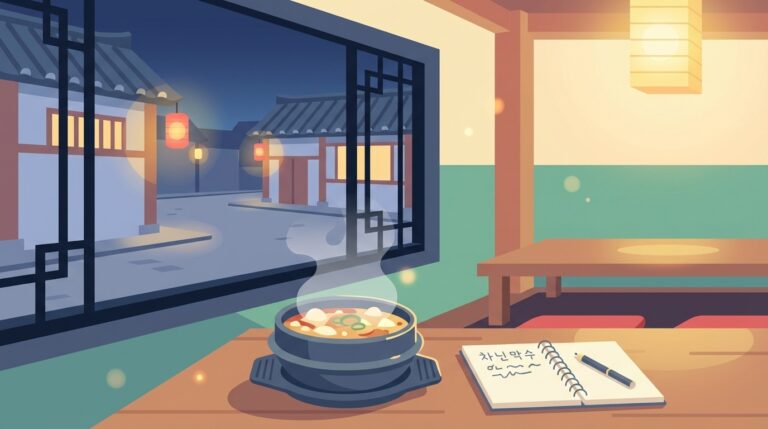
Imagine this: It’s 3:00 AM in Hongdae or Gangnam. The clubs are closing, the neon signs are flickering, and your feet are aching. You and your friends have officially missed the Mak-cha (last train). The crisp night air hits you, and someone points to a brightly lit, steamy storefront. It’s a 24-hour Gukbap (hot soup with rice) restaurant.
You walk in. The air smells like rich pork broth and roasted garlic. You see college students laughing over green Soju bottles, a businessman loosening his tie, and the legendary Imo (auntie) bustling between tables with a towering tray of side dishes. In K-Dramas, this is exactly where the male lead confesses his hidden feelings, or where the exhausted heroine finds solace in a steaming bowl of hangover soup (Haejang-guk).
But here’s the catch: Textbook Korean won’t cut it at 3 AM. If you just say “Give me water, please” like you learned in Chapter 1, you’ll survive. But if you want to be treated like a true local, get that extra free refill of soup, and comfortably wait out the night until the first subway runs? You need the insider language.
This guide is crafted from the actual late-night adventures of my advanced students. Let’s dive deep into the 24/7 Yashik (late-night snack) culture of Korea.
Phase 2: Core Expressions Deep Dive
Since you are at a C1 (Upper-Intermediate/Advanced) level, we are skipping the basics. Let’s look at what native speakers actually say when the clock strikes 2 AM.
1. “이모님, 저희 국물 좀 데워주실 수 있으세요?”
- Pronunciation: [Imo-nim, jeo-hui gungmul jom dewo-jusil su isseu-seyo?] (The ‘dewo’ sounds like ‘day-woah’).
- Meaning: (Literal) Auntie, can you warm up our soup? / (Real nuance) Our soup got cold while we were drinking/talking; could you heat it up and maybe add a little extra broth?
- K-Culture Moment: This is the ultimate “Jeong” (정) moment. At a 24h stew place, as the night drags on, your soup gets cold. Asking them to heat it up is standard, and often, the Imo will secretly add more broth or green onions for free.
- Editor’s Insight: The key here is the indirect politeness:
~주실 수 있으세요?rather than the direct데워주세요. It shows respect to the hardworking staff on the night shift. Also, calling the female staff이모님(Auntie) creates an instant pseudo-family bond.- Situation Spectrum:
- Casual with friends (talking to staff): ✅
- With coworkers/semi-formal: ✅
- Fancy Michelin restaurant: 🚫 (Never use Imo at fine dining!)
- 🤔 Think About It: Why do Koreans prefer boiling hot soup (뜨끈한 국물) when drinking cold alcohol like Soju? How does temperature play into the Korean concept of “refreshing” (시원하다)?
2. “막차 끊겼는데, 첫차 뜰 때까지 해장이나 할까?”
- Pronunciation: [Mak-cha kkeunkyeonneunde, cheot-cha tteul ttaekkaji haejang-ina halkka?]
- Meaning: (Literal) The last train is cut off, shall we do hangover-curing until the first train floats? / (Real nuance) We missed the last train. Let’s grab some hangover food and kill time here until the subway opens at 5:30 AM.
- K-Culture Moment: The dreaded (or anticipated) “Mak-cha” moment. Taxis at 2 AM in Seoul can be expensive or hard to catch. The cultural solution? Go to a 24-hour joint, eat Haejang-guk, and wait for the 5:30 AM Cheot-cha (first train).
- Editor’s Insight: “해장” (Haejang) is a brilliant cultural word. It means curing a hangover, but Koreans often do it while they are still drinking, or immediately after, rather than waiting for the next morning.
- Situation Spectrum:
- Casual friends: ✅
- Coworkers at a company dinner (Hoesik): ⚠️ (Only if the boss has left and it’s just the young team members).
- Formal/Elders: 🚫
- 🤔 Think About It: What does the existence of 24-hour restaurants waiting to serve “Haejang” food tell us about Korea’s work, play, and public transportation infrastructure?
3. “이모, 여기 얼큰하게 한 그릇 말아주세요!”
- Pronunciation: [Imo, yeogi eolkeun-hage han geureut mara-juseyo!]
- Meaning: (Literal) Auntie, please roll up one spicy bowl here! / (Real nuance) Auntie, please give me a piping hot, spicy bowl of soup with the rice already mixed in!
- K-Culture Moment: Picture a weary detective in a crime K-Drama. He sits alone at a tiny table, exhausted. He doesn’t even look at the menu; he just orders it Eolkeun-hage (spicy and soothing).
- Editor’s Insight: “얼큰하다” is a C1-level flavor word. It’s not just “spicy” (맵다) which can be painful. Eolkeun-hada is a deeply satisfying, savory heat that makes you sweat out your stress. “말아주다” comes from the culture of putting rice directly into the soup broth (국에 밥을 말다).
- Situation Spectrum:
- Casual / Regular customer: ✅
- First time / unsure of the vibe: ⚠️ (Stick to standard ordering if the place looks modern).
- Upscale dining: 🚫
- 🤔 Think About It: “Flavor” in Korean isn’t just about taste on the tongue; it’s about the physical sensation in the body. Do you have a word like Eolkeun-hada in your language?
Phase 3: Textbook vs. Real Korean
Let’s compare what you studied for the TOPIK exam versus what you actually hear at 3 AM in Jongno.
| Situation | 📖 Textbook Korean | 🗣️ Real Korean | 💡 Why the difference? |
|---|---|---|---|
| Calling the staff | 종업원님 / 저기요 | 이모(님)! / 사장님! | Koreans use family/hierarchy terms to create an emotional bond (Jeong) rather than transactional distance. |
| Asking for more side dishes | 반찬을 더 주시겠습니까? | 이모~ 여기 깍두기 좀 더 주세요. | Late-night joints are informal. Direct, friendly requests with a slight smile get you faster service. |
| Checking closing time | 24시간 동안 영업합니까? | 사장님, 혹시 몇 시까지 하세요? | Post-COVID, many “24h” signs are lies. Locals always double-check the actual closing or “break” times indirectly. |
| Asking to stay long | 오래 머물러도 됩니까? | (눈치껏 안주를 하나 더 시킨다) | Instead of asking to stay, locals use Nunchi. If you stay until 5 AM, you must order another side dish or drink. |
Bottom Note for C1 Learners: You know the polite forms perfectly. Now, it’s about mastering the tone. A slightly musical, warm intonation when saying “이모님~” makes all the difference between sounding like an AI and sounding like a local.
Phase 4: Cultural Context — K-Culture Deep Dive
4-1. The Non-Verbal Game: Nunchi at 4 AM
At a 24-hour restaurant, Nunchi (the art of reading the room) is crucial. If the restaurant is packed with drunk people, the staff are stressed. Don’t press the call bell multiple times. Catch the Imo’s eye as she walks by, raise your hand slightly (not too high), and speak your request quickly and clearly. Also, if you plan to sit there from 2 AM to 5 AM waiting for the subway, Nunchi dictates you order steadily. A single bowl of soup for 3 hours is a faux pas. Order a steamed egg (계란찜) or an extra bottle of beer to “pay for your rent.”
4-2. K-Drama Trope: The “Haejang” Confession
You’ve definitely seen this scene. The leads have been drinking heavily. It’s the middle of the night. They end up at a brightly lit, slightly shabby Sundae-guk (blood sausage soup) restaurant. The steam rises between them. One person is stirring the red pepper paste (다대기) into their soup, looking down, and softly confesses their true feelings or a dark secret.
Critical View: Why does this trope exist? In Korea, late-night food isn’t just about calories. It’s a liminal space. The formalities of the day and the office are stripped away. The alcohol has lowered defenses, and the warm, communal nature of sharing a bubbling pot of stew breaks down emotional walls. However, in reality, these places are incredibly loud—good luck whispering a romantic confession over the sound of three ajusshis cheering for their favorite soccer team at the next table!
Phase 5: Real-Life Roleplay Scenario
Setting: It’s 2:30 AM on a Friday night (technically Saturday morning) in Gangnam. You and your Korean friend, Min-ho, have just left a Noraebang (karaoke). You checked Kakao T, but the taxi queue is 50 people long. Min-ho leads you into a 24-hour Gamjatang (Pork bone stew) place. It’s loud, steamy, and bustling.
Characters:
– YOU: An expat who speaks great Korean but wants to master the late-night vibe.
– Min-ho (29): Your energetic Korean friend who is determined to show you the “real” Seoul night.
– Imo-nim (50s): The veteran waitress managing 10 tables at once.
Dialogue:
Min-ho: 아, 택시 절대 안 잡힌다. 우리 그냥 여기서 첫차 뜰 때까지 시간 때우자.
(Ah, taeksi jeoldae an japinda. Uri geunyang yeogiseo cheot-cha tteul ttaekkaji sigan ttaeuja.)
[Ah, we’re never getting a taxi. Let’s just kill time here until the first train runs.]
(🎭 Stage Direction: Min-ho grabs a table and throws his jacket on a chair.)
YOU: 그래. 나도 출출했는데 잘됐다.
(Geurae. Nado chulchulhaenneunde jal dwaetda.)
[Sure. I was feeling a bit peckish anyway, so this is great.]
Min-ho: 여긴 감자탕이 진리야. 이모님~!
(Yeogin gamjatang-i jilliya. Imo-nim~!)
[Gamjatang is the truth (the best) here. Auntie~!]
Imo-nim: 네~ 삼촌, 뭐 줄까?
(Ne~ samchon, mwo julkka?)
[Yes~ Uncle (affectionate term for young male customers), what can I get you?]
Min-ho: 여기 감자탕 소(小)자 하나랑, 소주 하나, 맥주 하나 주세요!
(Yeogi gamjatang so-ja hanarang, soju hana, maekju hana juseyo!)
[We’ll take a small Gamjatang, one Soju, and one beer, please!]
(🎭 1 Hour Later. You both have been talking, and the stew has gone cold. The fire underneath the pot is out.)
Min-ho: 야, 국물이 다 식었다. 네가 이모님한테 가서 좀 데워달라고 해볼래?
(Ya, gungmuri da sigeotda. Nega imo-nimhante gaseo jom dewodallago haebollae?)
[Hey, the soup got all cold. Do you want to try asking Auntie to warm it up?]
🔀 Your Turn! How do you ask the Imo-nim?
– A) “저기요. 국물이 차가워요. 데우세요.”
– B) “이모님~ 저희 이거 국물 좀 데워주실 수 있으세요?”
– C) “사장님, 여기 불 좀 다시 켜주면 안 됩니까?”✅ Best Choice: B — Reason: It’s the perfect blend of warmth (“이모님”) and polite, indirect requesting (“~주실 수 있으세요?”). You acknowledge she is busy but kindly ask for a favor.
⚠️ Choice A Analysis: This sounds like a demanding robot. Saying “it’s cold, heat it up” is far too direct and considered rude in Korean customer service, especially to elders.
⚠️ Choice C Analysis: A bit too masculine and authoritative (안 됩니까?). While acceptable for a middle-aged man, B is much more natural and endearing for a learner.
Imo-nim: 아이고, 식었네. 육수 좀 더 넣어서 끓여줄게!
(Aigo, sigeonne. Yuksu jom deo neo-eoseo kkeuryeo-julge!)
[Oh my, it did get cold. I’ll add some more broth and boil it up for you!]
YOU: 와, 감사합니다! 최고예요!
(Wa, gamsahamnida! Choegoyeyo!)
[Wow, thank you! You’re the best!]
Phase 6: 10-Second Shadowing Drill
Let’s practice the rhythm of a perfect, polite request to the Imo-nim. The key is not to sound angry, but apologetic yet cheerful.
🥺 이모님~ / 저희 / 국물 좀 / 데워주실 수 / 있으세요?
(Imo-nim~ / jeo-hui / gungmul jom / dewo-jusil su / isseu-seyo?)
Pro-Tip: Drag out the “님~” slightly. It softens the request immediately!
Phase 7: K-Culture Mini Dictionary
Mastering late-night culture requires knowing the jargon. Here are your C1 vocabulary words:
| 한국어 (Korean) | Romanization | English | Cultural Context |
|---|---|---|---|
| 야식 | Yashik | Late-night snack | A massive part of Korean culture, deeply tied to long study/work hours and delivery culture. |
| 해장 | Haejang | Hangover cure | Literally “resolving the bowels/stomach.” The act of eating hot, spicy, or rich food to sober up. |
| 첫차 / 막차 | Cheot-cha / Mak-cha | First train / Last train | The lifeline of Seoulites. Missing the Mak-cha (around midnight) dictates whether you take a $30 taxi or stay out until the Cheot-cha (5:30 AM). |
| 이모(님) | Imo(-nim) | Auntie | Used affectionately for middle-aged female staff in traditional or casual eateries. Adds Jeong. |
| 출출하다 | Chulchul-hada | Feeling peckish | The feeling you get at 11 PM. Not starving, but wanting a little something (like ramen). |
Phase 8: Traveler Survival Kit (Late-Night Edition)
Navigating Seoul after midnight can be daunting. Here are the survival phrases and tips you need.
🆘 Survival Phrases for the AM Hours
– 🇰🇷 “여기 몇 시까지 영업하세요?” (Yeogi myeot sikkaji yeong-eop-haseyo?)
– 🗣️ Meaning: Until what time are you open?
– 📍 Where to use: Anytime you enter a restaurant after 10 PM.
– 💡 Pro Tip: Post-COVID, many places still have “24시” (24 Hours) on their glowing signs but actually close at 10 PM or 2 AM. Always ask!📌 Editor’s Travel Note: The Late-Night App Stack
– Kakao T: Absolutely essential for catching a taxi after midnight. Don’t even try hailing one on a main street in Gangnam on a Friday; use the app.
– Naver Map: Filter restaurants by “영업 중” (Currently Open) to find actual 24-hour places near you.
– Payment: Remember, in most traditional Korean restaurants (like Gukbap places), you pay at the counter near the door after you finish eating, not at the table!
Phase 9: Critical Thinking Corner — “Going One Step Deeper”
Food & Identity: Why does Korea stay awake?
Have you ever wondered why Korea has such a thriving 24-hour restaurant and Yashik (late-night snack) culture? It’s not just because Koreans love food. Historically, it reflects a society that simply didn’t sleep. From students pulling all-nighters at Hagwons (cram schools) to office workers enduring brutal overtime and mandatory Hoesik (company dinners), the city’s lights had to stay on.
Late-night dining, therefore, isn’t just about hunger. It is a communal stress-relief mechanism. Sharing a boiling pot of stew at 3 AM is a collective sigh of relief, a moment where the rigid hierarchies of the daytime soften. The hearty, spicy food (Eolkeun-hada) is designed to literally sweat out the fatigue of a hyper-competitive society.
💬 Your Turn: Does your home country have a late-night dining culture? Do you eat to cure hangovers, or is it more about satisfying late-night cravings? Share your culture’s go-to 3 AM meal in the comments!
Phase 10: FAQ & Avoiding Misunderstandings
Q: Can I use “이모님” (Auntie) at every restaurant?
No! This is a very common expat mistake. “이모님” is strictly for casual, traditional Korean places (BBQ, Gukbap, Pojangmacha) and specifically for middle-aged or older female staff. If the staff is young (20s/30s), or if you are in a modern cafe, pasta restaurant, or upscale dining, using “이모님” is incredibly awkward. Just use “저기요” (Excuse me).
Q: Is it really okay to sit in a restaurant from 2 AM to 5 AM?
Yes, but with Nunchi. 24-hour spots are used to this. However, if you and three friends buy one bowl of soup and sit for 3 hours taking up a large table, you will get glaring looks. If you plan to camp out until the first train, be polite, order some extra drinks or side dishes, and keep your voices down.
❌ Common Mistake #1: Shouting “저기요!!!” across the restaurant.
✅ Do This Instead: Make eye contact first. A gentle wave of the hand, accompanied by a moderate volume “사장님~” or “이모님~” is the way to go. Korea has call bells (벨) on the tables—always check for that first!
Phase 11: Summary & Action Items
One-Liner Summary: Surviving Korea’s 24-hour dining culture requires knowing how to ask for warm soup politely, using affectionate titles like Imo-nim, and mastering the art of waiting for the first train.
Action Mission 3 Steps:
– 🥉 Bronze (Solo): Practice saying 이모님~ 저희 국물 좀 데워주실 수 있으세요? out loud 3 times with a polite, warm tone.
– 🥈 Silver (Online): Look up your favorite Korean food on Naver or Google Maps. Check if you can find a “24시” (24-hour) version of it in Seoul.
– 🥇 Gold (Real Life): Next time you are at a Korean restaurant, try asking for a side-dish refill using the polite indirect form: ~더 주실 수 있으세요?
K-Culture Mission:
Go watch an episode of Itaewon Class or Hospital Playlist. Pay close attention to the scenes where they eat late at night. Can you spot anyone using the word “해장” (Haejang) or pouring a shot of Soju into their soup?
Phase 12: Interactive Challenge (Quiz)
Test your late-night K-Culture survival skills!
1. Situational Judgment: It’s 4 AM. The 24-hour restaurant is completely empty except for you and the middle-aged female owner, who is resting at a table. You want to order another bottle of water. What is the BEST way to get her attention?
– A) Yell “아줌마! 물 줘요!” (Ajumma! Give water!)
– B) Ring the call bell 5 times until she gets up.
– C) Walk closer to her and say softly, “이모님, 죄송한데 물 한 병 주실 수 있으세요?”
2. Fill in the Blank:
“아, 술 너무 많이 마셨다. 내일 아침에 국밥으로 ______ 해야겠어.”
(Ah, I drank too much. Tomorrow morning, I need to do ______ with Gukbap.)
3. True or False – K-Culture Edition:
If a restaurant sign says “24시 식당” (24-Hour Restaurant) in massive red letters, you can 100% guarantee it is open and serving food at 3:30 AM.
👀 Click here for Answers & Explanations!
- Answer: C. Option A uses “Ajumma” which can sometimes sound rude or demanding, and the grammar is too direct. Option B lacks Nunchi. C shows respect for her rest time and uses C1-level polite phrasing.
- Answer: 해장 (Haejang). The ultimate hangover cure!
- Answer: False. Especially after the pandemic, many “24-hour” spots close late at night or have “break times” between 3 AM and 5 AM for cleaning and prep. Always ask: “혹시 몇 시까지 하세요?”
Frequently Asked Questions (FAQ)
Q: What does ""이모님, 저희 국물 좀 데워주실 수 있으세요?"" mean in Korean and how do you pronounce it?
A: In Korean, ""이모님, 저희 국물 좀 데워주실 수 있으세요?"" is pronounced [Imo-nim, jeo-hui gungmul jom dewo-jusil su isseu-seyo?] and means: (Literal) Auntie, can you warm up our soup? / (Real nuance) Our soup got cold while we were drinking/talking; could you heat it up and maybe add a little extra broth?
Q: What does ""막차 끊겼는데, 첫차 뜰 때까지 해장이나 할까?"" mean in Korean and how do you pronounce it?
A: In Korean, ""막차 끊겼는데, 첫차 뜰 때까지 해장이나 할까?"" is pronounced [Mak-cha kkeunkyeonneunde, cheot-cha tteul ttaekkaji haejang-ina halkka?] and means: (Literal) The last train is cut off, shall we do hangover-curing until the first train floats? / (Real nuance) We missed the last train. Let's grab some hangover food and kill time here until the subway opens at 5:30 AM.
Q: What does ""이모, 여기 얼큰하게 한 그릇 말아주세요!"" mean in Korean and how do you pronounce it?
A: In Korean, ""이모, 여기 얼큰하게 한 그릇 말아주세요!"" is pronounced [Imo, yeogi eolkeun-hage han geureut mara-juseyo!] and means: (Literal) Auntie, please roll up one spicy bowl here! / (Real nuance) Auntie, please give me a piping hot, spicy bowl of soup with the rice already mixed in!







