

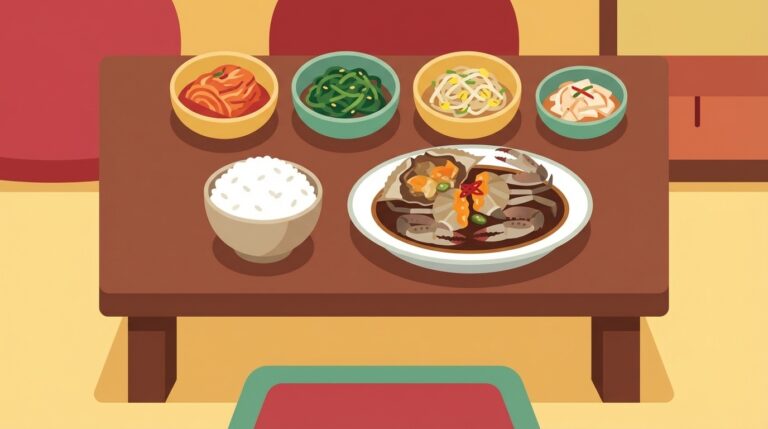
Phase 1: Empathy & The “Aha!” Moment
Hello! I’m the Senior Editor of Daily Hangul, your local culture navigator.
Imagine you are watching a K-Drama. The main characters are sitting at a bustling local restaurant. Suddenly, the female lead takes a bite of soy sauce marinated crab, her eyes widen, and she slams her hand on the table shouting, “이거 완전 도둑이네! (This is a total thief!)”.
You read the subtitles. Thief? Did someone steal her wallet while she was eating? Did the restaurant overcharge them? You pause the drama, utterly confused.
But let me tell you a secret: nobody stole anything. In fact, she just gave the restaurant the highest culinary compliment possible in Korea.
If you want to move beyond textbook Korean and truly understand the soul of Korean dining, you need to understand the concept of Banchan (반찬 – side dishes) and the legendary Bapdoduk (밥도둑). Knowing these expressions won’t just help you eat well; it will make restaurant owners treat you like a true local. Let’s dive in!
Phase 2: Core Expressions Deep Dive
1. 밥도둑 (The Highest Compliment)
- Pronunciation: Bap-do-duk [bap-doh-dook]
- Meaning: Literal: Rice Thief. / Real Nuance: A side dish so incredibly delicious, savory, or salty that it makes your bowl of plain white rice disappear like magic.
- K-Culture Moment: You’ll hear this constantly in Korean Mukbang (eating shows). When a YouTuber brings out Spam, seaweed, or marinated crab, the chat floods with “밥도둑 등장! (Enter the Rice Thief!)”.
- Editor’s Insight: You don’t use this for main dishes like pizza or steak. It is strictly reserved for side dishes that perfectly complement plain white rice.
- Situation Spectrum:
- Friends (Casual): ✅
- Coworkers (Semi-formal): ✅
- Boss/Elders (Formal): ✅ (It’s a universally loved cultural phrase!)
- 🤔 Think About It: Why does Korea use “rice” as the standard for measuring how good a side dish is? What is the staple food in your culture, and are there expressions related to it?
2. 공기밥 하나 추가요! (The Inevitable Result)
- Pronunciation: Gong-gi-bap ha-na chu-ga-yo! [Gong-gee-bahp ha-nah choo-gah-yo]
- Meaning: Literal: One bowl of air-rice added! / Real Nuance: I need another bowl of rice over here!
- K-Culture Moment: The moment you encounter a “Bapdoduk,” your rice bowl will empty rapidly. You will instinctively raise your hand in a crowded Korean BBQ place and shout this. Gonggibap refers to the standard stainless steel bowl of steamed rice.
- Editor’s Insight: The word ‘추가 (addition)’ is your best friend in Korean restaurants. You can add it to almost anything you want more of.
- Situation Spectrum:
- Friends (Casual): ✅
- Restaurant Staff (Semi-formal): ✅
- Boss/Elders (Formal): ⚠️ (Let the youngest person at the table order for everyone!)
- 🤔 Think About It: In many Western restaurants, ordering more bread or sides costs extra. In Korea, ordering more rice costs a little, but what about the side dishes?
3. 반찬 좀 더 주시겠어요? (The Magic Refill Request)
- Pronunciation: Ban-chan jom deo ju-si-get-seo-yo? [Bahn-chan johm duh joo-shee-get-suh-yo]
- Meaning: Literal: Would you give me a little more side dishes? / Real Nuance: Could I get a refill on these sides, please?
- K-Culture Moment: Korean tables are covered with small plates of kimchi, bean sprouts, and spinach. The unwritten rule? They are usually infinite and free.
- Editor’s Insight: You don’t just ask for “banchan” generally. You point to the specific empty dish or hold it up slightly while asking.
Phase 3: Textbook vs. Real Korean
| Situation | 📖 Textbook Korean | 🗣️ Real Korean | 💡 Why is it different? |
|---|---|---|---|
| Complimenting food | 이 반찬이 아주 맛있습니다. (This side dish is very delicious.) | 이거 완전 밥도둑이네요! (This is a total rice thief!) | “Bapdoduk” shows a deep understanding of Korean culinary combinations, sounding much more authentic. |
| Asking for more sides | 반찬을 더 주시겠습니까? (Would you give me more side dishes?) | 사장님, 여기 김치 좀 더 주세요~ (Boss, a little more Kimchi here~) | Koreans value speed and casual friendliness (Jeong) in local diners. Pointing out exactly what you want is faster. |
| Asking for more rice | 밥을 한 그릇 더 주세요. (Give me one more bowl of rice.) | 공기밥 추가요! (Rice addition!) | In busy restaurants, noun-focused phrases (“Addition!”) are heard much clearer over the noise. |
Bottom Note: For B2 learners, dropping the overly formal “~습/습니까” in casual restaurants and using “~요” with specific nouns will instantly make you sound like a local resident.
Phase 4: Cultural Context — K-Culture Deep Dive
4-1. Non-Verbal Cues: The Art of the Refill
When you ask for a banchan refill, don’t just sit with your hands in your lap. The polite, non-verbal “Nunchi” (social sense) move is to pick up the empty small plate with both hands and slightly extend it toward the server as they approach. It visually communicates what you need before you even finish your sentence!
4-2. K-Food Link: The Economics of Banchan
You might wonder, “How do Korean restaurants make money if side dishes are free?” This is rooted in the Korean concept of Insim (인심 – generosity/warmth of heart). Historically, serving a table full of food to guests was a sign of respect and care.
However, because they are free, there is an unwritten rule: Don’t waste it. Leaving mountains of uneaten, refilled banchan is considered bad manners. Only refill what you can finish!
Crucial exception: Premium banchan like Ganjang Gejang (marinated crab) or expensive meats usually require payment for refills. Knowing the difference between basic banchan and premium dishes is true K-Food survival.
Phase 5: Real-Life Roleplay Scenario
Setting: Friday night, 7:30 PM. A famous Ganjang Gejang (soy sauce marinated crab) restaurant in Mapo-gu. The smell of savory soy sauce and sesame oil fills the air. You are sitting with your Korean foodie friend, Minsu.
Characters:
* YOU: An expat who is discovering the joys (and dangers) of Korean dining.
* Minsu (30): Your energetic Korean friend who takes food very seriously.
Dialogue:
Minsu: 자, 게장 나왔다! 일단 밥부터 비벼봐. 🦀
(Ja, gejang nawatda! Ildan bapbuteo bibyeobwa.)
[Alright, the crab is here! First, try mixing your rice in it.]
(🎭 Stage Direction: Minsu scoops some rice into the crab shell for you.)
YOU: 와, 향이 진짜 미쳤는데요?
(Wa, hyang-i jinjja micheonneundeyo?)
[Wow, the smell is literally crazy!]
Minsu: 그치? 한 입 먹어봐. 어때?
(Geuchi? Han ip meogeobwa. Eottae?)
[Right? Take a bite. How is it?]
YOU: (Chewing, eyes widening) 음!!! 이거 짭짤하고 너무 맛있어요!
(Eum!!! Igeo jjapjalhago neomu masisseoyo!)
[Mmm!!! This is salty-savory and so delicious!]
Minsu: 내가 뭐랬어. 이거 완전 밥도둑이라니까. 밥 다 먹어가네?
(Naega mworaesseo. Igeo wanjeon bapdodugiranikka. Bap da meogeogane?)
[What did I tell you. I said it’s a total rice thief. You’re already running out of rice?]
🔀 Your Turn! The crab is too good, and your rice bowl is empty. What do you do?
* A) “밥 아껴 먹어야겠다.” (I should save my rice and eat slowly.)
* B) “사장님! 여기 공기밥 하나 추가요!” (Boss! One more bowl of rice here!)
* C) “게장만 그냥 먹을게요.” (I’ll just eat the crab by itself.)✅ Best Choice: B. In Korea, when facing a “Bapdoduk,” you don’t hold back. You order more rice!
⚠️ Choice C Analysis: Eating Ganjang Gejang without rice is a rookie mistake—it’s usually too salty on its own. Rice is the necessary canvas for the flavor!
YOU: 사장님! 여기 공기밥 하나 추가요!
(Sajangnim! Yeogi gonggibap hana chugayo!)
[Boss! One more bowl of rice here!]
Minsu: (Smiling proudly) 역시! 한국 사람 다 됐네.
(Yeoksi! Hanguk saram da dwaenne.)
[As expected! You’ve become a true Korean.]
Phase 6: 10-Second Shadowing Drill
Let’s practice ordering with confidence! Pay attention to the pauses (/) and the emotion tags.
- 😳 (Surprised by the taste) 와, / 이거 / 완전 / 밥도둑이네요!
(Wa, / igeo / wanjeon / bapdodugineyo!) - 🙋♂️ (Loud and clear to the kitchen) 이모님~ / 여기 / 공기밥 하나 / 추가요!
(Imonim~ / yeogi / gonggibap hana / chugayo!)
Phase 7: K-Culture Mini Dictionary
| Korean | Romanization | English | Cultural Context |
|---|---|---|---|
| 밥도둑 | bapdoduk | Rice Thief | A savory side dish that makes you eat lots of rice. |
| 공기밥 | gonggibap | Bowl of Rice | The standard serving of rice in a stainless steel bowl at restaurants. |
| 반찬 | banchan | Side Dishes | Small communal dishes served alongside rice, usually refillable. |
| 인심 | insim | Generosity | The warm-hearted generosity often felt when owners give extra food. |
| 이모님 | imonim | Auntie | An affectionate term used to call female staff in casual restaurants. |
Phase 8: Traveler’s Survival Kit
Navigating a Korean restaurant can be intimidating, but these tools will save you.
🆘 Survival Expressions for Restaurants
* 🇰🇷 “저기요! / 사장님!” (Jeogiyo! / Sajangnim!)
* 🗣️ Pronunciation tip: [Juh-gee-yo! / Sah-jang-neem!]
* 📍 Where to use: When you need to get the waiter’s attention.
* 💡 Pro Tip: Don’t be shy. In bustling Korean restaurants, politely raising your hand and calling out “Jeogiyo!” is completely normal and expected.📌 Editor’s Travel Note
* The Call Button (벨): Look at your table! Many Korean restaurants have a small doorbell-like button on the table. Just press it once. You don’t even need to shout!
* Self-Bar (셀프바): If you see a sign saying “반찬은 셀프입니다” (Banchan is self-serve), do not ask the staff for a refill. Grab a small plate and serve yourself from the buffet station.
* Tipping: There is NO tipping culture in Korea. Trying to leave a tip for good banchan will just cause confusion. Just say “잘 먹었습니다” (I ate well) on your way out!
Phase 9: Critical Thinking — “One Step Deeper”
Food & Identity: Why is ‘Rice’ Everything?
Have you ever noticed that Koreans use the word 밥 (Bap – cooked rice) to mean “a meal” in general? When a Korean asks “밥 먹었어?” (Did you eat rice?), they aren’t asking about your carbohydrate intake; they are asking “Are you okay? Are you taking care of yourself?”
Historically, rice was a precious commodity in Korea. Having enough rice meant you were safe and healthy. Therefore, communal eating—sharing banchan from the center of the table and eating your own bowl of rice—became a symbol of 정 (Jeong – deep emotional connection). When you share a “rice thief” side dish with someone, you aren’t just sharing food; you are sharing an intimate cultural experience.
💬 Your Turn: Does your language have a specific food word that is synonymous with an entire meal or well-being? Share it in the comments!
Phase 10: FAQ & Avoiding Misunderstandings
- Q: Can I ask to pack leftover Banchan to take home?
- A: No. Unlike main dishes, which you can usually pack up (포장), asking to take leftover free banchan home is considered rude.
- Q: Is it okay to eat Banchan before the rice arrives?
- A: Yes! Many Koreans snack on banchan while waiting for the main course. Just don’t fill up too much!
❌ Common Mistake #1: Asking “How much is the refill?” (리필 얼마예요?)
✅ Do This Instead: Just assume it’s free unless it’s a main ingredient (like extra meat). Say “반찬 좀 더 주세요” (Please give me more sides).
Phase 11: Summary & Action Items
- One-Liner Summary: A “Rice Thief” (밥도둑) is the ultimate compliment for a delicious Korean side dish that demands extra bowls of rice!
Action Mission 3-Steps:
* 🥉 Bronze (Solo): Look at a photo of Korean food and say “이거 완전 밥도둑이네!” out loud.
* 🥈 Silver (Online): Find a Korean Mukbang video on YouTube and leave a comment: “완전 밥도둑!”
* 🥇 Gold (Real Life): Visit a Korean restaurant, order a meal, and ask for a banchan refill using “반찬 좀 더 주시겠어요?”
K-Culture Mission:
The next time you watch a K-Drama where they are eating at home or a restaurant, count how many different small plates (banchan) are on the table. Try to guess which one is the “Bapdoduk”!
Phase 12: Interactive Quiz
1. You are eating incredibly delicious salty dried squid (banchan) at a restaurant. What is the most natural thing to say to your Korean friend?
A) “이 반찬 도둑 같아요.” (This banchan looks like a thief.)
B) “이거 완전 밥도둑이네!” (This is a total rice thief!)
C) “밥을 훔치지 마세요.” (Don’t steal the rice.)
(Answer: B. A is literal and weird. C is a direct command not to steal!)
2. True or False: In most everyday Korean restaurants, you must pay extra to get a refill of Kimchi or bean sprouts.
(Answer: False. Standard banchan is almost always free and unlimited!)
3. Fill in the blank:
When you need more rice because the banchan is too good, you yell: “사장님, 여기 [ _________ ] 추가요!”
(Answer: 공기밥 / Gonggibap)
Frequently Asked Questions (FAQ)
Q: What does "밥도둑 (The Highest Compliment)" mean in Korean and how do you pronounce it?
A: In Korean, "밥도둑 (The Highest Compliment)" is pronounced [Bap-do-duk [bap-doh-dook] and means: Literal: Rice Thief. / Real Nuance: A side dish so incredibly delicious, savory, or salty that it makes your bowl of plain white rice disappear like magic.
Q: What does "공기밥 하나 추가요! (The Inevitable Result)" mean in Korean and how do you pronounce it?
A: In Korean, "공기밥 하나 추가요! (The Inevitable Result)" is pronounced [Gong-gi-bap ha-na chu-ga-yo! [Gong-gee-bahp ha-nah choo-gah-yo] and means: Literal: One bowl of air-rice added! / Real Nuance: I need another bowl of rice over here!
Q: What does "반찬 좀 더 주시겠어요? (The Magic Refill Request)" mean in Korean and how do you pronounce it?
A: In Korean, "반찬 좀 더 주시겠어요? (The Magic Refill Request)" is pronounced [Ban-chan jom deo ju-si-get-seo-yo? [Bahn-chan johm duh joo-shee-get-suh-yo] and means: Literal: Would you give me a little more side dishes? / Real Nuance: Could I get a refill on these sides, please?







