

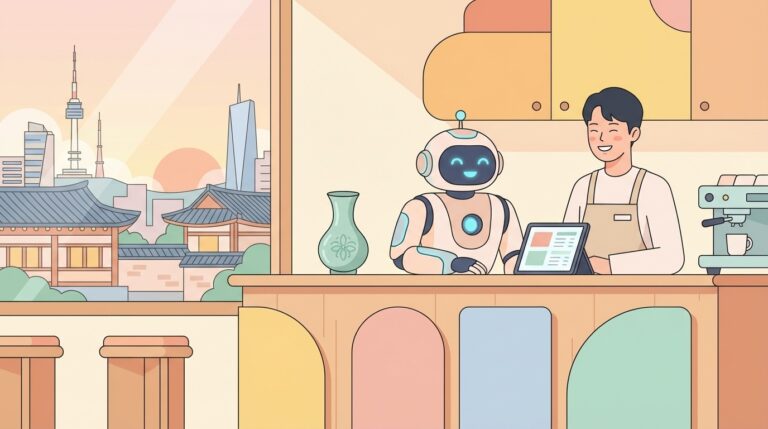
Phase 1: Empathy & The K-Culture Cold Open
Hello, learners! I’m your Lead Editor at Daily Hangul.
Imagine this: It’s 7:00 PM on a Friday. You finally get a table at that famous Samgyeopsal (pork belly) restaurant in Gangnam. But instead of a friendly Amoeni (auntie) shouting “Welcome!”, a sleek robot with digital cat ears rolls up to your table, carrying your meat while playing a cheerful K-Pop jingle. Suddenly, the older Korean gentleman at the next table gently takes his plates and says, “로봇님, 고맙습니다” (Thank you, Mr. Robot).
Wait… did he just use formal honorifics to a machine?
Welcome to modern South Korea, a country where ultra-fast technological adoption constantly collides with deeply traditional human values. From AI-powered virtual K-Pop idols like PLAVE to automated cafes and serving robots, the era of AI is already here.
But as a C1-level Korean learner, your goal isn’t just to order from a screen. It’s to discuss the ethics and social impact of this coexistence. How do Koreans express the subtle sense of loss when convenience replaces human connection? Let’s dive deep into the advanced vocabulary and cultural nuances of humans and AI coexisting in Korea.
Phase 2: Core Expressions Deep Dive
To talk about AI like a true intellectual in Seoul, you need more than just “AI is smart.” You need to express the emotional and cultural impact.
1. 사람 냄새가 안 나요
- Pronunciation: [saram naemsaega an nayo] / sa-ram naem-sae-ga an na-yo
- Meaning: (Literal) It doesn’t smell like a person. (Real nuance) It lacks the human touch / It feels too sterile and mechanical.
- K-Culture Moment: You’re listening to an AI-generated K-Pop track. The vocals are flawless, the beat is perfect, but your Korean friend takes off their headphones and sighs, saying this phrase. It’s the ultimate critique of art without soul.
- Editor’s Insight: We aren’t talking about body odor! In Korean, saram naemsae (human scent) refers to warmth, slight imperfections, and human empathy—what Koreans call Jeong (정).
- Situation Spectrum:
- Casual with friends: ✅
- Semi-formal with coworkers: ✅
- Formal debates/essays: ⚠️ (Use ‘인간미가 부족합니다’ for highly formal writing)
- 🤔 Think About It: Why does Korean culture equate “humanity” with a “scent”? What does this tell you about the physical, close-knit nature of traditional Korean communities?
2. AI가 절대 대체할 수 없는 건 ‘눈치’죠
- Pronunciation: [AI-ga jeoldae daechaehal su eomneun geon ‘nunchi’jyo] / AI-ga jeol-dae dae-chae-hal su-oom-neun-geon ‘nun-chi’-jyo
- Meaning: (Literal) The thing AI can absolutely never replace is ‘nunchi’. (Real nuance) AI might be smart, but it can never replicate human emotional intelligence and situational awareness.
- K-Culture Moment: In a K-Drama set in a tech startup, the brilliant but cold CEO tries to use AI to predict customer behavior, but the veteran employee saves the day using their gut feeling and empathy, delivering this exact line.
- Editor’s Insight: Daechaehada (to replace) is a crucial C1 vocabulary word for AI ethics. By pairing it with nunchi (tact/reading the room), you instantly show a profound understanding of Korean social mechanics.
- Situation Spectrum:
- Casual with friends: ✅
- Semi-formal with coworkers: ✅
- Formal with superiors: ✅ (A great conversational piece!)
- 🤔 Think About It: If an AI is programmed to read micro-expressions perfectly, would Koreans say it has nunchi? Or is nunchi inherently a shared human experience?
3. 편리하긴 한데, 왠지 씁쓸하네요
- Pronunciation: [pyeollihagin hande, waenji sseupsseulhaneyo] / pyeol-li-ha-gin han-de, waen-ji sseup-sseul-ha-ne-yo
- Meaning: (Literal) It is convenient, but somehow it’s bitter. (Real nuance) It’s incredibly convenient, but it leaves a bittersweet/melancholic taste in my mouth.
- K-Culture Moment: You visit your favorite old neighborhood cafe, but the friendly barista who knew your order has been replaced by a giant touchscreen kiosk. You get your coffee in 30 seconds, but you say this phrase to your friend.
- Editor’s Insight: Sseupsseulhada literally means a slightly bitter taste (like black coffee), but emotionally, it’s that complex feeling of knowing progress is good, but grieving what is lost.
- Situation Spectrum:
- Casual with friends: ✅
- Semi-formal with coworkers: ✅
- Formal with superiors: ✅
- 🤔 Think About It: Does your native language have a specific adjective to describe the “sadness of technological convenience”?
Phase 3: Textbook vs. Real Korean
When discussing technology and its flaws, textbooks sound like a computer manual. Let’s look at how humans actually complain about AI.
| Situation | 📖 Textbook Korean | 🗣️ Real Korean (Conversational) | 💡 Why the difference? |
|---|---|---|---|
| The AI/Kiosk isn’t working | 인공지능에 오류가 발생했습니다. (An error occurred in the AI.) | 기계가 말을 안 들어요. (The machine isn’t listening to me.) | Koreans often personify machines, blaming them as if they are disobedient children. |
| I prefer human service | 저는 대면 서비스를 선호합니다. (I prefer face-to-face service.) | 그래도 사람이 해주는 게 정(정)이 있죠. (Still, there’s Jeong when a person does it.) | Jeong (warmth/connection) is the ultimate justification for preferring human interaction. |
| AI makes me uncomfortable | AI 기술은 위화감을 줍니다. (AI tech gives a sense of incompatibility.) | 기계랑 대화하려니까 현타 오네요. (Talking to a machine gives me Hyunta.) | Hyunta (현타) is a popular slang for “a sudden realization of reality / feeling disillusioned.” |
Bottom Note for C1 Learners: “현타 오네요” (I’m having a reality check / feeling disillusioned) is a brilliant slang to use when you catch yourself saying “thank you” to ChatGPT or arguing with Siri.
Phase 4: Cultural Context — K-Culture Deep Dive
4-1. Non-Verbal Cues: The Disconnect
When Koreans interact with serving robots or AI avatars, you’ll notice an awkward physical phenomenon. Because Koreans rely heavily on eye contact (not staring, but acknowledging) and bowing to show respect, interacting with a screen causes a physical “glitch.” You might catch Koreans slightly bowing to a kiosk after taking their receipt. It’s a muscle memory of politeness that tech hasn’t erased.
4-2. K-Food Connection: The Death of “Amoeni” Culture?
Historically, Korean dining is profoundly social. You don’t just order; you interact. You ask the owner, “이모님, 오늘 뭐가 맛있어요?” (Auntie, what’s good today?). The owner might give you extra side dishes (Service – 서비스) just because they like you.
With AI robots and automated ordering tablets (T-order) now at every table, this human-to-human negotiation is disappearing. The ethical and social debate in Korea right now is: Are we trading our cultural warmth (Jeong) for 100% efficiency? While younger generations love the introverted convenience of not having to speak, older generations feel alienated. This generational gap regarding tech is a frequent theme in modern Korean literature and indie films.
Phase 5: Real-Life Roleplay Scenario
Setting: It’s 1:00 PM in the heart of Pangyo (Korea’s Silicon Valley). You and your Korean coworker, Minsu, just stepped into a high-end futuristic cafe. There are no baristas. A massive robotic arm is meticulously pouring pour-over coffee.
Characters:
– YOU: A foreign professional working in Korea, fascinated but slightly skeptical about AI replacing jobs.
– Minsu (32): Your Korean coworker. A tech-optimist who loves efficiency but still values a good human chat.
Dialogue:
Minsu: 와, 저 로봇 드립 커피 내리는 거 봐요. 진짜 정교하네요. ☕
(Wa, jeo robot deurip keopi naerineun geo bwayo. Jinjja jeonggyohaneyo.)
[Wow, look at that robot making drip coffee. It’s really precise.]
(🎭 Stage Direction: Minsu is recording the robot arm with his smartphone)
YOU: 그러게요. 속도도 빠르고 한 치의 오차도 없어 보이네요.
(Geureogeyo. Sokdodo ppareugo han chiui ochado eopseo boineyo.)
[I know, right? It’s fast and looks like it doesn’t make a single error.]
Minsu: 맞아요. 요즘은 어딜 가나 AI나 로봇이 다 대체하는 것 같아요.
(Majayo. Yojeumeun eodil gana AI-na robosi da daechaeha-neun geot gatayo.)
[Exactly. These days, it feels like AI and robots are replacing everything wherever you go.]
YOU: 편리하긴 한데, 커피에서 가장 중요한 게 빠진 것 같지 않아요?
(Pyeollihagin hande, keopieseo gajang jungyohan ge ppajin geot gatji anayo?)
[It’s convenient, but don’t you think the most important thing in coffee is missing?]
Minsu: 네? 원두요? 저거 최고급 스페셜티 원두라던데요?
(Ne? Wonduyo? Jeogeo choegogeup seupesyeolti wonduradeondeyo?)
[Huh? The beans? I heard those are top-tier specialty beans.]
🔀 Your Turn! How do you express your philosophical take on AI?
- A) “아니요, 가격이 너무 비싸요.” (No, the price is too expensive.)
- B) “그게 아니라… 기계가 만드니까 사람 냄새가 안 나잖아요.”
- C) “로봇은 눈치가 없어서 커피를 못 만들어요.”
✅ Best Choice: B — “That’s not it… since a machine makes it, it lacks the human touch (human scent).” This is a brilliant, native-like observation that shows deep C1-level emotional vocabulary.
⚠️ Choice C Analysis: While nunchi is a great word, saying a robot can’t make coffee because it lacks nunchi is logically awkward. Nunchi is for social situations, not brewing espresso.
Minsu: 아… 듣고 보니 그러네요. 예전엔 단골 카페 가면 사장님이랑 수다 떠는 맛이 있었는데.
(Ah… deukgo boni geureoneyo. Yejeonen dangol kape gamyeon sajangnimirang suda tteoneun masi isseonneunde.)
[Ah… now that you mention it, you’re right. In the past, going to a regular cafe meant enjoying a chat with the owner.]
YOU: 맞아요. 기술 발전도 좋지만, 인간과 AI가 어떻게 공존할지 고민해봐야 할 시점 같아요.
(Majayo. Gisul baljeondo jochiman, ingangwa AI-ga eotteoke gongjonhalji gominhaebwaya hal sijeom gatayo.)
[Exactly. Tech advancement is good, but I think it’s time we think deeply about how humans and AI will coexist.]
Minsu: 오, 한국어 실력에 한 번, 통찰력에 두 번 놀라고 갑니다! 커피는 제가 살게요! 💳
(O, hangugeo sillyeoge han beon, tongchallyeoge du beon nollago gamnida! Keopineun jaega salgeyo!)
[Oh, I’m amazed once by your Korean, and twice by your insight! I’ll pay for the coffee!]
Phase 6: 10-Second Shadowing Drill
Practice this thought-provoking sentence to sound incredibly eloquent at your next Korean networking event.
😌 기계가 / 모든 걸 / 대체하는 시대지만, / 사람만의 / 따뜻한 정은 / 남았으면 좋겠어요.
(gigyega / modeun geol / daechaeha-neun sidae-jiman, / saram-manui / ttatteuthan jeong-eun / namasseumyeon jogaesseoyo.)
Emotion Tags:
– 😌 Speak softly, with a reflective and slightly nostalgic tone.
– Focus on the pause after 시대지만 (era, but…), letting the contrast sink in before emphasizing 따뜻한 정 (warm affection).
Phase 7: K-Culture Mini Dictionary
Here are the essential terms defining the AI/Human ethics landscape in Korea:
| Korean | Romanization | English | Cultural Context |
|---|---|---|---|
| 키오스크 | kioseukeu | Kiosk (Touchscreen order) | The symbol of modern convenience, but also the center of the “digital divide” (older generations struggling to order food). |
| 버추얼 아이돌 | beochueol aidol | Virtual Idol | AI or motion-capture idols (like PLAVE). A massive ethical debate in K-Pop regarding parasocial relationships with non-humans. |
| 인간미 | inganmi | Human charm/touch | The slight imperfections and emotional warmth that AI cannot replicate. |
| 알고리즘의 노예 | algorijeum-ui noye | Slave to the algorithm | A very common self-deprecating joke Koreans use when they realize AI dictates their YouTube or shopping habits. |
Phase 8: Traveler Survival Kit
Even as an advanced learner, confronting a broken machine in a foreign country is stressful. Here is how you bypass the AI and get a human’s help.
🆘 Survival Phrases: Beating the Kiosk
– 🇰🇷 “저기요, 키오스크가 멈췄는데 직접 주문해도 될까요?”
– 🗣️ (jeogiyo, kioseukeu-ga meomchwonneunde jikjeop jumunhaedo doelkkayo?)
– 🇺🇸 “Excuse me, the kiosk froze. Can I order directly with you?”
– 📍 Where to use: Fast food chains, cafes, automated restaurants.
– 💡 Pro Tip: In highly automated stores, the single staff member is usually busy making the food. Make sure to say “바쁘신데 죄송하지만…” (I’m sorry to bother you while you’re busy…) before asking for human assistance!📌 Editor’s Travel Note
Many Korean automated convenience stores (무인 편의점) require a Korean credit card to unlock the door. If you only have cash or a foreign card, look for stores with a human worker, or wait for someone else to open the door (though the latter requires a bit of nunchi!).
Phase 9: Critical Thinking — “One Step Deeper”
🧠 Think Deeper: Language & Power — Why Do We Respect Machines?
Have you noticed that GPS navigations, AI speakers, and serving robots in Korea strictly use Hapsyo-che (the highest formal honorifics, ending in ~습니다)? The AI says “안내를 시작합니다” (I will begin guiding you).
But what’s fascinating is the human response. Many Koreans intuitively use polite language back to AI. When asking Siri or ChatGPT a question, a Korean might type “추천해 주시겠어요?” (Could you please recommend?).
In Korean culture, language reflects social hierarchy and respect. Using polite language with an AI isn’t necessarily about respecting the machine; it’s about maintaining the human speaker’s dignity and moral character. If you speak rudely to a machine, it reflects poorly on your own character (인성). It raises a beautiful ethical question for the AI era: Does treating a machine with respect make us more human?
💬 Your Turn: Do you say “please” and “thank you” to ChatGPT in your native language? Do you think we should? Share your thoughts in the comments!
Phase 10: FAQ & Avoiding Mistakes
Q: If an AI chatbot uses 반말 (casual language) as a “persona,” is it okay if I use casual language back?
A: Yes, but with a caveat. Some AI apps (like virtual friends) are programmed to use casual language to feel intimate. You can reply in 반말 to the app. However, never let this habit bleed into real life. It’s a common trap for learners to pick up “internet/AI casual talk” and accidentally use it with a real Korean stranger.
❌ Common Mistake: Complaining to the human staff by blaming them for the AI’s mistake.
✅ Do this instead: Separate the machine from the person. Say, “기계가 오류가 난 것 같아요” (I think the machine had an error) rather than “왜 주문이 안 들어가요?” (Why didn’t my order go through?). Acknowledging that it’s the machine’s fault shows great empathy toward the human worker.
Phase 11: Summary & Action Items
One-Liner Summary: True fluency in the AI era means knowing how to appreciate technology while gracefully expressing the irreplaceable value of human warmth (Jeong).
Take Action:
– 🥉 Bronze: Say “사람 냄새가 안 나요” out loud 3 times, focusing on the intonation of disappointment.
– 🥈 Silver: Write a short Korean journal entry comparing the convenience of ChatGPT with the joy of talking to a real Korean friend.
– 🥇 Gold: Next time you are at an automated cafe or store in Korea, actively thank the human staff member who is managing the machines. Give them a bit of that human Jeong!
K-Culture Mission:
Go to YouTube and search for a music video by a Korean Virtual Idol (like PLAVE or MAVE). Read the Korean comments. Can you spot any comments debating whether they prefer real humans or AI? Look for keywords like ‘기계’ (machine) and ‘인간’ (human)!
Phase 12: Interactive Challenge (Quiz)
1. Situational Judgment:
You are writing a formal university essay in Korean about the ethics of replacing therapists with AI. Which sentence is the most appropriate to describe AI’s limitation?
– A) AI는 눈치가 없어서 꽝이에요. (AI lacks nunchi so it sucks.)
– B) AI는 인간 특유의 공감 능력과 인간미를 완전히 대체할 수 없습니다.
– C) 기계가 말을 안 들어서 안 됩니다.
2. True or False — K-Culture Edition:
“In Korea, older generations generally prefer ordering through Kiosks because it minimizes the need to use honorifics with young part-time workers.”
– True or False?
(Answers below)
Click here for answers!
1. Answer: B.
Explanation: While ‘A’ (lacking nunchi) is great for conversation, a formal essay requires academic vocabulary like ‘공감 능력’ (empathy) and ‘인간미’ (humanity) and ‘대체할 수 없습니다’ (cannot replace). ‘C’ is a casual complaint about a broken machine.
2. Answer: False.
Explanation: The “digital divide” is a massive social issue in Korea. Many elderly people avoid stores with kiosks because the UI is confusing and uses too much English/Konglish (like ‘Take-out’, ‘Beverage’). They deeply miss the human interaction where they could simply ask for what they want.
Frequently Asked Questions (FAQ)
Q: What does "사람 냄새가 안 나요" mean in Korean and how do you pronounce it?
A: In Korean, "사람 냄새가 안 나요" is pronounced [saram naemsaega an nayo] and means: (Literal) It doesn't smell like a person. (Real nuance) It lacks the human touch / It feels too sterile and mechanical.
Q: What does "AI가 절대 대체할 수 없는 건 '눈치'죠" mean in Korean and how do you pronounce it?
A: In Korean, "AI가 절대 대체할 수 없는 건 '눈치'죠" is pronounced [AI-ga jeoldae daechaehal su eomneun geon 'nunchi'jyo] and means: (Literal) The thing AI can absolutely never replace is 'nunchi'. (Real nuance) AI might be smart, but it can never replicate human emotional intelligence and situational awareness.
Q: What does "편리하긴 한데, 왠지 씁쓸하네요" mean in Korean and how do you pronounce it?
A: In Korean, "편리하긴 한데, 왠지 씁쓸하네요" is pronounced [pyeollihagin hande, waenji sseupsseulhaneyo] and means: (Literal) It is convenient, but somehow it’s bitter. (Real nuance) It’s incredibly convenient, but it leaves a bittersweet/melancholic taste in my mouth.







