

Phase 1: Empathy & K-Culture Cold Open
Hello, language enthusiasts! It’s your Daily Hangul Editor.
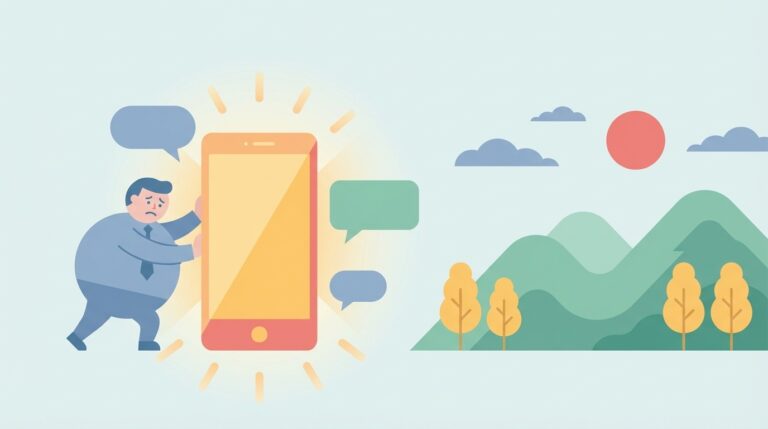
Picture this: You’re sitting in a beautiful Hanok cafe in Bukchon, sipping a meticulously crafted iced Americano. It’s 8 PM on a Friday. Suddenly, your phone buzzes. “Ka-tok!” Then again. “Ka-tok!” “Ka-tok!” It’s your work group chat. Someone just sent a file, and three others have already replied with bowing emojis. You feel your blood pressure rise. Sound familiar?
South Korea boasts some of the fastest internet speeds globally, but this hyper-connectivity comes with a heavy socio-psychological price: digital fatigue. In a society where the 빨리빨리 (ppalli-ppalli, hurry-hurry) culture extends to how fast you reply to messages, turning off your phone isn’t just taking a break—it’s a profound social statement.
As an advanced (C2) Korean learner, you already know the basics of texting. But how do you articulate the crushing weight of smartphone addiction, or politely request a digital detox without committing social suicide? Today, we dive deep into the nuanced vocabulary of Korea’s digital exhaustion.
Phase 2: Core Expressions Deep Dive
Let’s unpack the high-level vocabulary used to describe digital life and fatigue.
1. 단톡방 지옥 (Dantokbang Ji-ok)
- Pronunciation: [dan-tok-bang ji-ok] + ‘Dan’ like ‘Don’, ‘tok’ like ‘talk’, ‘bang’ like a door slamming. ‘Ji’ like ‘jeep’, ‘ok’ like ‘oak’.
- Meaning: (Literal) Group chat hell. / (Real Nuance) The inescapable, overwhelming trap of being in too many active KakaoTalk group chats.
- K-Culture Moment: In K-Dramas like Misaeng, you often see office workers staring blankly at their phones as the ‘1’ (unread mark) disappears from a group chat. Leaving a work group chat is considered extremely taboo until you literally quit the company.
- Editor’s Insight: This phrase perfectly captures the claustrophobia of digital connectivity. It’s not just annoying; it feels like an actual “hell” because you are socially obligated to monitor it.
- Situation Spectrum:
- Casual friends: ✅
- Close colleagues (Semi-formal): ⚠️ (Good for complaining together)
- Formal/Superiors: 🚫
- 🤔 Think About It: Why do Koreans prefer communal digital spaces (group chats) over individual DMs for both work and personal lives? How does this reflect the traditional collective society?
2. 잠수 타다 (Jamsu Tada)
- Pronunciation: [jam-su ta-da] + ‘Jam’ like traffic jam, ‘su’ like ‘sue’, ‘ta’ like ‘taco’, ‘da’ like ‘dad’.
- Meaning: (Literal) To ride a submarine. / (Real Nuance) To ghost, go completely off the grid, or cut off all digital contact.
- K-Culture Moment: Think of that dramatic K-Drama trope where the heartbroken protagonist throws their phone onto their bed and disappears to the countryside. Everyone frantically asks, “걔 요즘 잠수 탔어?” (Did they go off the grid lately?)
- Editor’s Insight: While ‘ghosting’ in English often implies abandoning a specific person, 잠수 타다 usually refers to a blanket withdrawal from everyone. It’s the ultimate, somewhat rebellious form of a digital detox.
- Situation Spectrum:
- Casual friends: ✅
- Colleagues (Semi-formal): 🚫 (Highly unprofessional)
- Formal/Superiors: 🚫
- 🤔 Think About It: Is taking a break from your phone viewed as “self-care” or “irresponsibility” in your culture compared to Korea?
3. 스마트폰에 얽매이다 (Seumateupone Eolmaeida)
- Pronunciation: [seumateupone eol-mae-i-da] + ‘Eol’ like the ‘ul’ in ‘gulp’, ‘mae’ like ‘may’, ‘i’ like ‘ee’, ‘da’ like ‘dad’.
- Meaning: (Literal) To be bound/tied to a smartphone. / (Real Nuance) To be chained to your phone, unable to disconnect due to anxiety or addiction.
- K-Culture Moment: Used heavily in news broadcasts or serious discussions about modern society, rather than casual banter.
- Editor’s Insight: At the C2 level, you should move beyond simply saying “스마트폰 중독” (smartphone addiction). 얽매이다 carries the passive, helpless nuance of being a prisoner to your device.
- Situation Spectrum:
- Casual friends: ⚠️ (A bit too formal/academic)
- Colleagues/Debates (Semi-formal): ✅
- Formal/Superiors: ✅
- 🤔 Think About It: How does the linguistic choice of a passive verb (being bound) shift the blame of addiction from the individual to the technology itself?
Phase 3: Textbook vs. Real Korean
| Situation | 📖 Textbook Korean | 🗣️ Real Korean | 💡 Why the difference? |
|---|---|---|---|
| Phone addiction | 스마트폰 중독입니다. (I am addicted to my smartphone.) | 폰 달고 살아요. (I live with my phone attached to me.) | Native speakers prefer vivid physical metaphors over clinical medical terms. |
| Disconnecting | 연락을 받지 않겠습니다. (I will not receive messages.) | 이번 주말엔 좀 잠수 탈까 해요. (I’m thinking of going off the grid this weekend.) | Direct refusal is harsh. “Riding a submarine” softens the blow with slang. |
| Being ignored | 제 메시지를 무시하셨네요. (You ignored my message.) | 카톡 읽씹 당했어요. (I got read-and-ignored on Katalk.) | “읽씹” (ilk-ssip) reflects the specific UI of Korean messenger apps. |
Note for C2 Learners: Integrating words like 읽씹 (Read & Ignore) and 안읽씹 (Unread & Ignore) shows you truly grasp the socio-linguistic fabric of modern Korea.
Phase 4: K-Culture Deep Dive — Cultural Context
4-1. Non-Verbal Communication: The “Nunchi” of Replying
In Korea, digital etiquette is heavily dictated by Nunchi (눈치). If a senior colleague texts you, leaving the ‘1’ (unread mark) for too long is rude, but reading it and not replying immediately is worse. Consequently, Koreans have developed the art of reading messages via the lock screen without opening the app—a digital survival skill to avoid the pressure of the immediate reply.
4-2. The “Always-On” Work Culture
KakaoTalk (카카오톡) isn’t just for friends; it’s the default operating system of corporate Korea. Unlike the West where WhatsApp/iMessage is personal and Slack/Teams is for work, the boundaries in Korea are blurred. It is incredibly common for bosses to send work instructions via KakaoTalk over the weekend. This is why the urge for a 디지털 디톡스 (Digital Detox) is currently a massive socio-cultural trend, pushing the government to debate laws like the “Right to Disconnect” (연결되지 않을 권리).
Phase 5: Interactive Roleplay Scenario
Setting: It’s 11 PM on a Friday at a noisy Makgeolli pub in Euljiro. You are with Jihoon, a Korean colleague who looks like he hasn’t slept in a decade. His phone keeps vibrating on the table.
Characters:
– YOU (The Expat): A manager trying to enjoy a rare weekend off.
– Jihoon (32): Your local colleague, visibly stressed by his phone.
Dialogue:
Jihoon: 하아… 부장님 또 카톡 보내셨네. 진짜 단톡방 지옥이야.
(Ha-a… bujangnim tto katok bonaesyeonne. Jinjja dantokbang ji-ok-i-ya.)
[Sigh… the manager sent another KakaoTalk. This is really group chat hell.]
YOU: 주말인데 또요? 너무 스마트폰에 얽매여 사시는 거 아니에요?
(Jumarinde tto-yo? Neomu seumateupone eolmaeyeo sasineun geo anieyo?)
[Again? On a weekend? Aren’t you living too chained to your smartphone?]
Jihoon: 내 말이! 아, 진짜 주말 내내 폰 꺼버리고 싶다.
(Nae mari! Ah, jinjja jumal naenae pon kkeobeorigo sipda.)
[Tell me about it! Ah, I really want to turn off my phone all weekend.]
🔀 Your Turn! How do you respond to Jihoon?
– A) “그냥 답장하지 마세요. (Just don’t reply.)”
– B) “우리 이번 주말엔 같이 잠수 탈까요? (Shall we both go off the grid this weekend?)”
– C) “부장님 카톡은 바로 답장해야죠! (You must reply to the manager immediately!)”✅ Best Choice: B — It uses high-level slang naturally and builds camaraderie.
⚠️ Choice A Analysis: Too direct and ignores the power dynamics of Korean work culture.
⚠️ Choice C Analysis: Sarcastic, but might accidentally trigger Jihoon’s corporate trauma!
(🎭 Stage Direction: Jihoon laughs, finally flipping his phone face-down on the table.)
Jihoon: ㅋㅋㅋ 콜! 나 진짜 이번 주말엔 잠수 탈 거야. 찾지 마요!
(Kkk kol! Na jinjja ibeon jumaren jamsu tal geoya. Chatji mayo!)
[Hahaha, deal! I’m seriously going off the grid this weekend. Don’t look for me!]
Phase 6: 10-Second Shadowing Drill
Practice expressing ultimate digital exhaustion. Pay attention to the pauses!
😤 단호하게 (Resolutely):
나 / 이번 주말에는 / 폰 끄고 / 완~전 / 잠수 탈 거야.
(Na / ibeon jumar-eneun / pon kkeugo / wan~jeon / jamsu tal geoya.)
“I’m going to turn off my phone and go com~pletely off the grid this weekend.”
😩 지치게 (Exhaustedly):
카톡 / 알림음만 들어도 / 스트레스받아.
(Katok / allim-eum-man deureodo / seuteureseu bada.)
“Just hearing the KakaoTalk notification sound stresses me out.”
Phase 7: K-Culture Mini Dictionary
| Korean | Romanization | English | Cultural Context |
|---|---|---|---|
| 단톡방 | dantokbang | Group Chat | Short for 단체 카카오톡방. The locus of both social life and workplace stress. |
| 읽씹 | ilkssip | Read & Ignore | Short for 읽고 씹다. A severe digital faux pas if done to a senior. |
| 안읽씹 | anilkssip | Unread & Ignore | Leaving the ‘1’ mark intentionally to avoid the obligation of replying. |
| 폰딧불이 | ponditburi | Phone Firefly | People staring at glowing screens in dark places like movie theaters. |
Phase 8: Traveler’s Survival Kit
Even as a tourist, your smartphone is your lifeline (maps, translation). What if you need a forced digital detox because your phone died?
🆘 Survival Phrases for the Disconnected Traveler
– 🇰🇷 “근처에 폰 충전할 데 있을까요?” (geuncheo-e pon chungjeonhal de isseulkkayo?)
– 🗣️ Is there a place to charge my phone nearby?
– 📍 Usage: Convenience stores, cafes, restaurants.
– 💡 Pro Tip: Korea is extremely generous with electricity. Most cafes have outlets everywhere, and convenience stores often sell cheap portable chargers (보조배터리).
- 🇰🇷 “여기 와이파이 비밀번호가 뭐예요?” (yeogi waipai bimilbeonhoga mwoyeyo?)
- 🗣️ What is the Wi-Fi password here?
- 💡 Pro Tip: The password is almost always written on the cafe receipt! Check there before asking.
Phase 9: Think Deeper — Language & Power
🧠 The Power Dynamics of the ‘1’ Mark
In KakaoTalk, an unread message displays a yellow ‘1’ next to it. When the recipient reads it, the ‘1’ vanishes. At a C2 level, it is vital to understand that this simple UI feature acts as a microscopic power struggle in Korean society. For superiors, the disappearing ‘1’ is a demand for immediate action. For subordinates, managing when to let that ‘1’ disappear is a calculated game of Nunchi. The language of digital read-receipts perfectly mirrors the hierarchical power dynamics embedded in traditional Korean honorifics—you do not control your own time; you manage the expectations of those above you.
💬 Your Turn: Does your primary messaging app use read receipts? How does your culture handle the pressure of being “left on read”? Share your thoughts below!
Phase 10: FAQ & Avoiding Misunderstandings
Q: Can I tell my boss “저 주말에 잠수 탈게요” (I’m going off the grid this weekend)?
Absolutely NOT. While it’s great slang, it implies a dereliction of duty. To a boss, you should use professional phrasing: “주말에는 개인적인 사정으로 연락이 어려울 수 있습니다.” (It may be difficult to reach me this weekend due to personal matters.)
Q: Is it rude to turn off my phone during a dinner gathering (회식)?
Yes and No. It’s actually highly polite to put your phone away and focus on the hierarchy of the table. However, completely powering it down might raise eyebrows if an emergency occurs. The polite move is phone face-down on the table.
❌ Common Mistake #1: Translating “I’m addicted to my phone” directly to “저는 핸드폰 중독자입니다.”
✅ Do this instead: At a C2 level, use “제가 폰에 좀 얽매여 있는 편이에요” (I tend to be a bit tied to my phone) or “요즘 폰을 달고 살아요” (I live with my phone attached to me lately). It sounds much more natural.
Phase 11: Summary & Action Items
💡 One-Liner Summary: True Korean fluency isn’t just knowing how to text; it’s knowing how to articulate the socio-cultural exhaustion of being perpetually connected.
🎯 Action Missions:
– 🥉 Bronze (Solo): Look at your phone usage stats and say out loud, “나 진짜 스마트폰에 얽매여 있구나.” (I’m really tied to my smartphone.)
– 🥈 Silver (Online): Leave a comment in Korean on this post explaining why you need a “디지털 디톡스” (Digital Detox).
– 🥇 Gold (Real-world): Next time you hang out with a Korean friend, tell them in advance: “오늘 만날 때는 폰 끄고 잠수 타자!” (When we meet today, let’s turn off our phones and go off the grid!)
🇰🇷 K-Culture Mission: Try watching one episode of a modern K-Drama and count how many times KakaoTalk notification sounds dictate the flow of the plot. You’ll be surprised!
Phase 12: Interactive Challenge (Quiz)
Q1. (Situational) Your close friend texts you constantly over the weekend complaining about work. You are exhausted and want to turn off your phone. What is the most natural, C2-level response?
1. “나는 핸드폰 중독자가 싫어.”
2. “나 이번 주말은 카톡 지옥에서 벗어나서 좀 잠수 탈게.”
3. “내일부터 스마트폰을 사용하지 않겠습니다.”
Check Answer
Correct Answer: 2. It naturally combines the colloquialism ‘카톡 지옥’ (Katalk hell) and ‘잠수 타다’ (to go off the grid).
Q2. (True/False) In Korean corporate culture, ignoring a KakaoTalk message from a boss over the weekend is completely acceptable and legally protected.
Check Answer
False. While there is a growing movement for the “Right to Disconnect,” currently, ignoring a boss’s message (even on weekends) requires a lot of ‘Nunchi’ and is often frowned upon in traditional corporate environments.
Frequently Asked Questions (FAQ)
Q: What does "단톡방 지옥 (Dantokbang Ji-ok)" mean in Korean and how do you pronounce it?
A: In Korean, "단톡방 지옥 (Dantokbang Ji-ok)" is pronounced [dan-tok-bang ji-ok] and means: (Literal) Group chat hell. / (Real Nuance) The inescapable, overwhelming trap of being in too many active KakaoTalk group chats.
Q: What does "잠수 타다 (Jamsu Tada)" mean in Korean and how do you pronounce it?
A: In Korean, "잠수 타다 (Jamsu Tada)" is pronounced [jam-su ta-da] and means: (Literal) To ride a submarine. / (Real Nuance) To ghost, go completely off the grid, or cut off all digital contact.
Q: What does "스마트폰에 얽매이다 (Seumateupone Eolmaeida)" mean in Korean and how do you pronounce it?
A: In Korean, "스마트폰에 얽매이다 (Seumateupone Eolmaeida)" is pronounced [seumateupone eol-mae-i-da] and means: (Literal) To be bound/tied to a smartphone. / (Real Nuance) To be chained to your phone, unable to disconnect due to anxiety or addiction.







