

Phase 1: Empathy (Immersion Open)
Hello! I’m the Lead Editor of Daily Hangul.
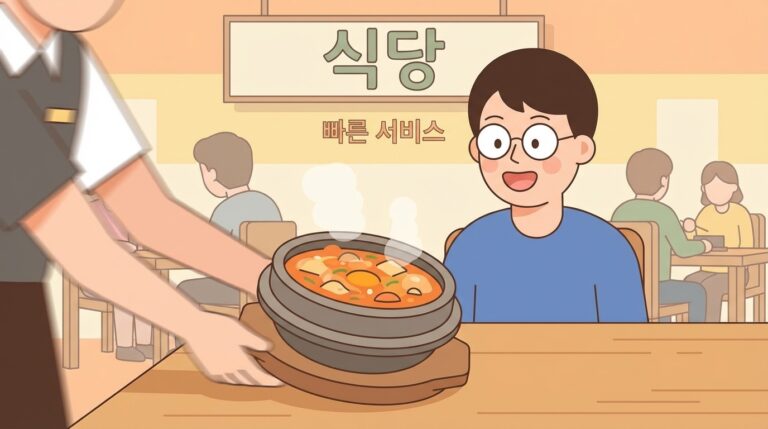
Imagine stepping into a bustling Gukbap (hot soup with rice) restaurant in the heart of Seoul during the lunch rush. You sit down, the waiter takes your order, and you pull out your phone to check a quick message. Before you can even finish typing a sentence—bam!—a boiling hot stone pot of soup is placed right in front of you. Five minutes? Sometimes it feels like five seconds!
Welcome to the magic of Korea’s Bbali-bbali (빨리빨리 – hurry, hurry) culture.
If you’ve ever watched a K-Drama, you’ve probably seen characters snip their noodles with scissors and start eating aggressively just seconds after sitting down. As a foreigner, this hyper-fast dining experience can feel both amazing and overwhelming. What do you say when your food arrives before you’ve even taken off your coat?
Today, we are going to learn the essential phrases you need to survive (and impress locals in) Korea’s lightning-fast food service. This post is built entirely on the real panic moments my expat students have shared with me. Let’s dive in!
Phase 2: Core Expressions Deep Dive
1. 벌써 나왔어요?
- Pronunciation: beolsseo nawasseoyo? [buhl-ssuh na-wa-ssuh-yo]
(Sound guide: ‘buhl’ sounds like ‘bull’ with a softer ‘u’, and ‘ssuh’ is like saying ‘duh’ but with an ‘ss’ sound.) - Meaning: Literal = Did it come out already? / Real nuance = Wow, that was incredibly fast!
- K-Culture Moment: You order an Americano at a busy cafe in Gangnam. You turn around to grab a napkin, and the barista is already calling your number. You say this with a look of pleasant surprise.
- Editor’s Insight: This isn’t a question demanding an answer. It’s an exclamation of praise! Koreans love efficiency, and restaurant owners feel immense pride when customers acknowledge their speed. It instantly makes you look like a socially aware insider.
- Situation Spectrum:
- Casual (Friends): ✅ (Say: 벌써 나왔어? beolsseo nawasseo?)
- Semi-formal (Coworkers/Staff): ✅
- Formal (Boss/Elders): ⚠️ (Better to say: 정말 빨리 나왔네요 – It came out really fast)
- 🤔 Think About It: Why do you think acknowledging someone’s speed is considered a compliment in Korea? In your culture, does fast service mean ‘good service’ or ‘rushed service’?
2. 얼마나 걸려요?
- Pronunciation: eolmana geollyeoyo? [uhl-ma-na guhl-lyuh-yo]
(Sound guide: ‘uhl’ sounds like the ‘u’ in ‘umbrella’.) - Meaning: Literal = How much does it take? / Real nuance = How long is the wait for the food?
- K-Culture Moment: You’re ordering delivery via a K-App, or you’re standing in a busy street food alley in Myeongdong. You need to know if you have time to wait because your K-Pop concert starts in 40 minutes!
- Editor’s Insight: Use this when you are in a rush. If the staff says “15 minutes,” in Korean restaurant time, it usually means 10. If they say “30 minutes,” the restaurant is completely packed.
- Situation Spectrum:
- Casual: ✅ (얼마나 걸려? eolmana geollyeo?)
- Semi-formal: ✅
- Formal: 🚫
- 🤔 Think About It: Koreans frequently ask this to plan their tight schedules. How important is “predictability of time” in your home country’s dining culture?
3. 금방 나와요
- Pronunciation: geumbang nawayo [geum-bang na-wa-yo]
(Sound guide: ‘geum’ rhymes with ‘boom’ but with a G. ‘bang’ sounds like a gunshot, but shorter!) - Meaning: Literal = It comes out shortly. / Real nuance = It will be ready in a second / It’s almost done.
- K-Culture Moment: You’re anxiously tapping your foot waiting for your Korean Fried Chicken takeout. The owner makes eye contact, smiles, and says, “금방 나와요~” to reassure you.
- Editor’s Insight: You will hear this more than you say it. It is the ultimate magic phrase restaurant owners use to soothe hungry, impatient customers. ‘Geumbang’ literally translates to ‘soon’, but in Bbali-bbali culture, it implies immediacy.
- Situation Spectrum:
- Casual: ✅
- Semi-formal: ✅
- Formal: ⚠️
- 🤔 Think About It: Notice the phrasing: “It comes out” (나와요) instead of “I will bring it.” Korean language often gives agency to the object (the food) rather than the subject (the server). Why do you think that is?
Phase 3: Textbook vs Real Korean
| Situation | 📖 Textbook Korean | 🗣️ Real Korean | 💡 Why is it different? |
|---|---|---|---|
| When the food arrives super fast | 음식이 아주 빨리 나왔네요. (The food came out very fast.) | 우와, 벌써 나왔어요? 대박! (Wow, it’s out already? Awesome!) | Expressing genuine surprise (‘벌써’) builds a better rapport with the staff than stating a dry fact. |
| Asking about wait time | 요리하는 데 시간이 얼마나 소요됩니까? (How much time is consumed to cook?) | 이거 얼마나 걸려요? (How long does this take?) | Shorter is always better in Bbali-bbali culture! Drop the formal verbs and keep it punchy. |
| Reassuring someone it won’t take long | 곧 음식이 준비될 것입니다. (The food will be prepared soon.) | 금방 나와요~ 조금만 기다리세요. (It’s coming right out~ Wait just a bit.) | Real Korean focuses on soothing the listener’s impatience using friendly, softening words like ‘조금만’ (just a little). |
Bottom Note: As a B1 learner, you don’t need to memorize long, robotic sentences. Capturing the vibe with words like ‘벌써’ (already) and ‘대박’ (awesome/jackpot) will make your Korean sound incredibly natural.
Phase 4: Cultural Context — K-Culture Deep Dive
4-1. Non-verbal Elements & ‘Nunchi’ (눈치)
When dining in a fast-paced Korean restaurant during lunch hour, your Nunchi (the subtle art of reading the room) is crucial.
– The Chopstick Setup: While waiting those glorious 5 minutes for the food, it is customary for the youngest or lowest-ranking person at the table to distribute the utensils, napkins, and pour the water. Do this proactively!
– Eat while it’s boiling: Korean stews (Jjigae) are served boiling hot in stone pots. The cultural expectation is to start eating immediately. Don’t wait 10 minutes for it to cool down while talking; dig in right away to show appreciation for the chef’s timing.
4-2. K-Food & Travel Connection
Have you ever seen a K-Drama scene set at a highway rest stop (휴게소)? Characters order Udon noodles, and the bowl slides out onto the counter before they even put their credit card back in their wallet.
In Korea, High Turnover Rate (회전율) is the lifeblood of affordable restaurants. Because the profit margins on a $7 bowl of soup are low, the restaurant needs customers to eat and leave quickly. This is why the service is fast, the chairs aren’t always padded, and the vibe is energetic. The speed isn’t about rushing you out rudely; it’s a mutually agreed-upon social contract: “We give you hot, cheap, delicious food instantly, and you eat and go about your busy day.”
Phase 5: Real-Life Roleplay Scenario
Setting: Friday, 12:15 PM. A packed Gukbap (soup rice) restaurant near Gangnam Station. Office workers with company lanyards are everywhere. The noise of clinking bowls and chatter fills the air.
Characters:
– YOU: An expat working in Korea for 6 months. You only have a 1-hour lunch break.
– Minsu (32): Your Korean coworker. He walks fast, eats fast, and loves efficiency.
Minsu: 여기 자리 났다! 빨리 앉아요.
(yeogi jari natda! ppalli anjayo.)
[Here’s an empty seat! Sit down quickly.]
(🎭 Stage Direction: Minsu grabs the menu, barely looks at it, and raises his hand high.)
Minsu: 이모님! 여기 돼지국밥 두 그릇이요!
(imonim! yeogi dwaejigukbap du geureusiyo!)
[Auntie! Two bowls of pork soup rice here!]
YOU: Minsu, there are so many people. Do you think we will make it back to the office by 1 PM?
Minsu: 에이, 걱정 마요. 여긴 국밥이라서 금방 나와요.
(ei, geokjeong mayo. yeogin gukbabiraseo geumbang nawayo.)
[Hey, don’t worry. It’s Gukbap here, so it comes out right away.]
(🎭 Stage Direction: Exactly 3 minutes later, the waitress slides two violently boiling stone pots onto your table along with 5 side dishes.)
Waitress: 뜨거우니까 조심하세요~ 맛있게 드세요!
(tteugeounikka josimhaseyo~ masitge deuseyo!)
[It’s hot, so be careful~ Enjoy your meal!]
🔀 Your Turn! How should you react to the waitress?
– A) “감사합니다. 잘 먹겠습니다!” (Thank you. I will eat well!)
– B) “우와, 벌써 나왔어요? 대박!” (Wow, it’s out already? Awesome!)
– C) “왜 이렇게 빨리 나와요? 이상해요.” (Why did it come out so fast? It’s weird.)✅ Best Choice: B — While A is perfectly polite and correct, B is the “Insider” choice. Acknowledging the speed makes the hard-working restaurant staff smile.
⚠️ Choice C Analysis: Never say it’s weird! In Western cultures, super-fast food might mean it was microwaved, but in Korea, it just means their kitchen system is a well-oiled machine.
Phase 6: 10-Second Shadowing Drill
Let’s practice the magic reaction phrase. Pay attention to the pauses (/) and the emotion!
😲 우와! / 벌써 / 나왔어요? / 진짜 빠르다!
(uwa! / beolsseo / nawasseoyo? / jinjja ppareuda!)
[Wow! / It came out / already? / That’s really fast!]
Pro-tip: Raise your pitch slightly on “벌써” (already) to sound genuinely impressed, not suspicious!
Phase 7: K-Culture Mini Dictionary
| Korean | Romanization | English | Cultural Context |
|---|---|---|---|
| 빨리빨리 | bbali-bbali | Hurry, hurry | The foundational philosophy of modern Korean service culture. |
| 이모님 | i-mo-nim | Auntie | A polite, affectionate term used for middle-aged female restaurant staff. |
| 회전율 | hoe-jeon-yul | Turnover rate | The speed at which tables empty and fill. Crucial for K-restaurants! |
| 눈치 | nun-chi | Social sense | The ability to read the room (e.g., knowing not to linger at a busy cafe). |
| 포장 | po-jang | Takeout / Packing | What you ask for if you couldn’t eat fast enough and need to go. |
Phase 8: Traveler’s Survival Kit
If you are traveling in Korea, you will definitely experience the 5-minute food phenomenon at rest stops, food courts, or busy markets. Here are your survival phrases!
🆘 Survival Phrases for Fast Dining
– 🇰🇷 “이거 얼마나 걸려요?” (igeo eolmana geollyeoyo?) – How long will this take?
– 🇰🇷 “남은 거 포장해 주세요.” (nameun geo pojanghae juseyo.) – Please pack the leftovers to go. (For when the Bbali-bbali pace beats you!)
– 🇰🇷 “영수증 버려주세요.” (yeongsujeung beoryeojuseyo.) – Please throw away the receipt. (Saves time at the counter!)📌 Editor’s Travel Note
– Bells on Tables: In most fast-paced Korean restaurants, you don’t need to make eye contact to order. Just press the call button (벨 – bell) on your table!
– No Tipping: Fast service doesn’t mean you need to tip. Tipping is not practiced in Korea and might actually cause confusion.
Phase 9: Critical Thinking — “One Step Deeper”
Food & Identity: The Roots of Bbali-Bbali
Many foreigners mistake Korea’s Bbali-Bbali culture for mere impatience. But let’s think deeper. Korea underwent rapid industrialization in the 1970s and 80s. The entire nation was in a rush to rebuild and grow, and this urgency naturally seeped into the dining culture. Furthermore, Korean food culture is highly communal. Serving food quickly while it is piping hot is considered the ultimate form of hospitality and respect for the diner. The restaurant isn’t rushing you out; they are honoring your time in a busy, modern world.
💬 Your Turn: Does your culture value taking your time over a meal, or eating efficiently to get back to work? Let me know in the comments!
Phase 10: FAQ & Avoiding Misunderstandings
Q: Can I yell “빨리빨리 주세요! (Give it to me quickly!)” to the waiter?
NO! While Koreans value fast service, demanding it aggressively is considered extremely rude. Let the system do its work. If you must ask, use the polite phrase we learned: “혹시 얼마나 걸려요?” (By any chance, how long will it take?).
Q: If the food comes out fast, do I have to eat it fast?
Unless there is a massive line of people glaring at you through the window (where your Nunchi should kick in), you can eat at your own pace. Just don’t sit chatting for an hour after your plates are empty during peak lunch hours.
❌ Common Mistake: Leaving a tip because the food came out in 3 minutes.
✅ Do This Instead: Say “잘 먹었습니다!” (I ate well!) loudly and cheerfully as you walk out. That is the Korean equivalent of a tip!
Phase 11: Summary & Action Items
One-Liner Summary: In Korea, fast food service is a sign of good hospitality—embrace it by acting pleasantly surprised with “벌써 나왔어요?”
Action Missions:
– 🥉 Bronze (Solo): Stand in front of your mirror and practice acting surprised: “우와! 벌써 나왔어요?”
– 🥈 Silver (Online): Drop a comment on a Korean food vlog on YouTube using the phrase: “한국 식당은 진짜 금방 나와요!” (Korean restaurants really serve food quickly!)
– 🥇 Gold (Real Life): Next time you visit a Korean restaurant or order from a K-food food truck, time your order. When it arrives, use the phrase to the staff!
🎬 K-Culture Mission: Watch any K-Drama episode featuring a meal scene (like a Pocha or K-BBQ spot). Count how many seconds it takes from the characters sitting down to the food appearing on screen!
Did you enjoy today’s lesson? Have you ever experienced Korea’s crazy fast delivery or restaurant service? Share your shock in the comments below!👇
Phase 12: Interactive Quiz
1. Situational Judgment: You are at a busy K-BBQ restaurant. You ordered cold noodles (Naengmyeon) to finish your meal, but your train leaves in 20 minutes. What is the most polite way to check on the food?
– A) 아줌마! 빨리빨리!! (Ajumma! Bbali-bbali!!)
– B) 저기요, 혹시 냉면 얼마나 걸려요? (Excuse me, by any chance, how long will the Naengmyeon take?)
– C) 냉면 벌써 나왔어요? (Did the Naengmyeon come out already?)
2. True or False: In Korea, if a restaurant brings your food out in 4 minutes, it implies they want you to leave immediately.
3. Fill in the blank:
Staff: “주문하신 김치찌개 ______ 나왔습니다!” (The Kimchi Jjigae you ordered is ______ ready!)
– A) 금방 (soon/right away)
– B) 눈치 (nunchi)
(Answers: 1: B – A is rude, C makes no sense if it hasn’t arrived. / 2: False – It’s just their standard of good service! / 3: A)
Frequently Asked Questions (FAQ)
Q: What does "벌써 나왔어요?" mean in Korean and how do you pronounce it?
A: In Korean, "벌써 나왔어요?" is pronounced [beolsseo nawasseoyo? [buhl-ssuh na-wa-ssuh-yo] and means: Literal = Did it come out already? / Real nuance = Wow, that was incredibly fast!
Q: What does "얼마나 걸려요?" mean in Korean and how do you pronounce it?
A: In Korean, "얼마나 걸려요?" is pronounced [eolmana geollyeoyo? [uhl-ma-na guhl-lyuh-yo] and means: Literal = How much does it take? / Real nuance = How long is the wait for the food?
Q: What does "금방 나와요" mean in Korean and how do you pronounce it?
A: In Korean, "금방 나와요" is pronounced [geumbang nawayo [geum-bang na-wa-yo] and means: Literal = It comes out shortly. / Real nuance = It will be ready in a second / It's almost done.







