

Hello! I’m your Daily Hangul Editor.
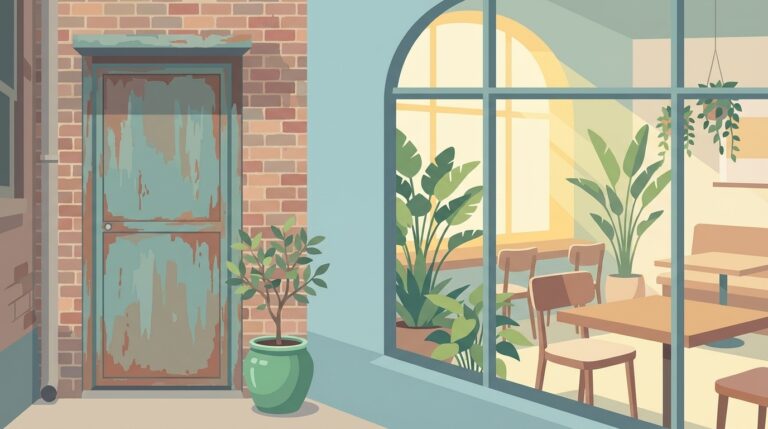
Imagine this: You’re wandering around the trendy alleys of Seongsu-dong or Euljiro. Your map app says you’ve “Arrived,” but all you see is a rusted metal door, an old printing shop, or a sketchy staircase. You double-check your phone. Did you get lost? Suddenly, a stylishly dressed Korean couple opens that heavy iron door, and boom—you hear the faint beat of an indie K-R&B track and catch the scent of roasted coffee beans and croffles.
Welcome to the world of Korea’s 인스타 감성 카페 (Insta-aesthetic cafes).
If you’ve watched any modern K-Drama, you know that cafes aren’t just places to grab a quick caffeine fix. They are social hubs, date spots, study rooms, and most importantly, the ultimate photo studios. But finding these hidden gems and navigating them requires a specific set of linguistic and cultural skills.
If you only know how to say “아메리카노 하나 주세요 (One Americano, please),” you’re missing out on half the fun. Today, we’re going beyond the textbook so you can find the best seat, order the most photogenic dessert, and blend right in with the locals!
Phase 2: Core Expressions Deep Dive
Let’s upgrade your cafe vocabulary to B2 level. Here are the phrases you’ll actually hear inside these aesthetic spaces.
1. 감성 미쳤다 (The vibe is insane!)
- Pronunciation: [gam-seong mi-chyeot-da]
- Sound-alike guide: ‘gam-sung’ sounds like a slightly softer ‘Samsung’ with a G. ‘mi-chyeot-da’ sounds like “me-chut-dah.”
- Meaning:
- Literal: The sensibility went crazy.
- Real Nuance: The aesthetic/vibe here is absolutely incredible.
- K-Culture Moment: You walk into a cafe that looks like an abandoned warehouse but features a breathtaking indoor waterfall and minimalist furniture. This is the exact phrase your Korean friend will whisper in awe.
- Editor’s Insight: The word ‘감성 (gam-seong)’ technically means ‘sensibility’ or ‘emotion’. But in modern Korean slang, it translates perfectly to ‘aesthetic’ or ‘vibe’. It’s the highest compliment you can give to a space.
- Situation Spectrum:
- Casual (Friends): ✅
- Semi-formal (Coworkers): ⚠️ (A bit too slangy, maybe just say “분위기 정말 좋네요”)
- Formal (Boss/Elders): 🚫
- 🤔 Think About It: Why do Koreans use the word “crazy” (미쳤다) to describe something exceptionally good? Does your native language have a similar dramatic expression for things that are visually pleasing?
2. 사진 잘 나오는 자리 (A spot with good lighting/background for photos)
- Pronunciation: [sa-jin jal na-o-neun ja-ri]
- Sound-alike guide: sah-jeen jal nah-oh-nun jah-ree.
- Meaning:
- Literal: A seat where pictures come out well.
- Real Nuance: The most “Instagrammable” spot in the cafe.
- K-Culture Moment: Before ordering, you and your friend are scanning the room. You spot a table next to a huge vintage window with natural sunlight pouring in. That is the 자리 (seat).
- Editor’s Insight: In Korea, securing the best seat happens before ordering. The verb “나오다 (to come out)” is uniquely used for photos. We don’t say “a place to take good photos,” we say “a place where photos come out well.”
- Situation Spectrum:
- Casual (Friends): ✅
- Semi-formal (Coworkers): ✅
- Formal (Boss/Elders): ⚠️ (They might not care about photos!)
- 🤔 Think About It: Does the passive framing of “photos coming out well” rather than “taking good photos” reflect a different cultural perspective on photography?
3. 여기 시그니처 메뉴가 뭐예요? (What’s your signature menu?)
- Pronunciation: [yeo-gi si-geu-ni-cheo me-nyu-ga mwo-ye-yo?]
- Meaning:
- Literal: What is the signature menu here?
- Real Nuance: What is the unique, highly photogenic drink that everyone comes here for?
- K-Culture Moment: You approach the counter. The menu has no pictures, just minimalist black English text on white paper. You don’t want a boring latte; you want the drink with the tiny teddy bear ice cube or the cloud of cotton candy on top.
- Editor’s Insight: Most indie cafes pride themselves on a “Signature” item. It’s usually a highly stylized cream latte (아인슈페너) or a unique fusion dessert. If you’re lost, just ask this!
- Situation Spectrum:
- Casual / Semi-formal / Formal: ✅ (Totally polite to use with the staff!)
- 🤔 Think About It: Why has English vocabulary like “Signature (시그니처)” become so dominant in Korean cafe culture instead of a native Korean word?
Phase 3: Textbook vs. Real Korean
How do we transition from the stiff language of textbooks to the trendy language of Seoul’s youth?
| Situation | 📖 Textbook Korean | 🗣️ Real Korean | 💡 Why is it different? |
|---|---|---|---|
| Expressing awe at the interior | 이 카페는 정말 예쁩니다. (This cafe is very pretty.) | 와, 여기 감성 미쳤다! / 분위기 대박. (Wow, the vibe is crazy / Jackpot.) | Young Koreans prefer highly expressive, slightly dramatic slang to show genuine excitement. |
| Asking for recommendations | 가장 맛있는 커피를 주세요. (Please give me the most delicious coffee.) | 시그니처가 뭐예요? / 인스타에서 본 이거 주세요. (What’s the signature? / Give me this one I saw on IG.) | Visual appeal (“Insta-worthy”) is often just as important as taste in cafe culture. |
| Securing a table | 의자에 앉아도 됩니까? (May I sit on the chair?) | 우리 자리부터 잡자. (Let’s grab a seat first.) | “자리 잡다” implies claiming your territory before heading to the ordering counter. |
Bottom Note: You don’t need to use extreme slang, but sprinkling words like “감성 (vibe)” and “시그니처 (signature)” will immediately make your Korean sound more natural and B2-appropriate.
Phase 4: Cultural Context — K-Culture Deep Dive
4-1. The Unspoken Rules of Cafe “Nunchi”
In Korea, 눈치 (Nunchi)—the ability to read the room—is crucial in cafes.
When you walk in, do not wait at the door to be seated! Most cafes are strictly self-seating. The ultimate display of Nunchi is scanning the room, making eye contact with a friend, and silently speed-walking to that one empty table by the window before someone else gets it.
Also, The “Phone Eats First” Rule: Do not touch the drink until the designated photographer of your group has taken photos from at least three different angles. It’s an unspoken law of friendship.
4-2. The “High-Trust” Society (K-Travel Connection)
If you’ve watched travel vlogs about Korea, you’ve probably seen this phenomenon. You find a seat, but your friend needs to go order with you. What do you do? You leave your $1,000 iPhone, your laptop, or your designer bag on the table and walk away.
In Korea, leaving personal belongings on a table is the universal sign for “This seat is taken.” It’s perfectly safe, and stealing in a cafe is practically unheard of. If you leave a tissue, people might take the tissue. If you leave a MacBook, your seat is safe for hours.
Phase 5: Interactive Roleplay Scenario
Setting: Saturday afternoon, Seongsu-dong (Seoul’s Brooklyn). The streets are packed. You and your Korean friend are standing in front of what looks like an abandoned shoe factory.
Characters:
– YOU: An exchange student who really wants to update their Instagram grid.
– Minji (25): Your Korean language exchange partner, a trendy local who knows all the hot spots.
(The Dialogue)
Minji: 야, 우리 다 왔어. 지도 보니까 여긴데?
(Ya, uri da wasseo. jido bonikka yeoginde?)
[Hey, we’re here. Looking at the map, it’s here.]
YOU: 진짜요? 간판이 없는데요? 그냥 폐공장 아니에요?
(Jinjja-yo? Ganpan-i eom-neun-de-yo? Geu-nyang pye-gong-jang a-ni-e-yo?)
[Really? There’s no sign? Isn’t this just an abandoned factory?]
Minji: 에이~ 이게 요즘 성수 감성이지! 들어가자.
(Ei~ i-ge yo-jeum Seong-su gam-seong-i-ji! Deu-reo-ga-ja.)
[Hey~ This is the Seongsu vibe these days! Let’s go in.]
(🎭 Stage Direction: Minji pushes a rusty metal door. Inside is a gorgeous, plant-filled oasis with jazz music playing.)
YOU: 와… 대박. 밖에서 볼 때랑 완전 다르네요.
(Wa… dae-bak. Bakk-e-seo bol ttae-rang wan-jeon da-reu-ne-yo.)
[Wow… Jackpot. It’s completely different from the outside.]
Minji: 그치? 일단 자리부터 잡자. 사람 짱 많아.
(Geu-chi? Il-dan ja-ri-bu-teo jap-ja. Sa-ram jjang man-a.)
[Right? Let’s grab a seat first. There are so many people.]
YOU: 창가 쪽에 사진 잘 나오는 자리 하나 비었어요! 저기 앉아요.
(Chang-ga jjog-e sa-jin jal na-o-neun ja-ri ha-na bi-eoss-eo-yo! Jeo-gi an-ja-yo.)
[There’s an empty seat by the window where photos come out well! Let’s sit there.]
Minji: 나이스! 나 화장실 좀 다녀올 테니까, 네가 먼저 가서 주문할래?
(Na-i-seu! Na hwa-jang-sil jom da-nyeo-ol te-ni-kka, ne-ga meon-jeo ga-seo ju-mun-hal-lae?)
[Nice! I’m going to run to the restroom, do you want to go order first?]
YOU: 네, 알겠어요. 뭐 마실래요?
(Ne, al-gess-eo-yo. Mwo ma-sil-lae-yo?)
[Yes, okay. What do you want to drink?]
Minji: 난 아아! (아이스 아메리카노). 내 지갑 여기 두고 갈게.
(Nan a-a! Nae ji-gap yeo-gi du-go gal-ge.)
[I’ll have an Iced Americano! I’ll leave my wallet right here.]
(🎭 Stage Direction: Minji drops her wallet and phone on the table and walks away.)
🔀 Your Turn! How do you react to her leaving her valuables?
– A) Panic and shove her wallet and phone into your pocket to protect them while you order.
– B) Leave them exactly where they are and casually walk to the counter to order.
– C) Run after her and tell her she forgot her things.✅ Best Choice: B — Reason: In Korea, leaving valuables on the table is the standard way to claim a seat while you order. Nobody will touch them!
⚠️ Choice A & C Analysis: Doing A will make Minji think you stole her things when she returns! Doing C will make you lose your precious window seat to someone else.
Bonus Scenario: At the Counter
YOU: 안녕하세요. 혹시 여기 시그니처 메뉴가 뭐예요?
(An-nyeong-ha-se-yo. Hok-si yeo-gi si-geu-ni-cheo me-nyu-ga mwo-ye-yo?)
[Hello. By any chance, what is the signature menu here?]
Staff: 저희는 ‘흑임자 크림 라떼’가 제일 잘 나갑니다.
(Jeo-hui-neun ‘heug-im-ja keu-rim ra-tte’ga je-il jal na-gap-ni-da.)
[Our ‘Black Sesame Cream Latte’ is the most popular.]
YOU: 아, 그럼 아이스 아메리카노 하나랑 흑임자 라떼 하나 주세요!
(A, geu-reom a-i-seu a-me-ri-ka-no ha-na-rang heug-im-ja ra-tte ha-na ju-se-yo!)
[Ah, then one Iced Americano and one Black Sesame Latte, please!]
Phase 6: 10-Second Shadowing Drill
Time to sound like a local! Pay close attention to the intonation marks (/) and pauses.
😊 Bright & Polite (At the counter):
안녕하세요! / 혹시 여기 / 시그니처 메뉴가 / 뭐예요?
(An-nyeong-ha-se-yo! / hok-si yeo-gi / si-geu-ni-cheo me-nyu-ga / mwo-ye-yo?)🤩 Excited & Impressed (To your friend):
와, / 여기 진짜 / 감성 / 미쳤다!
(Wa, / yeo-gi jin-jja / gam-seong / mi-chyeot-da!)
Phase 7: K-Culture Mini Dictionary
| Korean Word | Romanization | English Meaning | Cultural Context |
|---|---|---|---|
| 감성 | gam-seong | Aesthetic / Vibe | The visual mood of a place. Essential for Instagram. |
| 힙지로 | Hip-ji-ro | Hip + Euljiro | A nickname for the Euljiro neighborhood, famous for hidden, retro-style cafes. |
| 웨이팅 | we-i-ting | Waiting (in line) | The agonizing but necessary line outside a trendy spot. |
| 자리 맡다 | ja-ri mat-da | To save a seat | The act of putting your bag/phone down before ordering. |
| 카공족 | ka-gong-jok | Cafe studying tribe | People who study at cafes. Beware: aesthetic cafes often ban them to keep table turnover high! |
Phase 8: Traveler’s Survival Kit 🚜
If you’re cafe-hopping in Seoul, keep these survival phrases handy!
🆘 Survival Phrase #1: Navigating the Line
– 🇰🇷 “지금 웨이팅 있어요?” (ji-geum we-i-ting iss-eo-yo?)
– 🗣️ Meaning: Is there a wait right now?
– 💡 Pro Tip: Look for a tablet near the door! Many Korean cafes use an app called “Catch Table (캐치테이블)” to manage queues. You input your phone number (or email) and it texts you when it’s your turn.🆘 Survival Phrase #2: Power Needs
– 🇰🇷 “혹시 콘센트 있는 자리 있나요?” (hok-si kon-sen-teu it-neun ja-ri it-na-yo?)
– 🗣️ Meaning: Is there a seat with a power outlet (socket)?📌 Editor’s Travel Note:
– Navigation: Google Maps doesn’t work well for walking directions in Korea. Always download KakaoMap or Naver Map to find those hidden cafes.
– Payment: Korea is practically cashless. Cafes prefer credit cards or mobile pay (like Apple Pay or local equivalents).
– Tipping: ZERO. Do not leave a tip in a jar or on the table. It will just confuse the barista!
Phase 9: Critical Thinking Corner — “Going Deeper”
Space and Identity: Why are Koreans obsessed with “Aesthetic” Cafes?
Seoul is a hyper-dense megacity where most people, especially young adults, live in relatively small apartments or shared living spaces (like one-rooms). Because private living spaces are tight, cafes serve as the “extended living room” of the Korean public.
Paying $5 or $6 for a beautifully crafted cream latte isn’t just about buying caffeine; it’s the “admission ticket” to rent a beautifully designed space for a few hours. It represents 소확행 (So-hwak-haeng)—a small, certain happiness. In a highly competitive society, curating an aesthetic experience and sharing it online provides a sense of control, relaxation, and self-expression.
💬 Your Turn: How does the cafe culture in your home country compare? Is a cafe mostly for “grabbing a quick coffee” or is it an “experience”? Let us know in the comments!
Phase 10: FAQ & Avoiding Common Mistakes
Q: Is it rude to take too many photos in a cafe?
A: Generally, no! Taking photos is expected. However, it is considered bad manners to use a loud, professional camera with a flash, or to constantly block the pathways. Keep it to your phone, and be mindful of not getting other customers’ faces in your shot.
Q: Do I need to clean up my own table?
A: Yes! In 95% of Korean cafes, you are expected to return your tray and empty cups to the “Return” (반납 / ban-nap) counter when you leave.
❌ Common Mistake #1: Waiting at the door for the staff to seat you.
✅ Do This Instead: Walk right in, scan the room, put your bag on an empty table, and then go to the counter to order.❌ Common Mistake #2: Trying to order “Iced Coffee” (아이스 커피).
✅ Do This Instead: In Korea, iced drip coffee is rare. Always specify 아이스 아메리카노 (Iced Americano) or use the beloved abbreviation: 아아 (Ah-ah).
Phase 11: Summary & Action Items
📌 One-Liner Summary: In Korea’s aesthetic cafes, grab your table first, ask for the signature menu, and don’t forget to appreciate the “gam-seong (vibe)”!
🚀 Your Action Missions:
– 🥉 Bronze: Say “와, 여기 감성 미쳤다!” out loud while looking at a pretty picture of a cafe online.
– 🥈 Silver: Go to Instagram, search the hashtag #성수카페 (Seongsu cafe) or #카페투어 (Cafe tour), and leave a Korean comment on a post.
– 🥇 Gold: On your next trip to Korea (or at your local Korean cafe), use “여기 시그니처 메뉴가 뭐예요?” to order your drink!
🇰🇷 K-Culture Mission: Open Naver Map or KakaoMap, search for a cafe in Hongdae or Seongsu, and look through the photo reviews. Try to spot how many photos feature the “Signature” drinks!
Phase 12: Interactive Quiz 🧠
Test your new B2-level cafe knowledge!
1. You find a great table in a crowded cafe, but you need to go order. What is the most “Korean” way to save your seat?
– A) Stand by the table and yell your order to the counter.
– B) Leave your phone or jacket on the chair and walk to the counter.
– C) Ask a stranger to guard your seat for 5 minutes.
2. Fill in the blank: Wow, the interior here is amazing! 여기 _____ 미쳤다!
– A) 날씨 (nal-ssi / weather)
– B) 감성 (gam-seong / vibe/aesthetic)
– C) 공장 (gong-jang / factory)
3. True or False: If the cafe looks like a rundown, rusty warehouse from the outside with no obvious signage, you should definitely turn around and leave.
– True or False?
(Scroll down for answers!)
Answers: 1. (B) – Leaving valuables is the ultimate Korean flex of trust. / 2. (B) – Gam-seong! / 3. False – That rusty warehouse is probably the hottest, most aesthetic cafe in town!
Frequently Asked Questions (FAQ)
Q: What does "감성 미쳤다 (The vibe is insane!)" mean in Korean and how do you pronounce it?
A: In Korean, "감성 미쳤다 (The vibe is insane!)" is pronounced [gam-seong mi-chyeot-da] and means: a key conversational Korean expression covered in this lesson.
Q: What does "사진 잘 나오는 자리 (A spot with good lighting/background for photos)" mean in Korean and how do you pronounce it?
A: In Korean, "사진 잘 나오는 자리 (A spot with good lighting/background for photos)" is pronounced [sa-jin jal na-o-neun ja-ri] and means: a key conversational Korean expression covered in this lesson.
Q: What does "여기 시그니처 메뉴가 뭐예요? (What's your signature menu?)" mean in Korean and how do you pronounce it?
A: In Korean, "여기 시그니처 메뉴가 뭐예요? (What's your signature menu?)" is pronounced [yeo-gi si-geu-ni-cheo me-nyu-ga mwo-ye-yo?] and means: Literal: What is the signature menu here?







