

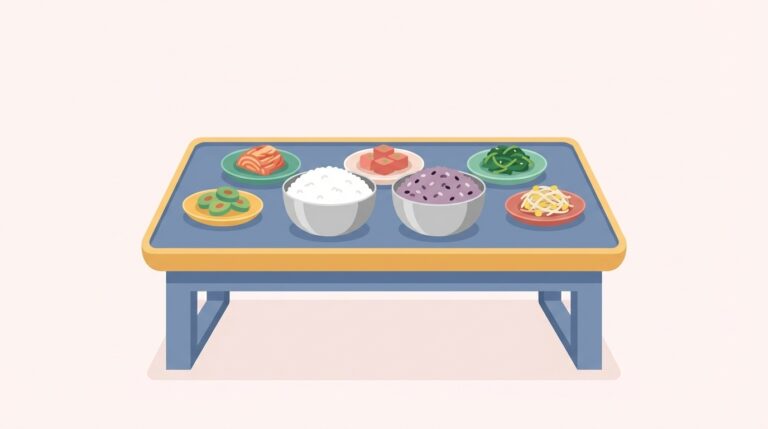
Phase 1: Welcome to the Korean Table
Hello there! I’m your lead editor and cultural navigator at Daily Hangul.
Picture this: You are watching a classic K-Drama family dinner scene. The mother angrily slams a bowl of rice onto the table in front of her rebellious son. But wait—why is the rice purple?
If you’ve ever eaten at an authentic Korean restaurant or stayed with a Korean family, you might have noticed that Korean rice isn’t always the fluffy, snowy white mountain you see in sushi. Sometimes it’s purple, sometimes it’s studded with beans, and sometimes it looks like a rustic mix of grains.
Understanding the difference between 흰 쌀밥 (White Rice) and 잡곡밥 (Multigrain Rice) isn’t just about ordering food; it’s about understanding Korean history, modern health trends, and even how a Korean mother shows her love. Today, as B2 learners, we are moving past basic vocabulary like “밥 주세요 (Give me rice)” and diving deep into the cultural nuances of the Korean bowl. Grab your spoon, and let’s dig in!
Phase 2: Core Expressions Deep Dive
1. 흰 쌀밥 (Huin Ssalbap)
- Pronunciation: huin ssal-bap [Hween-ssal-bop]
(Tip: ‘Huin’ sounds like a light, breathy sigh “hweeen”, and ‘ssal’ has a tense double ‘ss’ sound—hiss like a snake before saying ‘al’.)- Meaning: White rice (Literal: White uncooked-rice cooked-rice)
- K-Culture Moment: Imagine a steaming bowl of glossy, pearly white rice topped with a single piece of red Kimchi or a slice of fried Spam. In K-Food culture, this is the ultimate comfort food.
- Editor’s Insight: To Koreans, Huin ssalbap represents pure, unadulterated taste. It’s the perfect blank canvas for salty, spicy side dishes (like marinated crabs or spicy pork). However, in modern times, it’s often viewed as a “guilty pleasure” carb.
- Situation Spectrum:
- Everyday dining / Comfort food: ✅
- Health-conscious meals: 🚫
- 🤔 Think About It: In the past, pure white rice was a symbol of immense wealth in Korea. Commoners couldn’t afford it and had to mix their rice with barley. How does the perception of “expensive food” change over time in your culture?
2. 잡곡밥 (Japgokbap)
- Pronunciation: jap-gok-bap [Chap-gok-bop]
(Tip: ‘Jap’ sounds almost like ‘chop’, meaning ‘mixed’.)- Meaning: Multigrain rice (Literal: Mixed grains rice)
- K-Culture Moment: You visit a Korean friend’s house. Their mom hands you a bowl of dark purple rice with black beans. If you leave the beans, expect a loving (but firm) scolding!
- Editor’s Insight: Japgokbap is the cornerstone of modern Korean “well-being” (건강/health) culture. The famous purple rice you see is actually a type of Japgokbap made by mixing white rice with black rice (흑미). It’s a symbol of care—making multigrain rice requires soaking the grains for hours, so it shows the cook put extra effort into your health.
- Situation Spectrum:
- Family meals / Healthy restaurants: ✅
- Pairing with delicate, subtle-flavored dishes: ⚠️ (The grains can overpower the taste)
- 🤔 Think About It: Why do you think K-Pop idols on diets often talk about switching to Japgokbap or Hyeonmibap (Brown rice) instead of cutting out rice entirely?
3. 밥심 (Bapsim)
- Pronunciation: bap-sim [Bop-sheem]
- Meaning: The strength/energy that comes from eating rice.
- K-Culture Moment: A coworker looks exhausted before a big presentation. You pat their shoulder and say, “한국인은 밥심이지! (Koreans run on rice-power! Let’s go eat).”
- Editor’s Insight: This word perfectly captures the Korean soul. It’s not just about calories; it’s the psychological comfort and resilience gained from a proper Korean meal.
Phase 3: Textbook vs. Real Korean
| Situation | 📖 Textbook Korean | 🗣️ Real Korean | 💡 Why the difference? |
|---|---|---|---|
| Ordering standard white rice | “흰 쌀밥 한 그릇 주시겠어요?” (Could I have a bowl of white rice?) | “사장님, 여기 공기밥 하나요!” (Boss, one gonggi-bap here!) | We rarely say “white rice” at restaurants. We order by the standard stainless steel bowl it comes in, called a gonggi-bap (공기밥). |
| Asking if they have healthy rice | “잡곡밥이 있습니까?” (Do you have multigrain rice?) | “혹시 현미밥이나 흑미밥 있어요?” (Do you happen to have brown or black rice?) | People usually ask for specific types of healthy rice rather than the broad term “multigrain.” |
| Expressing hunger | “저는 배가 아주 고픕니다.” (I am very hungry.) | “아, 밥 당긴다.” (Ah, I’m craving rice/a meal.) | “당기다” is a B2-level native-sounding verb for “craving.” Notice how “bap” means both ‘rice’ and ‘a meal’. |
Phase 4: Cultural Context — K-Culture Deep Dive
4-1. Non-verbal Etiquette at the Table
No matter what kind of rice you are eating, there is one golden rule in Korea: Do not lift your rice bowl off the table.
In countries like Japan or China, lifting the bowl closer to your mouth is standard. In Korea, historically, lifting your bowl was seen as something beggars did, or considered “light and frivolous.” Keep the bowl firmly on the table and use your long-handled Korean spoon (숟가락) to bring the rice to your mouth.
4-2. K-Food Connection: The Art of the K-BBQ Finale
If you’ve watched K-Dramas, you know that eating Korean BBQ (Samgyeopsal) isn’t just about the meat. It’s a structured event.
During the meat phase, some people skip rice entirely, while others need Huin ssalbap to wrap inside their lettuce leaf (쌈). But the real K-Food magic happens at the very end: K-Dessert.
Koreans jokingly call Fried Rice (볶음밥 – Bokkeumbap) the “traditional Korean dessert.” After eating all the meat, you ask the staff to fry rice directly on the greasy grill with leftover kimchi and seaweed. Never order multigrain rice for this—it must be white rice to absorb all those savory oils perfectly!
Phase 5: Real-Life Roleplay Scenario
Setting: Friday night, 7:30 PM. A bustling, smoke-filled Samgyeopsal joint near Gangnam Station. You are with your Korean coworkers.
Characters:
– YOU: A foreign professional who wants to impress the team with native-level etiquette and Korean skills.
– Min-su (32): Your friendly Korean coworker who is acting as the grill-master today.
Dialogue:
Min-su: 고기 다 익었다! 먼저 드세요. 아, 혹시 밥 같이 드실래요? 🥩
(Gogi da igeotda! Meonjeo deuseyo. Ah, hoksi bap gachi deusillaeyo?)
[The meat is fully cooked! Go ahead and eat. Oh, by the way, do you want to eat rice with it?]
(🎭 Stage Direction: Min-su holds his tongs, waiting to call the waiter over.)
🔀 YOUR TURN! How do you respond?
– A) “네, 흰 쌀밥 주세요.” (Yes, give me white rice.)
– B) “아니요, 저는 이따가 볶음밥 먹을게요!” (No, I’ll eat the fried rice later!)
– C) “혹시 여기 잡곡밥 있나요? 다이어트 중이라서요.” (Do they have multigrain rice here? I’m on a diet.)✅ Best Choice: B — If you say this, your Korean coworkers will gasp in admiration. Knowing to save room for the “Bokkeumbap finale” proves you truly understand the K-BBQ timeline!
⚠️ Choice A Analysis: It’s totally fine and grammatically correct, but it sounds a bit textbook. Saying “공기밥 하나 추가할게요” (I’ll add one gonggibap) sounds much more natural.
⚠️ Choice C Analysis: While healthy, most standard Korean BBQ joints only serve white rice. Asking for diet multigrain rice at a pork belly restaurant might earn you a few confused chuckles!
Phase 6: 10-Second Shadowing Drill
Let’s practice ordering like a true local at a restaurant. Pay attention to the pauses (/) and the intonation!
😊 사장님~! / 여기 / 공기밥 하나랑 / 찌개 주세요!
(sajangnim~! / yeogi / gonggibap hanarang / jjigae juseyo!)
“Boss! / Over here / one bowl of rice and / stew, please!”
Pro tip: Drag out the “nim~” slightly to sound friendly and get their attention over the noisy restaurant!
Phase 7: K-Culture Mini Dictionary
| Korean | Romanization | English | Context |
|---|---|---|---|
| 공기밥 | gonggibap | Bowl of rice | The standard stainless steel bowl with a lid used to serve rice in restaurants. |
| 누룽지 | nurungji | Scorched rice | The crispy layer of rice stuck to the bottom of a traditional stone pot. Often boiled with water as a soothing after-meal drink. |
| 흑미밥 | heukmibap | Black rice | White rice mixed with black rice grains, resulting in a beautiful purple color. Very common in homes. |
| 밥도둑 | bap-doduk | Rice thief | A side dish so incredibly delicious and salty (like soy-marinated crab) that it makes you “steal” (eat) huge amounts of rice without realizing it. |
Phase 8: Traveler Survival Kit 🆘
If you have dietary restrictions or specific health preferences, these phrases are lifesavers when traveling in Seoul:
🆘 Survival Phrases
– 🇰🇷 “혹시 현미밥으로 바꿀 수 있나요?” (hoksi hyeonmibabeuro bakkul su innayo?)
– 🗣️ Meaning: “Is it possible to change this to brown rice?”
– 📍 Where to use: Salad shops, Poke bowl places, premium K-food restaurants.
- 🇰🇷 “밥은 반 공기만 주세요.” (babeun ban gonggiman juseyo.)
- 🗣️ Meaning: “Please only give me half a bowl of rice.”
- 📍 Where to use: When you want to reduce food waste or carbs.
📌 Editor’s Travel Note
– Rice Refills: In standard Korean diners (백반집 – Baekban-jib), side dishes (banchan) are infinitely refillable for free! However, rice (gonggibap) usually costs an extra 1,000 KRW per bowl.
– Tipping: Remember, do not leave a tip on the table after your meal. Just take your bill to the counter near the exit to pay.
Phase 9: Critical Thinking — “One Step Deeper”
Food & Identity: The Irony of White Rice
🧠 Think Deeper:
Historically, during times of poverty and war, pure Huin ssalbap (white rice) was a luxury reserved for the nobility and special holidays. The working class survived on Japgokbap—rice heavily diluted with cheap barley and millet. Fast forward to modern-day Korea: the country has become incredibly wealthy, yet the trends have completely reversed. Now, pure white rice is often avoided by the upper-middle class as “empty carbs,” while high-quality organic Japgokbap is sold at a premium for its health benefits. The food of the poor has become the wellness trend of the rich.💬 Your Turn: Does your culture have a food that used to be considered “poor man’s food” but is now considered a healthy luxury? Share it in the comments below!
Phase 10: FAQ & Avoiding Misunderstandings
Q: Is it rude to mix my rice into my soup?
A: Not at all! In fact, dishes like Gukbap (국밥) are specifically meant to have the rice dumped directly into the hot soup. However, if you are eating a shared stew (찌개) in the middle of the table, scoop the stew into your personal bowl or eat it alongside your rice—don’t dump your rice into the communal pot!
Q: Can I use chopsticks to eat rice?
A: Yes, many Koreans use chopsticks to pick up sticky clumps of rice. However, using a spoon for rice is perfectly standard and often preferred, especially when eating soups.
❌ Common Mistake #1: Sticking your chopsticks vertically into your bowl of rice.
✅ Do this instead: Lay your chopsticks horizontally across your bowl or place them on the table rest. Sticking them vertically resembles the incense sticks used at funerals (제사) and is considered an extreme taboo that will make your Korean friends gasp in shock!
Phase 11: Summary & Action Items
One-Liner Summary: Huin ssalbap is the traditional, delicious comfort carb, while Japgokbap is the modern, mom-approved healthy choice—just remember never to stick your chopsticks straight into either!
Action Mission 3 Steps:
– 🥉 Bronze (Solo): Look at your lunch today. Say out loud either “이건 흰 쌀밥이에요” or “이건 잡곡밥이에요.”
– 🥈 Silver (Online): Go to YouTube, search for “삼겹살 볶음밥” (Samgyeopsal fried rice), and watch how the K-Dessert is made.
– 🥇 Gold (Real World): Next time you visit a Korean restaurant, don’t ask for “white rice” in English. Say, “사장님, 여기 공기밥 하나 추가요!”
K-Culture Mission:
Next time you watch a K-Drama featuring a dining scene, pause the screen. Look closely at their rice bowls. Is the rice snowy white or slightly purple? Try to guess the socio-economic status or the health-consciousness of the characters based on their rice!
Phase 12: Quiz — Interactive Challenge
1. Situational Judgment: You are eating Kimchi Stew (Kimchi-jjigae) at a busy restaurant. You need more rice. What is the most natural thing to say?
– A) 흰 쌀밥을 더 주시겠어요?
– B) 사장님, 공기밥 하나 추가요!
– C) 잡곡밥이 필요합니다.
Answer: B. “공기밥 하나 추가요” is the absolute standard way to order more rice in a restaurant setting.
2. True or False – K-Culture Edition:
“When eating Japgokbap (multigrain rice), it is polite to lift the bowl to your mouth so you don’t drop the beans.”
Answer: FALSE. In Korea, you should keep your rice bowl flat on the table and use your spoon to bring the food up to your mouth. Lifting the bowl is considered poor table manners.
3. Fill in the Blank:
Koreans often say they get their energy and strength to work hard from eating a good meal. This concept is called _____ (rice-power).
Answer: 밥심 (Bapsim).
Frequently Asked Questions (FAQ)
Q: What does "흰 쌀밥 (Huin Ssalbap)" mean in Korean and how do you pronounce it?
A: In Korean, "흰 쌀밥 (Huin Ssalbap)" is pronounced [huin ssal-bap [Hween-ssal-bop] and means: White rice (Literal: White uncooked-rice cooked-rice)
Q: What does "잡곡밥 (Japgokbap)" mean in Korean and how do you pronounce it?
A: In Korean, "잡곡밥 (Japgokbap)" is pronounced [jap-gok-bap [Chap-gok-bop] and means: Multigrain rice (Literal: Mixed grains rice)
Q: What does "밥심 (Bapsim)" mean in Korean and how do you pronounce it?
A: In Korean, "밥심 (Bapsim)" is pronounced [bap-sim [Bop-sheem] and means: The strength/energy that comes from eating rice.







