

Phase 1: Empathy (Immersive Opening)
Hello! I’m your Chief Editor at Daily Hangul.
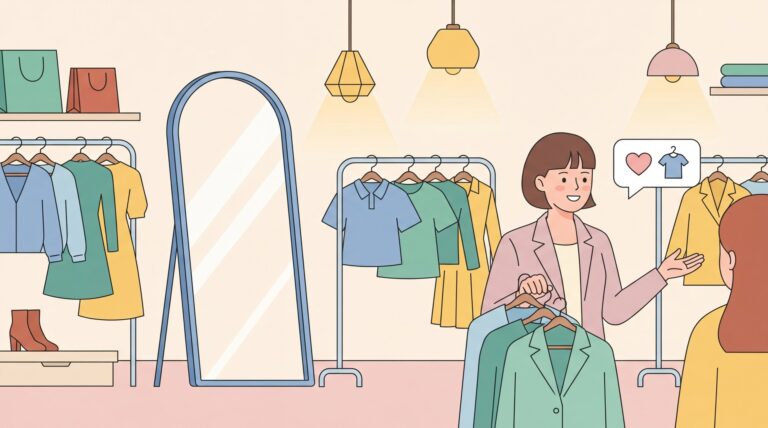
Imagine this: You step into a sleek, minimalist boutique in Hannam-dong (한남동) or Apgujeong (압구정). The K-Pop playlist is soft, the lighting is perfect, and a stylish staff member—perhaps a personal shopper—approaches you with a warm smile. You want to ask for recommendations that fit your body type, explain your usual style, or gently say an item isn’t quite ‘you.’ But suddenly, all your textbook Korean vanishes. You end up just pointing and saying, “이거요 (This one)” or “괜찮아요 (It’s okay).”
Does this sound familiar? In K-Dramas, the wealthy chaebol heir always walks in and says, “I’ll take everything from here to here.” But in reality, Korean fashion shopping is all about detailed, polite communication. If you know how to express your preferences clearly to a boutique clerk or a personal shopper, you won’t just get better clothes—you’ll get VIP-level respect.
This guide is based on real questions from intermediate learners who wanted to elevate their shopping Korean beyond “How much is this?” Let’s dive in!
Phase 2: Core Expression Deep Dive
Here are the three essential B2-level expressions you need when consulting a personal shopper or boutique staff.
1. 제 체형에 맞는 옷을 추천해 주시겠어요?
- Pronunciation: je chehyeong-e manneun oseul chucheonhae jusigesseoyo? [Sound-alike: jeh cheh-hyoung-eh mahn-neun oh-seul choo-chun-hae joo-she-gess-uh-yo?]
- Meaning: Literal: “Could you recommend clothes that fit my body type?” / Real nuance: “Can you style me based on what flatters my figure?”
- K-Culture Moment: This is the ultimate “expert consultation” phrase. In Korea, trusting the expert (whether it’s a hair stylist, dermatologist, or personal shopper) is deeply ingrained in the culture. Saying this shows you respect their eye for fashion.
- Editor’s Insight: The word 체형 (chehyeong) means ‘body shape/type.’ Using this specific vocabulary immediately signals to the staff that you are an intermediate speaker who knows their stuff.
- Situation Spectrum:
- Casual with friends: 🚫 (Too formal)
- Boutique staff/Personal Shopper: ✅ (Perfect)
- Department store VIP lounge: ✅ (Very polite)
- 🤔 Think About It: In Korean culture, why do you think asking for ‘recommendations’ (추천) is so common in restaurants, cafes, and shops? How does this reflect the cultural value of trusting collective or expert wisdom over individual trial-and-error?
2. 평소에 캐주얼하게 입는 편이에요.
- Pronunciation: pyeongso-e kaejueolhage imneun pyeonieyo. [Sound-alike: pyoung-so-eh keh-joo-uhl-ha-geh eem-neun pyun-ee-eh-yo. Note: ‘eu’ sounds like the disgusted sound you make when stepping in gum!]
- Meaning: Literal: “I am on the side of wearing casually usually.” / Real nuance: “I usually tend to dress casually.”
- K-Culture Moment: When the shopper asks about your lifestyle, you use this. You can swap ‘캐주얼하게’ (casually) with ‘단정하게’ (neatly/formally) or ‘화려하게’ (flashy/colorfully).
- Editor’s Insight: The grammar
~는 편이다(to tend to) is the bread and butter of B2 Korean. Koreans love this structure because it softens the statement. It’s less absolute than “I dress casually,” which sounds a bit rigid.- Situation Spectrum:
- Casual with friends: ✅ (Drop the ‘요’ -> 입는 편이야)
- Boutique staff/Personal Shopper: ✅
- Formal presentation: ⚠️
- 🤔 Think About It: Why do Koreans prefer saying “I tend to like this” rather than “I like this”? Does your native language also use softening phrases to avoid sounding too aggressive or definitive?
3. 이건 저한테 좀 과한 것 같아요.
- Pronunciation: igeon jeohante jom gwahan geot gatayo. [Sound-alike: ee-gun juh-hahn-teh johm gwah-hahn gut gah-tah-yo.]
- Meaning: Literal: “I think this is a bit excessive for me.” / Real nuance: “I think this is a bit too much (too flashy/bold) for my taste.”
- K-Culture Moment: The personal shopper brings out a bright neon jacket. You hate it. In a K-Drama, the villain might say “치워요!” (Take it away!). But in real life, you use this phrase to reject the item while protecting the shopper’s feelings (saving face).
- Editor’s Insight: ‘과하다’ (to be excessive) is a fantastic B2 vocabulary word. Combined with
~것 같아요(I think / it seems like), it becomes the ultimate polite refusal. It shifts the ‘blame’ to yourself (“it’s too much for me“) rather than insulting the clothes.- Situation Spectrum:
- Casual with friends: ✅ (과한 것 같아)
- Boutique staff/Personal Shopper: ✅ (Perfectly polite)
- Boss/Elders: ⚠️ (Depends on context)
- 🤔 Think About It: Indirect communication is a huge part of Nunchi (눈치). How do you politely refuse a recommendation in your country without offending the salesperson?
Phase 3: Textbook vs. Real Korean
Let’s see how standard textbook phrases evolve into natural, stylish Korean in a boutique.
| Situation | 📖 Textbook Korean | 🗣️ Real Korean | 💡 Why is it different? |
|---|---|---|---|
| Rejecting an item | 저는 이것이 마음에 들지 않습니다. (I do not like this.) | 아… 이건 저랑 잘 안 어울리는 것 같아요. (Ah… I don’t think this suits me well.) | Direct refusal sounds aggressive. Koreans prefer to say “it doesn’t suit me” to soften the blow. |
| Asking for popular items | 유명한 옷을 보여주십시오. (Please show me famous clothes.) | 요즘 제일 잘 나가는 게 뭐예요? (What’s the best-selling item these days?) | “잘 나가다” (to go out well) is a very common idiomatic expression for “best-selling.” |
| Trying it on | 제가 이것을 입어봐도 되겠습니까? (May I try this on?) | 이거 피팅해 봐도 돼요? (Can I fit this?) | Modern Koreans use English loanwords like “피팅” (fitting) frequently in fashion contexts. |
Phase 4: Cultural Context — K-Culture Deep Dive
4-1. Non-verbal Elements: The Art of the Fitting Room
When communicating with a personal shopper, non-verbal cues matter. If they hand you an item, receiving it with both hands (or one hand with the other supporting your elbow) shows immense respect. Also, always take your shoes off if there is a small step up into the fitting room—this is a strict rule in Korea!
4-2. K-Drama Trope vs. Reality
We’ve all seen the K-Drama makeover montage: The wealthy male lead drags the female lead to a luxury boutique, snaps his fingers, and says, “Dress her.” Dozens of outfits ensue.
Critical View: While fun to watch, this “bossing around” behavior is considered incredibly rude in real life. Real Korean VIP shopping or personal shopper experiences are highly collaborative. The shopper respects your “Personal Color” (퍼스널 컬러 – a massive trend in Korea right now) and your body type. You converse politely, using honorifics, even if you are the paying customer. ‘Gapjil’ (갑질 – abusing one’s power over service workers) is heavily frowned upon in modern Korean society.
Phase 5: Real-Life Roleplay Scenario
Setting: Saturday afternoon. You are in a chic designer showroom in Seongsu-dong (성수동). You’ve booked a 1-on-1 styling session. The personal shopper, Seo-yoon, has just brought out a few pieces for the upcoming fall season.
Characters:
– YOU: A foreign professional working in Seoul, looking to upgrade your office-casual wardrobe.
– Seo-yoon (29, Female): Your friendly and observant personal shopper.
Dialogue:
Seo-yoon: 손님, 평소에 어떤 스타일을 자주 입으세요? 😊
(sonnim, pyeongso-e eotteon seutaileul jaju ibeuseyo?)
(English: Customer, what style do you usually wear?)
YOU: 저는 회사에 다녀서, 보통 단정하면서도 캐주얼하게 입는 편이에요.
(jeoneun hoesa-e danyeoseo, botong danjeonghamyeonseodo kaejueolhage imneun pyeonieyo.)
(English: Since I go to the office, I usually tend to dress neatly but casually.)
Seo-yoon: 아, 그러시군요! 그럼 이 자켓은 어떠세요? 요즘 저희 매장에서 제일 잘 나가는 상품이에요.
(a, geureosigunyo! geureom i jakeseun eotteoseyo? yojeum jeohui maejang-eseo jeil jal naganeun sangpumieyo.)
(English: Ah, I see! Then how about this jacket? It’s our best-selling item these days.)
(🎭 Stage Direction: Seo-yoon holds up a very bright, oversized hot pink blazer)
🔀 YOUR TURN! How do you respond?
– A) “아, 싫어요. 너무 못생겼어요.” (Ah, I hate it. It’s too ugly.)
– B) “음… 색깔이 저한테 좀 과한 것 같아요. 다른 색상도 있나요?”
– C) “대박! 완전 제 스타일이네요!”✅ Best Choice: B — “Umm… I think the color is a bit too much for me. Do you have it in other colors?” This is the perfect polite refusal while keeping the consultation moving.
⚠️ Choice A Analysis: NEVER say this to a stylist. It’s too blunt and will ruin the mood instantly.
⚠️ Choice C Analysis: Only use this if you genuinely love the hot pink blazer!
Seo-yoon: 아, 색상이 조금 부담스러우실 수 있겠네요. 그럼 네이비 색상은 어떠세요? 핏이 정말 예쁘게 나왔어요.
(a, saeksang-i jogeum budamseureousil su itgenneyo. geureom neibi saeksang-eun eotteoseyo? pisi jeongmal yeppeuge nawasseoyo.)
(English: Ah, the color might be a bit burdensome. Then how about the navy one? The fit came out really beautifully.)
YOU: 오, 네이비 좋네요. 제 체형에 맞는 옷을 잘 추천해 주셔서 감사해요. 입어봐도 될까요?
(o, neibi jonneyo. je chehyeong-e manneun oseul jal chucheonhae jusyeoseo gamsahaeyo. ibeobwado doelkkayo?)
(English: Oh, navy is good. Thank you for recommending clothes that fit my body type well. Can I try it on?)
Bonus K-Culture Scenario: The Fitting Room Compliment
When you step out of the fitting room, Korean staff are famously generous with compliments.
Staff: “어머! 손님, 핏이 완전 예술이세요! 얼굴이 확 살아나요!” (Oh my! Customer, the fit is absolute art! Your face totally lights up!)
You (Humble response): “아유, 아니에요. 옷이 예뻐서 그런 것 같아요.” (Oh, no. I think it’s just because the clothes are pretty.)
Phase 6: 10-Second Shadowing Drill
Let’s practice the rhythm of polite refusal. Read this aloud in 10 seconds!
😅 음... / 이 색상은 / 저한테 좀 / 과한 것 같아요.
(eum... / i saeksang-eun / jeohante jom / gwahan geot gatayo.)
Emotion Tag: Slightly hesitant, apologetic but firm. Pause slightly at the slashes (/) to sound thoughtful, not robotic.
Phase 7: K-Culture Mini Dictionary
Impress your personal shopper with these trendy K-Fashion keywords:
| Korean | Romanization | English | Context |
|---|---|---|---|
| 퍼스널 컬러 | peoseuneol keolleo | Personal Color | A massive trend in Korea where experts analyze whether you are ‘Spring Warm’, ‘Summer Cool’, etc., to choose flattering clothes and makeup. |
| 핏 | pit | Fit | Used to describe how clothes drape on the body. “핏이 예쁘다” (The fit is pretty) is the highest compliment. |
| 꾸안꾸 | kku-an-kku | Effortlessly chic | Short for 꾸민 듯 안 꾸민 듯 (Like you dressed up, but didn’t). The ultimate goal of modern Korean street fashion. |
| 품절대란 | pumjeoldaeran | Sold-out crisis | Used when an item worn by a celebrity or idol sells out immediately everywhere. |
| 득템 | deuktem | Great find / Catch | Getting a great item, especially at a good price or finding a rare piece. (득 = get, 템 = item) |
Phase 8: Traveler’s Survival Kit
Even if you aren’t using a VIP personal shopper, you will definitely need these phrases when shopping in places like Hongdae, Myeongdong, or underground malls!
🆘 Survival Phrase #1: Can I try this on?
– 🇰🇷 “이거 입어봐도 돼요?” (igeo ibeobwado dwaeyo?)
– 📍 Where to use: Any clothing store.
– 💡 Pro Tip: At underground malls (like Goto Mall), trying on white shirts or tight knitwear is usually NOT allowed because makeup might rub off on the collar. Always ask first!🆘 Survival Phrase #2: Do you have a new one?
– 🇰🇷 “새 상품 있어요?” (sae sangpum isseoyo?)
– 📍 Where to use: When you want to buy the item, but don’t want the one displayed on the mannequin.🆘 Survival Phrase #3: It’s a bit too tight.
– 🇰🇷 “너무 딱 맞아요. 한 사이즈 큰 거 있어요?” (neomu ttak majayo. han saijeu keun geo isseoyo?)
– 📍 Where to use: Fitting rooms.
📌 Editor’s Travel Note:
– Face Covers: When trying on clothes, you will often be handed a white, non-woven fabric bag. This is a “페이스 커버” (Face cover). Put it over your head before pulling a shirt over, so your foundation/lipstick doesn’t stain the clothes!
– Returns/Refunds: In department stores, refunds are easy. In small street boutiques or underground markets, refunds are often strictly prohibited (환불 불가).
Phase 9: Critical Thinking — “One Step Deeper”
Media vs. Reality: The “Buy It All” Illusion
If you watch K-Dramas like Queen of Tears or classic rom-coms, you might think the ultimate flex in a Korean boutique is arrogance—treating the staff like servants and buying without looking. But in real-life Korea, manner makes the customer. The concept of “매너 소비자” (Well-mannered consumer) is highly valued.
Korean customer service is arguably some of the best in the world, rooted in a culture of extreme hospitality (정 – Jeong). However, in recent years, society has pushed back against rude customers (갑질 – Gapjil). Today, speaking respectfully using honorifics (존댓말) to service workers, regardless of your wealth or status, is considered the true mark of class and education.
🧠 Think Deeper:
The language you use reflects your character. Using softened phrases like “~것 같아요” (I think) instead of blunt commands shows emotional intelligence.💬 Your Turn: How is the relationship between a high-end salesperson and a customer viewed in your country? Is it more transactional, or is it a relationship built on mutual respect?
Phase 10: FAQ & Avoiding Misunderstandings
Q: Can I use “이건 저한테 좀 과한 것 같아요” to my boss if they give me too much work?
No! 🚫 While the grammar is correct, using “과하다” (excessive) to a boss regarding work sounds like you are judging their management skills. It’s strictly for things like fashion, makeup, or maybe a surprisingly huge portion of food.
Q: Can I bargain with a personal shopper or in a boutique?
Absolutely not. 🚫 Bargaining (흥정) is only acceptable in traditional markets (like Namdaemun or Dongdaemun late-night markets). In boutiques, department stores, or any shop with price tags, the price is fixed (정찰제).
❌ Common Mistake #1: Saying “너” (You) or “당신” (You) to the store clerk.
✅ Do this instead: Never use “You” in Korean to a stranger. Call them “저기요” (Excuse me) to get their attention, or refer to them as “직원분” (Staff) or simply “선생님” (Teacher—used politely for professionals). If they are styling you, “스타일리스트님” (Stylist) works perfectly.
Phase 11: Summary & Action Items
- One-Liner Summary: Master the art of polite refusal and preference expression to shop like a true Korean VIP!
-
Action Mission 3 Steps:
- 🥉 Bronze (Solo): Look at your own closet. Pick out a bright piece of clothing and practice saying: “이건 저한테 좀 과한 것 같아요” out loud.
- 🥈 Silver (Online): Go to an online Korean shopping mall (like Musinsa or Zigzag) and read the reviews. See if you can spot the word “핏” (Fit) or “재질” (Material).
- 🥇 Gold (Real-world): Next time you are in a Korean clothing store, try asking: “요즘 제일 잘 나가는 게 뭐예요?”
- K-Culture Mission: Watch a “Get Ready With Me” (GRWM) or shopping vlog by your favorite K-Pop idol on YouTube. Listen closely—do they talk about their “퍼스널 컬러” (Personal Color) or their “평소 스타일” (Usual style)?
Drop a comment below: What is your “평소 스타일” (usual style)? Try writing it in Korean! (e.g., 저는 캐주얼하게 입는 편이에요!)
Phase 12: Quiz — Interactive Challenge
1. Situational Judgment: The personal shopper brings you a tight leather jacket. It’s cool, but not your style for the office. What is the MOST polite way to reject it?
– A) “이거 싫어요. 다른 거 주세요.”
– B) “이건 제 체형에 안 맞아요.”
– C) “음… 이건 평소에 입기 좀 과한 것 같아요.”
2. True or False — K-Culture Edition:
“If you receive excellent service from a personal shopper in Korea, you should leave a 15% tip.”
3. Fill in the Blank:
“저는 주말에 보통 편하게 입는 ( ______ )이에요.”
(I tend to dress comfortably on weekends.)
Answers & Explanations (Click to reveal)
- C is correct! It politely expresses that it’s a bit ‘much’ for your usual daily wear. A is too rude. B is okay, but C is more natural for expressing personal taste.
- False! There is absolutely no tipping culture in Korea. Trying to tip a professional personal shopper might actually confuse or even offend them. A sincere “감사합니다” and perhaps returning as a loyal customer is the best reward!
- 편 (pyeon). The full grammar is ~는 편이에요 (tend to).
Frequently Asked Questions (FAQ)
Q: What does "제 체형에 맞는 옷을 추천해 주시겠어요?" mean in Korean and how do you pronounce it?
A: In Korean, "제 체형에 맞는 옷을 추천해 주시겠어요?" is pronounced [je chehyeong-e manneun oseul chucheonhae jusigesseoyo? [Sound-alike: jeh cheh-hyoung-eh mahn-neun oh-seul choo-chun-hae joo-she-gess-uh-yo?] and means: Literal: "Could you recommend clothes that fit my body type?" / Real nuance: "Can you style me based on what flatters my figure?"
Q: What does "평소에 캐주얼하게 입는 편이에요." mean in Korean and how do you pronounce it?
A: In Korean, "평소에 캐주얼하게 입는 편이에요." is pronounced [pyeongso-e kaejueolhage imneun pyeonieyo. [Sound-alike: pyoung-so-eh keh-joo-uhl-ha-geh eem-neun pyun-ee-eh-yo. Note: 'eu' sounds like the disgusted sound you make when stepping in gum!] and means: Literal: "I am on the side of wearing casually usually." / Real nuance: "I usually tend to dress casually."
Q: What does "이건 저한테 좀 과한 것 같아요." mean in Korean and how do you pronounce it?
A: In Korean, "이건 저한테 좀 과한 것 같아요." is pronounced [igeon jeohante jom gwahan geot gatayo. [Sound-alike: ee-gun juh-hahn-teh johm gwah-hahn gut gah-tah-yo.] and means: Literal: "I think this is a bit excessive for me." / Real nuance: "I think this is a bit too much (too flashy/bold) for my taste."







