

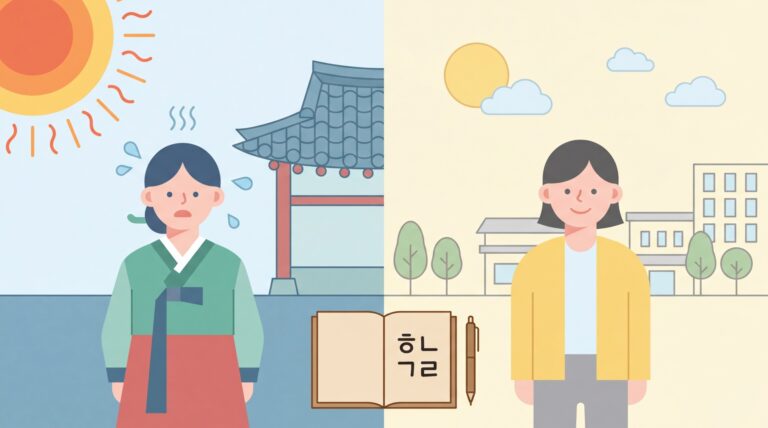
Phase 1: The K-Drama Snow Illusion vs. Reality
Hello there! I’m the Lead Editor at Daily Hangul. Have you ever watched a K-Drama where the main characters romantically stare at the first snow (첫눈) together, wearing stylish wool coats and looking absolutely flawless? But then you visit Seoul in January, and the Siberian wind makes your face freeze within seconds! Or maybe you stepped out of Incheon Airport in July and felt like you walked into a giant bowl of hot soup?
When you meet Koreans, talking about the weather isn’t just small talk—it’s a national bonding experience. Whether you’re shivering at a K-pop outdoor concert or sweating while eating spicy Tteokbokki, Koreans will inevitably ask you: “Is it this hot/cold in your hometown too?”
If you only know how to say “Yes, it is hot” (네, 더워요), you’re missing a golden opportunity to connect. In this guide, designed for B1 (Lower-Intermediate) learners, we’ll learn how to compare climates like a true insider. This guide is built from the exact moments my students realized that textbook Korean wasn’t enough to describe the intense “K-Weather.”
Phase 2: Core Expressions Deep Dive
Let’s master the 3 essential expressions you need when comparing the weather in Korea to your home country.
1. [Place]보다 (더/훨씬) [Adjective]
- Pronunciation: [boda (deo/hwolssin)] + Adjective (Sounds like ‘bo-dah’ / ‘hwol-sheen’)
- Meaning: (Much/Even) more [Adjective] than [Place]
- K-Culture Moment: You’re at a company dinner (회식), and everyone is wiping sweat from their foreheads. A coworker asks about your country. You say: “한국이 제 고향보다 훨씬 더워요!” (Korea is much hotter than my hometown!). Instantly, you get sympathetic nods and maybe an extra glass of cold beer.
- Editor’s Insight:
보다acts like “than” in English, but it attaches directly to the noun you are comparing against. Adding훨씬(much) or더(more) makes you sound completely fluent. - Situation Spectrum:
- Casual (Friends): ✅
- Semi-formal (Coworkers): ✅
- Formal (Boss/Elders): ✅
- 🤔 Think About It: Why does Korean put the “compared to” word (
보다) before the adjective, unlike English? How does this reflect the Korean language’s SOV (Subject-Object-Verb) structure where the most important description comes at the very end?
2. 제 고향은 ~은/는 편이에요
- Pronunciation: [je gohyangeun ~eun/neun pyeonieyo] (Sounds like ‘pyeon-ee-eh-yo’)
- Meaning: Literal: “My hometown is on the ~ side.” / Real nuance: “My hometown tends to be ~”
- K-Culture Moment: In K-Dramas, you rarely hear characters make absolute statements when meeting someone new. They say things are “on the good side” or “tend to be cold.” It’s a softer, more polite way of describing things.
- Editor’s Insight: B1 learners often overuse simple adjectives (추워요, 더워요). Using
~는 편이에요instantly levels up your Korean. It shows you understand nuance and aren’t just making black-and-white statements. - Situation Spectrum:
- Casual (Friends): ✅
- Semi-formal (Coworkers): ✅
- Formal (Boss/Elders): ✅
- 🤔 Think About It: Korean culture values humility and avoiding overly aggressive or absolute statements. How does the grammar structure
~는 편이다reflect this cultural desire to soften one’s opinions?
3. 습도가 장난 아니에요 / 너무 건조해요
- Pronunciation: [seupdoga jangnan anieyo / neomu geonjohaeyo] (‘seup-do-gah jang-nan ah-nee-eh-yo’)
- Meaning: Literal: “The humidity is no joke” / “It is very dry.” Real nuance: “It’s insanely humid / extremely dry.”
- K-Culture Moment: Try walking through Myeongdong in August. Your makeup melts in 5 minutes (a K-Beauty nightmare!). Koreans don’t just say it’s hot; they complain about the humidity (습도).
- Editor’s Insight:
장난 아니에요(It’s no joke) is the ultimate native-sounding phrase. Use it for anything extreme: weather, spicy food, or a busy subway. - Situation Spectrum:
- Casual (Friends): ✅
- Semi-formal (Coworkers): ⚠️ (Okay with close coworkers, but a bit casual)
- Formal (Boss/Elders): 🚫
Phase 3: Textbook vs. Real Korean
| Situation | 📖 Textbook Korean | 🗣️ Real Korean | 💡 Why the difference? |
|---|---|---|---|
| It’s very hot | 날씨가 매우 덥습니다. | 와, 완전 찜통이에요! (Wow, it’s a complete steamer!) | Koreans love comparing hot weather to cooking methods (steaming/boiling) for emphasis. |
| It’s very cold | 고향보다 더 춥습니다. | 칼바람 장난 아니에요. (The knife-wind is no joke.) | Seoul’s winter wind is notoriously sharp, hence ‘knife-wind’ (칼바람). |
| It rains a lot | 비가 많이 옵니다. | 비가 억수같이 쏟아져요. (It’s pouring buckets.) | Vivid imagery is preferred in daily conversation over dry facts. |
Bottom Note for B1 Learners: You don’t need to memorize heavy slang, but knowing descriptive words like 찜통 (steamer) will make your Korean friends’ jaws drop!
Phase 4: Cultural Context — K-Culture Deep Dive
4-1. Non-verbal Elements: The Art of “Nunchi” in Weather
When Koreans complain about the weather, it’s often a way to show empathy. If a colleague comes into the office shivering, don’t just say “Hello.” Say “너무 춥죠!” (It’s so cold, right!) while rubbing your arms. Sharing the mutual suffering of extreme weather builds instant camaraderie.
4-2. K-Food Connection: Eating the Weather
Did you know Korean weather dictates what you eat?
– Rainy Days (장마철): Koreans instinctively crave 파전 (Green onion pancake) and 막걸리 (Rice wine). The sound of rain hitting the pavement sounds exactly like the sizzling of the pancake batter in the pan!
– Freezing Winter: It’s time for hot 붕어빵 (Fish-shaped pastry) from a street vendor.
When comparing climates, naturally weaving in food makes you sound like a local: “My hometown rains a lot too, but we don’t eat Pajeon like in Korea!”
Phase 5: Interactive Roleplay Scenario
Scenario A: The Pajeon Tent on a Rainy Evening
Setting: A Friday evening in July during the monsoon season (장마). You are sitting in a cozy traditional pub (민속주점) with your Korean coworker, Min-su. Rain is aggressively hitting the windows.
Characters:
– YOU: An expat who has been working in Korea for 6 months.
– Min-su (32): Your friendly Korean coworker who loves treating you to local food.
Min-su: 와, 오늘 비 진짜 많이 오네요. 파전 시키길 잘했다! ☔
(Wa, oneul bi jinjja mani oneyo. Pajeon sikigil jalhaetda!)
(Wow, it’s really raining a lot today. Good thing we ordered Pajeon!)
(🎭 Stage Direction: Min-su pours you a bowl of Makgeolli)
YOU: 맞아요. 빗소리 들으면서 먹으니까 더 맛있어요.
(Majayo. Bitsori deureumyeonseo meogeunikka deo masisseoyo.)
(You’re right. Eating while listening to the rain makes it even tastier.)
Min-su: [Your Name] 씨 고향도 여름에 비가 이렇게 많이 와요?
([Your Name] ssi gohyangdo yeoreume biga ireoke mani wayo?)
(Does it rain this much in the summer in your hometown too?)
🔀 YOUR TURN! How do you answer?
– A) “네, 비가 와요.” (Yes, it rains.)
– B) “아니요, 제 고향은 한국보다 비가 안 오는 편이에요. 그리고 덜 습해요.”
– C) “한국 날씨 미쳤어요! 완전 찜통!”✅ Best Choice: B — Reason: It beautifully uses the
~는 편이다grammar and보다to compare, adding the crucial detail about humidity (습해요). It’s natural, polite, and descriptive.
⚠️ Choice A Analysis: Too textbook and cuts off the conversation.
⚠️ Choice C Analysis: A bit too dramatic and casual for a coworker you aren’t best friends with.
(Assuming you chose B)
Min-su: 아, 진짜요? 부럽다. 한국 여름은 습도가 너무 높아서 힘들어요.
(A, jinjjayo? Bureopda. Hanguk yeoreumeun seupdoga neomu nopaseo himdeureoyo.)
(Ah, really? I’m jealous. Korean summers are hard because the humidity is so high.)
YOU: 제 고향은 더워도 건조한 편이라서 견딜 만해요.
(Je gohyangeun deowodo geonjohan pyeoniraseo gyeondil manhaeyo.)
(Even when it’s hot, my hometown tends to be dry, so it’s bearable.)
Min-su: 좋네요! 자, 우리 짠 할까요? 건배!
(Jonneyo! Ja, uri jjan halkkayo? Geonbae!)
(That’s nice! Shall we cheers? Cheers!)
Scenario B: Bonus Taxi Ride in the Freezing Winter
Taxi Driver: 아이고, 날씨가 엄청 춥죠? 고향은 이렇게 안 춥죠?
(Aigo, nalssiga eomcheong chupjyo? Gohyangeun ireoke an chupjyo?)
(Oh my, the weather is freezing, right? Your hometown isn’t this cold, is it?)
YOU: 네, 맞아요. 한국 겨울이 제 고향보다 훨씬 추워요. 칼바람 장난 아니에요!
(Ne, majayo. Hanguk gyeouri je gohyangboda hwolssin chuwoyo. Kalbaram jangnan anieyo!)
(Yes, that’s right. The Korean winter is much colder than my hometown. The knife-wind is no joke!)
Taxi Driver: (Laughs) 한국 사람 다 됐네!
Phase 6: 10-Second Shadowing Drill
Practice reading this aloud to nail your rhythm! Pay attention to the pauses (/) and emotions.
😲 한국 여름은 / 제 고향보다 / 습도가 훨씬 / 높은 편이에요.
(Hanguk yeoreumeun / je gohyangboda / seupdoga hwolssin / nopeun pyeonieyo.)
“Korean summers / compared to my hometown / tend to have much higher humidity.”
😤 와, / 오늘 칼바람 / 장난 아니네요!
(Wa, / oneul kalbaram / jangnan anineyo!)
“Wow, / the biting wind today / is no joke!”
Phase 7: K-Culture Mini Dictionary
| 한국어 | Romanization | English | Context |
|---|---|---|---|
| 장마 | jangma | Monsoon season | Late June to mid-July. Always carry an umbrella! |
| 첫눈 | cheotnun | First snow | A highly romanticized event. People text their crushes when it falls. |
| 찜통더위 | jjimtongdeowi | Sweltering heat | Literally “steamer heat.” Used during August heatwaves. |
| 칼바람 | kalbaram | Biting wind | Literally “knife wind.” The freezing winter wind in Korea. |
| 롱패딩 | rongpaeding | Long puffer coat | The black, sleeping-bag-like coat every Korean wears from Nov to Feb. |
Phase 8: Traveler’s Survival Kit
Weather drastically affects your travel plans in Korea. Here are your absolute survival phrases!
🆘 Survival Phrases for K-Weather
– 🇰🇷 “우산 제일 싼 거 얼마예요?” (usan jeil ssan geo eolmayeyo?)
– 🗣️ English: How much is the cheapest umbrella?
– 📍 Where to use: Convenience stores (CU, GS25) when caught in a sudden downpour.
- 🇰🇷 “에어컨 좀 틀어주시겠어요?” (eeokeon jom teureojusigesseoyo?)
- 🗣️ English: Could you turn on the AC, please?
- 📍 Where to use: Taxis or small restaurants in the summer.
🇰🇷 “오늘 비 온대요?” (oneul bi ondaeyo?)
- 🗣️ English: Did they say it’s going to rain today?
- 📍 Where to use: Asking hotel staff or friends before heading out.
📌 Editor’s Travel Note:
– App Tip: Use the ‘Naver Weather’ (네이버 날씨) app for hyper-local rain forecasts. It’s much more accurate in Korea than global weather apps!
– Survival Tip: In summer, convenience stores sell ‘cup ice’ (얼음컵) for 1,000 KRW. Pour a pouch drink into it to survive the humidity!
Phase 9: Critical Thinking Corner — “One Step Deeper”
Media vs. Reality: The K-Drama Winter Wardrobe
If you watch K-Dramas like Goblin or Winter Sonata, you’ll see characters wearing gorgeous, slim-fit wool coats in the dead of winter, looking pristine as snow falls. But what is the reality?
Step onto any Korean street in January, and you will see a sea of black 롱패딩 (long padded jackets). The “Siberian” winds coming down the peninsula make fashion completely secondary to survival. This stark contrast between the romanticized media image of Korea and the practical reality of Korean daily life is fascinating. The weather shapes the true culture much more than the camera lenses do.
💬 Your Turn: Do movies or TV shows from your home country accurately portray the weather and how people actually dress? Share your thoughts in the comments!
Phase 10: FAQ & Avoiding Misunderstandings
Q: Can I just say “날씨가 나빠요” (The weather is bad)?
Editor says: Maybe. While grammatically correct, Koreans rarely say “나빠요” (bad) for weather. It sounds like a child’s textbook. Instead, say “날씨가 안 좋아요” (The weather is not good) or “날씨가 흐려요” (The weather is cloudy).
Q: Is it okay to complain about the weather to my boss?
Editor says: Yes! Complaining about extreme heat or cold is a universal ice-breaker in Korea, even with superiors. Just make sure to use polite endings (너무 덥죠! / 네, 찜통 같아요).
❌ Common Mistake #1: Forgetting the particle
보다(than).
Student says: “한국 제 고향 더워요.” (Meaningless)
✅ Do this instead: “한국이 제 고향보다 더워요.”
Phase 11: Summary & Action Items
One-Liner Summary: To compare climates like a native, use [Place]보다 더 (more than) and soften your sentences with ~는 편이에요 (tends to be).
Action Mission 3 Steps:
– 🥉 Bronze (Solo): Look out your window right now and describe the weather aloud using ~는 편이에요.
– 🥈 Silver (Online): Leave a comment below comparing your hometown’s weather to Korea’s!
– 🥇 Gold (Real Life): Next time you enter a Korean restaurant or cafe, say “오늘 날씨 진짜 덥죠/춥죠?” (The weather is really hot/cold today, right?) to the staff and watch their face light up.
🌟 K-Culture Mission:
Watch one episode of a K-Drama set in the winter. Count how many times the characters say “추워” (cold) and see if you can spot anyone wearing a realistic 롱패딩 (long puffer coat) in the background!
Phase 12: Quiz — Interactive Challenge
1. Fill in the Blank:
“Korean winters _________ much colder than my hometown.”
한국 겨울이 제 고향______ 훨씬 추운 ______.
(Hint: Use the comparison particle and the ‘tends to be’ grammar)
2. True or False – K-Culture Edition:
During the summer monsoon season (장마), Koreans traditionally love eating fried chicken and beer. (T/F)
3. Situational Judgment:
You are at a cafe. The barista hands you an iced Americano and says, “오늘 너무 덥죠?” (It’s so hot today, right?). What is the most natural native-like response?
A) “네, 날씨가 나쁩니다.”
B) “네, 완전 찜통이네요!”
C) “제 고향은 더 덥습니다.”
(Answers: 1. 보다, 편이에요 / 2. False! They prefer Pajeon and Makgeolli on rainy days! / 3. B – Using “찜통” shows huge B1 fluency!)
Frequently Asked Questions (FAQ)
Q: What does "[Place]보다 (더/훨씬) [Adjective]" mean in Korean and how do you pronounce it?
A: In Korean, "[Place]보다 (더/훨씬) [Adjective]" is pronounced [boda (deo/hwolssin] and means: (Much/Even) more [Adjective] than [Place]
Q: What does "제 고향은 ~은/는 편이에요" mean in Korean and how do you pronounce it?
A: In Korean, "제 고향은 ~은/는 편이에요" is pronounced [je gohyangeun ~eun/neun pyeonieyo] and means: Literal: "My hometown is on the ~ side." / Real nuance: "My hometown tends to be ~"
Q: What does "습도가 장난 아니에요 / 너무 건조해요" mean in Korean and how do you pronounce it?
A: In Korean, "습도가 장난 아니에요 / 너무 건조해요" is pronounced [seupdoga jangnan anieyo / neomu geonjohaeyo] and means: Literal: "The humidity is no joke" / "It is very dry." Real nuance: "It's insanely humid / extremely dry."







