

Phase 1: Empathy (The Seoul Traffic Reality Check)
Hello! I’m the Lead Editor of Daily Hangul.
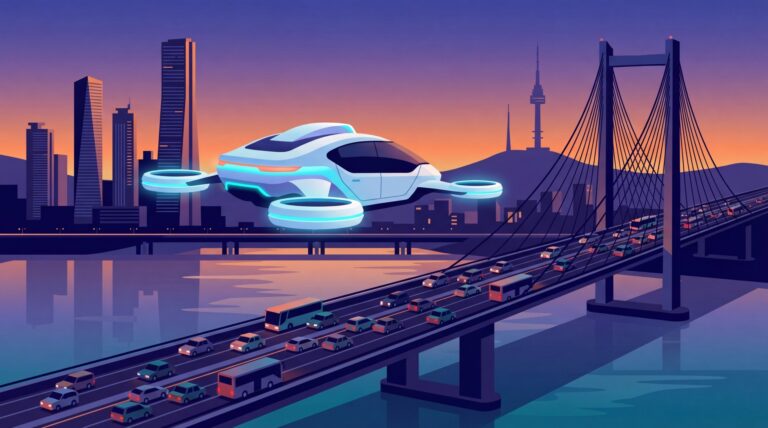
Imagine this: It’s 6:30 PM on a rainy Friday. You are stuck in a taxi on Teheran-ro, the heart of Gangnam’s tech district. The meter is ticking, the red taillights stretch endlessly into the horizon, and you have a dinner meeting in Yeouido in 20 minutes. You look up at the gloomy sky and think, “If only I could just fly over all this.”
Welcome to the exact pain point that is driving Korea’s obsession with Urban Air Mobility (UAM)—or flying taxis. In K-Dramas, you often see the suave Chaebol CEO looking down at the congested city from his penthouse, casually mentioning a helicopter ride. But in reality, Seoul’s engineers and policymakers are fighting a grueling battle to make UAM a daily reality for the masses.
As a C2-level learner, you already know the basic words for “technology” (기술) and “traffic” (교통). But how do Korean engineers and tech insiders actually talk about the brutal commercialization challenges (상용화 과제) of UAM? How do they express the frustration when cutting-edge tech hits the brick wall of government regulations and infrastructure limits?
Today, we are diving deep into the boardrooms and tech hubs of Seoul. This guide is built from the real conversations of foreign consultants and engineers working in Korea’s mobility sector.
Phase 2: Core Expressions – Deep Dive
Let’s look at the top expressions you need to sound like a true Korean tech insider discussing UAM commercialization.
1. 발목을 잡다 (To hold back / To hinder)
- Pronunciation: [balmogeul japda] (Think of the ‘bal’ sounding like ‘ball’ but shorter, and ‘mok’ like ‘mock’.)
- Meaning: Literal: “To grab the ankle.” / Real nuance: To hinder, interrupt, or prevent progress.
- K-Culture Moment: Picture a late-night company dinner (회식). An engineer downs a shot of Soju, slams the glass down, and sighs, “기술은 다 됐는데, 규제가 발목을 잡네요” (The tech is ready, but regulations are holding us back).
- Editor’s Insight: This isn’t just “delayed.” It implies a feeling of unjust restraint. You are trying to run forward, but an invisible hand (usually the law, budget, or infrastructure) is physically pulling you down.
- Situation Spectrum:
- Casual with peers: ✅
- Semi-formal with colleagues: ✅
- Formal (Blaming your boss directly): 🚫 (Never say your boss is grabbing your ankle!)
- 🤔 Think About It: Why does Korean use the “ankle” to symbolize progress? In an agrarian society, walking and moving forward physically was survival. If your ankle is caught, you are helpless. Does your language have a body-part idiom for being hindered?
2. 산 넘어 산이다 (Mountain after mountain)
- Pronunciation: [san neomeo sanida] (san as in ‘sun’, neomeo sounds like ‘nuh-muh’)
- Meaning: Literal: “Mountain over mountain.” / Real nuance: One obstacle after another; an endless series of challenges.
- K-Culture Moment: A startup team successfully tests a drone taxi over the Han River. They celebrate, but the CEO looks at the roadmap: Next up is building Vertiports, getting noise-level approvals, and changing aviation laws. The CEO mutters, “진짜 산 넘어 산이네.”
- Editor’s Insight: Korea is 70% mountainous. For centuries, traveling meant literally crossing endless peaks. Today, tech professionals use this proverb to describe complex, multi-stage R&D and regulatory hurdles.
- Situation Spectrum:
- Casual: ✅
- Semi-formal/Business meetings: ✅ (Highly recommended to show empathy in business!)
- Formal: ✅
- 🤔 Think About It: Notice how nature shapes idioms? A flat country might say “a long road ahead,” but Koreans say “mountain after mountain.”
3. 그림의 떡 (Pie in the sky)
- Pronunciation: [geurimui tteok] (geu-rim-ui sounds like ‘goo-rim-e’, tteok is a sharp, tense ‘duck’.)
- Meaning: Literal: “A rice cake in a picture.” / Real nuance: Something highly desirable but practically unattainable.
- K-Culture Moment: A glossy presentation shows air taxis landing on top of Gangnam skyscrapers by 2025. An experienced civil engineer whispers to you, “버티포트(Vertiport) 인프라 없이는 저거 다 그림의 떡이에요.” (Without vertiport infrastructure, that’s all just a fantasy.)
- Editor’s Insight: Tteok (rice cake) was a traditional delicacy. Staring at a painting of it when you are starving is pure torture. Use this when the UAM technology is amazing, but lacking commercial feasibility.
- Situation Spectrum:
- Casual: ✅
- Semi-formal: ✅
- Formal: ⚠️ (Use cautiously in formal settings as it sounds slightly pessimistic.)
Phase 3: Textbook vs. Real Korean
How does a textbook explain UAM challenges versus an actual engineer in Yeouido?
| Situation | 📖 Textbook Korean | 🗣️ Real Korean | 💡 Why is it different? |
|---|---|---|---|
| Discussing legal barriers | 법적 규제로 인해 상용화가 지연되고 있습니다. (Commercialization is delayed due to legal regulations.) | 낡은 제도가 혁신의 발목을 잡고 있어요. (Outdated systems are grabbing innovation’s ankle.) | Real Korean personifies the system as an active obstacle, highlighting the emotional frustration of innovators. |
| Realizing a new problem | 해결해야 할 문제가 끊임없이 발생합니다. (Problems to solve occur continuously.) | 산 넘어 산이네요. 끝이 안 보여요. (It’s mountain after mountain. I can’t see the end.) | Proverbs bridge the gap between cold engineering facts and shared human exhaustion. |
| Criticizing a concept | 인프라가 부족하여 실현 불가능합니다. (It’s impossible to realize due to a lack of infra.) | 버티포트 없이는 그냥 그림의 떡이죠. (Without vertiports, it’s just a picture of a rice cake.) | Metaphors using food carry a stronger, more visceral impact in Korean culture. |
Bottom Note for C2 Learners: At the C2 level, you aren’t just conveying facts; you are managing the emotional tone of a meeting. Mixing technical terms (버티포트, 상용화) with native idioms (그림의 떡) proves you truly belong at the table.
Phase 4: Cultural Context — K-Culture Deep Dive
4-1. Non-verbal Nuance: The “Sigh and Neck Grab”
When discussing deep regulatory challenges (like UAM flight paths over populated areas), Koreans rarely maintain a stiff, poker face. You might see an engineer gently massage the back of their neck (뒷목을 잡다) or let out a short, sharp sigh before saying, “규제가 발목을 잡네요.” This isn’t unprofessional; it’s a shared expression of Nunchi—acknowledging that everyone in the room knows the system is frustrating, but you are in this together.
4-2. The “Ppalli-Ppalli” Tech vs. Bureaucracy Trope
If you’ve watched K-Dramas like Start-Up, you’ve seen the classic trope: Brilliant, fast-moving young engineers (representing Korea’s famous 빨리빨리 or “hurry hurry” culture) clashing with older, risk-averse government officials.
UAM is the ultimate real-world stage for this drama. Korean tech companies want to launch air taxis tomorrow. They thrive on speed. However, Korea’s aviation laws and safety regulations are incredibly strict, partly due to geopolitical reasons (no-fly zones in northern Seoul). This friction between hyper-speed tech ambition and conservative legal frameworks is the core narrative of modern Korean engineering.
Phase 5: Real-Life Roleplay Scenario
Setting: A high-end tech networking event at a hotel in Yeouido. The room buzzes with drone manufacturers, government officials, and foreign consultants. You are standing at high-top table with Ji-hoon.
Characters:
– YOU: A foreign infrastructure consultant specializing in Vertiports.
– Ji-hoon (38): Lead Project Manager at a top Korean UAM startup. Passionate, a bit stressed, speaks his mind after a glass of wine.
Dialogue:
Ji-hoon: 이번 한강 실증 테스트 보셨어요? 기체 성능은 완벽했습니다.
(ibeon hangang siljeung teseuteu bosyeosseoyo? giche seongneungeun wanbyeokaetseumnida.)
[Did you see the Han River proof-of-concept test this time? The aircraft’s performance was perfect.]
YOU: 네, 아주 인상적이었습니다. 소음 제어도 훌륭하던데요.
(ne, aju insangjeogieotseumnida. soeum je-eodo hullyunghadeondeyo.)
[Yes, it was very impressive. The noise control was excellent too.]
Ji-hoon: (Sighs) 하아… 근데 뭐합니까. 도심 항공망 인프라가 없는데.
(haa… geunde mwohamnikka. dosim hangongmang inpeuraga eomneunde.)
[Sigh… But what’s the point? There’s no urban air network infrastructure.]
Ji-hoon: 아무리 기체가 좋아도, 이착륙할 버티포트(Vertiport)가 없으면 다 소용없어요.
(amuri gichega joado, ichangnyukal beotipoteuga eopseumyeon da soyong-eopseoyo.)
[No matter how good the aircraft is, without vertiports to take off and land, it’s all useless.]
🔀 Your Turn! How do you respond to show deep C2-level empathy?
– A) “맞아요. 인프라 구축이 지연되고 있습니다.” (Correct, but sounds like a news anchor.)
– B) “맞습니다. 인프라 구축 안 되면 그 좋은 기술도 다 그림의 떡이죠.” (Perfect empathy using a high-level idiom.)
– C) “대박! 인프라가 헐이네요.” (Way too casual/slangy for a business networking event.)✅ Best Choice: B — Reason: You instantly validate his frustration while using an idiom that proves you deeply understand the commercialization gap between R&D and reality.
YOU: 맞습니다. 인프라 구축 안 되면 그 좋은 기술도 다 그림의 떡이죠.
(matseumnida. inpeura guchuk an doemyeon geu joeun gisuldo da geurimui tteogijyo.)
[Exactly. If the infrastructure isn’t built, that great tech is all just pie in the sky.]
Ji-hoon: 제 말이 그겁니다! 게다가 비행 금지 구역 규제도 아직 발목을 잡고 있고요.
(je mari geugeomnida! gedaga bihaeng geumji guyeok gyujedo ajik balmogeul japgo igoyyo.)
[That’s exactly what I’m saying! Plus, the no-fly zone regulations are still holding us back.]
YOU: 안전도 중요하지만, 규제 혁신이 시급해 보이네요.
(anjeondo jung-yohajiman, gyuje hyeoksini sigeuphae boineyo.)
[Safety is important, but regulatory innovation seems urgent.]
Ji-hoon: 네, 하나 해결하면 또 다른 규제가 나오고… 진짜 산 넘어 산입니다.
(ne, hana haegyeolhamyeon tto dareun gyujega naogo… jinjja san neomeo sanimnida.)
[Yes, you solve one, and another regulation pops up… It’s truly mountain after mountain.]
Phase 6: 10-Second Shadowing Drill
Let’s practice the rhythm and emotion of a frustrated tech executive. Follow the slash marks for pauses.
😤 낡은 / 규제가 / 혁신의 발목을 / 꽉! 잡고 있습니다.
(nalgeun / gyujega / hyeoksinui balmogeul / kkwak! japgo itseumnida.)
[The outdated / regulations / are grabbing the ankle of innovation / tightly!]
Coach’s Tip: Put a heavy emphasis on “꽉!” (tightly) with a slightly frustrated, breathy tone. It makes the idiom sound 10x more natural.
Phase 7: K-Culture Mini Dictionary (Tech & Urban Mobility)
| Korean | Romanization | English | Cultural Context |
|---|---|---|---|
| 버티포트 | beotipoteu | Vertiport | A landing pad for UAM. In Seoul, they are heavily debated for placement on Han River parks or major subway hubs like Samseong Station. |
| 지옥철 | jiokcheol | Hell-subway | “Hell” + “Subway”. The extreme congestion on Seoul subways (like Line 9) during rush hour. The primary reason average citizens want UAM. |
| 규제 샌드박스 | gyuje saendeubakseu | Regulatory Sandbox | A system where the Korean gov allows new tech to be tested without existing regulations. Crucial for UAM commercialization. |
| 실증 사업 | siljeung saeop | Proof of Concept / Demo Project | You’ll hear this constantly in Korean engineering. It refers to government-backed pilot tests before commercialization. |
Phase 8: Traveler’s Survival Kit (Traffic Edition)
Since UAM isn’t commercialized just yet, if you are visiting Seoul today for a business trip, you still have to deal with the legendary traffic. Here are survival phrases for navigating Seoul’s ground mobility.
🆘 Survival Phrase #1: Checking Traffic
– 🇰🇷 “지금 강남 쪽 길 많이 막히나요?” (jigeum gangnam jjok gil mani makinayo?)
– 🗣️ Meaning: Is the traffic heavily congested toward Gangnam right now?
– 📍 Use it: Asking hotel concierges or taxi drivers before deciding between a taxi and the subway.🆘 Survival Phrase #2: Urgency
– 🇰🇷 “제가 회의가 있어서 그런데, 안 막히는 길로 가주실 수 있나요?” (jega hoe-uiga isseoseo geureonde, an makhineun gillo gajusil su innayo?)
– 🗣️ Meaning: I have a meeting, could you please take a route without traffic?
– 📍 Use it: In a Kakao T (taxi) when you are running late.📌 Editor’s Travel Note
– Apps to use: Never use Google Maps for driving/walking in Korea (national security laws limit its data). Always use Naver Map or KakaoMap.
– Subway over Taxi: Between 6 PM and 8 PM, the “지옥철” (Hell-subway) might be physically uncomfortable, but it is mathematically faster than a taxi in central Seoul.
Phase 9: Critical Thinking Corner — “Going One Step Deeper”
🧠 Think Deeper: Global Era & Korea’s Dual Identity
Korea presents a fascinating paradox in the global tech era. On one hand, it possesses a hyper-fast Ppalli-Ppalli culture that rapidly develops world-class technology (batteries, 5G, UAM aircraft). On the other hand, its legal and bureaucratic frameworks are deeply conservative, prioritizing collective safety and consensus over rapid deployment. The phrases we learned today—발목을 잡다 and 그림의 떡—are linguistic reflections of this exact societal friction. They capture the tension between an innovative tech sector desperate to fly, and an ancient, risk-averse institutional bedrock that demands they stay on the ground until every variable is controlled.
💬 Your Turn: Does your country’s tech sector face a similar cultural clash with government regulations? How do engineers in your language express this frustration? Share it in the comments!
Phase 10: FAQ & Avoiding Misunderstandings
Q1: Can I say “제도가 발목을 잡다” in a formal presentation?
Yes, but with caution. It’s very common in persuasive presentations or panel discussions to criticize a generic system (제도) or regulation (규제). However, never use it to point fingers at a specific person or partner company in the room.
Q2: Are UAM and drones considered the same in Korean daily conversation?
No. Drones are usually called “드론” and associated with cameras or small deliveries. UAM is often referred to in media as “플라잉카” (Flying cars) or “에어택시” (Air taxis).
❌ Common Mistake:
Translating “The project is challenging” directly as “프로젝트가 도전적입니다.” (In Korean, “도전적” sounds like the project is aggressively challenging your authority or is recklessly risky).
✅ Do this instead:
Use “이 프로젝트는 난제가 많습니다.” (This project has many difficult dilemmas) or simply our new phrase, “산 넘어 산이네요.”
Phase 11: Summary & Action Items
💡 One-Liner Summary:
To speak advanced Business Korean in the tech mobility sector, master the idioms that express the friction between innovation and regulation: 발목을 잡다 (hinder), 산 넘어 산 (endless hurdles), and 그림의 떡 (pie in the sky).
🚀 Action Mission:
– 🥉 Bronze (Solo): Stand in front of a mirror, let out a deep, stressed sigh, and say “규제가 발목을 잡네요” 3 times.
– 🥈 Silver (Online): Find an article on Naver News about UAM (search “UAM 상용화”). Skim the comments or article body and try to spot the word “규제” (regulation) or “인프라”.
– 🥇 Gold (Real-world): The next time you are in a meeting with Korean partners discussing project delays, sympathetically nod and say, “정말 산 넘어 산이네요.”
🚁 K-Culture Mission:
Next time you are stuck in Seoul traffic or riding a crowded subway, open Naver Maps, switch to Satellite view, and imagine where you would place a ‘Vertiport’. How much time would a flying taxi save you?
Phase 12: Quiz — Interactive Challenge
1. Situational Judgment:
Your Korean startup partner presents an amazing AI software, but they don’t have the server capacity to run it. You want to point out that without servers, the software is useless. Which phrase is best?
– A) 산 넘어 산입니다.
– B) 서버 없이는 그림의 떡이죠.
– C) 서버가 발목을 잡네요.
2. Fill in the Blank:
안전 테스트는 통과했지만, 이번에는 소음 민원 문제가 ( _________ ).
(We passed the safety test, but this time noise complaint issues are _________.)
– A) 발목을 잡네요
– B) 지옥철이네요
– C) 버티포트네요
3. True or False – K-Culture Edition:
When presenting a UAM project to the Korean government, emphasizing “빨리빨리” (unprecedented speed) is the best way to win their approval. (T/F)
(Answers: 1. B – ‘Pie in the sky’ fits perfectly for tech without infrastructure. C is also okay, but B highlights the uselessness without the missing piece. / 2. A – holding us back / 3. False – The government prioritizes safety and regulations; speed without compliance makes them nervous!)
Frequently Asked Questions (FAQ)
Q: What does "발목을 잡다 (To hold back / To hinder)" mean in Korean and how do you pronounce it?
A: In Korean, "발목을 잡다 (To hold back / To hinder)" is pronounced [balmogeul japda] and means: Literal: "To grab the ankle." / Real nuance: To hinder, interrupt, or prevent progress.
Q: What does "산 넘어 산이다 (Mountain after mountain)" mean in Korean and how do you pronounce it?
A: In Korean, "산 넘어 산이다 (Mountain after mountain)" is pronounced [san neomeo sanida] and means: Literal: "Mountain over mountain." / Real nuance: One obstacle after another; an endless series of challenges.
Q: What does "그림의 떡 (Pie in the sky)" mean in Korean and how do you pronounce it?
A: In Korean, "그림의 떡 (Pie in the sky)" is pronounced [geurimui tteok] and means: Literal: "A rice cake in a picture." / Real nuance: Something highly desirable but practically unattainable.







