

Hello! Daily Hangul Editor here. 👋
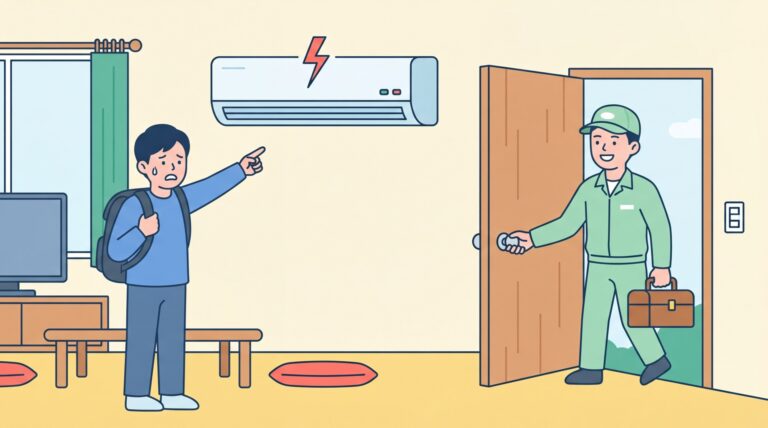
Picture this: It’s August in Seoul. The temperature is 35°C (95°F), and the humidity feels like you’re walking through a bowl of hot soup. You finally arrive at your cozy Korean Airbnb, drop your bags, and grab the air conditioner remote. You press the power button… and nothing happens. No beep. No cool breeze.
Or maybe you’re living your best K-Drama life, and you come home in the middle of winter, only to find out the floor heating (ondol) is freezing cold.
Panic mode? Not anymore.
When an appliance breaks down in Korea, you need help, and you need it fast. Today, I’m going to share the exact survival phrases my beginner (A1) students use to get things fixed in record time. No complicated textbook grammar—just the raw, real Korean phrases that will make your host or hotel front desk send help immediately.
Let’s dive in!
Phase 2: Core Expressions – Your Emergency Toolkit
Here are the three life-saving phrases you need when technology betrays you.
1. 이거 고장 났어요 (It is broken.)
- Pronunciation: igeo gojang nasseoyo [ee-guh / go-jang / nah-ssuh-yo]
- Meaning: This is broken / This is out of order.
- K-Culture Moment: In K-Dramas, the classic “my boiler is broken” (보일러가 고장 났어요) is a legendary excuse for characters to sleep over at someone else’s house. It’s the ultimate plot device!
- Editor’s Insight: Gojang means ‘breakdown’, and nasseoyo means ‘occurred’. You are literally saying, “A breakdown has occurred to this thing.” It takes the blame off you!
- Situation Spectrum:
- Casual with friends: ✅ (Drop the ‘yo’: 이거 고장 났어)
- Airbnb Host/Hotel Staff: ✅ (Perfectly polite)
- Formal/Business: ⚠️ (Okay, but you might use more formal words in a corporate email)
- 🤔 Think About It: Notice how Koreans say a breakdown “happened” rather than “I broke it”? How does your native language handle the blame when a machine stops working?
2. 안 돼요 (It doesn’t work.)
- Pronunciation: an dweyo [ahn / dway-yo]
- Meaning: It doesn’t function / No / It is not allowed.
- K-Culture Moment: You’ll hear this everywhere. Wi-Fi isn’t connecting? An dweyo. The credit card reader gives an error? An dweyo. Trying to enter a K-Pop concert without a ticket? The security guard will cross their arms and say, An dweyo!
- Editor’s Insight: This is the ultimate magic phrase for A1 beginners. If you don’t know the exact word for the problem, just point at the machine with a sad face and say, “안 돼요.” They will understand instantly.
- Situation Spectrum:
- Casual with friends: ✅ (안 돼)
- Airbnb Host/Hotel Staff: ✅
- Formal/Business: ✅
- 🤔 Think About It: “안 돼요” is used for broken machines AND to refuse a request (saying “No”). Why do you think Korean uses the same word for a machine not functioning and a person setting a boundary?
3. 고쳐 주세요 (Please fix it.)
- Pronunciation: gocheo juseyo [go-chuh / joo-say-yo]
- Meaning: Please fix it (for me).
- K-Culture Moment: When the Ajeossi (middle-aged handyman) arrives with his toolbox, you can bow slightly and use this phrase.
- Editor’s Insight: Adding ~juseyo (please give/do for me) makes any request polite. It shows you are asking for a favor, not barking an order.
- Situation Spectrum:
- Casual with friends: ✅ (고쳐 줘)
- Airbnb Host/Hotel Staff/Repairman: ✅
- Formal/Business: ✅
Phase 3: Textbook vs. Real Korean
When panic strikes, efficiency is key. Forget the long, robotic textbook sentences.
| Situation | 📖 Textbook Korean | 🗣️ Real Korean | 💡 Why is it different? |
|---|---|---|---|
| Reporting a broken AC | 에어컨이 오작동합니다. (The AC is malfunctioning.) | 에어컨 안 돼요. (The AC doesn’t work.) | People prefer short, direct phrases in everyday life. “오작동” sounds like a robot. |
| Asking for repairs | 수리해 주시겠습니까? (Would you please repair this?) | 고쳐 주세요! (Please fix it!) | “수리” is formal. “고쳐 주세요” is natural, polite, and gets straight to the point. |
| Saying “I don’t know why” | 원인을 알 수 없습니다. (I cannot determine the cause.) | 갑자기 안 돼요. (It suddenly stopped working.) | “갑자기” (suddenly) is the best way to say “It’s not my fault!” |
Phase 4: Cultural Context — K-Culture Deep Dive
4-1. Non-Verbal Tips: The “Help Me” Look
When telling someone an appliance is broken, don’t smile too brightly. Look slightly troubled or confused. Pointing at the broken item with your whole hand (not just one index finger) while saying “이거 안 돼요” shows respect while clearly indicating the problem.
4-2. K-Living: The Infamous Digital Door Lock
In Korea, traditional keys are practically extinct. Everyone uses digital door locks. But here is a vital survival tip: If your door lock suddenly plays a little melody (often Beethoven’s “Für Elise” or a sad little beep sequence) when you open it, the battery is dying!
If you ignore it, you will be locked out. If it completely dies, you’ll need to run to a convenience store, buy a rectangular 9V battery, and hold it against the emergency terminals outside the door to wake it up. If that fails? Time to text the host: “문이 안 돼요!” (The door doesn’t work!).
Phase 5: Interactive Roleplay Scenario
Setting: It’s 10:00 PM on a humid Friday night in Seoul. You’ve just returned to your Airbnb after a long day of exploring Myeongdong. You grab the AC remote, press ON, but nothing happens. You are sweating. You message Minho, your friendly Airbnb host.
Characters:
– YOU: A tired traveler desperately needing cool air.
– Minho: The Airbnb host who responds incredibly fast.
Dialogue:
YOU: 호스트님, 안녕하세요. 😥
(Hoseuteunim, annyeonghaseyo.)
[Hello, Host.]
Minho: 네, 게스트님! 무슨 일 있으신가요?
(Ne, geseuteunim! Museun il isseusingayo?)
[Yes, guest! Is everything okay?]
YOU: 저기요… 에어컨이 고장 났어요.
(Jeogiyo… eeokeoni gojang nasseoyo.)
[Excuse me… the AC is broken.]
Minho: 헉, 정말요? 전원이 안 켜지나요?
(Heok, jeongmalyo? Jeonwoni an kyeojinayo?)
[Gasp, really? Doesn’t the power turn on?]
YOU: 네, 리모컨이 안 돼요.
(Ne, rimokeoni an dweyo.)
[Yes, the remote doesn’t work.]
Minho: 아, 리모컨 건전지가 없는 것 같아요.
(Ah, rimokeon geonjeonjiga eomneun geot gatayo.)
[Ah, I think the remote is out of batteries.]
🔀 Your Turn! How should you respond?
– A) “빨리 고쳐 주세요!” (Hurry up and fix it!)
– B) “아~ 그럼 제가 편의점에서 살까요?” (Ah~ then should I buy some at the convenience store?)
– C) “너 책임이야!” (It’s your fault!)✅ Best Choice: B — Korean convenience stores are everywhere. Offering to buy a battery yourself (with a reimbursement later) is the most peaceful and fastest solution.
⚠️ Choice A Analysis: While grammatically correct, demanding “Hurry up” immediately can sound a bit rude to a host. Let them offer the solution first!
Minho: 아니에요! 제가 1층에 있으니까 지금 바로 가져다 드릴게요.
(Anieyo! Jaega il-cheunge isseunikka jigeum baro gajeoda deurilgeyo.)
[No! I am on the 1st floor, so I will bring them to you right now.]
YOU: 아, 다행이다. 감사합니다!
(Ah, dahaengida. Gamsahamnida!)
[Ah, what a relief. Thank you!]
Phase 6: 10-Second Shadowing Drill
Let’s practice the most crucial sentence. Speak aloud and follow the emotional tags!
🥺 호스트님... / 에어컨이 / 고장 났어요. / 갑자기 / 안 돼요.
(ho-seu-teu-nim… / e-eo-keo-ni / go-jang / na-sseo-yo. / gap-ja-gi / an / dwe-yo.)
Intonation Tip: Drop your pitch slightly at the end of “났어요” and “돼요” to sound appropriately disappointed and in need of help.
Phase 7: K-Culture Mini Dictionary
| Korean | Romanization | English | Context |
|---|---|---|---|
| 에어컨 | e-eo-keon | Air Conditioner | A Konglish word. Absolutely vital in July/August. |
| 보일러 | bo-il-leo | Boiler (Floor heating) | The heart of Korean winter survival. It heats the water under the floor (Ondol). |
| 도어락 | do-eo-rak | Door Lock | Digital keypad locks used on 99% of Korean front doors. |
| A/S | e-i-e-seu | After Service | Konglish for “Customer Service” or “Repair Service”. If you need repairs, you ask for “A/S” (에이에스). |
Phase 8: Traveler Survival Kit 🆘
When things break in your accommodation, here is your cheat sheet.
🆘 Survival Phrases for Broken Appliances
– 🇰🇷 “이거 고장 났어요.” (igeo gojang nasseoyo) – This is broken.
– 🇰🇷 “따뜻한 물이 안 나와요.” (ttatteushan muri an nawayo) – Hot water isn’t coming out.
– 🇰🇷 “와이파이가 안 돼요.” (waipaiga an dweyo) – Wi-Fi doesn’t work.📌 Editor’s Travel Note: The “Photo” Magic
If you can’t explain what’s broken in Korean, take a photo or a short video of the appliance acting weird, send it to the host or show it to the front desk, and simply say: “이거 안 돼요 (Igeo an dweyo).” Visual proof breaks all language barriers!
Phase 9: Critical Thinking — “One Step Deeper”
Korean in the Global Era: The Magic of “A/S”
In Korea, you don’t just ask for a repair; you ask for “A/S” (에이에스 – After Service). This Konglish term perfectly captures Korea’s hyper-fast, service-oriented culture. When you buy a TV, a fridge, or even a laptop in Korea, you are not just buying the hardware; you are buying the implicit promise of A/S—meaning if it breaks, a technician will be at your door, sometimes within hours, to fix it. This stems from Korea’s Palli-palli (hurry up) culture. Waiting a week for a repairman? That is unacceptable in Seoul!
💬 Your Turn:
How long does it usually take to get an appliance fixed in your country? Let me know in the comments!
Phase 10: FAQ & Avoiding Misunderstandings
Q: Do I need to tip the repairman who fixes my AC in Korea?
No! There is strictly no tipping culture in Korea. Tipping a repairman or a hotel staff member will only cause confusion. Offering a cold canned coffee, a Yakult, or a bottle of water, however, is considered extremely polite and very Korean (we call this Jeong – warmheartedness).
Q: Can I use “안 돼요” to people?
Yes, but the meaning changes. If you say “안 돼요” to a person, it means “No, you can’t do that” or “That is not allowed.”
❌ Common Mistake #1: Saying “안 해” (I won’t do it) instead of “안 돼” (It doesn’t work).
✅ How to fix it:
An hae (안 해) means you refuse to do something.
An dwae (안 돼) means the machine refuses to work.
Don’t mix them up, or your host will wonder why you are refusing to be an air conditioner!
Phase 11: Summary & Action Items
One-Liner Summary: When a machine betrays you in Korea, just point at it and say “안 돼요” (It doesn’t work) or “고장 났어요” (It’s broken).
Your Action Missions:
– 🥉 Bronze: Stand in front of your microwave or TV right now, point at it, and say “고장 났어요” three times out loud.
– 🥈 Silver: Leave a comment below using the word “안 돼요” to describe something that isn’t working for you today (e.g., “My brain 안 돼요”).
– 🥇 Gold: The next time you are in Korea and something actually breaks, use these phrases instead of relying on a translation app!
📺 K-Culture Mission:
Watch one episode of any K-Drama this week. Pay attention to the digital door locks. When the character presses the numbers and the door unlocks with a melodic chime, shout “도어락!” (Door lock!) at the screen.
Phase 12: Interactive Quiz
Test your survival skills before you pack your bags!
1. You are at a cafe, and the self-order kiosk screen is frozen. You catch the staff’s attention. What is the most natural thing to say?
A) 수리해 주시겠습니까? (Would you repair this?)
B) 기계가 오작동합니다. (The machine is malfunctioning.)
C) 저기요, 이거 안 돼요. (Excuse me, this doesn’t work.)
2. True or False: If a friendly Korean repairman comes to fix your Airbnb’s boiler, you should give him a 10,000 won tip for his hard work.
– [ ] True
– [ ] False
3. Fill in the blank:
The AC is broken. Please fix it!
에어컨이 _____ 났어요. 고쳐 주세요!
👀 Click here for Answers!
- C – Short, polite, and natural. A and B are way too robotic.
- False – Korea has no tipping culture! Offer him a cold canned drink instead. He will love it.
- 고장 (go-jang) – 고장 났어요 means “It’s broken.”
Did you enjoy today’s Daily Hangul lesson? Bookmark this page for your next trip to Korea, and you’ll never have to suffer through a hot summer night with a broken AC! Stay cool, and see you in the next lesson! 😊
Frequently Asked Questions (FAQ)
Q: What does "이거 고장 났어요 (It is broken.)" mean in Korean and how do you pronounce it?
A: In Korean, "이거 고장 났어요 (It is broken.)" is pronounced [igeo gojang nasseoyo [ee-guh / go-jang / nah-ssuh-yo] and means: This is broken / This is out of order.
Q: What does "안 돼요 (It doesn't work.)" mean in Korean and how do you pronounce it?
A: In Korean, "안 돼요 (It doesn't work.)" is pronounced [an dweyo [ahn / dway-yo] and means: It doesn't function / No / It is not allowed.
Q: What does "고쳐 주세요 (Please fix it.)" mean in Korean and how do you pronounce it?
A: In Korean, "고쳐 주세요 (Please fix it.)" is pronounced [gocheo juseyo [go-chuh / joo-say-yo] and means: Please fix it (for me).






