

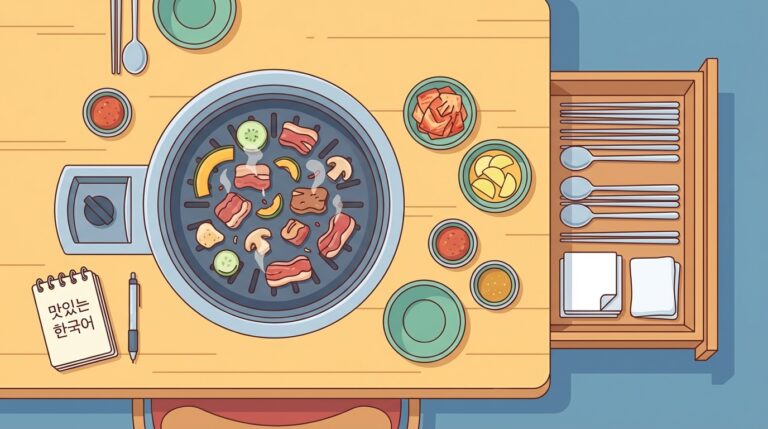
The Secret Under the Table: How to Find Utensils in a Korean Restaurant
Phase 1: Welcome to the ‘Secret Drawer’ Club!
Hello! I’m your Daily Hangul Editor, your friendly neighborhood Korean tutor and cultural navigator.
Picture this: You just sat down at a bustling, mouth-watering Korean BBQ restaurant in Seoul. The meat is sizzling, the side dishes (banchan) are laid out like a feast, and your stomach is growling. You’re ready to dig in! But wait… you look at the table. No chopsticks. No spoons. You look at the other tables, and everyone is eating happily. Did the waiter forget you? You raise your hand, nervously whispering, “Excuse me… where is my fork?”
Sound familiar? If you’ve watched a K-Drama dining scene, you might have noticed the characters doing a smooth little hand movement right at the edge of the table.
Welcome to one of the most brilliant inventions of Korean dining: The Hidden Table Drawer!
Knowing how to navigate this doesn’t just save you from an awkward interaction with the busy staff; it instantly gives you “local insider” points. Today, we’re going to learn how to find your utensils, set the table like a true Korean, and the basic A2 Korean phrases you need to survive a Korean dining experience. (Yes, this is based on real stories of my students who waited 15 minutes for chopsticks to magically appear!)
Phase 2: Core Expressions You Need to Know
Let’s look at the essential phrases for this situation.
1. 수저가 어디에 있어요? (Where are the utensils?)
- Pronunciation: sujeoga eodie isseoyo? [soo-jeo-ga / eo-dee-eh / ee-sseo-yo?]
- Sound guide: ‘eo’ sounds like the ‘u’ in ‘run’.
- Meaning: Literal: Where is the sujeo? / Real nuance: I can’t find my spoon and chopsticks!
- K-Culture Moment: You sit at a small Gukbap (hot soup and rice) restaurant. The table is bare. You ask your Korean friend this question, and they look at you with a smirk before doing a magic trick under the table.
- Editor’s Insight: ‘수저’ (Sujeo) is actually a combination word! 수 (Su) comes from 숟가락 (Sutgarak = Spoon), and 저 (Jeo) comes from 젓가락 (Jeotgarak = Chopsticks). It’s much easier to say than “Spoon and chopsticks, please.”
- Situation Spectrum:
[🚫 절대 금지] ———— [⚠️ 주의] ———— [✅ 자유롭게]
- Casual (Friends): ✅ (Drop the ‘yo’: 수저가 어디에 있어?)
- Semi-formal (Coworkers): ✅
- Formal (Staff/Elders): ✅
- 🤔 Think About It: Why are spoons and chopsticks always grouped together as one word in Korea? Does your native language have a single word for “knife and fork”?
2. 여기 서랍 안에 있어요! (It’s inside the drawer here!)
- Pronunciation: yeogi seorap ane isseoyo! [yeo-gee / seo-rap / ah-neh / ee-sseo-yo!]
- Meaning: Literal: Here drawer inside it is! / Real nuance: Ta-da! They are hidden right here in the table!
- K-Culture Moment: This is the line your Korean friend will say right before pulling out the hidden side drawer. Be prepared to say “Wow!” (우와!).
- Editor’s Insight: ‘서랍’ (seorap) means drawer. In most modern Korean restaurants, the utensils and napkins are cleverly hidden in a drawer built into the side of the table facing you.
- Situation Spectrum:
[🚫 절대 금지] ———— [⚠️ 주의] ———— [✅ 자유롭게]
- Casual (Friends): ✅
- Semi-formal (Coworkers): ✅
- Formal (Staff/Elders): ⚠️ (Use it politely to help an elder find them)
- 🤔 Think About It: Why did Korean restaurants start putting utensils in drawers instead of placing them on the table beforehand?
3. 저기요, 젓가락 하나 떨어뜨렸어요. (Excuse me, I dropped a chopstick.)
- Pronunciation: jeogiyo, jeotgarak hana tteoreotteuryeosseoyo. [jeo-gee-yo / jut-gah-rak / ha-na / tteo-reo-tteu-ryeo-sseo-yo]
- Meaning: I dropped a chopstick.
- K-Culture Moment: Korean metal chopsticks are flat and slippery. If you are not used to them, dropping one is a rite of passage! The whole restaurant hears the loud CLANG.
- Editor’s Insight: Don’t panic when you drop one. Instead of picking up the dirty one and using it, just pull a new one from the drawer! If the drawer is empty, use this phrase to ask the staff.
- Situation Spectrum:
[🚫 절대 금지] ———— [⚠️ 주의] ———— [✅ 자유롭게]
- Casual (Friends): ✅
- Semi-formal (Coworkers): ✅
- Formal (Staff/Elders): ✅
- 🤔 Think About It: Korea is the only country in the world that traditionally uses metal chopsticks. Why do you think that is?
Phase 3: Textbook vs Real Korean
Let’s see how real life differs from the textbook!
| Situation | 📖 Textbook Korean | 🗣️ Real Korean | 💡 Why is it different? |
|---|---|---|---|
| Looking for utensils | 숟가락과 젓가락이 어디에 있습니까? (Where are the spoon and chopsticks?) | 수저 어딨어요? (Where’s the sujeo?) | Koreans love efficiency (Pali-pali culture). “Sujeo” is much faster to say! |
| Asking for napkins | 냅킨을 주시겠어요? (Could you give me a napkin?) | 휴지 좀 주세요. (Please give me some tissues.) | “Hyuji” (tissue/toilet paper) is commonly used for all types of paper wipes in casual settings. |
| Dropped a spoon | 숟가락을 바닥에 떨어뜨렸습니다. (I dropped my spoon on the floor.) | 저기요! 숟가락 하나만요! (Excuse me! One spoon, please!) | In a loud restaurant, short and direct requests are much more effective! |
Bottom Note: At the A2 level, you don’t need to memorize long, perfectly formal sentences. Short, polite phrases with “주세요” (Please give me) are your best friends!
Phase 4: Cultural Context — K-Culture Deep Dive
4-1. Non-verbal Cue: The Ultimate “Nunchi” Move
In Korea, dining is a communal activity. Finding the drawer isn’t just about feeding yourself. When you sit down, someone usually takes charge of opening the drawer, pulling out the napkins, placing one in front of each person, and carefully laying the spoon and chopsticks on top of the napkin.
If you do this for your Korean friends or coworkers, their minds will be blown. This is peak 눈치 (Nunchi – social awareness). It shows you care about the group and understand Korean manners without saying a single word!
4-2. K-Food Connection: The Architecture of Efficiency
Why are the drawers there? Korean food requires a lot of table space. Think about a K-BBQ restaurant: you have the grill in the middle, at least 5-6 small plates of banchan (side dishes), lettuce wraps, garlic, ssamjang (dipping sauce), and your own rice bowl. There is literally no room for a big basket of utensils!
The hidden drawer (along with the call bell stuck to the table and the trash can hidden under the table) is the ultimate expression of Korean “빨리빨리” (Pali-pali / Hurry up) culture and spatial efficiency. Everything you need is at your fingertips.
Phase 5: Real-world Roleplay Scenario
Setting: Friday night, 7 PM. A smoky, lively Samgyeopsal (Pork Belly) restaurant near Gangnam Station. The smell of roasted garlic is in the air.
Characters:
– YOU: A foreigner on a 3-day business trip to Korea, invited to a team dinner.
– Min-su (32): Your friendly Korean coworker who is taking the lead on ordering.
Let’s Action!
Min-su: 여기 진짜 맛집이에요. 제가 고기 구울게요! 🥩
(yeogi jinjja matjibieyo. jaega gogi gu-ulgeyo!)
[This place is a real hot spot. I’ll grill the meat!]
(🎭 Stage Direction: Min-su grabs the tongs and scissors.)
YOU: 와, 냄새가 너무 좋아요! 배고파요. 🤤
(wa, naemsaega neomu joayo! baegopayo.)
[Wow, it smells so good! I’m hungry.]
Min-su: 다 구워졌어요. 빨리 드세요!
(da guwojyeosseoyo. ppalli deuseyo!)
[It’s all grilled. Hurry and eat!]
YOU: (Looking around confused) 어… 민수 씨, 수저가 어디에 있어요?
(eo… Minsu ssi, sujeoga eodie isseoyo?)
[Uh… Minsu, where are the utensils?]
Min-su: 아! 깜빡했네요. 여기 서랍 안에 있어요.
(Ah! kkamppakaenneyo. yeogi seorap ane isseoyo.)
[Ah! I forgot. They are inside the drawer here.]
(🎭 Stage Direction: Min-su points to the side of the table where you are sitting.)
YOU: 우와! 테이블 아래에 서랍이 있어요? 신기해요!
(uwa! teibeul araee seorabi isseoyo? singihaeyo!)
[Wow! There’s a drawer under the table? That’s fascinating!]
Min-su: 하하, 맞아요. 한국 식당은 보통 다 이래요. 자, 제가 꺼낼게요.
(haha, majayo. hanguk sikdangeun botong da iraeyo. ja, jaega kkeonaelgeyo.)
[Haha, right. Korean restaurants are usually all like this. Here, I’ll take them out.]
🔀 Your Turn! How should you react to show your Korean etiquette?
– A) Just wait patiently for Min-su to hand you the chopsticks.
– B) Grab the whole box from the drawer and hand it to Min-su.
– C) Pull out napkins from the drawer, place them on the table, and let Min-su put the utensils on top.✅ Best Choice: C — Putting down napkins (휴지) before placing utensils is the golden rule of Korean casual dining etiquette! It keeps the utensils clean from the sticky BBQ table. You will instantly become the team favorite.
⚠️ Choice A Analysis: It’s okay, but you miss a great chance to show off your Nunchi!
Bonus K-Culture Scenario: The K-Drama Twist
Imagine you drop your chopstick. You reach down to pick it up. At the exact same time, the cute person sitting across from you reaches down too. Your hands touch. 🌸 Romantic K-Drama music starts playing…
(Reality: You just bump heads under the table. Just say “아, 죄송해요!” (Ah, joesonghaeyo! – Ah, I’m sorry!) and grab a new chopstick from the drawer!)
Phase 6: 10-Second Shadowing Drill
Let’s practice speaking like a local! Follow the slashes for natural pauses, and match the emotion!
- 😲 우와! / 테이블 아래에 / 서랍이 있어요? (uwa! / teibeul araee / seorabi isseoyo?)
(Wow! There is a drawer under the table?) -
😊 여기 / 서랍 안에서 / 꺼내면 돼요. (yeogi / seorap aneseo / kkeonaemyeon dwaeyo.)
(You can just take them out from the drawer here.) -
🙋♂️ 저기요~ / 수저통 / 어딨어요? (jeogiyo~ / sujeotong / eodisseoyo?)
(Excuse me~ Where is the utensil box?)
Phase 7: K-Culture Mini Dictionary
| Korean | Romanization | English | Cultural Context |
|---|---|---|---|
| 수저 | sujeo | Spoon and chopsticks | The essential duo of Korean eating. Always set together. |
| 서랍 | seorap | Drawer | The magical hiding place for dining tools in Korea. |
| 냅킨 / 휴지 | naepkin / hyuji | Napkin / Tissue | Often placed under the sujeo to keep them clean. |
| 앞접시 | apjeopsi | Front plate / Sharing plate | Used to grab your portion from the shared central pots/grills. |
| 눈치 | nunchi | Social awareness | Anticipating the needs of others, like setting the table before being asked. |
Phase 8: Traveler Survival Kit 🆘
If you are traveling to Korea, you will eat out a lot. Here are your absolute survival phrases for Korean restaurants:
🆘 Survival Expression #1: Calling the Staff
– 🇰🇷 “저기요!” (jeogiyo!)
– 🗣️ Pronunciation Guide: [juh-gee-yo!]
– 📍 Where to use: Anytime you need a waiter. Don’t be shy! Say it loudly.🆘 Survival Expression #2: Asking for Sharing Plates
– 🇰🇷 “앞접시 좀 주세요.” (apjeopsi jom juseyo.)
– 🗣️ Pronunciation Guide: [ap-jeop-shee / jom / joo-seh-yo]
– 📍 Where to use: When eating communal dishes like stews (Jjigae) or BBQ.🆘 Survival Expression #3: Asking for Water
– 🇰🇷 “물 좀 주세요.” (mul jom juseyo.)
– 🗣️ Pronunciation Guide: [mool / jom / joo-seh-yo]
– 📍 Where to use: When your water pitcher is empty. (But check first if it says ‘물은 셀프’ – Water is self-service!)
📌 Editor’s Travel Note:
– The Bell: Look for a small round button on the table. Pressing it rings a bell (‘Ding-dong!’) and the waiter will come. No need to yell “Jeogiyo!”
– No Tipping: Korea has ZERO tip culture. Do not leave money on the table. You pay at the front counter when you leave!
Phase 9: Critical Thinking Corner — “One Step Deeper”
Food & Identity: The Culture of ‘Jeong’ (정)
🧠 Think Deeper:
Why do Koreans place so much importance on setting the table for others? In Korean culture, food is never just about feeding oneself; it is deeply tied to community and ‘Jeong’ (정), which means affection or deep connection. By pulling out the drawer, handing out the chopsticks, and ensuring everyone has a napkin, you are silently saying, “I care about you, and we are eating together as one group.” It transforms a simple meal into a bonding ritual.💬 Your Turn: Does your culture have a specific dining ritual that shows respect or care for others? Tell us in the comments!
Phase 10: FAQ & Common Mistakes
Q: “Is it rude to open the drawer on someone else’s side of the table?”
Yes and no. If it’s a stranger, don’t reach over! But if you are with friends or coworkers, the person sitting closest to the drawer is expected to open it and serve everyone.
Q: “If I drop my spoon, can I just take one from the empty table next to me?”
No, that’s generally considered rude to the staff who set up that table. Just politely ask the staff: “저기요, 숟가락 하나만 주세요” (Excuse me, one spoon please) or take a spare from your own drawer.
❌ Common Mistake #1: Leaving your chopsticks sticking upright in your bowl of rice.
✅ Do This Instead: Always lay your chopsticks flat across the bowl or put them back on the table/napkin. Sticking them upright resembles incense sticks at a traditional Korean funeral! Yikes!
Phase 11: Summary & Action Items
One-Liner Summary: Before you panic about missing utensils, check the secret drawer under your table and share the Sujeo to show off your Korean manners!
Action Mission:
– 🥉 Bronze (Solo): Practice saying “수저가 어디에 있어요?” out loud 3 times today.
– 🥈 Silver (Online): Next time you watch a K-Drama, look closely at the dining scenes. Can you spot the hidden table drawer?
– 🥇 Gold (Real Life): Visit a local Korean restaurant (even in your home country!) and confidently find your own utensils from the drawer.
K-Culture Mission:
Go to YouTube and search for a K-Pop idol’s “Mukbang” (Eating broadcast) V-Live. Watch how they set up their table before eating. Did they put a napkin down first?
Phase 12: Quiz — Interactive Challenge
Test your new knowledge!
1. Situational Judgment: You are at a restaurant and your table has no utensils on top. What is the FIRST thing you should do?
– A) Yell “Jeogiyo!” loudly.
– B) Eat with your hands.
– C) Feel along the side of the table for a hidden drawer.
– D) Take utensils from the next table.
2. Fill in the Blank:
“____ 안에 숟가락이 있어요!” (The spoon is inside the drawer!)
– A) 가방 (Bag)
– B) 서랍 (Drawer)
– C) 모자 (Hat)
3. True or False – K-Culture Edition:
If you drop your metal chopsticks on the floor, you should clean them with a wet wipe and keep using them. (True / False)
(Answers: 1: C, 2: B, 3: False – Always get a new one from the drawer or ask the staff!)
Did you enjoy today’s tip? Let us know in the comments if you’ve ever had an embarrassing restaurant moment in Korea! See you next time at Daily Hangul!
Frequently Asked Questions (FAQ)
Q: What does "수저가 어디에 있어요? (Where are the utensils?)" mean in Korean and how do you pronounce it?
A: In Korean, "수저가 어디에 있어요? (Where are the utensils?)" is pronounced [sujeoga eodie isseoyo? [soo-jeo-ga / eo-dee-eh / ee-sseo-yo?] and means: a key conversational Korean expression covered in this lesson.
Q: What does "여기 서랍 안에 있어요! (It's inside the drawer here!)" mean in Korean and how do you pronounce it?
A: In Korean, "여기 서랍 안에 있어요! (It's inside the drawer here!)" is pronounced [yeogi seorap ane isseoyo! [yeo-gee / seo-rap / ah-neh / ee-sseo-yo!] and means: Literal: Here drawer inside it is! / Real nuance: Ta-da! They are hidden right here in the table!
Q: What does "저기요, 젓가락 하나 떨어뜨렸어요. (Excuse me, I dropped a chopstick.)" mean in Korean and how do you pronounce it?
A: In Korean, "저기요, 젓가락 하나 떨어뜨렸어요. (Excuse me, I dropped a chopstick.)" is pronounced [jeogiyo, jeotgarak hana tteoreotteuryeosseoyo. [jeo-gee-yo / jut-gah-rak / ha-na / tteo-reo-tteu-ryeo-sseo-yo] and means: I dropped a chopstick.







