

Phase 1: Empathy (Immersive Open)
Hello! I am the Lead Editor of Daily Hangul.
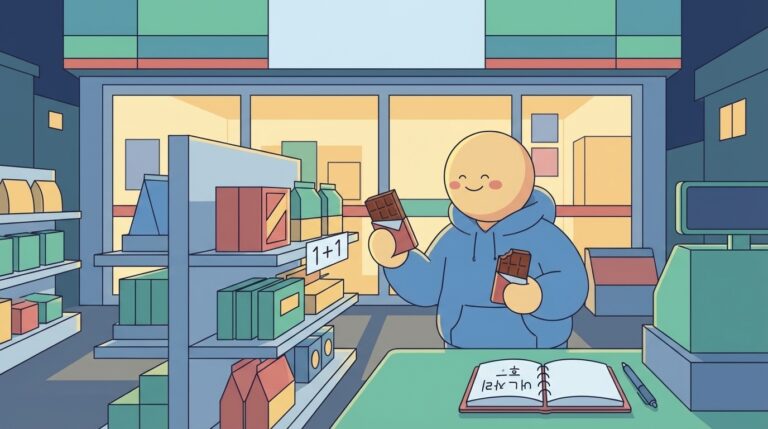
Picture this: It is 11 PM in Seoul. You just watched a K-Drama where the main characters, after a stressful day, sit under those iconic plastic convenience store umbrellas (편의점 파라솔). They are eating ramen and peeling open sweet chocolate bars. You feel inspired, so you walk into a brightly lit CU or GS25 near your hotel to grab a chocolate bar for yourself.
You find the chocolate aisle, pick up a bar of ‘Ghana’ chocolate, and head to the counter. The cashier scans it and suddenly asks you a question. You freeze. Was there a problem with your card? Did you do something wrong? Then, the cashier points to a colorful tag that says “2+1”.
Ah! You just missed out on free chocolate because you did not know the “magic words” of the Korean convenience store (K-CVS)!
If you only study textbook Korean, convenience stores can be surprisingly intimidating. But do not worry. As your local culture navigator, I am going to teach you the absolute basics (A1 level) of surviving a Korean convenience store, buying your favorite snacks, and never missing out on a sweet deal. This guide is built from the real panics and victories of my past students.
Phase 2: Core Expressions Deep Dive
Let’s learn the top 3 expressions you need when buying chocolate (or any snack) at a K-CVS!
1. 초콜릿 어딨어요? (Where is the chocolate?)
- Pronunciation: [chokollit eodisseoyo?] (Sounds like: choh-kohl-lit oh-dee-so-yo?)
- Meaning: Literal: Chocolate where is? / Real nuance: Excuse me, where can I find the chocolate?
- K-Culture Moment: You wander the aisles, overwhelmed by the sheer variety of snacks. You lock eyes with the part-time worker (알바생) arranging drinks. This is your go-to phrase to save time.
- Editor’s Insight: Notice there is no “you” or “I” in this sentence! In English, we say “Where do you keep the chocolate?” But Korean is all about context. Just name the item and add “eodisseoyo?” (where is it?). It is simple, effective, and perfectly polite.
- Situation Spectrum:
[🚫 Absolute No] ———— [⚠️ Caution] ———— [✅ Use Freely]
- To friends (Casual): ⚠️ (Drop the ‘yo’ and say ‘eodisseo?’)
- To a cashier (Polite): ✅
- To your boss (Formal): ⚠️ (A bit too casual for a strict boss, but fine for everyday interactions.)
- 🤔 Think About It: Why does Korean drop the subject (I, you) so often? Because Korean is a “High-Context” language. If you and the cashier both know you are looking for chocolate, saying “you” is considered unnecessary!
2. 이거 원플러스원이에요? (Is this 1+1?)
- Pronunciation: [igeo wonpeulleoseuwonieyo?] (Sounds like: ee-goh won-pluh-suh-won-ee-eh-yo?)
- Meaning: Literal: Is this one plus one? / Real nuance: Is this Buy One Get One Free?
- K-Culture Moment: You see a tag that says “1+1” under your favorite chocolate, but you want to make sure it applies to the specific flavor you chose.
- Editor’s Insight: “원플러스원” (One-plus-one) is classic “Konglish” (Korean-style English). If you say “Buy one get one free” in English, the cashier might panic. Just say “1+1” (won-plus-won) or “2+1” (two-plus-won) with a questioning tone!
- Situation Spectrum:
[🚫 Absolute No] ———— [⚠️ Caution] ———— [✅ Use Freely]
- To a cashier: ✅ (The ultimate money-saving question!)
- 🤔 Think About It: In many Western stores, things just go on sale for 50% off. Why do Korean stores prefer giving you an extra item (1+1) instead of a simple discount? Could it be related to the Korean culture of sharing?
3. 아니요, 괜찮아요. (No, thank you / I am okay.)
- Pronunciation: [aniyo, gwaenchanayo.] (Sounds like: ah-nee-yo, gwaen-chan-ah-yo)
- Meaning: Literal: No, it is okay. / Real nuance: No, I don’t need a bag/receipt, thank you.
- K-Culture Moment: You place your single chocolate bar on the counter. The cashier asks, “봉투 필요하세요?” (Do you need a bag?). You softly reply with this phrase and put the chocolate directly into your pocket.
- Editor’s Insight: Just saying “No” (아니요) can sound a bit cold or blunt in Korea. Adding “괜찮아요” (I am okay / It is fine) makes your refusal polite and soft. It is the perfect shield for any cashier question you want to say no to!
- Situation Spectrum:
[🚫 Absolute No] ———— [⚠️ Caution] ———— [✅ Use Freely]
- To a cashier: ✅
- To an elder offering food: ✅ (Very polite way to decline!)
Phase 3: Textbook vs. Real Korean
Let’s see how real life differs from your beginner textbooks!
| Situation | 📖 Textbook Korean | 🗣️ Real Korean | 💡 Why is it different? |
|---|---|---|---|
| Looking for an item | 과자 코너는 어디에 있습니까? (Where is the snack aisle?) | 초콜릿 어딨어요? (Where is the chocolate?) | Textbooks teach formal grammar, but real life favors quick, combined words (어디에 있어요 -> 어딨어요). |
| Asking about a discount | 할인이 되나요? (Is there a discount?) | 이거 원플러스원(1+1)이에요? (Is this 1+1?) | Convenience stores rarely do flat discounts; they rely heavily on 1+1 or 2+1 promotional events! |
| Declining a plastic bag | 아닙니다. 봉투는 필요 없습니다. (No. I do not need a bag.) | 아니요, 괜찮아요. (No, I’m okay.) | Koreans prefer indirect, softer refusals over blunt, direct rejections to maintain harmony. |
Bottom Note: As an A1 learner, you do not need long, complex sentences. A simple noun + “어딨어요?” (Where is…) or “괜찮아요” (It’s okay) will make you sound incredibly natural!
Phase 4: Cultural Context — K-Culture Deep Dive
4-1. Non-Verbal Tips (The Art of the K-CVS)
Do not just speak the language; act the language!
– The Two-Handed Handover: When handing your credit card to the cashier to pay for your chocolate, try using both hands, or support your right elbow with your left hand. This is a subtle sign of respect!
– Eye Contact & Nunchi: You do not need to maintain intense eye contact with the cashier. A polite nod when you enter and when you leave is perfect Korean “Nunchi” (social sense).
4-2. K-Drama Connection: The “CVS Therapy” Trope
Have you noticed how K-Drama leads always end up at a convenience store when they are heartbroken, stressed about work, or avoiding going home? The convenience store is not just a shop in Korea; it is a 24-hour safe haven.
When a character is furious, they might crush a can of beer. But when they are mildly stressed or studying hard, they always reach for sweet snacks—like a classic “Ghana” chocolate bar or a carton of “Choco Milk” (초코우유). Buying a 2+1 chocolate and handing one to your crush who happens to be sitting outside? That is a classic K-Drama romance starter!
Phase 5: Real-Life Roleplay Scenario
Let’s step into the scene. You are the main character now.
Setting: 10:30 PM. A quiet GS25 convenience store near Hongdae. You just finished a long day of touring and desperately need a sugar rush. You grab two bars of chocolate from a shelf that has a “2+1” sign.
Characters:
– YOU: An exhausted but excited traveler craving chocolate.
– Cashier (알바생): A 20-something university student working the night shift. He looks a bit tired but is friendly.
Action! 🎬
YOU: (Approaching the counter) 안녕하세요!
(annyeonghaseyo!)
[Hello!]
Cashier: 어서 오세요. (Scans the two chocolates) 삐- 삐-
(eoseo oseyo.)
[Welcome.]
Cashier: 손님, 이거 투플러스원(2+1) 행사 상품이에요. 하나 더 가져오세요.
(sonnim, igeo tupeulleoseuwon haengsa sampumieyo. hana deo gajyeooseyo.)
[Customer, this is a 2+1 promotion item. Please bring one more.]
(🎭 Stage Direction: The cashier points to the aisle, gesturing for you to get another one for free!)
YOU: 아! 진짜요?
(a! jinjjayo?)
[Ah! Really?]
Cashier: 네, 초콜릿 코너에 있어요.
(ne, chokollit koneoe isseoyo.)
[Yes, it is in the chocolate aisle.]
(🎭 Stage Direction: You run back, grab the 3rd chocolate, and put it on the counter. He scans it. 삐-)
Cashier: 봉투 필요하세요?
(bongtu piryohaseyo?)
[Do you need a bag?]
🔀 YOUR TURN! How do you answer?
– A) “아니요!” (No!)
– B) “아니요, 괜찮아요.” (No, I’m okay.)
– C) “네, 감사합니다.” (Yes, thank you.)✅ Best Choice: B or C!
If you brought an eco-bag or can put them in your pocket, B is the most natural, polite refusal. If you really need a plastic bag, choose C. (Note: Plastic bags usually cost 50 to 100 won!). Option A is a bit too blunt!
YOU: 아니요, 괜찮아요. 영수증 버려주세요.
(aniyo, gwaenchanayo. yeongsujeung beoryeojuseyo.)
[No, I’m okay. Please throw away the receipt.]
Cashier: 네, 결제되었습니다. 안녕히 가세요.
(ne, gyeoljedoeeotseumnida. annyeonghi gaseyo.)
[Yes, the payment is complete. Goodbye.]
Phase 6: 10-Second Shadowing Drill
Let’s practice speaking like a local. Read aloud, following the pauses (/) and the emotion tags!
🥺 Curious & Hopeful:
이거 / 원플러스원 / 이에요?
(igeo / won-pluh-suh-won / ieyo?)😊 Polite & Gentle waving of hands:
아니요, / 괜찮아요.
(aniyo, / gwaenchanayo.)
Phase 7: K-Culture Mini Dictionary
Here are some keywords you will see everywhere in Korea!
| Korean | Romanization | English | Context |
|---|---|---|---|
| 편의점 | pyeonuijeom | Convenience Store | The heart of Korean late-night culture (GS25, CU, 7-Eleven, Emart24). |
| 알바생 | albasaeng | Part-time worker | Usually young students working at cafes, restaurants, or CVS. |
| 원플러스원 | wonpeulleoseuwon | 1+1 (BOGO) | Buy one, get one free. The best tag to find! |
| 행사 상품 | haengsa sampum | Promotional Item | Items currently on discount or involved in a 1+1/2+1 deal. |
| 눈치 | nunchi | Social sense | Reading the room. In a CVS, it means having your card ready when there is a long line behind you! |
Phase 8: Traveler Survival Kit
If you are traveling to Korea, you will visit a convenience store. Save these flashcards to your phone!
🆘 Survival Phrases TOP 3
1. 🇰🇷 “이거 얼마예요?” (igeo eolmayeyo?)
– 🗣️ Meaning: How much is this?
– 📍 When to use: When the price tag is missing.
2. 🇰🇷 “카드 돼요?” (kadeu dwaeyo?)
– 🗣️ Meaning: Do you take cards?
– 📍 When to use: Almost everywhere in Korea, but good to ask if unsure.
3. 🇰🇷 “영수증 버려주세요.” (yeongsujeung beoryeojuseyo.)
– 🗣️ Meaning: Please throw away the receipt.
– 📍 When to use: To avoid a wallet full of paper!📌 Editor’s Travel Note:
– Payment: Korea is a cashless society! Your foreign Visa/Mastercard, or a rechargeable ‘T-money’ transit card, works perfectly to buy chocolate at any convenience store.
– Tipping: DO NOT TIP the cashier. There is no tipping culture in Korea. If you leave change on the counter, the cashier will run down the street to return it to you!
Phase 9: Critical Thinking — “One Step Deeper”
Food & Identity: The Psychology of “1+1”
🧠 Think Deeper:
Why are Korean convenience stores so obsessed with “1+1” and “2+1” deals instead of just offering a 50% discount? It goes deep into the Korean concept of Jeong (정)—a feeling of affection, bonding, and shared community.When you buy a “2+1” chocolate, you eat one, but what do you do with the others? You give them away! Handing a free chocolate bar to a coworker, a friend, or even the person sitting next to you in the library is a small, warm gesture of Jeong. The pricing strategy actually encourages the culture of sharing!
💬 Your Turn: Do stores in your country have “Buy One Get One” deals, or just simple discounts? Who would you give your ‘+1’ chocolate to? Share in the comments!
Phase 10: FAQ & Avoiding Misunderstandings
Q: If something is 1+1, do I just bring one to the counter and the cashier gives me the free one?
No! You must physically pick up TWO chocolates from the shelf and bring both to the scanner. If you only bring one, the cashier will tell you to go back and get the second one (like in our roleplay!).
Q: Can I eat my chocolate inside the store?
Yes! Most Korean convenience stores have a seating area with tables or a bar counter. You can eat, charge your phone, and relax.
❌ Common Mistake #1: Saying “아니요” (No) sharply when asked if you need a bag or a receipt.
✅ Do This Instead: Always soften it with “아니요, 괜찮아요” (No, I am okay). It shows great manners!
Phase 11: Summary & Action Items
🍫 One-Liner Summary: To master the Korean convenience store, remember to ask “어딨어요?” to find things, look out for “원플러스원” (1+1) deals, and politely say “괜찮아요” to refuse a bag!
Action Mission 3 Steps:
– 🥉 Bronze (Solo): Stand in front of a mirror and say “아니요, 괜찮아요” with a gentle smile and a small hand wave 3 times.
– 🥈 Silver (Online): Comment below: What is your favorite K-CVS snack? (Mine is definitely Pepero!)
– 🥇 Gold (Real Life): Next time you visit a Korean convenience store or an Asian supermarket, ask the staff “초콜릿 어딨어요?”
🍿 K-Culture Mission:
Watch one episode of any modern K-Drama today. I guarantee you will see a scene at a convenience store. Spot the colorful “1+1” or “2+1” price tags on the shelves behind the actors!
Phase 12: Quiz — Interactive Challenge
Let’s test your K-CVS survival skills!
1. Situational Judgment:
You are paying for your snacks. The cashier holds up a plastic bag and asks, “봉투 필요하세요?” You brought your own backpack. What is the most natural Korean response?
– A) 아닙니다. (No.)
– B) 아니요, 괜찮아요. (No, I am okay.)
– C) 초콜릿 어딨어요? (Where is the chocolate?)
2. True or False — K-Culture Edition:
You see a “1+1” sign under a Snickers bar. To get the deal, you only need to take ONE Snickers bar to the counter, and the cashier will magically produce the free one for you from under the desk. (T / F)
3. Fill in the Blank:
You want to ask if the chocolate you are holding is part of a Buy-One-Get-One-Free promotion.
“이거 _________ 이에요?”
(Check your answers by highlighting the invisible text below!)
[Answers: 1: B / 2: False (You must bring both items to the counter!) / 3: 원플러스원 (wonpeulleoseuwon)]
Frequently Asked Questions (FAQ)
Q: What does "초콜릿 어딨어요? (Where is the chocolate?)" mean in Korean and how do you pronounce it?
A: In Korean, "초콜릿 어딨어요? (Where is the chocolate?)" is pronounced [chokollit eodisseoyo?] and means: Literal: Chocolate where is? / Real nuance: Excuse me, where can I find the chocolate?
Q: What does "이거 원플러스원이에요? (Is this 1+1?)" mean in Korean and how do you pronounce it?
A: In Korean, "이거 원플러스원이에요? (Is this 1+1?)" is pronounced [igeo wonpeulleoseuwonieyo?] and means: Literal: Is this one plus one? / Real nuance: Is this Buy One Get One Free?
Q: What does "아니요, 괜찮아요. (No, thank you / I am okay.)" mean in Korean and how do you pronounce it?
A: In Korean, "아니요, 괜찮아요. (No, thank you / I am okay.)" is pronounced [aniyo, gwaenchanayo.] and means: Literal: No, it is okay. / Real nuance: No, I don't need a bag/receipt, thank you.







