

Phase 1: Empathy (Immersive Open)
Hello! This is the Lead Editor of Daily Hangul.
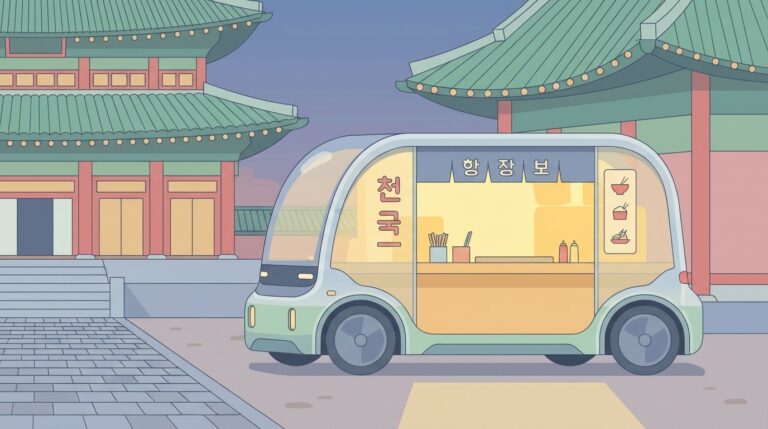
Imagine this: You are strolling through Seongsu-dong, the Brooklyn of Seoul. Amidst the renovated warehouses, a sleek, glass-walled autonomous vehicle silently glides to a stop. The doors slide open, revealing not passenger seats, but a fully operational, unmanned premium espresso bar. Or perhaps, you are on a K-Drama film set, and instead of a traditional ‘coffee truck’ (커피차) sent by fans, a high-tech Purpose-Built Vehicle (PBV) arrives, functioning as a mobile VR fan-meeting booth.
Welcome to the future of K-Mobility.
In Korea, the concept of Mobility Innovation (모빌리티 혁신), particularly Purpose-Built Vehicles (PBV – 목적 기반 모빌리티), is no longer just sci-fi; it is rapidly becoming part of the urban fabric. As an advanced (C2) Korean learner, you already know how to hail a taxi or ask for directions. But how do you intelligently discuss this paradigm shift in spatial utility with Korean tech professionals, trendsetters, or your local colleagues?
If you want to sound like an industry insider rather than a tourist, you need vocabulary that captures the philosophy behind the tech. Let’s dive into the sophisticated expressions that will make Koreans think, “Wow, this person truly understands the pulse of modern Seoul.”
Phase 2: Deep Dive into Core Expressions
To discuss PBVs fluently, we must shift our vocabulary from ‘transportation’ to ‘space’. Here are the top three expressions you need.
1. 단순한 이동 수단을 넘어, 공간의 혁신을 보여주네요.
- Pronunciation: [dansunhan idong sudaneul neomeo, gongganui hyeoksineul boyeojuneyo.] (Dan-soon-han ee-dong soo-dan-eul neo-meo, gong-gan-ui hyuk-shin-eul bo-yeo-joo-ne-yo.)
- Meaning: Literal: Beyond a simple means of movement, it shows the innovation of space. / Real Nuance: It’s not just a car; it’s a revolutionary use of space.
- K-Culture Moment: Picture a networking event at a Pangyo tech campus. A colleague points at a new autonomous mobile clinic. Saying “This car is nice” sounds elementary. Using this expression immediately positions you as a visionary thinker.
- Editor’s Insight: The phrase “단순한 ~을/를 넘어” (Going beyond a mere…) is a staple in high-level Korean rhetoric. It shows you can see the bigger picture.
- Situation Spectrum:
- Close Friends (Casual): ⚠️ (A bit too formal, unless you are having a deep intellectual debate)
- Colleagues (Semi-formal): ✅
- Boss/Seniors (Formal): ✅
- 🤔 Think About It: Korean professional discourse heavily values ‘innovation’ (혁신). Why do you think modern Korean society is so obsessed with constantly redefining the purpose of everyday objects?
2. 발길 닿는 곳 어디든 나만의 팝업스토어가 되는 셈이죠.
- Pronunciation: [balgil danneun got eodideun namanui papeopseuto-eoga doeneun semijyo.] (Bal-gil dah-neun got eo-di-deun na-man-ui pop-up-store-ga doe-neun sem-ee-jyo.)
- Meaning: Literal: Wherever your feet touch, it essentially becomes your own pop-up store. / Real Nuance: Wherever it goes, it instantly creates a custom pop-up experience.
- K-Culture Moment: K-Pop fandoms are famous for renting cafes to celebrate their idols’ birthdays. Now, imagine a fan club renting a PBV that acts as a moving merchandise store traversing Hongdae and Gangnam.
- Editor’s Insight: “~는 셈이죠” is an advanced grammatical structure meaning “it is practically…” or “you could say that…”. It softens a strong statement, making you sound incredibly natural and thoughtful.
- Situation Spectrum:
- Close Friends (Casual): ✅ (Drop the ‘요’: 셈이지)
- Colleagues (Semi-formal): ✅
- Boss/Seniors (Formal): ✅
- 🤔 Think About It: ‘발길 닿는 곳’ (wherever one’s feet reach) is a highly poetic native phrase contrasting beautifully with the tech-heavy ‘팝업스토어’. How does your language blend poetic idioms with modern tech terminology?
3. 사용자의 니즈에 맞춰 용도가 무한히 확장될 수 있어요.
- Pronunciation: [sayongjaui nijeue matchwo yongdoga muhanhi hwakjangdoel su isseoyo.] (Sa-yong-ja-ui needs-e match-wo yong-do-ga moo-han-hee hwak-jang-doel soo iss-eo-yo.)
- Meaning: Literal: Matched to the user’s needs, the usage can be infinitely expanded. / Real Nuance: Its applications are endlessly customizable depending on what the user wants.
- K-Culture Moment: Discussing Korea’s advanced delivery culture (배달의 민족). What if the vehicle isn’t just delivering food, but cooking it en route? This phrase perfectly describes the ultimate goal of PBVs.
- Editor’s Insight: Notice the use of the English loanword ‘니즈’ (needs). In Korean business and tech contexts, using ‘니즈’ instead of the pure Korean ‘요구’ sounds much more contemporary and corporate.
- Situation Spectrum:
- Close Friends (Casual): ⚠️ (A bit dry/academic)
- Colleagues (Semi-formal): ✅
- Boss/Seniors (Formal): ✅
- 🤔 Think About It: Korea is known for hyper-personalized services. Does this stem from the extreme competition in the market, or a cultural desire to make the ‘guest’ feel utterly special?
Phase 3: Textbook vs. Real Korean
Let’s look at how a textbook might explain these concepts versus how a Seoulite actually speaks in a business or trend-discussion setting.
| Situation | 📖 Textbook Korean | 🗣️ Real Korean | 💡 Why the difference? |
|---|---|---|---|
| Explaining a PBV’s function | 이 자동차는 여러 가지 목적으로 쓰입니다. (This car is used for various purposes.) | 목적에 따라 공간 커스터마이징이 가능한 모빌리티예요. | Real tech Korean heavily utilizes English loanwords (커스터마이징, 모빌리티) to convey industry-specific nuances instantly. |
| Praising an innovative idea | 아이디어가 아주 좋습니다. (The idea is very good.) | 진짜 발상의 전환이네요. 폼 미쳤다! (This is a true paradigm shift. The form is crazy!) | ‘발상의 전환’ is a sophisticated idiom, while ‘폼 미쳤다’ is a trendy slang praising extreme excellence. Mixing high-brow and slang is peak C2 level. |
| Discussing user experience | 사람들이 편하게 이용할 수 있습니다. (People can use it comfortably.) | 사용자 경험(UX)을 극대화한 맞춤형 서비스네요. | In advanced discussions, terms like ‘사용자 경험’ (UX) and ‘맞춤형’ (custom-fit) replace generic words like ‘편하다’ (comfortable). |
Bottom Note: At the C2 level, you aren’t just communicating facts; you are managing your professional persona. Using words like ‘공간 커스터마이징’ (space customizing) immediately establishes your credibility.
Phase 4: Cultural Context — K-Culture Deep Dive
4-1. Non-verbal Communication & ‘Nunchi’ in the Tech Era
Even when discussing futuristic technology, traditional Korean non-verbal cues apply. When passionately explaining an innovative concept like PBVs to a senior colleague, maintain a respectful posture. Avoid aggressive hand gestures. The Korean concept of Nunchi (눈치) in tech means reading the room—if the older executives seem skeptical about autonomous PBVs, soften your enthusiasm with phrases like, “물론 인프라 구축이 관건이겠지만요” (Of course, building the infrastructure is the key, though).
4-2. The Evolution of the ‘Coffee Truck’ (커피차) Culture
If you watch K-Dramas, you have undoubtedly seen the scene where a wealthy protagonist, or loyal fans, send a ‘Coffee Truck’ to a filming set. It is adorned with banners cheering the actors on.
Now, apply the PBV concept to this K-Culture staple. The future of the ‘Coffee Truck’ is a fully autonomous, unmanned PBV cafe. Fans won’t just send coffee; they will send an immersive, moving spatial experience equipped with digital screens playing the idol’s music videos.
Critical Viewpoint: While Dramas romanticize these mobile trucks as spontaneous acts of love, in reality, operating them involves strict municipal regulations and permits. The integration of PBVs in daily life will face similar bureaucratic hurdles in Korea, balancing rapid technological ambition with strict legal frameworks.
Phase 5: Real-Life Roleplay Scenario
Scenario A: The Tech Expo Networking
- Setting: Friday afternoon, 3 PM. Inside the sprawling COEX Exhibition Center in Gangnam. Neon lights reflect off the sleek metallic surface of a newly unveiled PBV prototype designed to be a mobile pop-up makeup studio. You are attending a mobility expo with a Korean business partner.
- Characters:
- YOU: An expatriate tech consultant who has lived in Seoul for 5 years. You know your stuff.
- Ji-yoon (34, Female): Your Korean business partner. Sharp, trend-conscious, and a big fan of K-Beauty.
Dialogue:
Ji-yoon: 와, 저거 보세요. 자동차 안에 완전한 메이크업 스튜디오가 들어갔네요.
(Wa, jeogeo boseyo. jadongcha ane wanjeonhan meikeueop seutyudioga deureoganneyo.)
[English] Wow, look at that. A complete makeup studio fits right inside the car.
(🎭 Stage Direction: Ji-yoon points at the PBV with wide eyes, pulling out her smartphone to take a picture)
YOU: 그러게요. 단순한 이동 수단을 넘어, 공간의 혁신을 보여주네요.
(Geureogeyo. Dansunhan idong sudaneul neomeo, gongganui hyeoksineul boyeojuneyo.)
[English] I know, right. Beyond a simple means of movement, it shows the innovation of space.
Ji-yoon: 맞아요. 올리브영 같은 브랜드가 저런 PBV를 활용하면 대박일 것 같지 않아요?
(Majayo. Ollibuyeong gateun beuraendeuga jeoreon PBV-reul hwaryonghamyeon daebagil geot gatji anayo?)
[English] Exactly. Don’t you think it would be a massive hit if brands like Olive Young utilized a PBV like that?
YOU: 확실히 그렇겠네요. 발길 닿는 곳 어디든 나만의 팝업스토어가 되는 셈이니까요.
(Hwaksilhi geureokenneyo. Balgil danneun got eodideun namanui papeopseuto-eoga doeneun sem-inikkayo.)
[English] It certainly would. Because wherever it goes, it essentially becomes a custom pop-up store.
Ji-yoon: 근데 외국인 관광객들도 저런 무인 서비스를 쉽게 이용할 수 있을까요?
(Geunde oegugin gwangwanggaekdeuldo jeoreon muin seobiseureul swipge iyonghal su isseulkkayo?)
[English] But do you think foreign tourists would be able to easily use such unmanned services?
🔀 Your Turn! How do you answer?
– A) “물론이죠. 사용하기 편해요.” (Of course. It’s easy to use.)
– B) “언어 장벽만 해결된다면, 사용자의 니즈에 맞춰 용도가 무한히 확장될 수 있어요.”
– C) “한국은 배달의 민족이니까 다 잘할 거예요!” (Korea is the nation of delivery, so they’ll do everything well!)✅ Best Choice: B — Reason: You are at a business expo. Choice B utilizes advanced vocabulary and directly addresses the potential of PBVs while acknowledging a practical hurdle (language barrier). It screams C2 fluency.
⚠️ Choice A & C Analysis: ‘A’ is too elementary (A2/B1 level). ‘C’ is witty and shows cultural knowledge, but might be too casual for a professional networking environment.
Scenario B: The Fan-Meeting PBV Surprise
A quick bonus situation! You are at a park by the Han River. A futuristic pod stops in front of a crowd. It’s a surprise PBV event by your favorite K-Pop group!
Fan next to you: 대박! 커피차가 아니라 아예 달리는 전시관이 왔네요!
YOU: 진짜 발상의 전환이네요! 공간 활용도 폼 미쳤다!
Fan next to you: 그니까요! 안에서 VR로 오빠들 볼 수 있대요. 빨리 줄 서요!
Phase 6: 10-Second Shadowing Drill
Speak out loud! Focus on the pauses (/) and the intonation.
😲 이건 / 단순한 이동 수단을 넘어, / 공간의 혁~~신을 / 보여주는 사례입니다.
(i-geon / dan-sun-han i-dong su-dan-eul neo-meo, / gong-gan-ui hyeok~~sin-eul / bo-yeo-ju-neun sa-rye-im-ni-da.)
- Emotion: 😲 Impressed and professional.
- Pro Tip: Lengthen the ‘혁’ (hyeok) slightly to emphasize the ‘innovation’. Drop your pitch at ‘사례입니다’ (sa-rye-im-ni-da) to sound authoritative and confident.
Phase 7: K-Culture Mini Dictionary
| Korean | Romanization | English | Contextual Explanation |
|---|---|---|---|
| 모빌리티 | mo-bil-li-ti | Mobility | In Korea, this word doesn’t just mean moving around; it represents the entire tech industry of future transportation (Uber, Kakao T, PBVs, autonomous driving). |
| 팝업스토어 | pa-beop-seu-to-eo | Pop-up Store | A massive trend in Seoul (especially Seongsu and Yeouido). Temporary retail spaces designed for highly photogenic, experiential marketing. |
| 맞춤형 | mat-chum-hyeong | Customized / Tailor-made | Koreans love ‘customized’ experiences, from skincare to algorithms. PBVs are the ultimate ‘맞춤형’ spatial solution. |
| 발상의 전환 | bal-sang-ui jeon-hwan | Paradigm shift / Thinking outside the box | A highly regarded professional trait in corporate Korea, moving away from traditional methods to innovative solutions. |
| 커피차 | keo-pi-cha | Coffee truck | A symbol of support sent to filming sets or offices. The cultural precursor to the future ‘purpose-built’ mobile hospitality vehicles. |
Phase 8: Traveler Survival Kit
Even if autonomous PBVs are still in the pilot phase, Korea’s mobility innovation is already everywhere. Here is how you navigate the current cutting-edge mobility services as an advanced traveler.
🆘 Survival Phrases for Advanced Mobility
– 🇰🇷 “자율주행 셔틀은 어디서 탑승하나요?” (ja-yul-ju-haeng syeo-teul-eun eo-di-seo tap-seung-ha-na-yo?)
– 🗣️ Meaning: Where do I board the autonomous shuttle?
– 📍 Where to use: Cheonggyecheon Stream or Sangam-dong where autonomous shuttles are currently operating.
– 💡 Pro Tip: In Seoul, use apps like ‘Kakao T’ or ‘Tmoney GO’ to book specialized mobility services. When riding a premium ‘Kakao T Venti’ (a precursor to PBV-style spacious mobility), you can even preset your preference for ‘Quiet Ride’ (조용히 가기) on the app.
📌 Editor’s Travel Note
– Tech Hubs: Want to see the future of K-Mobility? Visit Pangyo Techno Valley or the Hyundai Motorstudio in Goyang.
– Cash vs. App: Future mobility in Korea is 100% cashless. Make sure your international card is linked to local transit/mobility apps, or carry a loaded Namane/Tmoney card.
Phase 9: Critical Thinking — “One Step Deeper”
🧠 Think Deeper: Global Era & The “Pali-Pali” Society’s Spatial Evolution
Korea’s fascination with PBVs (Purpose-Built Vehicles) is intimately tied to its unique urban geography and the famous “Pali-Pali” (hurry up) culture. In hyper-dense cities like Seoul, real estate is astronomically expensive, and consumers demand immediate, customized gratification (evident in the world-class delivery apps). Therefore, the logical next step isn’t just delivering a product quickly, but delivering the entire space to the consumer. PBVs represent the ultimate democratization of premium spaces. Instead of traveling an hour to a high-end clinic or an exclusive pop-up store, the architecture itself becomes fluid, coming to you. This reflects a society that refuses to let physical constraints slow down the speed of life.💬 Your Turn: In your home country, do people prefer to travel to a specific destination for an experience, or do you see a trend of services coming to the user? Share your thoughts below!
Phase 10: FAQ & Avoiding Mistakes
Q: When talking about a PBV, should I just call it a ‘차’ (car)?
At a C2 level, if you are discussing the concept professionally, use ‘모빌리티’ (mobility) or ‘이동형 공간’ (mobile space). Calling a multi-million dollar autonomous moving medical clinic simply “이 차” (this car) diminishes the tech nuance.
Q: Is it okay to use English loanwords like ‘니즈’ or ‘커스터마이징’ with older executives?
Yes! In fact, in the Korean corporate and tech world, older executives use these terms extensively. It signals that you are in tune with modern business jargon. However, avoid using excessive casual English slang.
❌ Common Mistake #1: Translating “It’s a good vehicle” literally as “이것은 좋은 차량입니다.”
✅ Do this instead: To sound like a native professional, say “공간 활용도가 뛰어난 모빌리티네요” (It’s a mobility solution with outstanding spatial utility).
Phase 11: Summary & Action Items
- One-Liner Summary: Mastering the vocabulary of “Space and Innovation” (공간과 혁신) will elevate your Korean from a casual speaker to a visionary local insider when discussing Korea’s PBV mobility trend.
-
Action Mission 3 Steps:
- 🥉 Bronze (Solo): Look at a picture of a food truck and describe it out loud using today’s expression: “단순한 이동 수단을 넘어…”
- 🥈 Silver (Online): Leave a comment on a Korean YouTube video about future tech (like Hyundai’s PBV vision) using “발상의 전환이네요!”
- 🥇 Gold (Real World): Next time you take a Kakao T Venti or a premium mobility service in Seoul, strike up a conversation with the driver or your companion about how mobility spaces are changing.
- K-Culture Mission: Watch a modern tech-focused K-Drama (like Start-Up). Whenever they discuss new apps or AI, listen closely for words like ‘혁신’ (innovation) and ‘니즈’ (needs). How often do they use them?
Engagement: What kind of PBV would you design for yourself? A moving library? A mobile karaoke room? Let us know in the comments!
Phase 12: Interactive Challenge (Quiz)
1. Situational Judgment: You are at a mobility conference in Seoul. A presenter unveils a PBV that acts as a moving pet-grooming salon. What is the most C2-appropriate compliment?
– A) 차가 아주 귀여워요! (The car is very cute!)
– B) 강아지들이 좋아하겠네요. (The dogs will like it.)
– C) 사용자의 니즈에 맞춘 완벽한 발상의 전환이네요. (It’s a perfect paradigm shift tailored to the user’s needs.)
2. Fill in the Blank:
“이 자동차는 단순한 이동 수단을 ( _____ ), 완벽한 나만의 휴식 공간이 됩니다.”
– Hint: A grammatical structure meaning ‘going beyond…’
3. True or False (K-Culture Edition):
The concept of a ‘mobile space’ delivering services to users is completely alien to Korean culture and only started with modern tech.
– T / F
(Answers: 1. C (A and B are too basic for a conference), 2. 넘어 (neomeo), 3. False. The heavy reliance on delivery services (배달) and fan ‘coffee trucks’ laid the cultural groundwork for PBV acceptance!)
Frequently Asked Questions (FAQ)
Q: What does "단순한 이동 수단을 넘어, 공간의 혁신을 보여주네요." mean in Korean and how do you pronounce it?
A: In Korean, "단순한 이동 수단을 넘어, 공간의 혁신을 보여주네요." is pronounced [dansunhan idong sudaneul neomeo, gongganui hyeoksineul boyeojuneyo.] and means: Literal: Beyond a simple means of movement, it shows the innovation of space. / Real Nuance: It's not just a car; it's a revolutionary use of space.
Q: What does "발길 닿는 곳 어디든 나만의 팝업스토어가 되는 셈이죠." mean in Korean and how do you pronounce it?
A: In Korean, "발길 닿는 곳 어디든 나만의 팝업스토어가 되는 셈이죠." is pronounced [balgil danneun got eodideun namanui papeopseuto-eoga doeneun semijyo.] and means: Literal: Wherever your feet touch, it essentially becomes your own pop-up store. / Real Nuance: Wherever it goes, it instantly creates a custom pop-up experience.
Q: What does "사용자의 니즈에 맞춰 용도가 무한히 확장될 수 있어요." mean in Korean and how do you pronounce it?
A: In Korean, "사용자의 니즈에 맞춰 용도가 무한히 확장될 수 있어요." is pronounced [sayongjaui nijeue matchwo yongdoga muhanhi hwakjangdoel su isseoyo.] and means: Literal: Matched to the user's needs, the usage can be infinitely expanded. / Real Nuance: Its applications are endlessly customizable depending on what the user wants.







