

Phase 1: Empathy (The K-Drama Cold Open)
Hello there! It’s your Daily Hangul Editor.
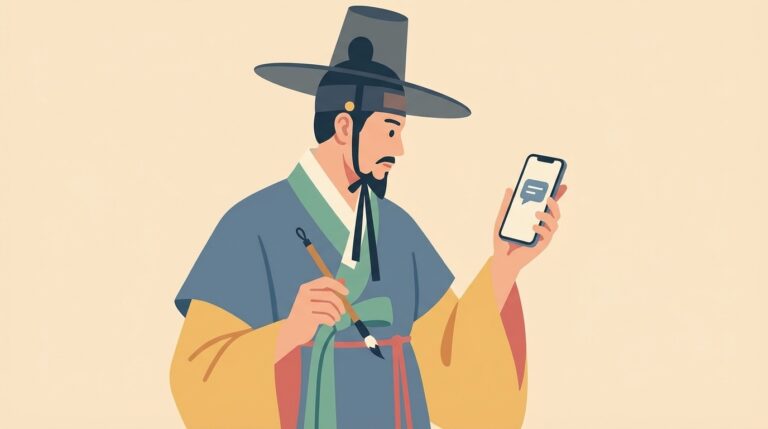
Picture this: You’re watching a traditional Korean historical drama (Sageuk, 사극). The King, clad in a majestic red robe, makes a minor, embarrassing mistake—perhaps he trips and falls off his horse. Flushing red, he glares at the man sitting quietly in the corner with a brush and paper. “Do not write about this,” the King commands. The man bows… and then meticulously writes down: ‘The King fell off his horse and ordered me not to write about it.’
This isn’t just a funny K-Drama trope; it’s a real historical event involving King Taejong! The man with the brush was a 사관 (Sagwan, Scribe), and the document he was creating became part of the 조선 왕조 실록 (Joseon Wangjo Sillok, The Annals of the Joseon Dynasty), a UNESCO World Heritage site and one of the most detailed, unfiltered historical records in human history.
Why does this matter to you as an advanced Korean learner? Because understanding this ancient obsession with ‘recording the truth’ unlocks the psychology behind modern Korean internet culture, workplace dynamics, and even the way Koreans argue! If you’ve ever wondered why Korean fans are so quick to bring up “receipts” (screenshots of past actions), or why workplace meeting minutes are taken so seriously, you are about to find out.
This article is built on the real “Aha!” moments of my advanced (C1) students who realized that Korean history directly dictates modern linguistic habits.
Phase 2: Core Expressions Deep Dive
To understand the spirit of the Joseon Annals, let’s look at how the concept of “recording” evolves from ancient times to modern slang.
1. 사관 (Scribe / Historian)
- Pronunciation: [sagwan] (Sounds like sah-gwan, with a soft ‘g’)
- Meaning: (Literal) Scribe/Historian / (Real Nuance) An impartial observer, or in modern slang, someone who documents an event meticulously.
- K-Culture Moment: In modern universities or workplaces, the person designated to type up the meeting minutes is often jokingly called the “modern-day Sagwan.”
- Editor’s Insight: This word carries weight. A true Sagwan in Joseon feared the judgment of history more than the blade of the King. When someone calls you a 사관 today, it implies you are highly observant and detail-oriented.
- Situation Spectrum:
- Close Friends (Casual): ✅ (Playful tease: “Are you a scribe? Why are you writing down my drunken mistakes?”)
- Coworkers (Semi-formal): ✅ (Joking about meeting minutes)
- Boss/Elders (Formal): ⚠️ (Use carefully; might sound a bit overly dramatic)
- 🤔 Think About It: Does your culture have a specific archetype for someone who tells the truth to power, solely relying on the act of recording?
2. 가감 없이 기록하다 (To record without adding or subtracting)
- Pronunciation: [gagam eopsi girokada] (Sounds like gah-gahm opp-shee gee-rok-ha-da)
- Meaning: (Literal) To record without addition or subtraction / (Real Nuance) To document the unvarnished, objective truth.
- K-Culture Moment: You’ll hear this in news reports, documentaries, or during serious corporate audits. It’s the exact principle the Joseon scribes followed—even when it meant risking their lives.
- Editor’s Insight: This is a very C1-level academic phrase. Using gagam eopsi (without addition or subtraction) immediately elevates your Korean to a highly professional level.
- Situation Spectrum:
- Close Friends (Casual): 🚫 (Too stiff)
- Coworkers (Semi-formal): ⚠️ (Good for formal presentations)
- Boss/Elders (Formal): ✅ (Perfect for professional reporting)
- 🤔 Think About It: Why is neutrality so highly prized in Korean historical contexts, yet modern media can be so polarized?
3. 박제하다 (To taxidermy / To screenshot for proof)
- Pronunciation: [bakjehada] (Sounds like bahk-jeh-ha-da)
- Meaning: (Literal) To stuff/taxidermy an animal / (Real Nuance) To screenshot or permanently save someone’s text, post, or photo before they can delete it, ensuring the evidence lives on forever.
- K-Culture Moment: This is the absolute modern internet equivalent of the Joseon Annals! If an idol makes a slight spoiler on a live stream, fans will instantly “bakje” it. If someone makes a controversial tweet and deletes it 3 seconds later, someone has already “taxidermied” it.
- Editor’s Insight: The Joseon scribes couldn’t “screenshot,” but their relentless note-taking was the 15th-century version of bakje. Using this slang correctly makes you sound incredibly fluent in modern Korean internet culture.
- Situation Spectrum:
- Close Friends (Casual): ✅
- Coworkers (Semi-formal): ⚠️ (Only with close, younger colleagues)
- Boss/Elders (Formal): 🚫 (Never!)
- 🤔 Think About It: The concept of ‘saving receipts’ exists globally, but comparing it to ‘taxidermy’ is uniquely Korean. What does this visceral metaphor say about the permanence of the internet?
Phase 3: Textbook vs. Real Korean
How do we talk about documenting things in real life versus what the textbook teaches?
| Situation | 📖 Textbook Korean | 🗣️ Real, Lived Korean | 💡 Why the difference? |
|---|---|---|---|
| Writing down a friend’s funny mistake | “친구의 실수를 기록했습니다.” (I recorded my friend’s mistake.) | “야, 이거 박제각이다.” (Hey, this is totally screenshot-worthy.) | ‘박제’ (taxidermy) emphasizes the digital permanence and the teasing nature of modern friendships. |
| Taking notes at a meeting | “회의 내용을 적어주세요.” (Please write down the meeting details.) | “오늘 회의록 사관 누구야?” (Who’s the scribe for today’s meeting?) | Using historical metaphors adds a touch of dramatic humor to mundane office tasks. |
| Telling the absolute truth | “사실만을 말하겠습니다.” (I will only speak the facts.) | “가감 없이 팩트 폭행할게.” (I’m going to fact-bomb you without filtering.) | Blending a formal Hanja phrase (가감 없이) with internet slang (팩폭 – fact violence) is a common C1 level rhetorical device. |
Phase 4: Cultural Context — K-Culture Deep Dive
4-1. The Non-Verbal “Scribe Stare” (눈치 vs. 원칙)
In Korean culture, Nunchi (reading the room) is usually paramount. However, the Scribe (사관) was the sole exception to this rule. A true scribe possessed zero Nunchi by design; their duty was strictly to the truth, not to the King’s feelings. Today, when you are doing a formal audit or taking official minutes, adopting a neutral, emotionless “scribe face”—avoiding direct, intimidating eye contact but never looking away from your notepad—signals your professionalism.
4-2. The K-Pop Connection: Fandoms as Modern Scribes
If the Joseon Dynasty had the Sillok, modern K-Pop has the Fandom Archives. K-Pop fans are meticulous historians. Every V-Live, every off-hand comment, every outfit worn at airports is categorized, translated, and archived globally. When an idol says, “I promise I’ll do a live stream next week,” the fans will reply, “박제 완료!” (Taxidermy complete / Screenshot taken!). The fans hold the idols accountable through these records, much like the scribes held the kings accountable for their actions and promises.
Phase 5: Interactive Roleplay Scenario
Setting: A sleek corporate boardroom in Gangnam. It’s 4 PM on a Friday. You are the newest member of the marketing team, and you’ve been tasked with writing the official meeting minutes (회의록).
Characters:
– YOU (The Reader): A competent foreign professional. Your Korean is great, but navigating office politics is a delicate art.
– Team Leader Choi (45): A bit old-school, likes to make grand statements, sometimes goes off-topic.
– Jimin (28): Your friendly coworker who sits next to you.
(The meeting is dragging on. Team Leader Choi is talking about a failed campaign.)
Team Leader Choi: 솔직히 이번 프로젝트는 타 부서에서 협조를 안 해서 망한 거지. 안 그래요?
(Soljiki ibeon peurojekteuneun ta buseo-eseo hyeopjoreul an haeseo manghan geoji. An geuraeyo?)
[Translation: Honestly, this project failed because the other departments didn’t cooperate. Right?]
(🎭 Stage Direction: Choi sighs and leans back, clearly venting off the record.)
Jimin: (Whispering to you) 저거 회의록에 쓰면 큰일 나요.
(Jeogeo hoeuiroge sseumyeon keunil nayo.)
[Translation: We’re in big trouble if you write that in the minutes.]
Team Leader Choi: 00씨, 방금 내가 한 말도 가감 없이 다 기록하고 있죠? 하하!
(00-ssi, banggeum naega han maldo gagam eopsi da girokago itjyo? Haha!)
[Translation: You’re recording everything I just said without filtering, right? Haha!]
🔀 Your Turn! How do you respond to the boss?
– A) “네, 사관처럼 한 글자도 빠짐없이 적었습니다!” (Yes, like a scribe, I wrote every single letter!)
– B) “아유, 팀장님의 빛나는 아이디어만 필터링해서 적고 있습니다.” (Oh, I’m only filtering and writing down your brilliant ideas, Team Leader.)
– C) “아니요, 욕설은 빼고 적었습니다.” (No, I left out the profanity.)✅ Best Choice: B — Reason: It shows excellent Nunchi. It playfully acknowledges his venting while reassuring him that the official document won’t get him fired. It’s the perfect mix of C1-level vocabulary and social grace.
⚠️ Choice A Analysis: While funny, if he has a moment of panic thinking you actually wrote his complaint down, it could cause unnecessary anxiety.
Phase 6: 10-Second Shadowing Drill
Channel your inner Joseon historian or modern-day internet archivist! Pay attention to the pauses.
😤 전하! / 역사에 / 어떻게 기록될지 / 두렵지 않으십니까?
(Jeonha! / yeoksa-e / eotteoke girokdoelji / duryeopji aneuseumnikka?)
[Translation: Your Majesty! Are you not afraid of how this will be recorded in history?]
(Pro-tip: Drop your voice an octave and speak slowly to sound like a dramatic Sageuk actor!)
😊 제가 / 방금 하신 말씀, / 캡처해서 / 박제했습니다~
(Jega / banggeum hasin malsseum, / kaepcheohaeseo / bakjehaetseumnida~)
[Translation: I took a screenshot of what you just said and preserved it~]
(Pro-tip: Say this with a playful, teasing smile to a friend.)
Phase 7: K-Culture Mini Dictionary
| Korean | Romanization | English | Cultural Context |
|---|---|---|---|
| 사극 | sageuk | Historical Drama | The genre where you will see the Joseon scribes at work. Famous for complex, archaic Korean. |
| 팩트 폭행 (팩폭) | paekteu pokhaeng (paekpok) | Fact-bombing | Using undeniable truth/records to win an argument, often leaving the other person speechless. |
| 흑역사 | heugyeoksa | Dark History | An embarrassing past event you wish you could delete, but someone likely ‘taxidermied’ (박제) it. |
| 뇌피셜 | noepisyeol | Brain-official | A claim made without evidence (records), strictly based on one’s own thoughts. The opposite of the Sillok! |
Phase 8: Traveler Survival Kit (Historical Edition)
If you’re fascinated by the Joseon Annals, you will likely visit the grand palaces of Seoul (like Gyeongbokgung) or historical museums. Here are the survival phrases you need to enrich your historical journey.
🆘 Survival Phrases for the History Buff
– 🇰🇷 “한국어 오디오 가이드 있나요?” (Hangugeo odio gaideu innayo?)
– 🗣️ English: Do you have a Korean audio guide?
– 📍 Where to use: Palaces, National Museum of Korea.
– 💡 Pro Tip: At the C1 level, try listening to the native Korean audio guide instead of the English one. The vocabulary is rich and challenging!
- 🇰🇷 “이거 사진 찍어도 되나요?” (Igeo sajin jjigeodo doenayo?)
- 🗣️ English: Is it okay to take a picture of this?
- 📍 Where to use: Inside museum exhibits (where some ancient records are light-sensitive).
📌 Editor’s Travel Note
– Recording your trip: Koreans love documenting everything on travel vlogs or Instagram. Don’t be shy about setting up a tripod at a palace, but be mindful of blocking pathways.
– Palace Tip: If you wear a Hanbok (traditional Korean clothing), entrance to the major palaces is free! It’s the perfect time to snap a photo and “bakje” your memories.
Phase 9: Critical Thinking — “One Step Deeper”
🧠 Think Deeper: Language & Power (The Independence of the Written Word)
The most remarkable aspect of the Joseon Annals is that even the King was not allowed to read them while he was alive. This institutional rule was designed to prevent rulers from abusing their power to alter history. The Scribes (사관) possessed a unique form of linguistic power: the power of ultimate accountability. In modern Korea, this spirit lives on in the intense demand for transparency, investigative journalism, and the citizen-led documentation of political events. The linguistic shift from honoring the king’s words to honoring the objective record shows a society that fundamentally values the truth over absolute authority.💬 Your Turn: In your home country, how is political or social history documented? Is there a culture of keeping leaders accountable through meticulous recording? Share your thoughts in the comments below!
Phase 10: FAQ & Avoiding Common Mistakes
Q: If I’m recording a conversation or a lecture in Korea, what’s the etiquette?
A: Legally and socially, Korea is very strict about privacy and voice recording without consent, especially in a professional or public setting. Always ask: “기록을 위해 녹음해도 될까요?” (May I record this for documentation purposes?).
Q: Can I use “박제하다” (taxidermy/screenshot) with my professor or boss?
A: Absolutely not. It is internet slang and carries a slightly confrontational or teasing vibe. Stick to “기록해 두었습니다” (I have noted/recorded it) in formal situations.
❌ Common Mistake:
Trying to speak like a Sageuk actor in real life. While saying “전하, 통촉하여 주시옵소서” (Your Majesty, please reconsider) is hilarious with close friends at a bar when they make a bad decision, using archaic historical verb endings (like ~사옵니다) with strangers will just confuse them. Keep the drama on the screen!
Phase 11: Summary & Action Items
One-Liner Summary: The meticulous, truth-obsessed spirit of the Joseon scribes lives on in Korea’s modern “receipt-keeping” internet culture and professional communication.
Action Mission:
– 🥉 Bronze (Solo): Stand in front of a mirror and dramatically declare the 10-second shadowing sentence: “전하! 역사에 어떻게 기록될지 두렵지 않으십니까?”
– 🥈 Silver (Online): Find a funny or cute photo of your favorite K-Pop idol or actor online and leave a comment saying “이 귀여움은 박제해야 해!” (This cuteness must be taxidermied/saved!).
– 🥇 Gold (Real Life): The next time you are studying Korean or taking notes during a class, write “가감 없이 기록 중” (Recording without addition or subtraction) at the top of your notebook to channel the focus of a Joseon scribe.
K-Culture Mission: Watch an episode of Rookie Historian Goo Hae-ryung (신입사관 구해령) on Netflix. Pay close attention to how the scribes interact with the royal family. Do you notice the tension between absolute power and the power of the written word?
What’s the most embarrassing moment you wish you could erase from your own “personal annals”? Let’s chat in the comments! 👇
Phase 12: Interactive Challenge (Quiz)
1. Situational Judgment: Your favorite idol accidentally reveals the name of their upcoming title track during a live stream, then gasps and covers their mouth. What is the most appropriate Korean fandom response?
– A) 사관님, 기록을 지워주세요.
– B) 이미 박제 완료!
– C) 가감 없이 팩트 폭행합니다.
2. True or False — K-Culture Edition:
In the Joseon Dynasty, the King frequently read the Annals (Sillok) to ensure the scribes were writing good things about him.
3. Fill in the Blank:
To describe a terrible, embarrassing middle school photo that you wish didn’t exist, you would call it your _________ (Dark History).
(Toggle for Answers below)
Click here to reveal answers!
1. Answer: B. Fans will immediately say “Already screenshotted/saved!” (박제 완료).
2. Answer: False. The King was strictly forbidden from reading the Annals to protect the scribes’ freedom of speech and the objectivity of the historical record.
3. Answer: 흑역사 (heugyeoksa).
Frequently Asked Questions (FAQ)
Q: What does "사관 (Scribe / Historian)" mean in Korean and how do you pronounce it?
A: In Korean, "사관 (Scribe / Historian)" is pronounced [sagwan] and means: (Literal) Scribe/Historian / (Real Nuance) An impartial observer, or in modern slang, someone who documents an event meticulously.
Q: What does "가감 없이 기록하다 (To record without adding or subtracting)" mean in Korean and how do you pronounce it?
A: In Korean, "가감 없이 기록하다 (To record without adding or subtracting)" is pronounced [gagam eopsi girokada] and means: (Literal) To record without addition or subtraction / (Real Nuance) To document the unvarnished, objective truth.
Q: What does "박제하다 (To taxidermy / To screenshot for proof)" mean in Korean and how do you pronounce it?
A: In Korean, "박제하다 (To taxidermy / To screenshot for proof)" is pronounced [bakjehada] and means: (Literal) To stuff/taxidermy an animal / (Real Nuance) To screenshot or permanently save someone's text, post, or photo before they can delete it, ensuring the evidence lives on forever.







