

Phase 1: Empathy (The K-Culture Cold Open)
Hello! I’m the lead editor at Daily Hangul.
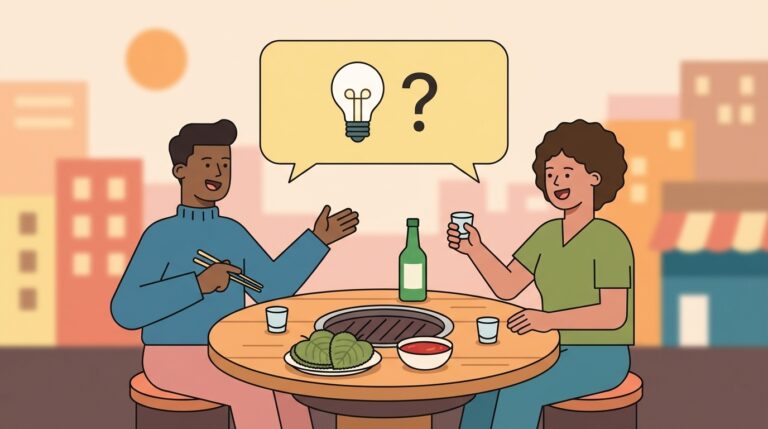
Picture this: It’s Friday evening, and you’re at a bustling Samgyeopsal (Korean BBQ) restaurant in Gangnam. The Soju is flowing, the meat is sizzling, and suddenly, one of your Korean colleagues brings up a hot topic—maybe it’s the infamous ‘Perilla Leaf Debate’ (깻잎 논쟁) or whether mint chocolate tastes like toothpaste. Everyone at the table is passionately throwing arguments back and forth. You have a brilliant counter-argument! You want to jump in and say, “I completely disagree, and here is why…”
But when you open your mouth, all that comes out is: “아니요, 안 좋아요.” (No, not good.)
Frustrating, isn’t it? When you’re at an intermediate (B2) level, you understand what’s going on, but your vocabulary often limits your ability to express complex logic. Textbooks teach you formal phrases like “저는 반대합니다” (I oppose), but say that at a casual dinner, and everyone will freeze, thinking you’re actually angry.
Today, I’m going to teach you how to argue, persuade, and express your opinions like a sophisticated—yet socially savvy—Korean local. This guide is based on real struggles my B2 students faced when trying to survive Korean work dinners and university group projects.
Phase 2: Core Expressions Deep Dive
Let’s look at the smartest ways to present your arguments without breaking the ‘Nunchi’ (social harmony).
1. 그 말씀도 일리가 있지만…
- Pronunciation: geu malsseumdo illiga itjiman…
- Sound-alike guide: ‘illi’ sounds like ‘Eel-lee’ (like the fish, then Lee).
- Meaning: What you’re saying makes sense, but… (Literal: Your words also have some reason, but…)
- K-Culture Moment: You’ll see this in every corporate K-Drama (like Misaeng or Start-Up). The smart underdog employee never says “You’re wrong” to the boss. They nod respectfully and say, “Manager, what you say makes perfect sense, BUT…” before dropping a massive counter-argument.
- Editor’s Insight: This is the ultimate Korean conversation buffer. ‘일리(一理)’ means ‘one reason’ or ‘some validity’. Acknowledging the other person’s point first is the golden rule of Korean debates.
- Situation Spectrum:
- Casual (Friends): ✅ (Usually shortened to “네 말도 맞는데…”)
- Semi-formal (Co-workers): ✅
- Formal (Boss/Elders): ✅
- 🤔 Think About It: Why do Koreans prioritize validating the opponent’s opinion before disagreeing? How does this reflect the cultural value of ‘Chemyon’ (saving face)?
2. ~다는 점에서 저는 반대/찬성합니다.
- Pronunciation: ~daneun jeom-eseo jeoneun bandae/chanseong-hamnida.
- Sound-alike guide: ‘jeom’ sounds like ‘jum’ (like jump without the p).
- Meaning: I disagree/agree on the grounds that… (Literal: From the point that ~, I disagree/agree.)
- K-Culture Moment: This is your university group project (팀플) lifesaver. When everyone is arguing emotionally, you step in with this structure. It instantly makes you sound like a logical, highly educated professional.
- Editor’s Insight: At the B2 level, you need to move beyond simple “왜냐하면” (because). Using “~다는 점에서” shows you can pinpoint the exact reason or condition for your stance.
- Situation Spectrum:
- Casual (Friends): ⚠️ (A bit too stiff for a pub)
- Semi-formal (Co-workers): ✅
- Formal (Boss/Elders): ✅
- 🤔 Think About It: Does your native language have a specific sentence structure that instantly elevates your “intellectual” vibe during an argument?
3. 솔직히 그건 좀 에바(오바) 아닌가요?
- Pronunciation: soljiki geugeon jom eba(oba) aningayo?
- Sound-alike guide: ‘eba’ sounds like ‘Eh-bah’.
- Meaning: Honestly, isn’t that crossing the line? / That’s a bit much.
- K-Culture Moment: Imagine K-Pop fans debating over their idol’s new agency policy. You’ll see “에바” all over Twitter and casual forums. It originated from the English word “Over” (as in overreacting or going overboard).
- Editor’s Insight: This is the real Korean you use with friends. When a friend argues that mint chocolate is the best flavor in the world, you don’t use logic. You just drop this phrase.
- Situation Spectrum:
- Casual (Friends): ✅✅✅
- Semi-formal (Co-workers): ⚠️ (Only with very close colleagues of the same age)
- Formal (Boss/Elders): 🚫 (Never!)
Phase 3: Textbook vs. Real Korean
| Situation | 📖 Textbook Korean | 🗣️ Real Korean | 💡 Why the difference? |
|---|---|---|---|
| Completely Agreeing | 저는 전적으로 동의합니다. (I completely agree.) | 완전 인정. / 쌉인정. (Totally admit it.) | ‘인정’ (admit/acknowledge) has become the go-to slang for “I agree” among Millennials/Gen Z. |
| Disagreeing with a friend | 저는 당신의 의견에 반대합니다. (I oppose your opinion.) | 아, 그건 선 넘었지. (Ah, that crossed the line.) | Direct opposition feels stiff; Koreans prefer visual metaphors like “crossing the line”. |
| Presenting facts | 사실은 이렇습니다. (The fact is like this.) | 팩트폭력 (팩폭) 좀 할게. (Let me hit you with some facts.) | Internet culture turned the act of stating undeniable facts into a playful “attack” (violence). |
Phase 4: Cultural Context — K-Culture Deep Dive
4-1. Non-Verbal Cues in Korean Debates
When presenting a counter-argument to someone older or higher in status, do not cross your arms or maintain unbroken, intense eye contact. In Western debate culture, this shows confidence. In Korea, it reads as defiance and arrogance. Instead, nod slightly while they speak, and use hand gestures that are open and inviting when it’s your turn.
4-2. The “Perilla Leaf Debate” (깻잎 논쟁)
The most famous modern Korean debate isn’t about politics; it’s about food manners and jealousy.
The Scenario: You, your partner, and your friend are eating together. Your friend is struggling to separate two sticky pickled perilla leaves (깻잎) with their chopsticks. Your partner uses their chopsticks to hold the bottom leaf down so your friend can peel the top one.
The Debate: Is your partner just being polite (Manners), or is this an inappropriate level of intimacy (Cheating)?
This viral K-Culture meme is the perfect safe topic to practice your debate skills with locals!
Phase 5: Real-Life Roleplay Scenario
Setting: Friday evening, 7 PM. A smoky Korean BBQ restaurant near Gangnam Station. The table is filled with side dishes. You are with your Korean friends.
Characters:
– YOU: An expat who has been studying Korean for a year.
– Min-su (30): Your outgoing Korean friend who loves to stir the pot.
– Ji-a (29): Your logical friend who always plays the devil’s advocate.
Dialogue:
Min-su: 야, 솔직히 깻잎 떼어주는 건 그냥 매너 아니야? 🥩
(Ya, soljiki kkaennip tte-eojuneun geon geunyang maeneo aniya?)
[Hey, honestly, peeling the perilla leaf is just basic manners, isn’t it?]
(🎭 Stage Direction: Min-su confidently flips the pork belly)
Ji-a: 절대 안 되지! 왜 내 남친이 다른 여자 젓가락을 신경 써?
(Jeoldae an doeji! Wae nae namchini dareun yeoja jeotgarageul singyeong sseo?)
[Absolutely not! Why is my boyfriend paying attention to another woman’s chopsticks?]
Min-su: 밥 먹다가 답답하니까 도와주는 거지. [You]는 어떻게 생각해?
(Bap meokdaga dapdaphanikka dowajuneun geoji. [You]-neun eotteoke saenggakhae?)
[He’s just helping because she’s struggling while eating. What do you think, [You]?]
🔀 Your Turn! How do you answer Min-su?
– A) “민수 씨가 틀렸어요. 저는 반대합니다.”
– B) “민수 말도 일리가 있는데, 내 생각은 좀 달라.”
– C) “진짜요? 대박!”✅ Best Choice: B — Reason: Choice A is too direct and sounds like a news anchor. Choice C doesn’t answer the question. Choice B uses the perfect buffer “일리가 있는데” (makes sense, but) before you drop your own logic.
YOU: 민수 말도 일리가 있는데, 내 생각은 좀 달라. 젓가락이 닿는다는 점에서 좀 질투 날 것 같아.
(Minsu maldo illiga inneunde, nae saenggageun jom dalla. Jeotgaragi danneundaneun jeom-eseo jom jiltu nal geot gata.)
[What you say makes sense Min-su, but I think differently. On the grounds that the chopsticks touch, I think I’d get a bit jealous.]
Ji-a: 거봐! 외국인도 내 말이 맞다잖아! 완전 팩폭!
(Geobwa! Oegugindo nae mari matdajana! Wanjeon paekpok!)
[See! Even a foreigner says I’m right! Total fact-attack!]
Phase 6: 10-Second Shadowing Drill
Practice this sentence to perfect your pacing. The pauses (/) are crucial for sounding natural!
😤 그 말씀도 / 일리가 있지만, / 제 생각은 / 좀 다릅니다.
(geu malsseumdo / illiga itjiman, / je saenggageun / jom dareumnida.)
(Emotion: Confident but respectful, nodding slightly at the beginning)
Phase 7: K-Culture Mini Dictionary
| Korean | Romanization | English | Context |
|---|---|---|---|
| 눈치 | nunchi | Social situational awareness | The crucial skill of reading the room before arguing. |
| 팩폭 | paekpok | Fact-bombing | Slang for hitting someone with an undeniable, painful fact. |
| 취존 | chwijon | Respecting preferences | Short for 취향 존중. Used to end debates like “Mint Choco vs. Normal”. |
| 깻잎 논쟁 | kkaennip nonjaeng | Perilla Leaf Debate | A viral debate about relationship boundaries and manners. |
Phase 8: Traveler Survival Kit
Even as a tourist, you might need to present a logical argument or reason—like when negotiating at a market or dealing with a taxi driver who took a wrong turn.
🆘 Survival Expression: Arguing Your Case
– 🇰🇷 “기사님, 지도 앱이랑 방향이 좀 다른 것 같은데요?”
– 🗣️ (gisanim, jido aebirang banghyangi jom dareun geot gateundeyo?)
– 🇬🇧 “Driver, the direction seems a bit different from the map app?”
– 📍 Where to use: In a taxi.
– 💡 Pro Tip: Notice how we don’t say “You are going the wrong way!” (틀렸어요). We say “It seems different” (다른 것 같은데요). It’s a non-confrontational way to present evidence (the map app).📌 Editor’s Travel Note
– Bargaining: Use logic! “이거 두 개 사니까, 깎아주시면 안 될까요?” (Since I’m buying two, can’t you give me a discount?)
– Complaints: If your hotel room is missing something: “예약한 거랑 좀 다른 것 같아서요.” (Because it seems different from what I booked.)
Phase 9: Critical Thinking Corner — “한 발 더 깊이”
🧠 Think Deeper: Language & Power
Have you noticed that Koreans rarely use the word “틀리다” (Wrong) during a debate? Instead, they heavily rely on “다르다” (Different). “제 생각은 좀 다릅니다” (My thought is a bit different). In a society deeply rooted in Confucian hierarchy, directly telling someone they are “wrong” is a severe attack on their ‘Chemyon’ (face). By framing a disagreement as merely a “difference,” Korean language allows both parties to maintain their dignity. The strict hierarchy actually birthed a highly sophisticated, polite debate language.💬 Your Turn: In your culture, is it considered rude to directly tell someone they are wrong? How do you soften your disagreements? Share in the comments!
Phase 10: FAQ & Avoiding Common Mistakes
Q: Can I use “당신(You)” when arguing with someone?
A: NO! 🚫 In English, “You are wrong” is normal. In Korean, calling someone “당신” during an argument is essentially declaring war. Use their title (선배님, 과장님) or drop the subject entirely.
❌ Common Mistake #1: Saying “저는 반대해요!” (I oppose!) to your boss or older friends.
✅ Do this instead: “아쉬운 부분이 있는 것 같습니다.” (I think there are some lacking parts.) – This is the ultimate corporate Nunchi phrase.❌ Common Mistake #2: Confusing 다르다 (Different) and 틀리다 (Wrong).
✅ Do this instead: Remember that opinions are “다른 것” (different), not “틀린 것” (wrong).
Phase 11: Summary & Action Items
One-Liner Summary: To debate like a Korean, always validate their point first with “일리가 있지만” (It makes sense, but) before introducing your logic.
Action Mission 3 Steps:
– 🥉 Bronze: Say “그 말씀도 일리가 있지만…” out loud 3 times in front of a mirror with a respectful nod.
– 🥈 Silver: Go to a Korean YouTube video about the ‘Perilla Leaf Debate’ and leave a comment using “~다는 점에서 찬성/반대합니다.”
– 🥇 Gold: Next time a Korean friend asks your opinion on a movie or food, disagree with them using “내 생각은 좀 달라. 왜냐하면…”
K-Culture Mission: Watch any legal or corporate K-Drama this week. Count how many times the characters say “일리가 있지만” before they destroy their opponent in a boardroom!
Phase 12: Interactive Challenge (Quiz)
1. Situational Judgment: You are at a team dinner. Your manager says, “We should work on weekends to finish this project.” How do you disagree politely?
– A) 부장님이 틀렸어요. (Manager, you are wrong.)
– B) 솔직히 그건 에바죠. (Honestly, that’s crossing the line.)
– C) 부장님 말씀도 일리가 있지만, 주말엔 쉬어야 능률이 오를 것 같습니다.
2. Fill in the Blank:
“The chopsticks touch _____ I think I will be jealous.”
(젓가락이 닿는______ 좀 질투 날 것 같아.)
– A) 다는 점에서
– B) 왜냐하면
3. True or False – K-Culture Edition:
In Korea, crossing your arms and staring directly into your opponent’s eyes shows you are a confident and respectful debater. (T/F)
(Answers: 1. C – A is rude, B is slang. / 2. A / 3. False – It is considered defiant to elders.)
Did you enjoy this lesson? Let me know your stance on the Perilla Leaf debate in the comments below! 깻잎 떼어주기, 찬성인가요 반대인가요?
Frequently Asked Questions (FAQ)
Q: What does "그 말씀도 일리가 있지만..." mean in Korean and how do you pronounce it?
A: In Korean, "그 말씀도 일리가 있지만..." is pronounced [geu malsseumdo illiga itjiman...] and means: What you're saying makes sense, but... (Literal: Your words also have some reason, but...)
Q: What does "~다는 점에서 저는 반대/찬성합니다." mean in Korean and how do you pronounce it?
A: In Korean, "~다는 점에서 저는 반대/찬성합니다." is pronounced [~daneun jeom-eseo jeoneun bandae/chanseong-hamnida.] and means: I disagree/agree on the grounds that... (Literal: From the point that ~, I disagree/agree.)
Q: What does "솔직히 그건 좀 에바(오바) 아닌가요?" mean in Korean and how do you pronounce it?
A: In Korean, "솔직히 그건 좀 에바(오바) 아닌가요?" is pronounced [soljiki geugeon jom eba(oba] and means: Honestly, isn't that crossing the line? / That's a bit much.







